
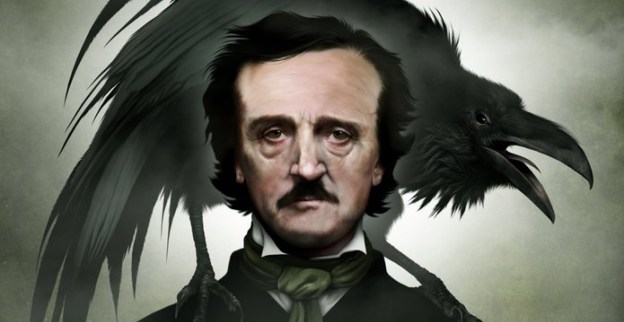
Emma Kenney
Edgar Allan Poe is one of the most well-known writers of the American Romanticism genre of all time. His poems and short stories incorporate many common Romanticism themes and concepts, such as the elevation of emotion over reasoning and nature over civilization. He used descriptive language and fantastical undertones to draw his readers in and earn him the title of one of America’s most famous poets.
Poe was born in Boston, Massachusetts to two professional actors on January 19, 1809. By the time he turned three, his birth parents had passed away and he was taken in by the Allans in Richmond, Virginia. He began writing at a young age but was shamed for it by his foster father, who wanted him to take over the family business. This helped create the rocky relationship between Poe and his foster father, one that would only worsen over the years. Poe received education at one of the best boarding schools in the country and later was accepted into the University of Virginia. Here he met a girl named Sarah Royster, and soon the two were engaged. However, the young man had to drop out of the college a year into his education after his gambling got him into financial trouble. This was the final straw, and Poe and his foster parents had a large falling out that ended with the Allans refusing to help Poe pay off his debt or let him come back home to stay with them until he could pay it off himself. Soon after, Poe discovered Sarah had been cheating on him, and he called off his engagement with her, depressed and broken-hearted.
The man joined the army after this, and it was this year (1827) that his first volume of poetry was published. He published a few more volumes of poetry within the next two years, though they weren’t exactly successful. After his failed first attempt at poetry, Edgar Allan Poe began attending the United States Military Academy at West Point. Though he was an excellent student, Poe once again had to drop out of school because he was financially unable to support himself, and he couldn’t seem to handle the strict military duties that came with the Academy. He once again fought with his foster father, who had remarried after his foster mother passed away. Once again, Poe was told he was not allowed to come home and he would not be receiving any help financially. After this he moved in with his aunt and younger cousin in Maryland, having nowhere else to go.
Then Poe began writing and publishing short stories. He also began writings and editing for various magazines including the Broadway Journal in New York City. He spent the next ten years of his life doing this, during which he married his cousin, who was about 14 at the time. During these ten years Poe published some of his most famous works, including “The Fall of the House of Usher” and “The Raven.” He struggled to get by for a while, but after one of his short stories won a writing competition, Poe became a sensation almost over night. Poe’s foster father passed away during this time, creating even more resentment on the part of Poe when he left him out of the will entirely but included an illegitimate child in it instead.
Poe was a vicious critic; his reviews of books and other writings would eventually create so much drama he would be asked to leave the magazine or change his review style. Poe chose to leave. Some sources say his struggle with alcoholism played into the magazine’s decision to ask him to leave, but so far it hasn’t been proven for sure either way.
A few years after this his wife grew ill and passed away. Poe struggled greatly dealing with this; he became extremely depressed, and his alcoholism reached a new peak. He once again began to struggle financially, as he focused mainly on fueling his desire for alcohol. Eventually his extreme alcohol intake caused him to experience extremely poor health, and it eventually caused him to die of “congestion of the brain” on October 7, 1849.
After his death, one of his literary rivals was granted the task of writing his obituary. This rival purposefully strove to make Poe seem as horrible as possible, calling him not only an alcoholic but also an abuser of women and a deranged psychopath as well. This succeeded in damaging Edgar Allan Poe’s reputation for quite some time after his death. This same man wrote the first ever biography of Edgar Allan Poe, ruining his reputation after death even more. Eventually, however, the general public began reading the works of Poe again, and he finally achieved the renown commonly associated with him today.
Poe is a spectacular example of American Romanticism, which, as previously stated, is defined by characteristics such as the elevation of emotion of reason and the elevation of nature over civilization. It also commonly uses writing techniques such as using what could be considered almost excessive descriptive language.
One of the prime examples of this is his “The Tell-Tale Heart.” This story is about a man who gets a new neighbor. After a short period of time, the man begins to become paranoid, hating one of his neighbor’s eyeballs. He even goes so far as to name it “The Evil Eyeball.” This eye begins to drive the narrator madder and madder. Finally he comes to the conclusion he needs to kill his neighbor after both the eye and the beating of his neighbor’s heart continue to haunt his every hour. The narrator smothers him to death and takes out his heart. He then decides to chop the neighbor up and hide him under the floorboards. However, he still heard the beating of the heart. It drives him madder and madder yet again, until finally he can no longer take it and confesses the crime he committed.
This is a prime example of American Romanticism because right off the bat it elevates emotion over reason. The narrator’s obsession with the eye and heart are by no means reasonable. The beating of the heart after death is certainly emotionally based, as it is illogical to believe it could truly happen in real life. The entire story is about emotion itself; it shows how the emotion of guilt can eat away at a person even if he gets away with something, until finally the guilty person can no longer take it. It shows emotion is a driving force behind human actions. The narrator murders a man simply because he finds his eye annoying, symbolizing that humans will do terrible things and justify them as being okay because it got rid of a situation that was bringing them discomfort.
Overall, Poe is a wonderful example of American Romanticism, and he will most likely be a beloved American poet and short story author for many years to come.
 Redeeming Pandora