
Christopher Rush
A Game of Thrones (A Song of Fire and Ice #1), George R.R. Martin ⭐⭐⭐
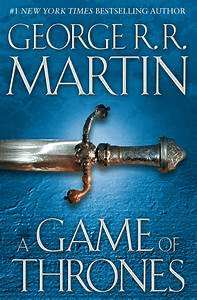
I’ll go with 2.5 stars rounded up, how’s that. I’m not really sure I “liked it,” since there is very little content in here (including characters) we are really supposed to “like” in any traditional sense. As the high-school toddlers who recommended (and leant) it to me warned me at the outset, “all the characters take turns playing the bad guys.” And by jingo, they were right. Sure, you may say this is more “realistic and gritty” for a medieval-fantasy-type story, when life is hard and smelly and morals are subsumed under survival. That’s fine. This is a “grown-up” fantasy.
My two main issues, apart from the gratuitous stuff (which is likely the main reason why it is popular on television), are 1) there’s no overt point — the characters are just doing their thing, living their lives, reacting to what has been decided around them. That may add to the “realism” of the world, but I can’t help but contrasting it with The Wheel of Time. That series is much different, and I like it better for those differences: there is a goal, the story is heading somewhere intentionally (even if at a languorously snail’s-crawl pace) — there is a clear “bad side.” The “good side” of TWoT is not so straightforward, so I’m not necessarily faulting GoT for not having “pristine, angelic-like John Wayneish heroes.” TWoT has flawed, “shades of grey” heroes all over the place, possibly just as “Biblically unmoral” as GoT (though much less explicit about it).
Perhaps you’ll say “oh, there’s definitely a point to GoT: Dany is going to reconquer the Seven Kingdoms, marry Jon Snow, destroy the Lannisters, raise Tyrion as Ruler of Everything Else” and all sorts of other stuff only you know about having seen/read beyond book 1. Well, maybe. But I don’t get any of that sense from the book itself. Things just happen. Which leads us to my 2nd issue.
2) most of the book is reaction, not action. Yes, a few key things happen “on screen” (still talking about narrative focus in the novel), but so much of the book is just “apparently some time has passed, and here’s what they are thinking about now.” The passage of time is horribly haphazard, it seems to me (perhaps Mr. Martin has everything calendared out, which would be swell). We get hundreds of pages setting up to Ned Stark’s climax … and it barely is mentioned indirectly when Arya is sort of not looking. Out of seemingly nowhere, armies have started terrorizing the countryside … why, because Catelyn snatched up Tyrion? Is that why? A bit unclear, really. (Maybe I’m just a bad reader.) I understand this can be a fine way to move the story along without going over every single detail (in stark, so to speak, contrast with TWoT), but so much of the “action” in this novel was “reaction,” reaction to things we haven’t really experienced. Maybe you real fans like that; I found it a bit niggling. That’s me. I’m probably wrong. I’ll keep reading the series, though, mainly to see how it ends, I guess (I hear some unspeakably grotesque things will happen soon, so we’ll talk about that when I get there).
A Clash of Kings (A Song of Ice and Fire #2), George R.R. Martin ⭐⭐⭐
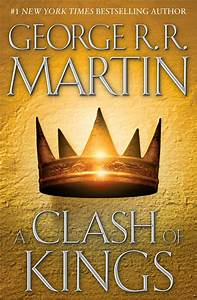
Continuing shortly from A Game of Thrones, A Clash of Kings broadens both the character base and geographic areas of Westeros. New characters such as Stannis Baratheon, Davos Seaworth, and Brienne of Tarth give us more people to actually root for (well, maybe not Stannis) in an otherwise grim and unfriendly land. The Starks continue to encounter nothing but problems: Arya is trapped between King’s Landing and Winterfell, Sansa is trapped in King’s Landing, Robb is doing his thing (he spends almost no time in the forefront of the action in this book), Bran is still crippled though gaining special dream powers, Rickon is still a whiny baby, Jon is still unsure of himself in the wintry regions beyond the Wall, and Catelyn is still choosing to be with her father instead of returning to be with her own helpless children. Meanwhile, things aren’t going much better for Tyrion, even though he has a great deal of power and influence now. Since no one trusts him or credits him, everything he does to save the situation for his family and the city is largely ignored. Daenerys is still over in the sands, trying to find passage to Westeros. The only significant aspect of her storyline this book is the expansion of our understanding of the diverse cultures of Esteros. Other than that, her story is rather uninteresting this time around.
This second book still has the ubiquitous graphic content, no doubt for some sense of “authenticity” of this fantasy world in a sort of Late Middle Ages setting, but it’s not any more than the first book. It’s best to just skim/skip over that stuff and try to focus on what’s going on … which isn’t all that much. This is mostly a reorganizing of players and plots sort of book (until the slam-bang finish).
Like the first installment, a great deal happens between chapters, since we are given the limited perspective of a handful of characters who are usually away from the major events themselves. The “Clash of Kings” is a bit of a misnomer as well, unless by “clash” Mr. Martin means some sort of group, such as a “murder of crows” or “pride of lions.” There is certainly a brief “conference between kings” toward the middle, and a definite clash happens in the slam-bang finish, but it’s not really between kings. Even so, the general story does get a bit more interesting thanks mainly to the new characters. The aftereffects of the poor decisions in the first book continue to resound. Some mysteries are sort of explained, new possibilities for old characters are finally enabled, and desperate situations force our “heroes” into life-altering (again) situations, setting us up for a very exciting third installment.
A Storm of Swords (A Song of Ice and Fire #3), George R.R. Martin, ⭐⭐⭐⭐
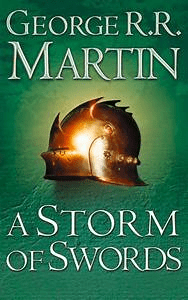
Well, that was a bit of a roller coaster. I give it 4 stars not necessarily because I think it is a great book, but it is certainly superior to the first two in the series, acknowledging of course it does not have to do the same things the first two do and benefits from their scaffolding tremendously. Yet, Mr. Martin did not disappoint with that underpinning, which is why it deserves its merit on its own. Some people seem to revel in the “woah, I didn’t see that coming!” aspect of the series — though, taken literally, were that completely true, that would be a sign of poor writing on Mr. Martin’s part, so while most of the surprises are unexpected and we didn’t see them coming, the well-craftedness of them upon further reflection demonstrates them as wholly believable and consistent (even the last page, yes).
This book reminds us more than the first two Robb Stark is not a main character. At best, he is a supporting character. He never has any POV chapters, he spends almost no time “on stage” during Clash of Kings, he is always seen in relation to his mother (not a bad thing, but not a sign of his individuality or importance), and clearly he is young and makes mistakes — but when you are styling yourself as a king, making mistakes along the lines of betraying your most populous supporters is a really bad mistake to make.
Catelyn Stark, likewise, doesn’t seem terribly capable of making proper decisions either. She laments she is far from her two children who need her, acknowledges she doesn’t need to be with Robb, yet she doesn’t go back to protect Rickon and Bran and stays with Robb, effectively selfishly staying with her own father (for whom she does no good either) and away from her family who needs her. In other words, she’s not really any different from her sister. And she may be worse, since she makes almost all of it worse from what she did in book one to Tyrion.
Speaking of Tyrion, this guy really has a rough time in this book. We know he is the hero of the Battle of Blackwater and is effectively single-handedly responsible for saving King’s Landing, but no one else seems to. And things get worse for him throughout the book: everyone abandons him, people who know better allow their minds to be changed about him, and he is literally in the pits as the book closes, with him having lost just about everything.
Meanwhile, Dany has gained quit a bit … but her storyline is again wholly uninteresting and possibly less interesting than Bran’s storyline. She feels betrayed by practically everyone, becomes a misguided social justice warrior (not that I think freeing slaves is a bad idea, of course, just that she is easily distracted from her purpose without thinking through what the next step after freeing the people is — how will they live?), switches heroes, and effectively abandons her main goal by the end. The only good thing about her story is the reintroduction of a noble man we haven’t seen for a while.
Jon Snow does some things in this book as well. They are somewhat interesting and sad, as usual. Sansa is also in this book, mostly passive, as usual.
The new characters in this book are engaging (the new characters usually bring a vivacity to the new book), especially as we get a clearer pictures of the southern kingdoms around Highgarden and Dorne. Truly the highlight of this novel is the Adventures of Jaime and Brienne storyline. It is such an odd pairing but somehow Mr. Martin makes it work very well. The only bad part about it is it ends. Not only is it a very welcome addition to finally get inside the head of Jaime Lannister, but hearing from him what happened before the first novel began sheds some interesting light on these people and their recent history (which is still a bit confusing). Jaime, though, is also part of the saddest moment of the whole book, his final parting from Tyrion — this is such a disappointing moment for many reasons (which is probably why Mr. Martin wrote it the way he did). “Weren’t there other, sadder, more shocking moments in this book!?” you exclaim. Sure, sure, I suppose — but, frankly, none of them (by “them” we mean “deaths of seemingly major characters”) were all that surprising, and more frankly, some of them were rather welcome.
The other odd pairing is certainly Arya and Sandor Clegane, an odd couple that doesn’t have the same vivacity as the Jaime and Brienne Story, but it is much more interesting than, say, everything with Robb, Catelyn, and Sansa, that we are a bit sad when it ends, though glad Arya is finally going somewhere with the possibility of some meaning.
This book is replete with “so close”s — many of the characters who have been trying to reconnect with others are a gnat’s wing away in space and time from achieving some sort of positive reunion … but that’s not how Westeros operates. The spatial proximity is likely supposed to add to the bitterness within us when the planned salvation/reunion occurs, but by this time we have become so inured to it, most of them just end up being obvious foreshadowings of inevitable failures and (perhaps unintentionally) actually cushion the blows.
Let’s see, what else … oh, yes. Davos is in this one as well, being a great bulwark for morality and honor, having lost his “luck” in the Battle of Blackwater (and most of his children) but gaining perhaps a clearer vision of what is right and somehow presses that upon Stannis. Good for him.
We finally get a better look at Wildling life, which isn’t so bad, but discipline, it turns out, is indeed superior to sheer numbers after all (one of the few things Ned Stark seemed to get right). What we don’t get any good look at this time is the Iron Islands. In fact, Balon Greyjoy turns out to be truly the most disappointing facet of this book. Dany is likely the most dull, Jaime and Tyrion’s parting is the saddest, but the Balon Greyjoy facet is certainly the most disappointing.
On the positive side, this book clears up a few mysteries that have been hanging around from the beginning of book one, and we even get an eyebrow raising confession about the incident that started the whole thing even before book one, another of the “we didn’t see it coming … but we should have!” delicious twists. By the end of this book, we have the feeling it’s time for a whole new story. Major shifts have occurred for every major character/location, significant political events will drastically alter the direction of most nations and rulers, magic is increasing in potency, the Others are starting to make their move (though why that is we still have no idea), some wars are over but others are just beginning … the potential at the end of book two has certainly paid off rich dividends in book three, and now we are in for something very different indeed.
Oh, and then the epilogue happened … say what?!
The Fires of Heaven (The Wheel of Time #5), Robert Jordan ⭐⭐⭐
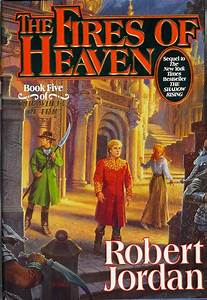
Continuing the sensation of “the end is nigh but we have enough time to sail on ships for a few weeks,” The Fires of Heaven has very little to do with its title, but it does give us the impression things are burning, slowly in some parts of the world and quickly in others. For the first time, one of the major characters, Perrin, is not present in a novel (though Rand was out for most of The Dragon Reborn) — perhaps because some of his events in Shadow Rising occurred during the events of this novel (hard to tell at times) — though he is referenced a couple of times by Mat and Rand. This gives Nynaeve and Elayne more “screen time,” though fans of the series who don’t like Nynaeve will likely find this tedious, especially as most of her storyline in this book feels like a bizarre side-mission (more so than usual with her). Strangely, Nynaeve somehow becomes subordinate to Egwene, who herself becomes a bit of a jerk toward the end, and there is a fair amount of “men are imbeciles” before this book is over (again, more so than usual from the Aiel women).
Pacing is certainly the burgeoning trademark of this series: many would say it doesn’t have any, but they’d be impatient and wrong. As indicated in other book reviews of the series, Robert Jordan patiently spends time with characters, giving us great details on their experiences, far more than most fantasy tales, focusing on that character until, usually, he or she departs the present town for another. This continues for most of this book as well, whether you like it or not: by now, you should be used to it. If you don’t like such focused attention, you probably haven’t gotten this far in the series. This book is about 500 pages of slow-burning set-up, followed by a fairly intense double-climactic pair of showdowns. Some may not like it, but again, that’s what this series is. Oddly, the first of the climactic showdowns happens mostly off-screen, and while that may seem anticlimactic to some, it actually relieves us from a lengthy and tedious battle description, none of which would help advance the characters or stories — perhaps we’ll see it in the movie/series adaptation.
Things get a little saucy in this book, beyond the recent descriptions of female anatomy in the last couple of books, but Jordan is likewise abstemious in his details (while at the same time continuing the fairly ribald attitudes among the Aiel). Some may not like that, but there it is.
While it’s easy to call this another Aiel-heavy book (which it is), we do get the occasional relief by spending time with Suian and her female posse, including Logain, as they have to deal with being stilled, how to survive, what to do next, how to retake the White Tower, and more. This sidestory is both enjoyable (as it brings Gareth Bryne back into our field of vision) and irritating (as the Sisters in Exile treat our heroes poorly, which is always irritating when characters you are rooting for are mistreated especially by “good” people who should know better) … but that irritation gives us a keener look into the world in which these characters live. It matters almost nothing that Suian used to be Amyrlin Seat: she is now stilled — she herself virtually does not matter. She has fallen as far as possible, but she will not let that stop her from protecting The Dragon Reborn … in her own way, of course.
Similarly, there is a bit of a cessation of Moraine’s seemingly-endless secret keeping from Rand, as she finally starts to tell him things, though most of those lessons occur offscreen. At least she is finally explaining things to the Dragon Reborn instead of always trying to run him like a puppet master. By the end of the book we find out why she has changed so drastically, which takes us in a significantly different direction at the end (quite literally for Lan, especially), but at least it is refreshing while it lasts.
The villains don’t get a lot of time here, and in fact the first Trolloc attack doesn’t happen until several hundred pages into the book. This is more of a “there are different kinds of villains” entry in the series, I suppose, as former friends seem to shift their allegiances (or reveal their true colors, shall we say). We get to spend a lot of time with the good guys (except Perrin), and even Mat gets to be heroic again (without ever wanting to). Pretty good book, even if it feels like “nothing happens until the end.” But, whew, when stuff does happen, it’s big stuff.
And we aren’t even halfway through the whole series, yet.
Lord of Chaos (The Wheel of Time #6), Robert Jordan ⭐⭐⭐
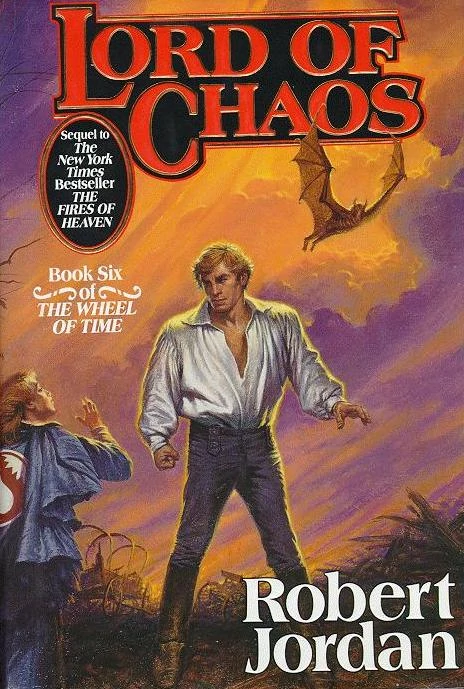
It’s possible the Lord of Chaos wrote this book himself. I’m not saying it’s bad — it was pretty good. A few things we’ve been wanting to happen for a number of books finally happen in this one, if in unexpected (possibly less than satisfactory) ways, such as Elayne, Egwene, and Nynaeve reuniting and becoming Aes Sedai and Rand and Perrin meeting again. We have been waiting for these things for a long time, but we still have to wait for Nynaeve to overcome her block (this is really taking too long), Rand is still having trouble communicating with Mat and Perrin (you’d think they’d be used to being ta’veren by now), plus a few other things here and there. Mostly we are irritated (as we always are in series such as this) by the non-heroes getting in the way of what our core group of heroes are trying to do, especially the Tower Aes Sedai, the Rebel Aes Sedai, the Children (obviously) … basically, we are almost cheering for some of the bad guys to start wiping out some of these second- and third-tier characters (is that wrong of me?).
I said the Lord of Chaos may have written this book because structurally a lot of what we have become used to in the previous installments are out the window here: most chapters have multiple points of view (sometimes switching back-and-forth between characters in a single chapter), the prologue also covers several character groups, the Forsaken get a whole lot of screen time (after being mostly mysterious and obscure characters up until basically the previous book) — including POV chapters!, we leave POV characters before characters leave their locations (though, admittedly, not a whole lot of movement happens in this book, not including Rand’s teleporting between cities frequently), and even the Dark One gets a few lines. He is the one who brings up the Lord of Chaos, so I don’t think he (the Dark One) is the eponymous character — who is it? I don’t know. The characters seem to, so that’s fine.
Some fans seem to dislike this one because not a whole lot happens (which isn’t all that true, but it does sort of feel like it more than the last couple) and it seems more like it stops suddenly rather than wraps up a complete tale-within-the-tale like the last few did so well. It’s almost like it’s a part one with Crown of Swords being part two. I liked it, but I, too, sort of felt like something was a bit missing with this story, but I did enjoy a good deal of the moments in it.
It has a lot more humor than the last couple, perhaps the most since The Dragon Reborn, and a lot of it comes from, as usual, Mat, who is increasingly becoming a great character, despite his flaws (and despite the fact most of the other heroes wholly misunderstand and undervalue him; very frustrating, that). Another of the great humorous scenes involves Loial (finally he returns!) and an unexpected arrival of his fellow Ogiers. Though, the humor of it is somewhat dampened by a seemingly dropped plot point: Rand delivers the Ogiers to where he thinks Loial is, finds out later that isn’t so, and instead of trying to rectify it they seem to be just forgotten … I trust Mr. Jordan enough to believe this is not the end of this storyline.
Even though, as I said, it doesn’t “feel” like a lot of movement or progress happens, enough does to feel like we have turned a serious corner (or are a gnat’s wing away from completing the turn) and a new phase of the Wheel of Time saga is about to happen: finally, Rand is getting the attention (and fear) of Aes Sedai (thanks to the appearance and involvement of Mazrim Taim!), progress is moving on Rand’s three wives situation, dissension may be popping in the Children, Elayne and Avienda have reunited (and revealed some needed facts), Egwene has told the truth to the Wise Ones, and a few other conversations we’ve been wanting to happen have occurred (not all of them, of course). Some good things have happened to our characters, though, as always, they have come at a price. And Rand is sort of coming to terms (not the best way of putting it) with the Dragon Reborn … since it may be more accurate to say the Dragon has been reborn inside him and not just as himself!
And, oh yes, the Forsaken are really starting to make some big power play moves. And the Lord of Chaos is out there doing something (maybe). And the Dark One is intentionally allowing Rand to live and fight. That is perhaps the scariest part of this series. Boy, I am enjoying this a good deal.
The Crystal Shard (Icewind Dale Trilogy #1), R.A. Salvatore ⭐⭐⭐

If you are looking for a generally good-natured romp through DnD fantasy, you could probably do a lot worse than the mildly-beloved The Crystal Shard. Sure, in the last almost thirty years, this has become noted for being “the first Drizzt story!” even though he is supposedly a supporting character here before his famed skyrocketed him to greatness. I don’t agree with the idea he is a supporting character here, though: he is in it just as much as everyone else, possibly even more than any other individual. He is single-handedly responsible for the most important “big plot” occurrences, which is not to diminish the important deeds his buddies (Bruenor, Wulfgar, and Regis) do throughout the adventure. He is very much a main character in a novel about these four ragtag outsider buddies.
This is the kind of DnD fantasy I would write, or at least the kinds of characters I usually create: outsiders, yes, but all are generally kindhearted and atypical members of their races/classes; only Regis is really flawed (I don’t use Halfling thieves anyway), and Drizzt, Bruenor, and Wulfgar all show their strong-yet-sensitive sides frequently in their adventures. Because of this absence of nonsensical character conflict (there is some, with some supporting characters, but that’s expected), the book is all the more enjoyable: the good guys are good, the bad guys are bad, people learn their lessons (except Regis), and it’s all very clean, very straightforward, very enjoyable (for what it is, a goofy DnD fantasy romp).
Streams of Silver (Icewind Dale Trilogy #2), R.A. Salvatore ⭐⭐⭐
The second of this trilogy is rather darker than the first: not only are our heroes in much more peril, the peril is far more personal than the hordes of the first book. Poor Cattie-Brie is terrorized for much of the book in very dark and intimate ways, making her sections of the book more disturbing than the general slaughter throughout. Our main quartet of heroes likewise go through personal losses throughout, resulting in a very different ending from the first installment.
Even with the darkness (perhaps because of it), this book feels more like Dungeons and Dragons, likely because the scale is much smaller than the grand battling armies and squabbling nations of the first book. This is a small group of adventurers fighting some battles (not too many), sneaking around gathering supplies and information, facing mysterious forces everywhere they go, and then suddenly a huge dragon shows up and things fall apart quickly.
Bruenor is a bit of a jerk for most of the book, learning too late his friends and comrades today are more important than trying to revive the past, but at least others can benefit from what the friends have learned and suffered throughout this installment.
Our heroes are at a very low point at the conclusion of this book, but despite their warranted glumness, we have the sneaking suspicion things will get all straightened out by the end of the final part.
The Road to Oz (Oz #5), L. Frank Baum ⭐⭐
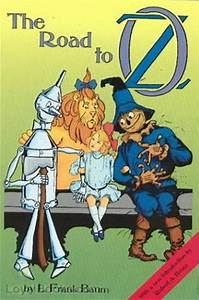
We seem to find ourselves on a bit of a formulaic track by this time. Once again Dorothy and some new people (who don’t really matter) find themselves on a magical trip to who-knows-where that eventually becomes the road to Oz (as the title makes a bit clearer this time). At least there is a bit of a better payoff this time: instead of just getting to Oz then leaving right away (as in the previous book), this time Dorothy and friends get to celebrate Ozma’s birthday (how they know it’s her birthday considering her/his life story is anyone’s guess — perhaps they just declared it is her birthday, which is fine). Toto is back this time, and so are some of the other ol’ friends we haven’t seen for a bit (most notably Jack Pumpinkhead), and most of the A-list friends are back, though just briefly at the end (though “the end” is a rather drawn-out affair). Along the way we meet new sorts of wild and wacky characters, most of them annoying, but all the trials and obstacles are overcome with a snap, a shake, and a sure-why-not and all is well. If you are interested in seeing the ol’ gang again, this is nice, but it’s again mostly a showoff of Baum’s diverse character creative abilities (including some stars of other novels of his, such as Queen Zixi). Not the worst, I suppose, but you are likely going to find the first half far more tedious than the second half.
 Redeeming Pandora