





While you are having a fun summer vacation watching top-notch anime series and movies, I am hoping I will be organizing my Star Trek CCG collection. Not that it is in total shambles, mind you. Just because I haven’t played the game since Hanson was on the charts doesn’t mean my Star Trek CCG collection is in disrepair. What I mean is ever since the summer of 2015 I’ve felt like taking inventory of what I have, what I don’t have, investigating what it may take to fill in some of those gaps, and, ideally, actually play the game again. Despite popular opinion, I don’t really enjoy acquiring things just to have them: I do want to read the books I own, I do want to play the games I own, I do want to watch the digital video discs I own, et cetera. I’m not big on just having objects in my home just for the purported joy of ownership. It’s all God’s anyway, right?
I have no false hopes the electronic-bay will suddenly get giddy for my extras: “oh, you have 121 ‘Anaphasic Organism’s? Here’s a bajillion dollars!” I doubt I could get a ha’penny for all my “Anaphasic Organism”s, “Archer”s, “Phaser”s, et cetera put together. I’m sure the world has no need for my commons. Nor do I have any designs on selling my rares (no one ever believed the “I.K.C. Pagh” was “rare”). I’m not trying to get back the, shall we say, hefty amount of money that was paid for this decent-sized collection (I admit wholeheartedly my parents paid for most of it). I just want to know what I have.
Then I want to give most of it away. Are you interested?
I can tell you now it’s all 1st-edition stuff, basically up to Deep Space Nine and a bit beyond. It’s been awhile since I’ve really looked into the game, not counting a few dormancy-ending days last summer, so I’m not sure what I’m missing as far as what sets I have none of in the 1st edition. I’m hoping my brother will be able to get a few boxes of packs or whatnot at GenCon this year, maybe even dabbling in 2nd edition, but we’ll see. This past Christmas, my dad got us a box of Marvel Dice Masters booster packs, and Julia and Ethan and I had a good deal of fun opening them, seeing what cards and dice came in the packs, and then I had a swell time organizing it all, seeing what was missing, what we got … and all the fun of opening CCG packs back in the ’90s came back to me.
Coming from a long line of librarians, or a short line depending on your angle, organizing must be in my blood. Like, possibly, most who grew up in the CCG age, I spent a lot more time organizing, bindering, listing, organizing, and deckmaking than I spent actually playing the game. I’ve already told you the story of how I got the ultra-rare “Future Enterprise” card from a 97-cent discount pack from WaldenBooks my mom got me one summer afternoon, and how she got me the limited edition Kivas Fajo Collection as a pick-me-up after I broke my arm (it was only until later, when I grew up a bit, that I found out it is somewhat incongruous to spend a good deal of money for a gift to cheer up someone who just cost you a great deal of money on hospital bills as a consequence for doing what you shouldn’t have been doing in the first place — it must have been love). But that’s part of the fun with CCGs, really: much like Wordsworth’s dual-view of poetry, CCGs are both the overflow of powerful emotions (buying the boosters and seeing what new cards are inside … or more likely what duplicates you got again) and those powerful emotions recollected in tranquility (the calm joys of sorting, organizing, and checking off your growing collection). The only downside is the cost.
And storage. I’m out of storage space. Do you want to help?
Hey, if you come take my duplicates, we could maybe then starting playing the game together. Everyone wins. Give it a thought. Let me know. It’ll be fun.
P.S. — Are you interested in Decipher’s Middle Earth: The Wizards CCG?
P.P.S. — Even if you don’t want any anime or feel like starting your own hand-me-down Star Trek CCG collection, I hope you can come over for the summer gaming days. That may be even more fun.
P.P.P.S. — In any event, we at Redeeming Pandora are very grateful for your loyal readership over the years through all 20 exciting issues. I recently looked at issue 1 … man, we hit the ground running and we have been having a blast ever since. I say “we,” even though most of the team has fluctuated over the years, but the willingness of the ol’ staff to continue contributing, as evidenced in this very issue, has been a genuine delight for me, especially seeing how they have grown and improved after their time with us. Here’s to 20 more issues, faithful reader!
Enjoy your summer!
Remember: “wherever you go, whatever you do, whatever you say … say, say, say … say it with love!”

In addition to the fine recommendation my brother has just given you, I thought I would offer some of my own recommendations for some enjoyable, exciting, moving, and more or less important anime series of note from recent years. In stark contrast to most of the things we recommend here at Redeeming Pandora, these present recommendations are more critically popular than you might expect from us — instead of the overlooked, the obscure, the forgotten, and the ignored, these are some of the most beloved and acclaimed series around. Why, then, the need for such a list, you may wonder? Fair enough query. The thought occurs, while the anime circles out there in life are presently aware of these gems, you perhaps are not. Maybe you’ve been under the impression “anime is just Japanese inappropriateness” or something along those lines. As with all sorts of human endeavors, however, a few extreme examples should not besmirch an entire genre. Just as Grand Theft Auto (for example) should not motivate us to generalize the entire videogame enterprise as horrible, a few of the more saucy anime series out there should not prevent us from enjoying and experiencing the better works the field has to offer. (Either that, or you’ve realized by now all of my articles are worth reading, regardless of subject matter and thus “need” is replaced by “just for giggles” and that’s why you are reading this; for that I thank you.) Here, then, in no particular order, are four series worth watching as you while away the summer waiting for the weather to get deliciously cooler and the skies to get beautifully grayer.
Attack on Titan
I admit at the first this is a violent show. Its “Mature” rating is well-deserved. It’s not as bloodily violent as, say, The Wild Bunch or Fight Club, which we’ve somehow gotten away with recommending at Redeeming Pandora, but its violence is intense and pervasive (if not, shall we say, “conventionally graphic”). The series also is occasionally salty, but not nearly as salty as, say, Tim O’Brien’s important and heartily-recommended work The Things They Carried. It would be fair to say, then, this series is recommended despite its violence and mild saltiness.
What, then, you wonder, makes it commendable? I’m not usually a big “post-apocalyptic world” fan, and Attack on Titan is certainly a post-apocalyptic series. Like many anime series, the main protagonists are youngish characters thrust into a chaotic world in which their worth and contributions must be proved and maintained. Somewhat typically with such tales, the main protagonists lose their parents early on and must struggle to get by before they can grow and fend for themselves. Here come the commendations. What is less typical of such stories is Attack on Titan begins in a post-apocalyptic world that has more or less forgotten it is a post-apocalyptic world. 100 years ago, giant “titans” (10-50-feet tall neutered human-like beings) appeared seemingly out of nowhere and began devouring the human race. Somehow, some of humanity survived long enough to build three huge concentric circular walls around the last vestiges of the race. Humanity adjusts to its present condition, more or less, almost getting used to it, despite the elite cadre of military that periodically forays outside the walls, until one day a 200-foot titan appears and batters a hole in the outermost wall, allowing dozens of seemingly-mindless titans to resume the destruction of mankind. Our heroes are caught in the middle, their lives are turned upside down, and suddenly they must live once again with the threat of the titans.
The majority of the 1-season (as of this writing) show follows our three heroes (Eren Yeager, his foster sister Mikasa Ackerman, and their buddy Armin Arlert) as they make their way to the Military to start taking an active role in the defense of mankind and eventually, hopefully, the reclamation of the planet from the mysterious titans. Eren is a conflicted protagonist, and before too long, as is often the case, he has a special destiny integral to the survival of mankind. Mikasa proves herself as an impressive killing machine, as the military uses impressive technology to fight the giant titans. Armin, though initially suffering from self-confidence issues, soon enough proves himself as a brilliant strategist and scientific mind. Along the way, we meet a number of supporting characters who get very interesting the more we get to know them. The only problem with this, is, since most of them are front-line military against a nearly-invincible and relentless foe, the mortality rate among the supporting cast is high — you can’t get too attached to them, really.
I don’t recommend it for the violence, of course. I recommend it because it is a tense show with a large number of exciting mysteries (where did these titans come from? why is Eren so special?) and twists and turns, combined with the sort of Battlestar Galactica-like “humanity banding together to fight off destruction, all the while exploring what it means to be human and moral and all that good stuff” that makes a show like this much more philosophically satisfying than others of its kind. Sprinkled throughout are engaging battle scenes, heroic sacrifices, intriguing layers of politics and betrayal, poignant quiet moments, revealing flashbacks … and then, suddenly, your jaw will drop, your eyes will bulge, and everything you thought you knew about the series and its characters twists inside out. And then it happens again. And you’ll be hooked.
It is only one season, so far, but feel free to use it to motivate you to read the manga, since that is much further along in the overall storyline than the anime series is thus far (and, naturally, it’s richer in character moments, subplots, and other literary goodies not always translatable to a short television show).
Cowboy Bebop
Considered one of the all-time greats for good reasons, Cowboy Bebop is certainly a worthwhile viewing experience. It, too, is occasionally mature, especially in the dialogue, but its overall presentation, fascinating characters, wholly believable world, philosophical explorations, and diverse musical score all overshadow the sporadic saltiness. It is also a limited series, with only 26 episodes (plus one later mid-story movie), so it doesn’t take a lengthy commitment, but the complete series leaves you with such a positive impression, you are glad you watched it.
In a way, Cowboy Bebop is also a kind of post-apocalyptic series: after a nuclear accident, parts of Earth are uninhabitable, but fortunately we have discovered interstellar gate travel and have colonized and encountered other planets and so we are okay. Sort of. Corruption and basic human nature have followed us into outer space, and since space is a vast place, the major corporations and generally decent folk need bounty hunters (called “cowboys”) to help make the spaceways a better place for all. Two such noble bounty hunters/cowboys aboard their ship Bebop are our heroes for the series: Spike Spiegel and Jet Black. Along the way, they meet new friends, we learn about their old enemies, secrets are uncovered, choices are made, and things will never be the same. And the series is only half over.
It is an impressively dynamic series: some episodes are very dramatic, some are poignant, some are adventurous and funny, some are nerve-wracking — all are high quality. Even the episodes you like least are better than other shows you really like. It’s a very layered show: you have to pay attention to the details, as moments and cameos in one episode will come back a couple episodes later. This adds to the overall heft of the series as well as encourages you to watch it again and again. Additionally, it’s a very rich world: the corporations, the supporting characters, the layers of past and present all imbricate in top-notch ways. I know I’m starting to recapitulate generally high praise, but this series deserves all the accolades it has garnered and more. I’m not saying it’s my most favorite series of all time (you know what that is already), but this is definitely a contender for anyone’s short list, anime or not. You will enjoy this in deeper, more meaningful ways than just “yeah, I liked it.” It gets you thinking about a whole lot of important ideas without coming off as didactic or belabored. I realize this is awfully general, but I really don’t want to spoil too much of anything else, as it’s best enjoyed out of wonder without too many preconceptions or spoilers. It will not disappoint you.
Fate/Zero
This yet-another 26-episode complete series is a prequel to another fairly enjoyable anime series Fate/Stay Night. Fate/Stay Night is a computer/videogame with multiple storylines and directions (as in, the story and characters can change depending on which “track” you choose to follow based on your actions and such). The basic premise in both Fate series is every 60-some years, a Holy Grail (not necessarily the Holy Grail) appears on Earth to give one worthy mage and his/her Heroic Spirit companion a wish. Before this can happen, several want-to-be-worthy mages each summon a Heroic Spirit (famous person from history) to beat the other competitors in a Street Fighter/Moral Kombat-like battle to the death. Thus, this series, too, is a bit mature at times. (The main and obvious villain of the series is horrifically villainous — you will immediately be rooting against him and his sheer evil.)
The first half of the series introduces the main combatants, their historical Heroic Spirit counterparts, their goals, their wishes, their conflicts, and a whole lot of other interesting notions (such as the families and mystical secret organizations involved in the centuries of these Grail Wars … secret cabals that make the Illuminati seem like the Boy Scouts of America). The protagonist of the series, Emiya Kiritsugu, is very layered, as are almost all the characters. My favorite duo is mage Waver Velvet and his companion Alexander the Great. Their scenes are among the best of the series, which is saying a lot, considering how good the series is.
Since the mages have called upon Heroic Spirits (except the villain of the series has conjured up a truly heinous person of history), one of the intriguing themes of the series is honor in its many forms: how to achieve it, how it can be lost, can it be regained? and all that. Our main protagonist, who has a checkered past at best, is aligned with King Arthur, as truly a noble historical figure as possible (though there’s a pretty big twist I don’t want to spoil for you here). Their interactions are likewise engaging. These heroes, being noble, often struggle with the need to eliminate each other during the grail contest, even though they know they are in effect servants of the grail until they win it and gain their deepest wish.
Since it’s a prequel to a story/series that was made years before, the ending is likely well-known and necessary. I’m usually in favor of reading/seeing things in the order in which they were made and not their in-world chronological order (my thoughts on the proper order of The Chronicles of Narnia are well known), but I don’t know if watching Fate/Stay Night is better, especially since I experienced Fate/Zero first. I certainly think it’s worth watching Fate/Stay Night as well, but it is very much a more typical “young teens are the heroes to save the world” sort of story, whereas Fate/Zero is definitely a grown-up series (the kids of the characters in Fate/Zero are most of the main characters in Fate/Stay Night, 20-years later instead of the usual 60).
Don’t let the “mages conjuring heroes of the past” put you off. The only off-putting thing is the main villain, but he is so obviously heinous all the other characters rally around the rightness of getting rid of him. Fate/Zero is a great story of nobility, sacrifice, redemption, heroism, and much more.
Fullmetal Alchemist/FMA: Brotherhood
Some may say I’ve saved the best for last, but that may be tainted by the fact Fullmetal Alchemist is much longer than the other series listed here, with 50-some episodes in the first series and 60-some in the “reboot-like” series Brotherhood. The length of the series naturally lends itself to deep, thorough plots, well-rounded and beloved supporting characters, meaningful conflicts and resolutions, and all the things that make an adventure television series great.
Edward and Alphonse Elric lose their mom when they are still fairly young (you can see a trend among this series), but instead of accepting her mortality they use their alchemy skills to try to bring her back to life. It does not go well. Alphonse loses his body; Edward loses his arm and leg while attempting to save Alphonse’s soul, attaching it to a giant suit of armor. Their childhood friend, Winry Rockbell, creates a new arm and leg for him. (This is all the first minute of the first episode, so I’m not spoiling anything.) Having survived such an experience, the brothers realize they need to improve their alchemy skills and find some way to get Alphonse’s body back. Thus begins their journey.
As with all of these, a great deal of the enjoyment of the series comes in the diverse supporting cast, the ups and downs of their journey, and the growing menace of the behind-the-scenes puppet masters, as well as the philosophical quandaries the Elric brothers encounter along their journey. Having violated one of the key laws of alchemy (don’t attempt human transformation), the Elric brothers begin on the outs, even as they subordinate themselves to the Military (yeah, I know, it seems to have a lot of similarities to Attack on Titan, but they are radically different stories) in an effort to gain access to more knowledge about alchemy, perhaps even tracking down the elusive Philosopher’s Stone. Edward meets several other dubious alchemy users (sort of how Huck Finn meets other likeminded characters warning him against living this sort of life), and he is often tested in how he will live and use his powers: has he learned his lesson? is he committed to others? or is “accomplishing their goals” the only value worth embracing, regardless of who is affected? It’s a very rich show.
Without giving too much away, I’ll comment on two engaging aspects of these series. First, one of the main group of antagonists are named after the Seven Deadly Sins. Though some characters in the two series represent different Sins (e.g., “Dave” is Pride in FMA but Envy in Brotherhood), they make for a very menacing and thought-provoking group of antagonists. Second, unlike almost every American show, the heroic adults of both versions of the show recognize their need to help the Elric brothers since they are young boys and vocalize their responsibility as adults to help and lead the boys as trustworthy adults. Instead of American shows that tell us children are smarter than their parents and other authority figures, Fullmetal Alchemist enjoins us as adults to live exemplary lives to lead the youth for the good of all considered, and children should allow the trustworthy adults in their lives to protect and care for them when it’s the right thing for them to do.
I definitely recommend watching the entirety of the original series first, even though soon enough the two series become drastically different. The first Fullmetal Alchemist began before the manga wrapped up, and thus it started telling its own story about halfway through. Fullmetal Alchemist: Brotherhood (as it’s known here in the U.S.) follows the manga more closely (so I’m told — I haven’t read it yet). I agree with those who find the ending of Brotherhood more satisfactory than the ending of the original (even with the original’s post-series wrap-up movie The Conquerer of Shambhala), but the original’s story and the fate of many supporting characters is satisfying as well. I’ll probably write a more detailed article about this idea next year, once you’ve had time this summer to watch both series.
There you have it. Four high-quality anime series to lead you into what may be a fresh genre of television enjoyment and life improvement. Have a good summer of watching great series! (It’s a great way to avoid sunburns, at least.)

The Hayao Miyazaki oeuvre covers so many beloved classics of anime such as My Neighbor Totoro, Spirited Away, Kiki’s Delivery Service, and Princess Mononoke. Often overlooked is his very first film directorial effort, The Castle of Cagliostro. It’s not hard to see why: it doesn’t quite fit with the themes and elements that characterize much of the rest of his work. There isn’t a young girl protagonist, no moving to a new country home, no emphasis on the importance of preserving nature. Instead, we have a film that is part of a different large body of work, specifically the Lupin the Third series by Monkey Punch, an anime series Miyazaki himself worked on. But let me tell you right now, The Castle of Cagliostro is not merely my favorite animated film of all time, but also in my top three movies (live action or animated) ever.
You see, Castle of Cagliostro has what I like in movies on a base, visceral level: excitement, adventure, and really wild things. Castle of Cagliostro starts with a Monaco casino heist at the height of conflict, our “heroes” Lupin and Jigen running away from the police with arms stuffed so overly full of cash bills stream behind them as they impossibly hurdle over obstacles on their way to their getaway vehicle. The police bumble their way into their own vehicles, which proceed to fall apart in spectacular and equally impossible ways: splitting down the middle, wheels flying off, crunching to a halt after moving mere inches — all of these the product of sabotage by Lupin, as revealed by his taunting note left on the engine compartment of one of the now-useless cars.
This illustrates what is the true hallmark of this movie: portraying a thrilling adventure where the rules of physics shall bend beyond that of reality, but only in ways that enhance the thrills and humor without destroying important dramatic tension. The most obvious example of this is my favorite sequence of the film, a car chase around a winding cliff path with Lupin and Jigen trying to intercede on behalf of a woman being chased by some thugs. At one point in this tense chase, Lupin drives his Fiat 500 (a ridiculous car to even be in such a chase) sideways up the side of the cliff. It’s completely mad, but just wonderful to watch. Yet while physics have been defied, dramatic tension remains — we are still worried for the well being of the woman in the pursued car, as it creeps toward falling off a cliff. Even in later action sequences we still hold our breath, hoping our hero can make it through.
This says nothing of the lavish setting of the movie, where even on his limited budget Miyazaki fills the fictional Grand Duchy of Cagliostro with detail and intricacies. Miyazaki’s love of visual landscapes packed with wonders to explore can be seen even here in his earliest directorial work. There are more than a few long, lingering shots that may not move the plot forward but help immerse you in this little independent city-state where most of the movie takes place.
But of course, we need to address the 500-pound gorilla in the room: can you enjoy The Castle of Cagliostro without knowing a lick about Lupin the Third? Honestly, it’s actually ideal not to have preconceived notions of the Lupin characters. On its initial release in the late seventies, The Castle of Cagliostro was actually criticized for its portrayal of the beloved Lupin the Third characters. For instance, Miyazaki’s Lupin is far more heroic and less arrogant, and his treatment of female lead Fujiko Mine gives her depth and skill as opposed to being a sex object. Miyazaki makes these characters his own, and the movie is better for it. You get all the needed history in the film itself, from Lupin and Fujiko’s mutual admiration to the complex relationship of Lupin and his law enforcement foil Koichi Zenigata.
The Castle of Cagliostro has also stood the test of time for me, personally. As one of the three movies I will pop on the TV whenever I truly need a pick-me-up, it has never failed to put a smile on my face. I have watched it dozens of times, only rivalled in number by the other members of my movie holy trilogy (Jaws and Shaun of the Dead), and it is always the right choice to watch. It is my favorite anime of any sort, movie or series, and you absolutely should give it a try.

There are many different reasons why female authors have chosen to take male pennames. In years past, the reason was political. Authors like Mary Ann Evans (George Eliot) wrote under a male name to ensure their more political novels were taken seriously in an era when women’s rights were practically nonexistent. Other reasons were due to great influence by male authors and the desire to imitate them. An example of this is Amantine-Lucile-Aurore Dupin (George Sand). In more modern times, female authors have still felt they had to write under a male pseudonym to ensure their books were accepted by the male audience, such as Christina Lynch and Meg Howrey (Magnus Flyte). This final essay explores yet another reason a female writer to write under a male pseudonym.
Robert Galbraith is the author of the Comoran Strike series, which presently consists of three books: The Cuckoo’s Calling, The Silkworm, and Career of Evil. It is widely known, however, this award-winning author is not an old war veteran after all, but a pseudonym for J.K. Rowling, the author of the Harry Potter series.
Joanne Rowling was born in July 1965 at Yate General Hospital in England and grew up in Chepstow, Gwent, where she went to Wyedean Comprehensive. She left Chepstow for Exeter University, where she earned a French and Classics degree. She then moved to London and worked as a researcher at Amnesty International among other jobs. The Harry Potter series began during a delayed Manchester to London King’s Cross train journey, and during the next five years, outlined the plots for each book and began writing the first novel. Jo then moved to northern Portugal, where she taught English as a foreign language. She married in October 1992 and gave birth to a daughter, Jessica, in 1993. When the marriage ended, she and Jessica returned to the UK to live in Edinburgh, where Harry Potter & the Philosopher’s Stone was eventually completed. The book was first published by Bloomsbury Children’s Books in June 1997, under the name J.K. Rowling. Her initials were used instead of her full name because her publisher thought a female author would deter the target audience (young boys) from reading the books.
As is known, the Harry Potter series was wildly successful, having sold over 450 million copies in 69 languages. So why then, at the height of her success, would J.K. Rowling write under a male pseudonym?
According to the author herself:
To begin with I was yearning to go back to the beginning of a writing career in this new genre, to work without hype or expectation and to receive totally unvarnished feedback. It was a fantastic experience and I only wish it could have gone on longer than it did. I was grateful at the time for all the feedback from publishers and readers, and for some great reviews. Being Robert Galbraith was all about the work, which is my favorite part of being a writer. Now that my cover has been blown, I plan to continue to write as Robert to keep the distinction from other writing and because I rather enjoy having another persona.
J.K. Rowling wrote under a male pseudonym in order to receive unbiased feedback. This is something to be respected. She didn’t use a penname under some illusion her books wouldn’t sell because she was a woman; she wanted to start again. And her books sold with or without the disguise.
In previous eras, the reasoning for male pseudonyms may have been political, but today more often than not women do it just because. And that’s encouraging. Social justice has come a long way, and now women don’t have to pretend they’re men in order to have their political opinions heard and valued.
Bibliography
Rowling, Joanne. J.K. Rowling. N.p., 2012. Web. 18 May 2016. <www.jkrowling.com/en_GB/#/about-jk-rowling>.
—. Robert Galbraith. N.p., 2014. Web. 18 May 2016. <robert-galbraith.com/about/>.
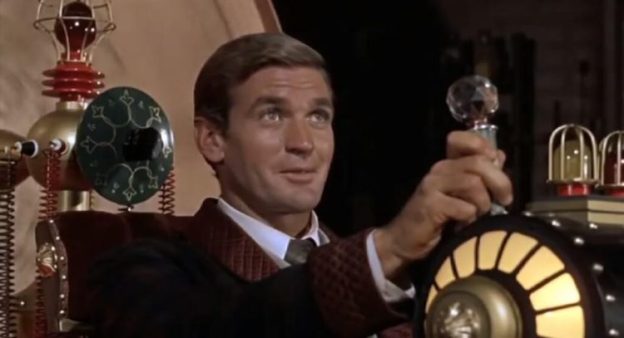
H. G. Wells was one of the singular most formative authors in the genre of science fiction. Wells was among the first of authors to introduce the concept of a “time machine” to popular literature; he even coined the term. The Time Machine, written in 1895, stands apart from other novels of its time as one of the most innovative pieces of literature of its time. The novel’s importance does not come only from its scientific imagining, but the themes presented along with it. H. G. Wells offered his era much more than mere scientific dime novels.
The Time Machine introduced multiple dystopian ideas in a time where literature was often saturated with utopian themes. For example, people such as Edward Bellamy were writing novels such as Looking Backward: 2000–1887 and Equality in the 19th century: these books were very Marxist in nature and often focused on the proposed dangers of capitalism in society versus the success of socialist strategy. H. G. Wells did not take this route when writing his first novel. When his protagonist the Time Traveler travels forward into the future and encounters a strange society filled with shallow and complacent beings, it seems Wells is taking the utopian route. When night falls, however, the Time Traveler discovers the truth of the society he has landed in, and it is far from utopian.
Wells seemed to have some disregard for the utopian presentations of reality prevalent in other literature at the time. He did not write this story to have a happy ending. In fact, it seems rather tragic. The Time Traveler’s adventure does not bring him to a glistening society in which people live together in perfect community, bolstered by technology. Instead, he discovers a primeval food chain where a caricatured “upper class” is juxtaposed against nocturnal ape-like creatures that feast on their flesh. He travels to the literal end of the world, and instead of returning to his time to warn humanity of its impending fate, he disappears from his time. H.G. Wells was not writing to convey wishful fairytales, but to demonstrate what he believed to be the reality of human society. Many of his early works may be described as almost pessimistic (The Invisible Man, The War of the Worlds) in the same manner The Time Machine seems to be.
H.G. Wells was one of the greatest science fiction authors not only because of the revolutionary ideas he presented, but also because of the themes he channeled through his novels. His books were formative to the earliest era of science fiction, and his creation of the term “time machine” spawned countless stories revolving around the theme of time travel. Few authors would be able to say they were the creator of a common literary trope, but H.G. Wells is among the privileged who can.

On October 25, 1854 during the Crimean War the Battle of Balaclava was part of the Siege of Sevastopol (1854–1855). This indecisive military engagement of the Crimean War is best known as the inspiration of the English poet Alfred, Lord Tennyson’s “Charge of the Light Brigade.” In this battle, the Russians failed to capture Balaklava, the Black Sea supply port of the British, French, and Turkish forces in the southern Crimea; but the British lost control of their best supply road connecting Balaklava with the heights above Sevastopol, the major Russian naval center under siege.
Early in the battle the Russians occupied the Fedyukhin and the Vorontsov heights, bounding a valley near Balaklava, but they were prevented from taking the town by General Sir James Scarlett’s Heavy Brigade and by Sir Colin Campbell’s 93rd Highlanders, who beat off two Russian cavalry advances. Lord Raglan and his British staff, based on the heights above Sevastopol, however, observed the Russians removing guns from the captured artillery posts on the Vorontsov heights and sent orders to the Light Brigade to disrupt them. The final order became confused, however, and the brigade, led by Lord Cardigan, swept down the valley between the heights rather than toward the isolated Russians on the heights. The battle ended with the loss of 40 percent of the Light Brigade.
This poem is an extremely popular poem. It has been featured in The Blind Side, and was even published in the newspaper after being written. Written shortly after the battle, it outlines one of the biggest military failures for the British.
Half a league half a league,
Half a league onward,
All in the valley of Death
Rode the six hundred:
“Forward, the Light Brigade!
Charge for the guns” he said:
Into the valley of Death
Rode the six hundred.
Tennyson starts at the beginning with the order to charge. “Half a league” in modern terms equates to about 1.25 miles. So the poem starts out by ordering the 600-man Light Brigade to charge the guns a little over a mile away. Tennyson uses Biblical allusions to bring home the sacrifice made by the soldiers by stating “the valley of death.” This is from the Psalm 23, which says: “Yea, though I walk through the valley of the shadow of death, I will fear no evil: for thou art with me; thy rod and thy staff they comfort me.” Clearly there is no belief these men will return from this charge alive.
“Forward, the Light Brigade!”
Was there a man dismay’d?
Not tho’ the soldier knew
Some one had blunder’d:
Theirs not to make reply,
Theirs not to reason why,
Theirs but to do & die,
Into the valley of Death
Rode the six hundred.
This is perhaps the most famous section of the poem. Tennyson starts with a question asking if anyone was dismayed. Not just that, but if anyone thought someone had blundered: clearly there must be some mistake, sending a light brigade to go fight a heavy artillery position over a mile away through a dead man zone makes no sense. One part of this stanza often misquoted is “Theirs but to do and die.” Often people say “to do OR die,” but this gives a totally different and wrong meaning. Tennyson used “to do and die” to show the troops, even in the face of certain death and blunder, will charge for King and country. By saying “to do or die,” you essentially take away the belief they will actually charge. Not only did the light brigade charge, they didn’t question it, or even try to reason themselves out of it; they simply heard the order and went. This takes an extremely large amount of courage and valor.
Cannon to right of them,
Cannon to left of them,
Cannon in front of them
Volley’d & thunder’d;
Storm’d at with shot and shell,
Boldly they rode and well,
Into the jaws of Death,
Into the mouth of Hell
Rode the six hundred.
Flash’d all their sabres bare,
Flash’d as they turn’d in air
Sabring the gunners there,
Charging an army while
All the world wonder’d:
Plunged in the battery-smoke
Right thro’ the line they broke;
Cossack & Russian
Reel’d from the sabre-stroke,
Shatter’d & sunder’d.
Then they rode back, but not
Not the six hundred.
The next two stanzas give a lot of detail on the actual charge itself. We see in the third stanza they are literally surrounded on all sides by cannons. They are being shot at and losing men rapidly, but even with all the odds stacked against them they rode on through the valley of death. It is interesting he uses the terms “jaws of death” and then “into the mouth of hell.” This is another Bible reference this time to Isaiah 5:14: “Therefore death expands its jaws, opening wide its mouth; into it will descend their nobles and masses with all their brawlers and revelers.” He is saying death will literally eat them alive. In stanza 4 we begin to see them draw their swords and begin to reach the line of cannons. Tennyson states they charged while all the world wondered, basically showing no one knew why they charged into a death trap. After they broke through the lines, there was a fight between the Russian Cossacks and the British light brigade. From the last line we can see the Cossacks retreat but not the light brigade.
Cannon to right of them,
Cannon to left of them,
Cannon behind them
Volley’d and thunder’d;
Storm’d at with shot and shell,
While horse & hero fell,
They that had fought so well
Came thro’ the jaws of Death,
Back from the mouth of Hell,
All that was left of them,
Left of six hundred.
“When can their glory fade?
O the wild charge they made!”
All the world wonder’d.
Honour the charge they made!
Honour the Light Brigade,
Noble six hundred!
In stanza 4 we see the immediate aftermath of the skirmish between the Cossacks and the British cavalry. They fought through the far line of the Russian cannons and fought their way out of the jaws of death. The charge amazingly did not wipe out the light brigade but did inflict massive casualties. Most of the force was either dead or wounded. Tennyson wants us to honor the bravery of the 600. They willingly sacrificed themselves on a mistaken order without question.

We are exhausted. We are stressed and anxious. We are depressed. We are born with curiosity and given a straightjacket. We are led to believe the sacrifice of our emotional and physical wellbeing is worth twelve years of standardized schooling. We think all we need to know is found in the heavy textbooks that strain our spines (Warner) in our pursuit of facts we forget in a week. This is how the secondary educational system is structured. And it is hurting us. G.K. Chesterton once said “The purpose of compulsory education is to deprive the common people of their common sense” (Pearce). The American public school system is detrimental to the mental and emotional wellbeing of students.
The struggle for educational reform in America has existed for hundreds of years. In colonial New England, education was considered a local responsibility. But education soon started its shift toward being under the government’s control, and as early as 1647, Massachusetts law mandated every town of 50 or more families had to have a school, and every town of 100 or more families must have a Latin school to ensure Puritan children learn to read the Bible and receive basic information about their Calvinist religion. After the American Revolution in 1779, Thomas Jefferson argued the school system should be tax-funded and should teach more than just basic skills and build knowledge of the classics, sciences, and education for citizenship. This was called a two-track educational system (“Historical Timeline”). His pleas were ignored, and local schools continued as the norm in the early days of the U.S. As for teachers, a 1789 Massachusetts law dictated school masters must have a college education and produce a certificate of qualifications and good morals from an established minister or selectman. Despite this, schools were often taught by people whose credentials were often self-exampled knowledge (like Laura Ingalls). The same year this law was passed, another required public schools to serve females as well as males. In 1790 the Pennsylvania state constitution called for free public education, but only for poor children (“Historical Timeline”). The literacy rate of both men and women, who were often home taught, was higher than that of European countries in early America (Iorio 3).
According to raceforward.org, in 1805, “New York Public School Society was formed by wealthy businessmen to provide education for poor children. Schools were run on the ‘Lancasterian’ model, in which one ‘master’ taught hundreds of students in a single room. These schools emphasized discipline and obedience; qualities that factory owners wanted in their workers.” 1820 saw the opening of the first public high school in the U.S., Boston English. Seven years afterwards Massachusetts made all levels of public schooling free. In the 1840s Irish Catholics in New York City fought for local neighborhood control of schools in an attempt to prevent their children from being force-fed a Protestant curriculum. Massachusetts passed its first compulsory school law in 1851 anyway in an attempt to educate the poorer children of foreign immigrants flooding into the U.S., and New York followed suit the year after. By 1865 the number of public schools had increased massively, but the level of education available varied and compulsory attendance did not exist nation-wide. Grammar books called Readers were the dominant form of learning for the reading, writing, and arithmetic core, but school reformers eventually influenced the inclusion of spelling, geography, history, the U.S. Constitution, nature study, physical education, art, and music (Iorio 4).
A set of principles called Scientific Management were introduced to the education system by Frederick Winslow Taylor. Taylor encouraged employers to reorganize for maximum efficiency by subdividing tasks, speeding production, and making workers more interchangeable. This theory of mass production with minimum cost was applied to schooling. It is Taylor we have to thank for standardized records of efficiency ratings, standardized tests, building score cards, teaching loads, standardized conditions of school buildings and classrooms, standardized operations for school personnel and students, and monetary rewards for teachers whose students meet assigned goals. Students were taught by drills, memorization, and regimented routines (Iorio 9).
Progressive educators, such as John Dewey, were swept up in the national enthusiasm for industrial education. The Report of the Massachusetts Commission on Industrial and Technical Education in 1906 claimed the “old-fashioned” type of schooling that existed before the progressive movement caused large numbers of children to leave school early, unprepared to be useful citizens. The commission recommended the majority of children should be trained in school with vocational and commercial studies for jobs in industry, instead of “literary education.” For women, occupations such as clerks, teachers, and nurses were emphasized (Iorio 11).
By the late 1940s many public schools had either partially or wholly embraced progressive schooling, but during the post-Cold War era it lost favor when questions were raised about the liberal roots of its reforms. Rudolf Flesch’s popular study Why Can’t Johnny Read (1955) claimed the progressive “reading in context” approach was inadequate preparation for the next generation of Americans (Iorio 13).
The heir to progressive education movement was constructivism, which argues children are active participants in making meaning and must be engaged in the educational process to effectively learn. In the late ’60s, the open classroom movement seemed to be moving away from Taylor’s industrialism. In this movement, students and teachers worked together without walls separating classrooms, regardless of age or grade level. This helped revitalize some of Dewey’s child-centered reforms. It was James B. Conant, however, who argued for a national testing program and an educational achievement index, and increased federal support for vocational guidance in public schools (Iorio 13, 14).
Recently, institutions like Magnet schools (competitive schools often focusing on a particular vocation) have spread across the nation (Iorio 22). Widespread homeschooling ended with the compulsory attendance laws of the 1800s but has steadily been gaining popularity since the 1960s (Iorio 24). During the Clinton administration, the GOALS 200: Educate America Act became law as an attempt to bolster reform. By 2001 only 22 states had adopted these promoted standards. These goals required high school students to take at least four years of English, three years of math, three years of science, three years of history and/or social studies, half a year of computer science, and college-bound students were required to take two years of a foreign language. By the year 2000, most states had not achieved the Goals 2000 mandate (Iorio 24, 25). Such attempts and failures continued with the presidency of George W. Bush with NCLB (No Child Left Behind) and the “adequate yearly progress” (AYP), the goal of a 100% pass rate by the academic year 2013-2014 (Iorio 25). Any school that does not reach AYP for five years could be closed. As goals for reading and math proficiency become more rigorous, more schools are unable to make AYP and more and more schools face impending reorganization or closure (Iorio 26). In March of 2011 the Washington Post reported more than three-quarters of all public schools in America could be labeled as “failing” based on AYP.
This ever constant struggle and seeming back-and-forth between government and business-centered education and localized education has brought us to where we are today. That is, a mind-numbing machine that very rarely allows for the existence of any personal knowledge or talent. As Sir Ken Robinson, an internationally recognized leader in the development of innovation and human resources once said, “We have sold ourselves into a fast food model of education, and it’s impoverishing our spirit and our energies as much as fast food is depleting our physical bodies.” This is where the public education system exists today.
My thesis is relevant because the next generation — the poorly educated ones graduating from public schools now — are going to be in charge of reforms in the future. These reforms could have a huge impact on the way schooling is done everywhere in America. We can’t hide in the bubble of a private Christian school forever. It is up to us to change the education system now, and for the better, for the sake of our future and our children’s future.
The key terms for my thesis are “education,” “learning,” “compulsory” or “mandatory,” and “mental health.” “Education” is defined by the Encyclopædia Britannica as “discipline that is concerned with methods of teaching and learning in schools or school-like environments as opposed to various non-formal and informal means of socialization.” “Learning” is defined as “the alteration of behavior as a result of individual experience,” also by Britannica. “Compulsory” or “mandatory” is defined by Merriam-Webster as “required by law or rule.” “Mental health” is defined by MentalHealth.gov as “our emotional, psychological, and social well-being.” These are the key terms for my thesis the American public school system is detrimental to the emotional and physical wellbeing of students.
I will prove three arguments to confirm my thesis. First, the structure of the public educational system is detrimental to students. Second, the public educational system is hurting those in it right now. Third, the public school system produces detrimental societal expectations.
I will also refute three counterarguments against my thesis. First, if education is not compulsory, children will not learn. Second, trigger warnings are helpful for people who have suffered traumatic experiences. Third, the stress high-schoolers are made to endure will prepare them for later life.
My first argument is the structure of the public educational system is detrimental to students. This is manifest in the existence of mandatory attendance and excessiveness of testing. In my narration, I defined the terms “learning” and “education” separately. This is because popular society too often believes learning only occurs in a highly structured educational system. This leads to the two entirely different words becoming synonymous in one’s vocabulary. Education should not be mandatory because one cannot force a person to learn. Many students feel they are forced to go to school (which in most cases they are), and they rebel by not putting any effort into learning what they are taught. This occurs because they have to go, but don’t want to. Students like these are a distraction to those who do want to learn and to the teachers. If given the opportunity to leave and enter the work force or even simply vocational training, perhaps they would then see the value of an education and return of their own free will, this time taking responsibility for their lives and choices. And even if they chose not to return, with the students who aren’t interested in learning “freed” from the classroom, the teachers would have more time and energy to focus on improving the quality of education for those who chose to stay. School should certainly be available for primary and secondary school students (through 12th grade), but it should certainly not be mandatory. People cannot be made to care about anything, and they cannot be forced to learn. If school were not mandatory, perhaps the students in the system wouldn’t dread it so much.
Mandatory attendance also eliminates better alternatives and opportunities some students would be far more interested and successful in. The school system may partially acknowledge some students have unique gifts, and offer the basic AP or Honors classes to try and accommodate them, but in the end a standardized, mandatory system just doesn’t know what to do with advanced children. A mandatory system doesn’t account for personal learning paces or strong and weak areas. It is merely an attempt to make sure all the children in America have an at least basic knowledge of something or other.
The public school system, as it is, focuses almost ad nauseum on preparing for “the real world,” giving students unrealistic, materialistic expectations for the life they’re guaranteed to have if they stay the course for twelve, fourteen, eighteen, or more years of schooling. But the fact is the only way those high expectations could ever be achieved is through actual hard work at a real job and a little dash of magic thrown in.
In his 2012 State of the Union address, President Obama proposed “that every state — every state — requires that all students stay in high school until they graduate or turn eighteen.” He claimed the reason for this was “When students are not allowed to drop out, they do better,” (“State of”). But the fact is, states with higher compulsory school attendance (CSA) ages do not have higher graduation rates than states with lower CSA ages. Based on an analysis by Grover J. Whitehurst, a senior fellow in Governance Studies and director of the Brown Center on Education Policy at the Brookings Institution and Sara Whitfield, a Financial and Administrative Assistant in the Brown Center on Education Policy at the Brookings Institution, with or without demographic controls, states with CSA until age 18 have graduation rates 1- to 2-percent lower than the states that only require attendance until age 16 or 17. This has been a steady trend since the 2008-2009 school year (Whitehurst and Whitfield). Mandatory attendance doesn’t just harm the students in the system; it doesn’t even accomplish its purpose in the first place.
Another detriment from the structure of American public schools is the overabundance of testing. Testing does not display knowledge. It merely displays how well a student is at taking tests. Testing does not promote learning. It promotes the downloading of facts into our brains to pull up whenever it will help us pass a test. The American school system is drowning in tests. From individual subject tests, to exams, to SOLs, to the PSAT, to the SAT — a student’s high school career is almost built upon taking harder and harder tests. Dawn Neely-Randall, teacher for more than 25 years in Ohio, told The Washington Post in a 2014 interview she was “sick and tired of the effects that obsessive standardized testing is having on her students.” Neely-Randall said her time and ability to actually teach her fifth-grade students how to read and write was being constantly interrupted by a series of required tests — amounting to over eight hours of testing. She wrote:
Tests, tests, and more freakin’ tests.
And this is how I truly feel in my teacher’s heart: the state is destroying the cherished seven hours I have been given to teach my students reading and writing each week, and these children will never be able to get those foundational moments back. Add to that the hours of testing they have already endured in years past, as well as all the hours of testing they still have facing them in the years to come. I consider this an unconscionable a theft of precious childhood time. . .
. . . Many students didn’t speak out as much as they acted out. Cried. Gave their parents a hard time about going to school. Disengaged in class. Got physically sick. Or became a discipline problem. Struggling students struggled even more (Strauss).
This emphasis on testing must be replaced with an emphasis on learning if students are to remember their high school years with anything but dread.
My second confirmation point to prove my thesis is the public educational system is hurting those in it right now, both psychologically and physically. Psychologically, this can be shown in anxiety levels, the seeming epidemic of teenage depression and Attention Deficit or Hyperactivity Disorder. According to The Washington Post, “Fully 83 percent of teenagers said school was ‘a somewhat or significant source of stress.’ Twenty-seven reported ‘extreme stress’ during the school year, though that number fell to 13 percent in the summer. And 10 percent felt stress had a negative impact on their grades” (Shapiro). In a survey conducted by the American Psychological Association in 2014, the stress levels of teenagers even rival those of adults — especially during the school year. When asked to rate their stress on a scale of 1 to 10, teenagers’ stress levels far exceeded what is thought to be healthy during the school year (an average of 5.8 versus 3.9) and this tops the average adult’s stress level (5.8 for teenagers as opposed to 5.1 for adults). 31% of teenagers also reported feeling overwhelmed by stress, and 30% feel depressed or sad as a result of stress. 36% of teens report fatigue or feeling tired, and nearly a quarter (23%) report skipping a meal due to stress. Despite these statistics, teens are more likely to claim their levels of stress are not detrimental to their physical health (54% of teenagers as opposed to 39% of adults) or their mental health (52% versus 43%) than adults; meaning that while it affects teenagers more, they complain about stress less and are unaware of the harm it is causing them. According to the survey, not many teens claim their stress is decreasing. While 16% reported a decrease, 31% reported an increase in their stress levels, and 34% believe their stress level will increase in the coming year. Almost half of teenagers (42%) are not sure if they are doing enough to manage their stress. More than 1 in 10 (13%) say they never even set aside time to manage stress. These numbers may seem small, but the effects of stress can be extremely detrimental to the development of teenagers (“American Psychology”).
Considering a large amount of teenagers’ time is being consumed by schooling, it is not hard to tie these high levels of stress back to being overworked and over-tested. In a 2014 study of Californian schools published in the Journal of Experimental Education by Denise Pope, senior lecturer at the Stanford Graduate School of Education, researchers sought to examine the relationship between homework load and student well-being and engagement, as well as to understand how homework can act as a stressor in students’ lives. Research showed excessive homework is associated with high stress levels, physical health problems, and lack of balance in children’s lives; 56% of the students in the study cited homework as a primary stressor in their lives. Pope wrote, “We found a clear connection between the students’ stress and physical impacts — migraines, ulcers and other stomach problems, sleep deprivation and exhaustion, and weight loss” (Enayati). On average, teens report sleeping much less than the recommended amount — 7.4 hours on school nights and 8.1 hours on nights they don’t have school, as opposed to the 8.5 to 9.25 hours recommended by the National Sleep Foundation. 36% of teenagers reported feeling tired because of stress in the past month. Stress also affects the exercise and eating habits of students negatively, causing them to binge on eating unhealthy foods, or worse, skipping meals because of stress (“American Psychology”). According to Psychology Today, the average high school student today has the same level of anxiety as the average psychiatric patient in the early 1950s. Stress has a major impact on our later health, and school is a major component of stress in the teenage years. The school system is hurting us psychologically.
The negative effects of psychological damage can be seen later in the child’s life as the damage festers and increases, but purely physical detriments can be traced back to the school system as well. In a 2010 study from Web MD, Jennifer Warner writes “A backpack loaded with books may set your child up for spine strain rather than success.” According to Timothy B. Neuschwander, MD, of the University of California, backpack loads are in fact responsible for the majority of adolescent back pain. In the study, MRI scans were performed on the spines of eight children of the average age of 11. Each child had one scan done with an empty backpack, then one with backpack loads of 10%, 20%, and 30% of their body weight (the average backpack load or 9, 18, and 26 pounds, respectively). The results showed with the loaded backpacks the discs that act as a cushion between the bones of the spine were compressed, the back pain increased with the load size (5 out of 10 with the heaviest load), and most children had to adjust their postures in order to be able to carry the 26-pound load. Warner writes, “Researchers say the results showed that heavy backpacks cause compression of the spinal discs and increased spinal curvature that are related to the back pain reported by children.” In the study, the children wore both straps of the backpack, but researchers say the spinal curvature could be even worse if only one strap were used.
When discussing the psychological effects of the public education system, I mentioned the unhealthy homework load. This amount of work is what causes these backpack loads to be so heavy, causing even physical hurt to students.
My third confirmation point to prove my thesis is the public school system produces detrimental societal expectations, such as being coddled and sheltered from opposing views as they are or were in school. These manifest in claimed “microaggressions” and subsequent demands for “trigger warnings.” In December 2014, Jeannie Suk wrote in an online article for The New Yorker about law students asking her fellow professors at Harvard not to teach rape law — or, in one case, even use the word violate (as in “that violates the law”) lest it cause distress. In February of last year, Laura Kipnis, a professor at Northwestern University, wrote an essay in The Chronicle of Higher Education describing new campus politics of sexual paranoia. She was then subjected to a long investigation after students who were offended by the article and by a tweet she’d sent filed Title IX complaints against her. In June of the same year, a professor wrote under a protective pseudonym an essay describing how gingerly he has to teach. The headline read, “I’m a Liberal Professor, and My Liberal Students Terrify Me.” Many popular comedians have stopped performing on college campuses, such as Chris Rock. Others like Jerry Seinfeld have publicly condemned the oversensitivity of college students. Two terms have risen from this hypersensitivity: microaggressions, defined as small words or actions or word choices that seem on their face to have no malicious intent but are thought of as an act of violence nonetheless; and trigger warnings, meaning alerts professors are expected to issue if something (e.g., books or other course materials or subjects) might cause a strong emotional response. An example of a microaggression is to ask Asian or Latino Americans where they were born, because the question implies they are not real Americans. This question could be completely benign, but the fact such questions are often met with a drastic overreaction is what invalidates the offense. An example of a trigger warning is some students have called for warnings Harper Lee’s To Kill a Mockingbird includes a less than savory name for African Americans, and might “trigger” memories of past trauma or racism (Lukianoff and Haidt).
Recent claims of microaggressions border on the surreal. At Arizona State University, students claimed Walk-Only Zones were discriminatory toward those who could not walk. They started a Change.org petition to rename these paths to Pedestrian-Only Zones or “any other inclusive title.” A flyer advertising the petition featured silhouettes of people using crutches, wheelchairs, and canes, and urged people to “make ASU a more inclusive space for ALL students and faculty” and claimed “Not everyone at ASU can walk, so WHY use the lingo ‘Walk Only’?” They must not have realized pedestrian derives from the Latin pedestere, which means “going on foot” (Beard 4-5). At Brandeis University Asian-American students attempted to “foster a healthy dialogue about racism … and how harmful and pervasive microaggressions can be.” However, several students felt the display itself was a microaggression and the group was forced to apologize (Beard 4). This hypersensitivity in students is fostered by a basic failing of the American education system: students are being taught what to think, not how to think — that is, they are being taught their own personal opinions and categories of what is “offensive” (microaggressions) are more important than an actual learning environment.
This careful, calculated protectiveness can possibly be traced back to before the 1980s. The surge in crime from the ’60s through the early ’90s caused Baby Boomer parents to be far more protective than their own parents. As stories of abducted children flooded the news, parents tightened the reins on their children in the hopes of keeping them safe. This obsession with safety also happened at school. Dangerous play structures were removed from playgrounds; peanut butter was banned from student lunches. After the 1999 Columbine massacre in Colorado, several schools cracked down on bullying, implementing “zero tolerance” policies. In many ways, children born after 1980 got one message from adults: life is dangerous, but adults will do whatever it takes to protect you … not just from strangers, but from each other as well (Lukianoff and Haidt).
Also in the 1980s and ’90s college campuses began censoring such free speech, driven by political correctness in the school system. According to Professor Donald Downs, censorship “go[es] in cycles,” and now censorship is coming back as “liberty and equality are increasingly pitched against each other. This time it’s students who, in the name of equality, are demanding a climate free from offense, waging a war against microaggressions and calling for trigger warnings” (Williams). A world free from offense will never exist while humanity does. People’s demands to censor others because they don’t agree with them is quite plainly an immature way of trying to avoid what they will have to deal with in any situation in life. In today’s postmodern society, it is claimed there is no universal truth; every man has his own truth. But that would mean there is no basis for telling people what they’re saying is wrong in the first place. A person can make a racist or arrogant statement and there is no way to judge whether that statement is right or not. And yet these attempts at censorship and trigger warnings quite clearly are acting on the basis some things are wrong for anyone to say, and this list of censored speech (or microaggressions) is being provided by nothing more than the arbitrary popular culture developed by a culture of hypersensitivity. Early in high school, students are being taught according to this warped worldview.
In some school districts, students are forbidden from using any Christian terms, criticizing Barack Obama, expressing support for the Second Amendment or socialism, or condemning radical Islamic suicide bombers. One school in California was sued by their 2014 salutatorian after he was made to rewrite his speech multiple times due to his inclusion of his Christian faith. He was even made to rewrite it because he mentioned the Bible by name and referred to Jesus Christ as “my savior.” The school said the student had no right of free speech, claiming the salutatory speech was not a private one and thus the student speaker was merely the “school district’s authorized representative.” Through this role, the student became an agent of the state government and could only say what the government deemed appropriate. And yet, due to the United State Supreme Court’s 1969 case of Tinker vs. Des Moines Independent Community School District, students do not forfeit their First Amendment rights when they attend public school (Klukowski).
Students are being taught free speech is only permitted if the government says so. With the overwhelming emphasis on liberalism and racial and gender inequality, it is no wonder most claimed microaggressions are toward women or minorities. Students are being taught only certain people are allowed to be offended, but those who are allowed to be offended is entirely arbitrary. There will always be disagreement over who is wrong and who is right, whether that’s offensive or if it isn’t. It’s a chaotic system that only serves to create unrealistic expectations for later interactions in life. And students are being indoctrinated from a very young age in school.
But there is an even deeper problem with trigger warnings. According to basic tenets of psychology, helping people with anxiety disorders avoid the things they fear is misguided. A person who is trapped in an elevator during a power outage may panic and think she is going to die. That terrifying experience can change neural connections in her amygdala, leading to an elevator phobia. If you actually want this woman to continue to fear for her life, you should help her avoid elevators. However, if you want her to return to normalcy, the idea of elevators must be reintroduced to the woman in a positive light — through exposure therapy. Through the gradual reintroduction of elevators as not being dangerous, the woman’s amygdala will reprogram itself to associate the previously-feared situation with safety or normalcy. The same process can be used to students who call for trigger warnings in order to return to normalcy. Students with PTSD should obviously get treatment, but that does not mean they should try to avoid normal life (Lukianoff and Haidt). Students and faculty should not be limited by hypersensitivity. The school system is setting students up to believe others will change their opinions to match their own if they’re bullied and silenced. They are taught every man is an island and everyone has his own truth, and that’s okay … except when others’ truths offend them. Then those truths are wrong and theirs are right. This is an unrealistic and unhelpful expectation for society.
The first counterargument against my thesis is if education is not compulsory, children will not learn. But the fact of the matter is, learning is not mandatory in the present education structure — school is. And there are examples of how when children explore unprecedented ways of learning, they live very satisfying lives, sometimes even compared to those who went through the system. Some two million families in the United States homeschool — that is, teach their children at home instead of sending them to school — but around ten percent of that two million actually identify as “unschooled.” In a survey of 232 parents who unschooled their children by Peter Gray and his colleague Gina Riley, respondents were overwhelmingly positive about their unschooling experience. Parents said it not only improved their children’s learning, but also their psychological and social wellbeing as well as family harmony. Challenges were mostly defending their choice of learning to their friends and family, as well as overcoming their own deeply ingrained ways of thinking about education (Gray and Riley 1). According to Gray, people learn through “exploration and interaction with their environment.” In the public school system, this means interaction with teachers, same-age peers, textbooks, assignments, tests, et cetera, selected for the child as part of a pre-planned curriculum. While the school system claims to prepare students for the “real world,” unschooling actually makes the child’s classroom the real world. While culture as a whole is moving toward more narrowly defined curricula, more standardized testing, and more hours, days, and years in school, the unschooling movement is growing.
While often considered a branch of homeschooling, the fundamental difference between the two is homeschooling is literally schooling at home, while unschooling is based on learning through everyday experiences, like a baby learning to talk through being spoken to. Also, in unschooling the children choose their experiences and therefore experience things that automatically match their abilities, interests, and learning styles (Gray and Riley 2). When those taking part in the survey were asked to define their unschooling, one parent stated
For us, unschooling is self-directed, interest-driven, freedom-based learning all the time. We do not use curriculum, nor do we have certain days or hours where we schedule learning. We are learning as we live. We view learning as a natural part of humanity, and we believe that learning is naturally joyful and desirable. We value a spirit of wonder, play, and meaningful connections with others. We seek to experience “education” as a meaningful, experiential, explorative, joyful, passionate life.
The majority of families that took place in the survey identified with this definition (Gray and Riley 8). Many of the families’ reasons for unschooling were wasted time, the paltry amount of learning that occurred, and/or their child’s boredom, loss of curiosity, or declining interest in learning. These families felt their children’s love of learning and intrinsic passion was being buried under the busy work and/or homework. More said they pulled their children out of school due to their child’s unhappiness, anxiety, or condition of being bullied at school. One parent said
My older daughter was having test anxiety (it was the first year that No Child Left Behind was implemented) and wasn’t eating at lunchtime, was overcome by the noise and the smells, and was distracted in the classroom. My younger daughter was bored and beginning to refuse to participate in classroom activities…. Things finally got to the breaking point and I pulled them out without having a plan, but I knew I could definitely do better than the school. I was done sending them someplace that made them so sad and created so much tension in our family.
When asked how they transferred from traditional schooling to unschooling, many families described it as a gradual journey, using structured homeschooling or state-supplied curriculum before unschooling (Gray and Riley 10). One parent’s reason for the switch was homeschooling was “taking the problems my son had at public school and [was] just changing the location.” The same parent tried numerous forms of homeschooling, having researched unschooling but unable to trust it would work. He describes his “ah-ha moment” as when his two younger children taught themselves to read (Gray and Riley 10-11). One unschooling mother wrote her husband was teaching at a small high school, and when their oldest child reached school age
the experience of dealing with kids who did not fit the system really opened his eyes. It pained him so many students had simply given up all enthusiasm for learning at that point in their lives. The kids had either learned to jump through the hoops or had completely stopped trying, but there was very little real passion for learning left in them (Gray and Riley 13).
When asked to describe the benefits of unschooling, nearly 60% of the respondents described the greatest advantages were for their children’s learning. They saw their children learning “more efficiently and eagerly, and learning more life-relevant material.” One parent wrote, “The children can participate in the real world, learn real life skills, converse with people of all ages.” Many also said their children retained greater curiosity and interest in learning. A little over 52% described benefits such as their children being happier, less stressed, more self-confident, more agreeable, and/or more socially outgoing and prepared than they would be if they were in school or being schooled at home — unlike the antisocial stereotypes of home and unschoolers — due to the fact they were constantly interacting with people of all ages and backgrounds in a larger community instead of just their same-age peers in a classroom. 57% of the respondents also said they had an increased family closeness due to unschooling. According to Gray, parents “reported greater closeness with their children and improved sibling relationships” (Gray and Riley 16).
Nearly forty percent named a freedom of scheduling as a benefit as well. Since there was no set schedule disrupting the flow of their day, they could travel as a family and continue learning through experience (Gray and Riley 17), the very definition of learning stated in my confirmation! Unschoolers have gone on to complete bachelor’s degrees or higher, and attend and graduate a variety of colleges, from Ivy League universities to state universities and smaller liberal-arts colleges. They (the unschoolers) called the transfer into the college environment fairly easy due to their high self-motivation and capacity for self-direction. Their most frequent complaints, according to Gray, “were about the lack of motivation and intellectual curiosity among their college classmates, the constricted social life of college, and, in a few cases, constraints imposed by the curriculum or grading system,” or in other words, their counterparts limited by mandatory education (Vangelova).
In modern-day America, the word “success” has become synonymous with “schooling.” However, this is not true in either a financial or an intellectual sense. Benjamin Franklin spent only two years in the Boston Latin School before dropping out at age ten and apprenticing as a printer. Einstein dropped out of high school at age 15. John D. Rockefeller, the world’s first recorded billionaire, dropped out of high school two months before graduation to take business courses at Folsom Mercantile College. Walt Disney dropped out at 16 to join the army, but being too young to enlist, he joined the Red Cross with a forged birth certificate (Davies et al.). Tumblr founder David Karp dropped out of high school at the age of 15 and in 2013 sold his startup Tumblr for 1.1 billion dollars. Oscar winner Quentin Tarantino also dropped out of high school at 15, and now he has been nominated for 152 awards and has won 114. Others are Billy Joel, and James H. Clark, the self-made businessman and cofounder of Netscape considered to be the first Internet billionaire (Gillett). The most important thing is not whether you are well-known or financially successful, but whether or not you are doing what you are passionate about. In his famous 2006 Ted Talk (which remains the most-viewed Ted Talk to this day), Sir Ken Robinson, Former Professor of education at University of Warwick, said:
Our education system is predicated on the idea of academic ability. And there’s a reason. Around the world, there were no public systems of education, really, before the 19th century. They all came into being to meet the needs of industrialism. So the hierarchy is rooted on two ideals. Number one, that the most useful subjects for work are at the top. So you were probably steered benignly away from things at school when you were a kid, things you liked, on the grounds that you would never get a job doing that. Is that right? Don’t do music, you’re not going to be a musician; don’t do art, you won’t be an artist. Benign advice — now, profoundly mistaken. The whole world is engulfed in a revolution. And the second is academic ability, because the universities designed the system in their image. If you think of it, the whole system of public education around the world is a protracted process of university entrance. And the consequence is that many highly-talented, brilliant, creative people think they’re not, because the thing they were good at at school wasn’t valued, or was actually stigmatized. And I think we can’t afford to go on that way.
He is saying the public education system is set up to try and make people “successful” in very specified areas in which they may or may not be talented. But earning more in a career in science or mathematics is not conducive to happiness. Without compulsory, standardized schooling, students would have more time, effort, and energy to pursue things they actually liked. Thus, compulsory education is not the only way for a child to learn or lead them to what makes them happy, instead it often draws them away from pursuing their passions in favor of a higher salary.
The second counterargument against my thesis is trigger warnings are helpful for people who have suffered traumatic experiences. This idea that words or sensory input can trigger painful memories of past trauma has existed since at least World War I, when psychiatrists began treating soldiers for what is now known as PTSD, or Post-Traumatic Stress Disorder. However, explicit trigger warnings are believed to have originated much more recently on message boards in the early days of the Internet. Trigger warnings, or warnings of potentially sensitive material, became particularly prevalent in self-help and feminist fora, where they allowed readers who had suffered from events like sexual assault to avoid graphic content that might trigger flashbacks or panic attacks. Search-engine trends show the phrase “trigger warning” broke into mainstream use online around 2011, spiked in 2014, and reached an all-time high in 2015. The use of trigger warnings on campus seems to have followed a similar trajectory. That is, seemingly overnight, students at universities across the country have begun demanding their professors issue warnings before covering material that might elicit a negative response (Lukianoff and Haidt). This sounds beneficial, but the real application of “trigger warning demands” are substantially less altruistic.
In 2013, a task force composed of administrators, students, recent alumni, and one faculty member at Oberlin College, in Ohio, released an online resource guide for faculty (later retracted due to faculty pushback) that included a list of topics warranting trigger warnings. These topics included classism and privilege, among many others. It’s hard to imagine how novels illustrating classism and privilege could provoke or reactivate the kind of terror typically implicated in PTSD. The real problem here is trigger warnings are generally demanded for a long list of ideas and attitudes some students find politically offensive, all under the misleading guise of preventing other students from being harmed. This is an example of what psychologists call “motivated reasoning” — we spontaneously generate arguments for conclusions we want to support. Books for which students have called publicly for trigger warnings within the past couple of years include Virginia Woolf’s Mrs. Dalloway at Rutgers for “suicidal inclinations” and Ovid’s Metamorphoses at Columbia for sexual assault. Jeannie Suk compares teaching under demands for trigger warnings to trying to teach “a medical student who is training to be a surgeon but who fears that he’ll become distressed if he sees or handles blood.”
Students struggling from PTSD are not being helped by demands trigger warnings. As a whole, it would be better for them to adjust to normal life in college so they can enter society as healthy, mature adults. Thus, trigger warnings are not helpful for people who have suffered traumatic experiences.
The third counterargument against my thesis is the stress high-schoolers are made to endure will prepare them for later life. Although it is true all human beings will probably encounter stress of various forms and levels in their lives, enduring unhealthy levels of stress at the formative ages of high school can be detrimental later in life (note that “stress” is different from “microaggressions.” Trigger warnings are not demanded in order to avoid stress, but to avoid politically uncomfortable subjects). The fact of the matter is, adults ordinarily fail to recognize the incidence and magnitude of stress in the lives of children. For example, studies have shown “parents perceive children as having lower levels of stress than children perceive themselves having” (Humphrey 8). This is confirmed by a nation-wide survey that concludes “parents underestimate how much children worry” (Witkin 11).
Although stress can provide energy to handle emergencies, make changes, meet challenges, and excel, the long-term consequences of stress are damaging to one’s mental and physical health. If stress is constant and unrelieved, the body has little time to relax and recover. The body is put into overdrive, so to speak, a state scientists call “hyperarousal”; when blood pressure rises, breathing and heart rates speed up, blood vessels constrict, and muscles tense up. Stress disorders such as high blood pressure, headaches, reduced eyesight, stomachaches and other digestive problems, facial, neck, and back pain, can result. High levels of the major stress hormone, cortisol, depress the immune system. A number of studies conducted by institutions like the National Center for Biotechnology, the University of California, and the American Cancer Society found high levels of cortisol (one of three main “stress hormones,” including adrenalin) are often indicators of AIDS, MS, diabetes, cancer, coronary artery disease, and Parkinson’s disease. These problems do not go away when children mature to adults.
“Stressed children are vulnerable to these disorders as well as: sleep disturbances…skin diseases, and infections. Like adults, they become more accident prone. Research suggests that even physical conditions with a genetic basis — like asthma, allergies, and diabetes — can be adversely affected by childhood stress” (Lewis 4). Patterns learned in childhood roll over to adulthood. Dr. Reed Moskowitz, founder and medical director of Stress Disorders Clinic at New York University says “Stress disorders exist at all ages. The physiological consequences of stress build up over years and decades.” Thus, as opposed to positively preparing one for their future, stress caused by mandatory public high school is detrimental to students for the rest of their lives (Tennant).
In my thesis, I have discussed the failings of the American public school system. Changes must be made in order to better prepare students for the world they are set to inherit, or even improve that world before it becomes their responsibility. For it will be the job of the upcoming generation to deal with some of the biggest social, political, and environmental issues to date, such as the definition of gender, ISIL, privacy on the Internet, and Global Warming. The school system as it is is clearly not preparing students to deal with what they will face — it is making it worse. The only way the school system will change is through the dedication and involvement of people who care about the future of this country. So ask yourself; will I live my life in a Christian bubble I’m comfortable in, watch the world burn, and say “I told you so”? or will I shape the world my grandchildren and great-grandchildren will inherit into a better place?
Works Cited
“American Psychology Survey Shows Teen Stress Rivals That of Adults.” American Psychological Association. N.p., 11 Feb. 2014. Web. 25 Jan. 2016. <www.apa.org/news/press/releases/2014/02/teen-stress.aspx>.
Beard, Sterling. “Illiberal Liberalism (or, How to Keep College Students from Ever Encountering an Opinion They Don’t Already Share).” Intercollegiate Review: 4-5. Print.
Davies, Helen, Marjorie Dorfman, Mary Fons, Deborah Hawkins, and Martin Hintz. “15 Notable People Who Dropped Out of School.” How Stuff Works. How Stuff Works, 11 Sept. 2007. Web. 1 Feb. 2016. <people.howstuffworks.com/15-notable-people-who-dropped-out-of-school.htm>.
Enayati, Amanda. “Is homework making your child sick?.” CNN. CNN, 21 Mar. 2014. Web. 22 Mar. 2016. <http://www.cnn.com/2014/03/21/health/homework-stress/>.
Gray, Peter, and Gina Riley. “The Challenges and Benefits of Unschooling, According to 232 Families Who Have Chosen that Route.” Journal of Unschooling and Alternative Learning 1.14 (2013): 1-27. Web. 1 Feb. 2016. <jual.nipissingu.ca/wp-content/uploads/sites/25/2014/06/v72141.pdf>.
Gillett, Rachel. “11 Successful People Who Dropped Out of High School.” TIME: 37 pars. Web. 1 Feb. 2016. <time.com/4099830/successful-high-school-dropouts/>.
“Historical Timeline of Public Education in the U.S.” race forward. N.p., 13 Apr. 2006. Web. 8 Feb. 2016. <www.raceforward.org/research/reports/historical-timeline-public-education-us>.
Humphrey, James. Helping Children Manage Stress. Washington DC: Child & Family Press, 1998. 1-91. Print.
Iorio, Sharon H. “School Reform: Past, Present, and Future.” Wichita State University website. N.p., 25 July 2011. Web. 8 Feb. 2016.
Klukowski, Ken. “School Claims Student Has No First Amendment Rights Against Censorship.” Breitbart. Brietbart, 13 July 2014. Web. 25 Jan. 2016. <www.brietbart.com/california/2014/07/13/school-claims-student-has-no-first-amendment-rights-against-censorship/>.
Leahy, Robert L. “How Big a Problem is Anxiety?” Psychology Today. Psychology Today, 30 Apr. 2008. Web. 25 Jan. 2016. <www.psychologytoday.com/blog/anxiety-files/200804/how-big-a-problem-is-anxiety>.
“Learning.” Encyclopaedia Britannica. 15th ed. 2010. Web. 8 Feb 2016. <www.britannica.com/topic/learning>.
Lewis, Sheldon and Sheila. Stress-Proofing Your Child. New York City: Bantam Books, 1996. 1-216. Print.
Lukianoff, Greg, and Jonathan Haidt. “The Coddling of the American Mind.” The Atlantic Sept. 2015: 60 pars. Web. 25 Jan. 2016. <www.theatlantic.com/magazine/archive/2015/09/the-coddling-of-the-american-mind/399356>.
Pearce, Joseph. “The End of Education.” The Imaginative Conservative. Ed. Stephen Klugewicz. N.p., 18 Feb. 2014. Web. 10 Feb. 2016. <www.theimaginativeconservative.org/2014/02/end-education.html>.
Rampell, Catherine. “Free speech is flunking out on college campuses.” The Washington Post 22 Oct. 2015: 20 pars. Web. 25 Jan. 2016. <www.washingtonpost.com/opinions/free-speech-is-flunking-out-on-college-campuses/2015/10/22/124e7cd2-78f5-11e5-b9c1-f03c48c96ac2_story.html>.
Robinson, Ken, “Do Schools Kill Creativity?” TedTalks. TedTalks, Feb. 2006. Web. 13 Mar. 2016. <www.ted.com/talks/ken_robinson_says_schools_kill_creativity?language=en.>
Shapiro, Margaret. “Stressed-out teens, with school a main cause.” The Washington Post. The Washington Post, 17 Feb. 2014. Web. 25 Jan. 2016. <www.washingtonpost.com/national/health-science/stressed-out-teens-with-school-a-main-cause/2014/02/14/d3b8ab56-9425-11e3-84e1-27626c5ef5fb_story.html>.
“State of the Union Address.” The White House. Washington D.C. 24 Jan. 2012. Web. 25 Feb. 2016. <www.whitehouse.gov/the-press-office/2012/01/4/remarks-presidents-state-union-address>.
Strauss, Valerie. “Teacher: No longer can I throw my students to the ‘testing wolves.’” The Washington Post. The Washington Post, 5 Sept. 2014. Web. 21 Mar. 2016. <www.washingtonpost.com/news/answer-sheet/wp/2014/09/05/teacher-no-longer-can-i-throw-my-students-to-the-testing-wolves/>.
Szyliowicz, Joseph S. Encyclopaedia Britannica. 15th ed. 2010. Web. 8 Feb. 2016. <www.britannica.com/topic/education>.
Tennant, Victoria. “The Powerful Impact of Stress.” John Hopkins School of Education. John Hopkins School of Education, Sept. 2015. Web. 1 Feb. 2016. <www.education.jhu.edu/PD/newhorizons/strategies/topics/Keeping%20Fit%20for%20Learning/stress.html>.
Vangelova, Luba. “How do Unschoolers Turn Out?” KQED News. Mind/Shift, 2 Sept. 2014. Web. 1 Feb. 2016. <ww2.kqed.org/mindshift/2014/09/02/how-do-unschoolers-turn-out/>.
Warner, Jennifer. “Heavy Backpacks Strain Kids’ Spines.” Web MD. Web MD, 3 Feb. 2010. Web. 10 Feb. 2016. <www.webmd.com/children/news/20100203/heavy-backpacks-strain-kids-spines>.
“What Is Mental Health?” MentalHealth.gov. US Department of Health & Human Services, n.d. Web. 21 Mar. 2016. <www.mentalhealth.gov/basics/what-is-mental-health/>.
Whitehurst, Grover J., and Sarah Whitfield. “Compulsory School Attendance: What Research Says and What It Means for State Policy.” Brookings. Brown Center on Education Policy at Brookings, 1 Aug. 2012. Web. 25 Feb. 2016. <www.brookings.edu/~/media/Research/Files/Papers/2012/8/01-education-graduation-age-whitehurst-whitfield>.
Williams, Joanna. “Liberal Academics Let Censorship Happen.” sp!ked 19 Oct. 2015: 9 pars. Web. 25 Jan. 2016. <www.spiked-online.com/newsite/article/liberal-academics-let-censorhip-happen/17549#.VtHIY_A8KrU>.
Witkin, Georgia. KidStress: What It Is, How It Feels, How To Help. Westminster, London: Penguin, 2000. 1-224. Print.
Socialism sounds like a utopia. Imagine a world in which no one goes hungry, everyone has accessible medical care, and college is free. Socialists dream of a world where everyone is provided for equally. For many middle class families, free medical care and food would be extremely beneficial. Socialism’s intent to divide wealth evenly sounds enticing, but how effective are its policies? Would a socialist country even participate in international trade? History does not confirm any of socialism’s wishful thinking. Past examples of socialist takeovers and economic implementation only disprove the effectiveness of socialism in the real world.
It is fair to say history has shown more instances in which socialism fails than in which it succeeds. Russia’s Red Terror during the early 20th century serves as a prime example for how easily a government that feels threatened by a percentage of its population can turn against it in order to preserve the longevity of socialism. Grigory Zinoviev describes the essence of the Soviet Union’s goal in imprisoning, torturing, and murdering scores of its own people: “To overcome our enemies we must have our own socialist militarism. We must carry along with us 90 million out of the 100 million of Soviet Russia’s population. As for the rest, we have nothing to say to them. They must be annihilated” (Winter 13).
Socialism is specifically defined as “a system or condition of society in which the means of production are owned and controlled by the state.” A state is defined as “1) a politically organized body of people usually occupying a definite territory, or 2) a government or politically organized society having a particular character.” Economy is “the structure or conditions of economic life in a country, area, or period; also: an economic system” (Merriam-Webster).
Socialism is an altruistic system. The goal of socialism is to equalize wealth distribution so the ninety-nine percent of people who have less can exist at the same level as the one percent of people who have the most. Socialism’s intent is, ideally speaking, a noble one; in the real world, however, well-intended goals do not always result in a functional system. The essential problem with socialism is not its intent is immoral, but it requires humans to interconnect in a way diametrically opposed to human nature. This truth alone implies such a system would, in the least, have many logistical problems.
This will be a critical analysis of socialism’s blatant failure in both past and present human society. Points pertaining to historical examples and economic theory will be used to explain why this is true. I will first show socialism’s inability to maintain an effective economy compared to an effective capitalist model. I will also explain the greatest ethical flaw of socialism: it requires the human race be altruistic. I will also address and refute arguments for past nations’ lack of relevancy to modern socialism. I will explain how the proposed solution to socialism’s problematic economy through quota implementation has failed before and cannot solve its need for a true market economy, and I will show how a socialist nation in a world of capitalism will never survive. In the end I will address the socialist solution for its unwieldy human populous and its occasional lack of Marxist zeal by demonstrating the past failure of the Bolshevik Takeover.
My first argument will demonstrate socialism’s failure in comparison to capitalism’s modern success. The socialist system fails because it intends to take the basic mechanism for modern capitalism, that of individual economic freedom, and replace it with the authority of the State. The capitalist approach to economic efficiency is, as Milton Friedman puts it, is “misleadingly simple.” His premise is two parties will not voluntarily participate in an exchange if they do not believe they will benefit from it. This basis for economic efficiency functions on more than just the individual level; it applies to all economics. Friedman extrapolates to explain how the principle of supply and demand occurring as a result of voluntary action between people serves to create an efficient system between millions of people which “enables [them] to cooperate peacefully in one phase of their life while each one goes about his own business in respect of everything else” (Friedman 13).
Friedman’s argument is socialism has no realistic substitute for this system of voluntary exchange. He demonstrates how even Russia, “the standard example of a large economy that is supposed to be organized by command” (9), is routinely infiltrated by many capitalist economic traits. Whether legally or illegally, voluntary cooperation between individuals supplants itself where, according to a Marxist model, the state should have unyielding control.
In the labor market individuals are seldom ordered to work at specific jobs; there is little actual direction of labor in this sense. Rather, wages are offered for various jobs, and individuals apply for them — much as in capitalist countries. Once hired, they may subsequently be fired or may leave for jobs they prefer. Numerous restrictions affect who may work where, and, of course, the laws prohibit anyone from setting up as an employer — although numerous clandestine workshops serve the extensive black market. Allocation of workers on a large scale primarily by compulsion is just not feasible; and neither, apparently, is complete suppression of private entrepreneurial activity (10).
My second argument will explain how taking incentives out of an economic system does not serve to equalize wealth, but to destroy the market’s functionality. Within a free market, workers function in accordance with the principle of supply and demand on multiple scales. To feed one’s family, one must attain a certain level of profit on a timely basis. For a company to remain competitive in the business scene, it must meet consumer demands for its stylized brands. For nations to be capable of making beneficial trade deals with other countries, they must first be capable of producing what those countries want. Incentive is a key element in all economic transactions, but socialism intends to function without it.
Mark Perry explains how socialism fails because it does not utilize three major incentive-based components. First, the system of price within the market functions “so flawlessly that most people don’t appreciate its importance.” The mechanism a simple price-tag symbolizes is a crucial element to a functional economy. The existence of a flexible price system broadcasts information about surplus or scarcity within the market and enables it to adapt to the ever-fluctuating economic landscape. Perry uses an example of oil restriction by the Organization of Petroleum Exporting Countries in the 1970s to exemplify how prices affect the market. Oil prices skyrocketed, and both buyers and distributors reacted accordingly. “Consumers … were forced to change their behavior dramatically. [They] reacted to the scarcity by driving less, carpooling more, taking public transportation, and buying smaller cars. Producers reacted to the higher price by increasing their efforts at exploration for more oil.”
Second, socialism lacks a coherent profit and loss system. This system is the mechanic used to gauge the general success of any business within the market. Businesses that do well receive profit while those that do not are met with harmful losses. This functions as a “disciplinary system” that effectively regulates the economy in a way that weeds out the ineffective business firms and rewards the efficient ones. Under a socialist system, however, “there is no efficient way to determine which programs should be expanded and which ones should be contracted or terminated” (Perry).
Third, socialism takes away the right to private property in favor of ownership by the state. An example of how the dissolution of private property is an issue is Britain’s 16th century “tragedy of the commons.” This refers to the occasion in Britain when villages publicly owned certain land for open grazing of cattle. Instead of creating an effective resource for public use, however, the grazing land quickly became overused and barren. The creation of a communal resource did not qualify as a first step to a Marxist utopia of economic equality; it was abused and exploited until it became literally worthless. Perry explains how publicly owned resources are not supported by individual incentives to inspire good stewardship. “While private property creates incentives for conservation and the responsible use of property, public property encourages irresponsibility and waste.” If everyone owns something, then no one owns it; and if no one owns it, then no one will take care of it. Therefore, “the failure of socialism around the world is a ‘tragedy of commons’ on a global scale.”
My third argument will explain the basis for socialism’s failure: it cannot function alongside flawed human nature. Socialism goes against the basic principles humans live by. Very few people can truthfully admit they care about the economic well-being of everyone other than themselves enough to dole out labor for their sake. That idea simply does not mesh with human nature. Socialism ignores this fact entirely. After all, the premise for socialism originated from the Marxist-Leninist belief the ideal world would exist in a state of global communism. People who uphold this principle must believe human nature is inherently altruistic; if they do not, their entire worldview falls apart. The lie of humanity’s altruistic nature is the only reason socialists today have been capable of forging such a large political following. For a functional economic model to exist, those involved in it must see humanity for what it is, not what they want it to be.
Some socialists suggest past examples of socialist experimentation are irrelevant to their proposed “modern model.” More specifically, the first argument is the failures of socialism’s failed implementation in countries such as Russia throughout history are irrelevant to what true socialism aims to achieve. Bertell Ollman states in an article supporting socialism’s vast modern potential, “Where there is little to share, socialism will have difficulty working, but where material abundance already exists and is simply badly distributed, socialism can flourish.” He argues past nations’ failed experimentation in socialism should be attributed to how those nations did not contain the necessary elements for socialism’s success. For socialism to work, he claims, it must have both democratic principles and a populous willing to cooperate with the state. His socialism is one based on individual choice, not just state-based control (ironically so, because socialism requires the dissolution of private property and identity). According to Ollman, even Marx believed countries needed certain material elements before they could successfully function, such as industrialization and an altruistic population.
The author makes some partially correct points, but assumes others that are fairly naïve (rather than progressive). While the fact of Russia’s lack of necessary components (cooperative populous) for an effective socialistic model is correct, the idea a society will one day reach such a level of collective ability to unite in total submission to a state-controlled economy is ludicrous. According to Ollman’s representation of socialism’s extensive list of mandatory components, a viable society would require a population willing to cooperate by both handing away its economic independence and learning to work for the incentive of the “greater good” rather than profit. This argument’s flaw lies not in false representations of history, but in how it assumes a human population is capable of surpassing that which faulted Russia or China. A whole country of people will never be able to transcend the divide between social classes to work together for the common good; it is not that no one wishes for such a reality, but that they do not have the capacity to enable it.
Again, the flaw in a socialist system lies in the problem of the human condition. Humans are imperfect, greedy, and capable of great evil. No individual can achieve in any respect a life devoid of selfishness. Socialism requires humanity to be truly autonomous in nature; since humans are not capable of autonomy, socialism is therefore incapable of functionality. Attempting to force socialism upon society is equivalent to forcing a square peg into a round hole: once it begins to fit, the hole itself has been dealt nearly irreparable damage. Essentially, the idea socialism will not function without the correct conditions is true; however, to believe those conditions are even remotely possible is contrary to human nature itself.
The second point I will refute is socialism’s attempts at reconciling the difficult nature of a population with their altruistic views by demonstrating the consequences of such action. Socialist groups in the past have tried to circumvent this difficulty of human nature by commandeering society to implement their system. Once the state is able to make socialism a reality, its citizens would ideally realize the new position is superior to the capitalist model. This is a hopeful, but false, proposition.
The Bolshevik party of 20th-century Russia tried to accomplish exactly this. The first free elections in Russian history occurred during the Constitutional Convention of 1917. The Bolsheviks held only one-fourth of the seats; ironically, they only represented a minority of the Russian people, even though “Bolshevik” was derived from the Russian word for “majority.” This serves to prove the “People’s Revolution” was never a collective uprising against the government; it was a political minority that felt it necessary to force economic revolution upon over an entire population. Instead of being met with the open arms of civilians hoping for a better, more efficient economic system, the Bolshevik revolutionaries were met with a civil war waged primarily by the White (anti-Bolshevik) Party that lasted five years and resulted in over three million officially documented deaths (Wheatcroft).
As I have explained, socialism is inherently detrimental to society no matter how attractive it may initially appear. Human nature is observably incompatible with the precepts of socialism, as can be derived from both modern and past examples of socialist systems. Sadly, political leaders and social rights activists today do not see this as reality. Whether their motivations are altruistic or not, we must remember the repercussions the institution of socialism can and will have on society. To avoid the possibility of dissolution of private property and a complete takeover by the State, citizens must actively vote against politicians who exhibit a socialist leaning. In the case of socialism’s introduction into society against the will of the populous, it is the moral obligation of the citizenry under such a government to fight against those oppressive policies, for they are not only protecting their right to property and individual identity, but also that of the following generation.
Works Cited
Friedman, Milton, and Rose D. Friedman. Free to Choose: A Personal Statement. New York: Harcourt Brace Jovanovich, 1980. Print.
Ollman, Bertell. “A Bird’s Eye View of Socialism.” A Bird’s Eye View of Socialism. N.p., n.d. Web. 20 Jan. 2015.
Perry, Mark J. “Why Socialism Failed.” FEE Freeman Article. Foundation for Economic Education, 31 May 1995. Web. 6 Dec. 2015.
Wheatcroft, Stephen G. “Victims of Stalinism and the Soviet Secret Police: The Comparability and Reliability of the Archival Data — Not the Last Word.” Europe-Asia Studies 51.2 (1999): 315-45. Web.
Winter, Russ. “The Hidden Suppressed History of Red Terror in Post-WWI Europe.” Winter Watch. 18 Feb. 2016. Web. 20 Feb. 2016.
 Redeeming Pandora