
Christopher Rush
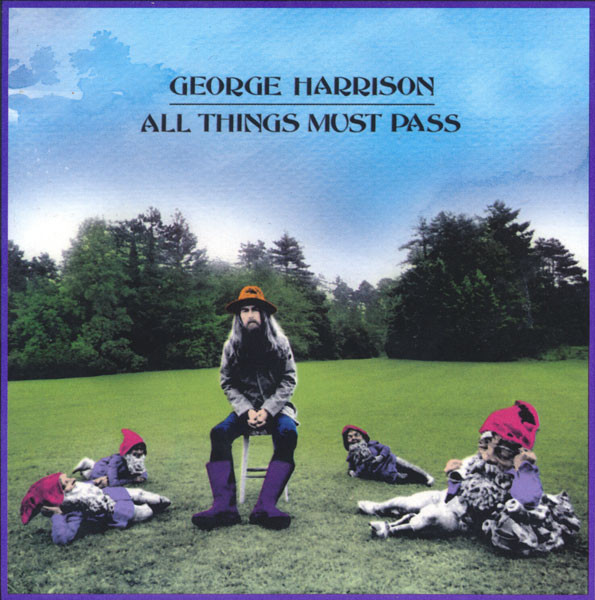
I have been spending a good deal of time lately listening to the Beach Boys and post-Beatles solo albums, partly in preparation for a forthcoming elective, but mainly for the pleasure of listening to quality music. My wife even got tickets for us to see Brian Wilson, Al Jardine, Blondie Chaplin and Co. last August for the 50th Anniversary Tour of Pet Sounds. I admit I hadn’t listened to that album too much in comparison to the other Beach Boys’ albums, but we did prepare for the concert by listening to it a few times (I was able to snag a copy for myself at a family reunion in July). Additionally, my father leant me a number of his albums he wasn’t planning on listening to soon, and he even got me my own copy of George Harrison’s debut lyrical album All Things Must Pass. I have been listening to this one quite a bit, because it is very good. I don’t think it is fair to compare it to Pet Sounds, but I would be willing to say it is better than any Beatles album. That’s a very bold statement, I admit, but if you listen to All Things Must Pass, with or without the 30th anniversary bonus tracks, you may at least have to reexamine your view of the Beatles: if John Lennon and Paul McCartney knew they had George Harrison in their band, why was he allowed only a few songs on their albums, especially by the end? especially when so much of All Things Must Pass is far superior to so much of the entire Beatles canon? But don’t take my word for it (I’m sure you won’t). Let the work convince you. For simplicity’s sake, I will touch upon only a few of my favorite highlights, in the hopes you will experience the work in its entirety soon and frequently.
Disc 1
The album begins very relaxed and tranquil, with “I’d Have You Anytime,” a lovely patient song co-composed with Lucky Wilbury (better known as Bob Dylan). It may seem like an atypical choice for an opener to a rather liberating mega-album, especially considering how many other peppy/rocky songs are included in this opus, but further reflection draws us to the complete propriety of this track as the opening. “Herein is something wholly unlike what you are used to from the Beatles,” says this opening number. “I am free. Time for something new.” I’m certainly not accusing the Beatles of being insincere, mind you (I’m sure they were, and at the moment of this writing I haven’t seen Ron Howard’s Eight Days a Week, which will likely shed light on their depths), but this opening number, in its almost laconic beauty, subtly yet forcefully presents a fresh sincerity sorely needed not only in those likely painful mid- to post-break-up times (plus all the other crazy things going on in the late ’60s) but certainly as much today.
My favorite songs on disc 1 are “Wah-Wah,” “Isn’t it a Pity,” and “Let it Down.” Let’s toss “Run of the Mill” in there as well. That’s not to say “What is Life,” “My Sweet Lord,” “If Not for You,” or “Behind that Locked Door” are bad songs. Truly, this mega-album does not have any bad songs. I’m just telling you the ones I like the most. “If Not for You” and “Behind that Locked Door” are very enjoyable slower, quieter numbers. So is “I Live for You,” a bonus track from the anniversary edition. The balance and diversity are quite enjoyable throughout, especially as it is not just the typical slow-fast-slow-fast or fast-fast-slow-fast-fast-slow sort of song lineup. It’s possible “slow” songs dominate the album, but some of them are tenuously “slow” at best – but none of that matters, since it’s such a great album. Why are these my favorite of the disc? “Wah-Wah” I like because of the “wall of sound,” thanks to Mr. Phil Spector. The musical interludes are especially enjoyable. Admittedly it’s not the most lyrically profound song, but its jubilant nature and instrumentation make it very fun.
“Isn’t it a Pity” is close to a perfect song in most respects: lyrically it is, if not profound, challenging and thought-provoking; musically, the build-up to the “Hey Jude”-like conclusion is very satisfying, coupled with its extreme patience rhythmically. “Let it Down” is perhaps more complex lyrically, and its patience is similarly an enjoyable part of this song. Initially, the “pacing” may seem like the typical “quiet verse”/“loud chorus” contrast, which is not a “pacing” issue at all, really, but the impressive pacing for me is seen better in the spread of syllables throughout the verses, the stark contrast between the slow rhythm of the music and the multiple syllables George is singing on top of the melodic line. It’s the near-talking relaxed nature of it all that is so distinct for the song, especially when combined with the dramatic, heavily-punctuated (musically) terseness of the chorus (lyrically).
The title of “Run of the Mill” initially gives us the impression it will be about something basic, almost banal, and it almost is: it is your choice how you will live your life, what you will find important, what you will find offensive, how you will lose friendships. I suspect it may have some additional layers about being in charge, as if we all own our own mills (or the mill is metonymic for life itself) and we have the “run” of it – and while that sort of sounds clever I haven’t fully followed it through (but again I suspect Mr. Harrison had that and more in mind when coming up with this faceted ironic title). Another reason I like it, in addition to the generally peaceful musical accompaniment, is its similarity to Babylon 5, my favorite show (and also the best of all time, coincidentally enough). Both the show and this song boil life down to very important, basic truths: it’s your life, stop blaming other people, take responsibility for your choices, remember your choices have significant consequences, and live correctly.
Disc 2
As with disc 1 (or record 1, if you prefer), if I mention a few selections as my favorites that’s only a sign I have accomplished something very difficult, like identifying which bites I enjoyed most from a favorite pizza pie. All these songs are very good. It’s possible disc 2 is superior to disc 1, but that’s not something worth investigating seriously. “Beware of Darkness,” “All Things Must Pass,” “I Dig Love,” and “Hear Me Lord” are among my favorites (assuming I don’t need to reiterate my enthusiasm for “Isn’t It a Pity” version two) of this disc. “Beware of Darkness” is another nearly-perfect musical experience. Setting aside for now (as we covertly have done thus far) the Eastern mystical connections of the song, the philosophical truths of this song should not be ignored: watch out for dangerous aspects of life, especially the mental dangers that so easily entangle, disrupt, and damage us. Illusions (“Maya”), false views of reality, should be avoided whenever possible. I can’t find anything Biblically wrong with these premises. Yes, the Bible says it is better to go to a house of mourning than a house of joy, but the Bible also says sorrow lasts for a night yet joy comes in the morning (Psalm 30:5b), also the Man of Sorrows came to give life, and in His presence are joys forevermore and an absence of tears (“but in Thy presence Joy entire” says Milton in Paradise Lost, book 3, line 265). So, just as Shakespeare says in Twelfth Night, sorrow has its proper time and season but should not move in forever, when George Harrison says “[t]hat is not what you are here for,” it’s hard to disagree with him when he aligns with Milton, Shakespeare, and the Bible. Additionally, the use of internal rhyme as well as end-line rhyme propels the song along quite rhythmically conjoined with the fine, soothing musical elements of the song.
Remember what I just said about “Beware of Darkness” being near-perfect and its lyrics aligning pretty much with the Bible and all that and the music being very soothing? I think it was about fifteen seconds ago. Pretend I just said it all again for “All Things Must Pass” without the “near-” and “pretty much” parts, and you’ve got how I feel about the eponymous track on this mega-album. It’s likely my favorite of the bunch (perhaps tied with “Isn’t it a Pity”). It’s a perfect song for when you are feeling down; it’s a perfect song for when you are feeling good (memento mori, everyone, memento mori).
“I Dig Love” is a fun, lighthearted, the-clever-side-of-George-Harrison, unserious groove that adds to the diversity of the mega-album’s musical offerings. Mr. Harrison has proved irrefragably he can pen moving, intellectually profound songs. No one should be thinking he is doing that here. Even so, hidden among the humorous litany of love sources (some of which may be inappropriate but only if interpreted as such), Mr. Harrison slides in a wholly-Biblical “And try to live love, come on, that’s where you should be.” I don’t think we can argue against that.
“Hear Me Lord” … well, let’s get into it, then, shall we? We’ve been putting it off all album long. What should we, as thinking-listening Christians, do in response to George Harrison’s 30-some-year foray into Hindu mysticism and Hare Krishna spirituality? I’d say … nothing. Don’t do a thing about it. Now, I’m not saying YHWH and Krishna are the same Being. I’m not saying there are many paths to salvation. I agree with Milton when he has God say “As many as are restor’d, without Thee none” (Paradise Lost iii.289, emphasis added), that no one will return to Paradise apart from the salvific work of Christ. Surely you know I believe that by now. But did anyone get around to telling that to George Harrison? He surely sounds like one wholly receptive to the possibility for humankind’s restoration to Heavenly peace. Perhaps no one got around to telling him something other than Hinduism. Would it do any good to excoriate the album now? No. Should we tell everyone to stop watching The Muppet Movie? No. Should we listen attentively and respectfully, with the ability to, shall we say, cull the wheat from the chaff? Yes, I think so. Do I like “My Sweet Lord”? Sort of. I think it would be a perfectly true song if you change a few words here and there, but I still think it would be valid to sing most of it directed toward a different audience than what Mr. Harrison intended – and I don’t think that would be “disrespectful” in any way to Mr. Harrison or his art. Why would redirecting something made in all sincerity “according to one’s lights” as the kids say toward its proper destination be “disrespectful” or other recriminatory words some of you could likely conjure up? I don’t think it is. Similarly, I sing “Hear Me Lord” toward YHWH, and perhaps Mr. Harrison did in his way as well. (One could likely say the same for much of his final album, Brainwashed, which we may explore together soon as well.) As the final song on this album, not including the Apple Jam EP, we cannot just dismiss the intensity with which Mr. Harrison implores the divine: help me, Lord; forgive me, Lord; hear me, Lord. It sounds very sincere to me, and I don’t think he is calling upon Rama, or Vishnu, or Brahma, or Shiva, or even Krishna (though I could certainly be mistaken about that). It sounds very much like a song King David would sing, and so can you, and so can I. (Those mmmms at the beginning, especially, are fantastic.)
Not much needs be said about Apple Jam: it’s a pretty fun and impressive collection of mostly instrumental numbers, made all the more impressive when you find out who the musicians are playing these riffs. “Thanks for the Pepperoni” may be my favorite, but that’s not saying much of anything: they are all very enjoyable (though “It’s Johnny’s Birthday” understandably has the least replayability of the bunch, to no one’s discredit). Sure, there is some general similarity among the tracks, but closer attention can dissect their differences, if you feel up for it. If not, that’s okay, too: enjoy the riffs from an all-star collection of musicians.
So In Conclusion To Sum Up
All Things Must Pass is a very good mega-album. Some tracks are better than others, but there aren’t any genuinely “weak” tracks on it. The more you listen to it, the better it gets, which seems like an unnecessary thing to say about a very good mega-album (sort of obvious, that). My only complaint is it is on two discs so I have to keep switching them (not a problem for you kids with your digital versions and your hula hoops and your fax machines). As we have discussed, one does not need to feel bad about listening to George Harrison sing “Hare Krishna”; instead, be reminded of the genuine need so many people have for communion with the divine, then go out and share about the hope you have within you with gentleness and respect. Then delight in the great diversity of musical and lyrical brilliance of All Things Must Pass. You will be forever glad you did.
I don’t want to sound hyperbolic (who, me?), but listening to All Things Must Pass, especially attentively for the first time, feels akin to getting back the use of an organ or limb for the first time in a long while. It’s that good, that useful, and that beautiful.
 Redeeming Pandora