
Justin Benner
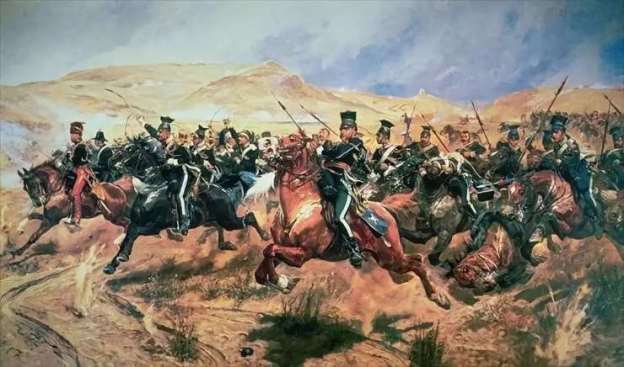
On October 25, 1854 during the Crimean War the Battle of Balaclava was part of the Siege of Sevastopol (1854–1855). This indecisive military engagement of the Crimean War is best known as the inspiration of the English poet Alfred, Lord Tennyson’s “Charge of the Light Brigade.” In this battle, the Russians failed to capture Balaklava, the Black Sea supply port of the British, French, and Turkish forces in the southern Crimea; but the British lost control of their best supply road connecting Balaklava with the heights above Sevastopol, the major Russian naval center under siege.
Early in the battle the Russians occupied the Fedyukhin and the Vorontsov heights, bounding a valley near Balaklava, but they were prevented from taking the town by General Sir James Scarlett’s Heavy Brigade and by Sir Colin Campbell’s 93rd Highlanders, who beat off two Russian cavalry advances. Lord Raglan and his British staff, based on the heights above Sevastopol, however, observed the Russians removing guns from the captured artillery posts on the Vorontsov heights and sent orders to the Light Brigade to disrupt them. The final order became confused, however, and the brigade, led by Lord Cardigan, swept down the valley between the heights rather than toward the isolated Russians on the heights. The battle ended with the loss of 40 percent of the Light Brigade.
This poem is an extremely popular poem. It has been featured in The Blind Side, and was even published in the newspaper after being written. Written shortly after the battle, it outlines one of the biggest military failures for the British.
Half a league half a league,
Half a league onward,
All in the valley of Death
Rode the six hundred:
“Forward, the Light Brigade!
Charge for the guns” he said:
Into the valley of Death
Rode the six hundred.
Tennyson starts at the beginning with the order to charge. “Half a league” in modern terms equates to about 1.25 miles. So the poem starts out by ordering the 600-man Light Brigade to charge the guns a little over a mile away. Tennyson uses Biblical allusions to bring home the sacrifice made by the soldiers by stating “the valley of death.” This is from the Psalm 23, which says: “Yea, though I walk through the valley of the shadow of death, I will fear no evil: for thou art with me; thy rod and thy staff they comfort me.” Clearly there is no belief these men will return from this charge alive.
“Forward, the Light Brigade!”
Was there a man dismay’d?
Not tho’ the soldier knew
Some one had blunder’d:
Theirs not to make reply,
Theirs not to reason why,
Theirs but to do & die,
Into the valley of Death
Rode the six hundred.
This is perhaps the most famous section of the poem. Tennyson starts with a question asking if anyone was dismayed. Not just that, but if anyone thought someone had blundered: clearly there must be some mistake, sending a light brigade to go fight a heavy artillery position over a mile away through a dead man zone makes no sense. One part of this stanza often misquoted is “Theirs but to do and die.” Often people say “to do OR die,” but this gives a totally different and wrong meaning. Tennyson used “to do and die” to show the troops, even in the face of certain death and blunder, will charge for King and country. By saying “to do or die,” you essentially take away the belief they will actually charge. Not only did the light brigade charge, they didn’t question it, or even try to reason themselves out of it; they simply heard the order and went. This takes an extremely large amount of courage and valor.
Cannon to right of them,
Cannon to left of them,
Cannon in front of them
Volley’d & thunder’d;
Storm’d at with shot and shell,
Boldly they rode and well,
Into the jaws of Death,
Into the mouth of Hell
Rode the six hundred.
Flash’d all their sabres bare,
Flash’d as they turn’d in air
Sabring the gunners there,
Charging an army while
All the world wonder’d:
Plunged in the battery-smoke
Right thro’ the line they broke;
Cossack & Russian
Reel’d from the sabre-stroke,
Shatter’d & sunder’d.
Then they rode back, but not
Not the six hundred.
The next two stanzas give a lot of detail on the actual charge itself. We see in the third stanza they are literally surrounded on all sides by cannons. They are being shot at and losing men rapidly, but even with all the odds stacked against them they rode on through the valley of death. It is interesting he uses the terms “jaws of death” and then “into the mouth of hell.” This is another Bible reference this time to Isaiah 5:14: “Therefore death expands its jaws, opening wide its mouth; into it will descend their nobles and masses with all their brawlers and revelers.” He is saying death will literally eat them alive. In stanza 4 we begin to see them draw their swords and begin to reach the line of cannons. Tennyson states they charged while all the world wondered, basically showing no one knew why they charged into a death trap. After they broke through the lines, there was a fight between the Russian Cossacks and the British light brigade. From the last line we can see the Cossacks retreat but not the light brigade.
Cannon to right of them,
Cannon to left of them,
Cannon behind them
Volley’d and thunder’d;
Storm’d at with shot and shell,
While horse & hero fell,
They that had fought so well
Came thro’ the jaws of Death,
Back from the mouth of Hell,
All that was left of them,
Left of six hundred.
“When can their glory fade?
O the wild charge they made!”
All the world wonder’d.
Honour the charge they made!
Honour the Light Brigade,
Noble six hundred!
In stanza 4 we see the immediate aftermath of the skirmish between the Cossacks and the British cavalry. They fought through the far line of the Russian cannons and fought their way out of the jaws of death. The charge amazingly did not wipe out the light brigade but did inflict massive casualties. Most of the force was either dead or wounded. Tennyson wants us to honor the bravery of the 600. They willingly sacrificed themselves on a mistaken order without question.
 Redeeming Pandora