
Christopher Rush
In addition to the fine recommendation my brother has just given you, I thought I would offer some of my own recommendations for some enjoyable, exciting, moving, and more or less important anime series of note from recent years. In stark contrast to most of the things we recommend here at Redeeming Pandora, these present recommendations are more critically popular than you might expect from us — instead of the overlooked, the obscure, the forgotten, and the ignored, these are some of the most beloved and acclaimed series around. Why, then, the need for such a list, you may wonder? Fair enough query. The thought occurs, while the anime circles out there in life are presently aware of these gems, you perhaps are not. Maybe you’ve been under the impression “anime is just Japanese inappropriateness” or something along those lines. As with all sorts of human endeavors, however, a few extreme examples should not besmirch an entire genre. Just as Grand Theft Auto (for example) should not motivate us to generalize the entire videogame enterprise as horrible, a few of the more saucy anime series out there should not prevent us from enjoying and experiencing the better works the field has to offer. (Either that, or you’ve realized by now all of my articles are worth reading, regardless of subject matter and thus “need” is replaced by “just for giggles” and that’s why you are reading this; for that I thank you.) Here, then, in no particular order, are four series worth watching as you while away the summer waiting for the weather to get deliciously cooler and the skies to get beautifully grayer.
Attack on Titan
I admit at the first this is a violent show. Its “Mature” rating is well-deserved. It’s not as bloodily violent as, say, The Wild Bunch or Fight Club, which we’ve somehow gotten away with recommending at Redeeming Pandora, but its violence is intense and pervasive (if not, shall we say, “conventionally graphic”). The series also is occasionally salty, but not nearly as salty as, say, Tim O’Brien’s important and heartily-recommended work The Things They Carried. It would be fair to say, then, this series is recommended despite its violence and mild saltiness.
What, then, you wonder, makes it commendable? I’m not usually a big “post-apocalyptic world” fan, and Attack on Titan is certainly a post-apocalyptic series. Like many anime series, the main protagonists are youngish characters thrust into a chaotic world in which their worth and contributions must be proved and maintained. Somewhat typically with such tales, the main protagonists lose their parents early on and must struggle to get by before they can grow and fend for themselves. Here come the commendations. What is less typical of such stories is Attack on Titan begins in a post-apocalyptic world that has more or less forgotten it is a post-apocalyptic world. 100 years ago, giant “titans” (10-50-feet tall neutered human-like beings) appeared seemingly out of nowhere and began devouring the human race. Somehow, some of humanity survived long enough to build three huge concentric circular walls around the last vestiges of the race. Humanity adjusts to its present condition, more or less, almost getting used to it, despite the elite cadre of military that periodically forays outside the walls, until one day a 200-foot titan appears and batters a hole in the outermost wall, allowing dozens of seemingly-mindless titans to resume the destruction of mankind. Our heroes are caught in the middle, their lives are turned upside down, and suddenly they must live once again with the threat of the titans.
The majority of the 1-season (as of this writing) show follows our three heroes (Eren Yeager, his foster sister Mikasa Ackerman, and their buddy Armin Arlert) as they make their way to the Military to start taking an active role in the defense of mankind and eventually, hopefully, the reclamation of the planet from the mysterious titans. Eren is a conflicted protagonist, and before too long, as is often the case, he has a special destiny integral to the survival of mankind. Mikasa proves herself as an impressive killing machine, as the military uses impressive technology to fight the giant titans. Armin, though initially suffering from self-confidence issues, soon enough proves himself as a brilliant strategist and scientific mind. Along the way, we meet a number of supporting characters who get very interesting the more we get to know them. The only problem with this, is, since most of them are front-line military against a nearly-invincible and relentless foe, the mortality rate among the supporting cast is high — you can’t get too attached to them, really.
I don’t recommend it for the violence, of course. I recommend it because it is a tense show with a large number of exciting mysteries (where did these titans come from? why is Eren so special?) and twists and turns, combined with the sort of Battlestar Galactica-like “humanity banding together to fight off destruction, all the while exploring what it means to be human and moral and all that good stuff” that makes a show like this much more philosophically satisfying than others of its kind. Sprinkled throughout are engaging battle scenes, heroic sacrifices, intriguing layers of politics and betrayal, poignant quiet moments, revealing flashbacks … and then, suddenly, your jaw will drop, your eyes will bulge, and everything you thought you knew about the series and its characters twists inside out. And then it happens again. And you’ll be hooked.
It is only one season, so far, but feel free to use it to motivate you to read the manga, since that is much further along in the overall storyline than the anime series is thus far (and, naturally, it’s richer in character moments, subplots, and other literary goodies not always translatable to a short television show).
Cowboy Bebop
Considered one of the all-time greats for good reasons, Cowboy Bebop is certainly a worthwhile viewing experience. It, too, is occasionally mature, especially in the dialogue, but its overall presentation, fascinating characters, wholly believable world, philosophical explorations, and diverse musical score all overshadow the sporadic saltiness. It is also a limited series, with only 26 episodes (plus one later mid-story movie), so it doesn’t take a lengthy commitment, but the complete series leaves you with such a positive impression, you are glad you watched it.
In a way, Cowboy Bebop is also a kind of post-apocalyptic series: after a nuclear accident, parts of Earth are uninhabitable, but fortunately we have discovered interstellar gate travel and have colonized and encountered other planets and so we are okay. Sort of. Corruption and basic human nature have followed us into outer space, and since space is a vast place, the major corporations and generally decent folk need bounty hunters (called “cowboys”) to help make the spaceways a better place for all. Two such noble bounty hunters/cowboys aboard their ship Bebop are our heroes for the series: Spike Spiegel and Jet Black. Along the way, they meet new friends, we learn about their old enemies, secrets are uncovered, choices are made, and things will never be the same. And the series is only half over.
It is an impressively dynamic series: some episodes are very dramatic, some are poignant, some are adventurous and funny, some are nerve-wracking — all are high quality. Even the episodes you like least are better than other shows you really like. It’s a very layered show: you have to pay attention to the details, as moments and cameos in one episode will come back a couple episodes later. This adds to the overall heft of the series as well as encourages you to watch it again and again. Additionally, it’s a very rich world: the corporations, the supporting characters, the layers of past and present all imbricate in top-notch ways. I know I’m starting to recapitulate generally high praise, but this series deserves all the accolades it has garnered and more. I’m not saying it’s my most favorite series of all time (you know what that is already), but this is definitely a contender for anyone’s short list, anime or not. You will enjoy this in deeper, more meaningful ways than just “yeah, I liked it.” It gets you thinking about a whole lot of important ideas without coming off as didactic or belabored. I realize this is awfully general, but I really don’t want to spoil too much of anything else, as it’s best enjoyed out of wonder without too many preconceptions or spoilers. It will not disappoint you.
Fate/Zero
This yet-another 26-episode complete series is a prequel to another fairly enjoyable anime series Fate/Stay Night. Fate/Stay Night is a computer/videogame with multiple storylines and directions (as in, the story and characters can change depending on which “track” you choose to follow based on your actions and such). The basic premise in both Fate series is every 60-some years, a Holy Grail (not necessarily the Holy Grail) appears on Earth to give one worthy mage and his/her Heroic Spirit companion a wish. Before this can happen, several want-to-be-worthy mages each summon a Heroic Spirit (famous person from history) to beat the other competitors in a Street Fighter/Moral Kombat-like battle to the death. Thus, this series, too, is a bit mature at times. (The main and obvious villain of the series is horrifically villainous — you will immediately be rooting against him and his sheer evil.)
The first half of the series introduces the main combatants, their historical Heroic Spirit counterparts, their goals, their wishes, their conflicts, and a whole lot of other interesting notions (such as the families and mystical secret organizations involved in the centuries of these Grail Wars … secret cabals that make the Illuminati seem like the Boy Scouts of America). The protagonist of the series, Emiya Kiritsugu, is very layered, as are almost all the characters. My favorite duo is mage Waver Velvet and his companion Alexander the Great. Their scenes are among the best of the series, which is saying a lot, considering how good the series is.
Since the mages have called upon Heroic Spirits (except the villain of the series has conjured up a truly heinous person of history), one of the intriguing themes of the series is honor in its many forms: how to achieve it, how it can be lost, can it be regained? and all that. Our main protagonist, who has a checkered past at best, is aligned with King Arthur, as truly a noble historical figure as possible (though there’s a pretty big twist I don’t want to spoil for you here). Their interactions are likewise engaging. These heroes, being noble, often struggle with the need to eliminate each other during the grail contest, even though they know they are in effect servants of the grail until they win it and gain their deepest wish.
Since it’s a prequel to a story/series that was made years before, the ending is likely well-known and necessary. I’m usually in favor of reading/seeing things in the order in which they were made and not their in-world chronological order (my thoughts on the proper order of The Chronicles of Narnia are well known), but I don’t know if watching Fate/Stay Night is better, especially since I experienced Fate/Zero first. I certainly think it’s worth watching Fate/Stay Night as well, but it is very much a more typical “young teens are the heroes to save the world” sort of story, whereas Fate/Zero is definitely a grown-up series (the kids of the characters in Fate/Zero are most of the main characters in Fate/Stay Night, 20-years later instead of the usual 60).
Don’t let the “mages conjuring heroes of the past” put you off. The only off-putting thing is the main villain, but he is so obviously heinous all the other characters rally around the rightness of getting rid of him. Fate/Zero is a great story of nobility, sacrifice, redemption, heroism, and much more.
Fullmetal Alchemist/FMA: Brotherhood
Some may say I’ve saved the best for last, but that may be tainted by the fact Fullmetal Alchemist is much longer than the other series listed here, with 50-some episodes in the first series and 60-some in the “reboot-like” series Brotherhood. The length of the series naturally lends itself to deep, thorough plots, well-rounded and beloved supporting characters, meaningful conflicts and resolutions, and all the things that make an adventure television series great.
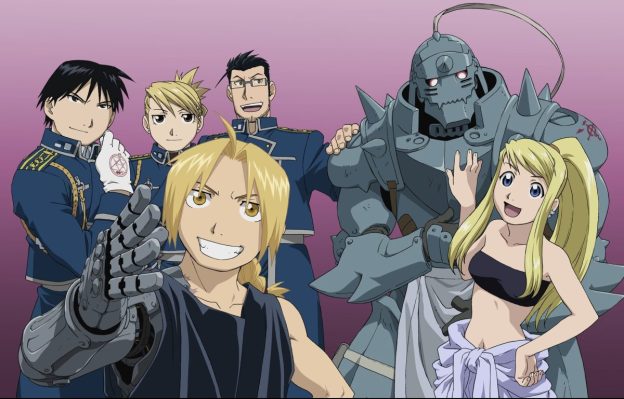
Edward and Alphonse Elric lose their mom when they are still fairly young (you can see a trend among this series), but instead of accepting her mortality they use their alchemy skills to try to bring her back to life. It does not go well. Alphonse loses his body; Edward loses his arm and leg while attempting to save Alphonse’s soul, attaching it to a giant suit of armor. Their childhood friend, Winry Rockbell, creates a new arm and leg for him. (This is all the first minute of the first episode, so I’m not spoiling anything.) Having survived such an experience, the brothers realize they need to improve their alchemy skills and find some way to get Alphonse’s body back. Thus begins their journey.
As with all of these, a great deal of the enjoyment of the series comes in the diverse supporting cast, the ups and downs of their journey, and the growing menace of the behind-the-scenes puppet masters, as well as the philosophical quandaries the Elric brothers encounter along their journey. Having violated one of the key laws of alchemy (don’t attempt human transformation), the Elric brothers begin on the outs, even as they subordinate themselves to the Military (yeah, I know, it seems to have a lot of similarities to Attack on Titan, but they are radically different stories) in an effort to gain access to more knowledge about alchemy, perhaps even tracking down the elusive Philosopher’s Stone. Edward meets several other dubious alchemy users (sort of how Huck Finn meets other likeminded characters warning him against living this sort of life), and he is often tested in how he will live and use his powers: has he learned his lesson? is he committed to others? or is “accomplishing their goals” the only value worth embracing, regardless of who is affected? It’s a very rich show.
Without giving too much away, I’ll comment on two engaging aspects of these series. First, one of the main group of antagonists are named after the Seven Deadly Sins. Though some characters in the two series represent different Sins (e.g., “Dave” is Pride in FMA but Envy in Brotherhood), they make for a very menacing and thought-provoking group of antagonists. Second, unlike almost every American show, the heroic adults of both versions of the show recognize their need to help the Elric brothers since they are young boys and vocalize their responsibility as adults to help and lead the boys as trustworthy adults. Instead of American shows that tell us children are smarter than their parents and other authority figures, Fullmetal Alchemist enjoins us as adults to live exemplary lives to lead the youth for the good of all considered, and children should allow the trustworthy adults in their lives to protect and care for them when it’s the right thing for them to do.
I definitely recommend watching the entirety of the original series first, even though soon enough the two series become drastically different. The first Fullmetal Alchemist began before the manga wrapped up, and thus it started telling its own story about halfway through. Fullmetal Alchemist: Brotherhood (as it’s known here in the U.S.) follows the manga more closely (so I’m told — I haven’t read it yet). I agree with those who find the ending of Brotherhood more satisfactory than the ending of the original (even with the original’s post-series wrap-up movie The Conquerer of Shambhala), but the original’s story and the fate of many supporting characters is satisfying as well. I’ll probably write a more detailed article about this idea next year, once you’ve had time this summer to watch both series.
There you have it. Four high-quality anime series to lead you into what may be a fresh genre of television enjoyment and life improvement. Have a good summer of watching great series! (It’s a great way to avoid sunburns, at least.)
 Redeeming Pandora