Monthly Archives: June 2022

Stop Applauding Charles Dickens: A Bigoted, Aimless, and Opinionated Rant

Daniel Blanton

About five minutes ago, I just finished the very last paragraph on the very last page of one of Dickens’s most beloved novels, Great Expectations: I confess sadly it was too much of a struggle for me to finish it when it was first assigned to me in high school, and even now as I lay the book down I must admit the British Literature course I am currently taking required me to have the book finished a good two weeks ago. So even though I had already taken the test and written a paper or two on the novel, I thought since I was so close to the end it might be a good idea just to finish the darned thing, if only to avoid having to read it again in the future. Upon finishing the novel once and for all, and evaluating it in context with every other Dickens novel I’ve ever read, a startling conclusion presented itself before me: a teacher who makes his students read Charles Dickens and then wonders why their writing is bad is like a mother who decides to live next to a nuclear power plant and then wonders why her children have cancer. So if you come across any particularly bad writing as you read this, please excuse me, as I have been studying Dickens intently for the purpose of writing this and may have been infected.

Now, I do not mean to say Dickens was a bad writer. Instead, I simply mean to say Dickens was a good writer who did a lot of bad writing. Many literary scholars wonder at what kind of great works Samuel Taylor Coleridge may have produced if he had never gotten himself addicted to opium: they see Coleridge’s genius shining through the few poems he did write, and lament he was kept from writing much more. Fans of Dickens will read his work and see the mind of a genius, and when I read something like Great Expectations, I also see the mind of a true master of language. The difference, however, lies in the fact these fans will often perceive Dickens as a visionary in complete control over his creative faculties, whereas I, on the other hand, see him in the same way I see Coleridge: as a writer whose great potential and talent was largely spoiled by unfortunate limitations.

First off, it’s important to remark the following — although an informed opinion — is merely an opinion. With this in mind, you’re now probably at the verge of throwing this rant down to the ground. Who am I to criticize Charles Dickens, after all? Surely I can have nothing of real value to say — but hold on a moment. A few years ago, I would have been incredulous at the thought Charles Dickens produced anything less than high-quality work. One cannot think of classic British literature without his name leaping to mind; as far as 19th-century British literature is concerned, his popularity is matched by no other. The difference between the way I looked at classic novels then and the way I look at classic novels now is now, having read considerably more novels from the time period, I have a standard by which to evaluate new works I encounter. I reference specifically the Russian authors — in fact, I am of a very strong conviction everything written in Russia during the 19th century put together holds more inherent quality than everything written everywhere else in the world during that same time frame. It is rumored in literary circles Hemingway remarked his chief goal as an author was for the very best of his works to surpass in quality the very worst of Dostoevsky’s works; toward the end of his life, he declared he had failed. Finally, of all the novels I have read, I have only encountered five I consider to be perfect: two of them are from 19th-century Russia. I bring this up only to eliminate the argument I am holding Dickens to too high a standard and I must change my usual criteria when evaluating 19th-century works. For if Dostoevsky and Turgenev were able to write what they wrote in their circumstances, then I must hold their contemporary Dickens to the same plumb line and question why he did not produce works of equal measure.

But now an entirely different problem arises: how does one measure literary quality, or any kind of artistic quality in general? To do this, we must examine certain examples individually and parse out positive and negative elements. While we have so many differing opinions on what good music is, somehow bad music is far easier to recognize: so I’ll begin with passages from Dickens that strike me as “bad music.” Let’s begin with Great Expectations.

My father’s family name being Pirrip, and my Christian name Philip, my infant tongue could make of both names nothing longer or more explicit than Pip. So I called myself pip, and came to be called Pip.

Okay, not a bad start. This concise opening clearly informs us about our character’s real name and the origin of his nickname. But then we move down only half a page and we get this gem:

To five little stone lozenges, each about a foot and a half long, which were arranged in a neat row beside their grave and were sacred to the memory of five little brothers of mine — who gave up trying to get a living exceedingly early in that universal struggle — I am indebted for a belief I religiously entertained that they had all been born on their backs with their hands in their trousers pockets, and had never taken them out in this state of existence.

Just when I think I’m beginning to like the book, a sentence like this comes along and makes me want to punch myself in the face. This process repeats itself about every two or three paragraphs on average. First, let’s address what is grammatically wrong with this sentence. Halfway through reading this sentence, I found myself struggling to remember exactly what the sentence was trying to say. This happens because Dickens places the subject of the sentence after the sentence’s midpoint, instead beginning the sentence with a prepositional object. And as if this didn’t disrupt the flow of the sentence enough, Dickens separates the subject from the prepositional object to which it refers with not one, not two, but three dependent clauses and a compound usage of the same “being” verb were. By making you rush through the sentence to discover the significance of the prepositional phrase at the beginning, Dickens makes all of the elaborately melodramatic prose he sets up (“gave up trying to get a living exceedingly early in that universal struggle” … oh, how pithy) entirely superfluous. Rereading the sentence becomes something one does not of admiration for the sentence, but out of a struggle to comprehend it. This is the definition of bad writing. And what is more, the sentence is entirely irrelevant in the grander scheme of what’s going on in this opening chapter. When we begin a book, we care about learning a little bit about a main character, and information relating to the main character’s family is certainly helpful. It’s certainly beneficial here to know Pip has deceased relatives, and in Pip’s five deceased siblings we can see Dickens smuggling in some sly social commentary on Britain’s high infant mortality rate. However, at this point in the novel, do we really care enough about Pip’s inner imaginings to read a ninety-word sentence about fantasies of dead children with their hands in their trouser pockets? Absolutely not! In theory, a child’s whimsical daydreams might certainly enhance the intimacy the story has with our character’s thoughts. Such passages might even provide special insight into the child’s perspective of the world. Yet just as Dickens allows endless phrases and clauses to disrupt the flow of his sentences, he allows his sentences to disrupt the train of thought of the whole paragraph, and by extension the whole narrative he sets up.

I could dig up an example sentence like this from nearly every page in Great Expectations, and I could do the same for nearly every other novel I have read by him. Even the grand opening to A Tale of Two Cities, which I remember liking, fails on the same level. Though grammatically incorrect (it mashes together no less than 14 independent clauses in a row without any kind of conjunction — take note semicolons had been around for at least 300 years at this time, and Dickens still refuses to use them here), the opening to this sentence works because of its contrast:

It was the best of times, it was the worst of times, it was the age of wisdom, it was the age of foolishness, it was the epoch of belief, it was the epoch of incredulity, it was the season of Light, it was the season of Darkness, it was the spring of hope, it was the winter of despair, we had everything before us, we had nothing before us, we were all going direct to Heaven, we were all going direct the other way….

I can’t help but admit this is poetry. It speaks a kind of mournful nostalgia for a time Dickens clearly yearns to have known but was born too late to take part in. But just as the sentence sets itself up for greatness, it has to spiral into this:

— in short, the period was so far like the present period, that some of its noisiest authorities insisted on its being received, for good or for evil, in the superlative degree of comparison only.

Wait … what?! This is the kind of sentence where you can know the meaning of each individual word, but when those words are put together, the obtuseness of the language becomes an indecipherable mess. Like, “being received in the superlative degree of comparison only”? What does that even mean? I would have to diagram this sentence to pick it apart, and I would even have considerable difficulty doing that. And before someone goes off saying, “you ignorant dolt, how can you assume just because you have difficulty understanding a phrase, everyone else does as well?”, I’d like to point out I searched that exact phrase on GoogleTM and immediately I found page after page on all sorts of different sites where people were trying to piece apart that specific phrase. So I’m sorry for insulting this beloved sentence, but the phrasing is just downright awkward.

So why is Dickens’s prose so bizarre? Well, earlier on I mentioned how I viewed Dickens as a genius constrained by limitations — it’s about time to explain what I mean by that. Dickens’s sentences are long because he was paid by the word, thus incentivizing him to write longer sentences. Wait. What’s this? Ladies and gentlemen, someone has just called and informed me Dickens was in fact not paid by the word. But, surely that can’t be true! I’ve had three different English professors confirm it to me! After all, there’s no other explanation for how someone who commands language so beautifully could write so poorly! … Well, turns out those three English professors were wrong. The “paid by the word” story is actually a popular myth generated by frustrated readers trying to explain Dickens’s awful prose. In reality, Dickens was paid per installment, a policy that encouraged him to write very long and bloated novels. And yet, this doesn’t explain his strange sentence structure. The only reason I could provide for that was Dickens, as a writer, was, as many readers believed in the first place, in full control of his faculties …  and he made the decision to write that way consciously. Looking back at these passages I’ve analyzed, a picture begins to emerge — a picture of a writer who goes back and revises his sentences with 100% craft but 0% restraint. It’s like if he comes up with a phrase he perceives as clever, he can’t let go of it. When you’re writing like Charles Dickens, anything that possibly could be said about the subject of your sentence must be said.

Among other public buildings in a certain town, which for many reasons it will be prudent to refrain from mentioning, and to which I will assign no fictitious name, there is one anciently common to most towns, great or small: to wit, a workhouse; and in this workhouse was born; on a day and date which I need not trouble myself to repeat, inasmuch as it can be of no possible consequence to the reader, in this stage of the business at all events; the item of mortality whose name is prefixed to the head of this chapter.

That was the opening sentence to one of his most beloved stories, Oliver Twist. It’s not enough to say there is a building in a town. He feels he has to say he can’t tell you the name of the town; he has to avoid addressing the fact directly the building is a workhouse by prefacing it with “anciently common” and so on; he has to tell us he deliberately avoids telling us the birthday of the main character; he even has to tell us the reason he omits the birthday of Oliver Twist is because at this point we don’t care about what his birthday was! If you know we don’t care, then why are you including this information?! So let’s say you’re writing a novel, and you’re deciding whether or not to provide some piece of interesting exposition on your main character. These are your options.

A) Include that information.

B) Exclude that information.

C) Exclude that information, except tell your readers explicitly you’re not sharing that information with them.

The logical, simple choice for a writer would be A or B, and this would be correct. But if you happen to be a young and impressionable hardcore Dickens fan, I’d put my money on your choosing option C, which would give you this sentence:

On this fine day — and it was as fine a day as any other, as far as fine days are concerned — our hero was born, and as no good child is born without being christened, he was christened with a first, last, and middle name, the latter of which surely would be no matter of interest to you, and for this reason I provide the first and last name of this character only, which you already know because I named this book after him.

Does anyone see for any reason at all why a sentence like that could be somewhat problematic? So as much as it pains me to say it … *breathes in* … it certainly seems as this point Dickens was a … let’s just say “less-than-excellent” writer. You know, at least on some level.

So now a new mystery arises. If Dickens is indeed a … “less-than-excellent” writer … then why is his work so popular? In the end, it all really boils down to his characters. Now why did I say “characters” and not “great stories”? Truth is, despite the fact the “paid by the word” thing was a myth, Dickens was still paid by installments, so even though he told great stories, it takes a heck of a long time for him to tell them. He deliberately stalls for time focusing on minute events and then tries to attach significance to those minute events 200 pages later when he brings characters back around in the most contrived way possible. Oh, remember Jaggers’s maid? I bet you were wondering why he included her in the story and spent such a long time describing her and her relationship with Mr. Jaggers, considering she had no significance to the story at the time. Well, turns out she’s actually Estella’s mother! And Magwitch was the father! Bet you didn’t see that coming, considering it’s the most unbelievable coincidence ever.1 And I understand the same could be said of modern TV shows, how everything is all about building suspense over time and developing and exploring characters — and you know what, writing a 1,000-page novel where characters come back around and interact with each other in extremely coincidental ways over a long period of time is perfectly fine! I mean, Victor Hugo does it in Hunchback of Notre Dame and he does it even more successfully in Les Misérables and neither time does it feel contrived, because the novel is well-paced and way more entertaining (you know, aside from those Grand Canyon-sized detours where Hugo feels there is no possible way he could tell you this story without giving the most in-detail description of the Notre Dame cathedral and the philosophy of architecture in general … but maybe that’s a subject for another rant). I can’t say I don’t have a soft spot for Oliver Twist, but that was mainly because I watched the movie religiously when I was a kid — I shiver in fear knowing some day I’ll have to force myself to read the book. But I have read David Copperfield, which is basically the same semi-autobiographical rags-to-riches story told in both Oliver Twist and Great Expectations, except this time barely anything happens at all. And I also read Great Expectations, of course, which you know my thoughts on. And on top of that, I have read A Tale of Two Cities, which had a pretty touching ending, despite the fact I can’t really remember at all anything that happened during the rest of the book. And then, of course, there’s A Christmas Carol, which is probably the most popular of Dickens’s works, and which I can say is legitimately good; that one gets a free pass. The bottom line here is I believe the specific details of Dickens’s stories are generally not culturally remembered all that well — their characters, rather, are what receive more discussion. We may not remember exactly what happens in a story like Oliver Twist or Great Expectations, but we remember Oliver, Pip, Miss Havisham, Magwitch, Fagin, Bill Sykes, and Dodger. Dickens’s characters are memorable because they are caricatures — and such striking ones at that. Oliver and Pip are exceedingly pitiful and meek; Miss Havisham is exceedingly decrepit and crazy; Dodger is exceedingly friendly, Fagin is exceedingly stingy, Bill Sykes is exceedingly violent, and so on, and so on. Dickens heightens this notion of caricature not only through the behavior of his characters but also through his physical descriptions of them. This certainly creates entertaining and memorable characters, which is why they’re well remembered. But something tells me it limits these characters’ dimensionality. And of course two-dimensional characters would be fine if Dickens were writing merely comedy, but Dickens’s satire is more than light-hearted politics; it is a biting discussion of poverty and terrible working-class conditions, a discussion which oftentimes gets undercut by the light tone and happy endings Dickens prefers to use.

Which brings us to my final point: the seriously underrated Hard Times. Oh, so you think you were reading a long boring rant vilifying a time-honored and popular author? Well, in fact this was all an elaborate ruse: a trap to lure you into a carefully concealed book recommendation. Hard Times is one of the least talked about Dickens works, possibly because it is as every bit as depressing as the title seems to indicate — as if getting people to read a book entitled Bleak House wasn’t hard enough. But the difference between Hard Times and something like Great Expectations is while both make equally apt points about contemporary British society, Hard Times hits these points much harder through its pessimistic attitude. Most of its characters end the novel in an unhappy position, as opposed to Dickens’s lighter novels in which characters will come across good fortune by chance. Within Hard Times we see the full horrific consequences of a defunct social mindset, hence out of all the Dickens books I have read, Hard Times emerges as my personal favorite due to its absolutely jarring impact.

Consider the way the book is divided up: the first segment is entitled “Sowing,” the second “Reaping,” and the third “Garnering.” This is a story in which the behaviors of particular characters are set up, and time is given for their behaviors to result in consequences that extend far beyond their own sphere. “Reaping” and “garnering” often mean the same thing, but here a distinction is made: the “reaping” is the simple cutting of the grain, the emergence of the consequences. By contrast, the “garnering” is where the tragic hero of the story must walk out into the field and gather up the wheat that has been cut: in other words, he must fully face and acknowledge the events taken place are the consequences of his own actions in the past. This book has been praised for its social commentary, but it is far more than mere cultural satire because it dares to fully explore and develop the painful struggle of each of its characters. More specifically, it is a story about characters slowly discovering their own humanity; a cautionary tale about allowing strict reason to rule so supremely emotions are seen as weakness, illustrating how a society founded on such austere principles will ultimately come to ruin. This is demonstrated through the character of Thomas Gradgrind, a schoolteacher who instills this philosophy into the children in his classroom and the children under his own roof. The result: his daughter Louisa suppresses emotion to the extent she resigns herself to a loveless marriage with a man thirty years her senior, and his son Tom entirely loses his emotions altogether, becoming a criminal and encouraging his sister to enter into the aforementioned union for his own financial benefit. Louisa and Tom see absolutely nothing wrong with their actions because they were instructed to see the world that way. And then, all at once, Mr. Gradgrind and children watch their world collapse around them. The book is highly cathartic, as it concludes in such a way we see every character receiving a fitting end, but even more important, it’s delightfully short. Though nowhere near as good as A Christmas Carol, it’s important to point out why this book stands out amongst Dickens’s oeuvre.

My goal here in writing this has not been to defame a great author. Rather, I write this as a means of calling attention to literary flaws we may not notice when we’re not reading an old text as carefully as we could. I don’t wish to see Dickens removed from any school curricula, but I caution any young students interested in writing well to take extra special care as to how they are reading Dickens. And amidst all of these negative points, I want to call attention to my one positive: I have been able to find a great book I like by an author I greatly dislike, and if you feel the same way I do about Dickens, maybe you should give Hard Times a chance. After all, take into consideration while critics who enjoyed the novel have called it one of Dickens’s best, Dickens himself is reported to have disliked it. Perhaps, then, one might conclude Dickens is at his best when what he writes is the least Dickensian.

1I did not make this up. This is actually what happens at the end of Great Expectations.

Same-Sex Eroticism in Romans 1:26-27: The Christian Homosexuality Debate

Caitlin Montgomery Hubler

It is true contemporary debates over homosexuality in many Christian denominations focus less on arguments over specific Biblical passages and more on an overall Scriptural narrative, church tradition, or the value of experience in determining normative ethical judgments. Nonetheless, it remains true debate in some circles over the applicability of certain Pauline texts continues as a central aspect in the discussion over the ethicality of homosexuality. It is an issue that has and continues to divide Christian denominations, churches, and families. Especially for Protestant traditions that pride themselves on Scriptural authority, a thorough exegesis of Biblical passages referring to same-sex eroticism is central to determining the scope of Paul’s claims.

Although multiple passages of interest exist on the topic, in this paper I will limit my comments to Romans 1:18-32. This is arguably the most cited passage of contemporary Christians who claim it to be a clear condemnation of homosexual acts that extends to the present day. See the passage below:

For this reason God gave them up to degrading passions. Their women exchanged natural intercourse for unnatural, and in the same way also the men, giving up natural intercourse with women, were consumed with passion for one another. Men committed shameless acts with men and received in their own persons the due penalty for their error (Romans 1:26-27, NRSV).

I have bolded the word “unnatural” because this Greek phrase “παρὰ  φύσιν” is key for the claim I wish to make in this paper. In contrast to those who would cite Romans 1:26-27 as a condemnation of homosexuality writ large applicable in contemporary Christianity, I will argue it is hermeneutically irresponsible to cite Paul as opposing homosexuality because he opposes same-sex eroticism on different grounds than do contemporary Christians (who cite the passage as a proof text of their own views) who oppose homosexuality. My goals are modest: I do not argue Paul would have been accepting, or even neutral, on the issue of homosexuality. What I will argue is simply to cite the verse as a proof text against homosexuality conceals the complex nature of Paul’s opposition to same-sex eroticism, which depends on elements of Jewish mythological narratives and Greco-Roman culture that many who cite the verses in this way would reject. In order to substantiate this claim, I will evaluate two different exegeses of the phrase “παρὰ  φύσιν” advanced by biblical scholars Dr. John Boswell and Dr. Richard Hays.

Boswell believes Paul’s talk of “nature” in Romans 1 is in reference to the specific, individual “natures” or “characters” of the Gentiles in question and the passage thus refers to heterosexuals engaged in same-sex eroticism as opposed to constitutional homosexuals. Hays counters this by arguing Paul links the Gentile idolatry and same-sex eroticism in such a way as to suggest both are rejections of God’s universal created order as represented in Genesis. Ultimately, I will agree with a third scholar, Dr. Dale Martin, who somewhat side-steps the exegetical question and takes up a hermeneutical one: stating Paul’s opposition to same-sex eroticism stems from entirely different considerations than modern-day Christian opposition to homosexuality. This is important for any hermeneutic of Romans 1 because of the ideological solidarity many Christians assume to have with Paul.

Some preliminary comments about the literary context of the passage in question are now in order. In order to understand how various scholars interpret Paul’s passage in Romans 1, a brief overview of the letter’s main themes and purpose for being written will be useful.

The Apostle Paul had not yet traveled to Rome at the time of his writing the Epistle to the Romans in 56-56 C.E. However, his growing influence in the Greco-Roman Christian world and reputation for counseling churches through ethnic and religious tensions lent him the authority to write this theological treatise to the Christians in Rome. Romans is the work of a developed theological mind, apparently written in response to tensions between Christian Jews and Christian Gentiles in Rome who were confused about how the coming of Jesus affected their relationship to the Mosaic law. Paul counsels the Romans that while the law had its purpose (namely, to reveal the universal human need for grace), the coming of Christ was a major turning point in salvific history. Now, salvation ought not to be understood as a result of meticulous keeping of the law, but as a free gift which comes through belief in Jesus Christ, the Messiah.

Naturally, since Paul had not yet been introduced to the Roman Christians, he had to first find some way of establishing common ground with them. After the formulaic epistolary greeting, Paul runs a clever argument in Romans 1-3 that begins with a condemnation of the Gentile pagans in Rome. Importantly, he apparently thought this condemnation of the pagans to be something that would establish good rapport with both Christian Jews and Christian Gentiles in Rome. Only later does he turn the tables and suggest the Roman Christians perhaps were not so holy themselves — what with all their stubborn insistence on strict adherence to the Mosaic Law and internal ethnic divisions. The purpose of Romans 1 is for Paul to use characteristically Pauline rhetorical strategies to liken his attitudes to those of the Romans, later using this to his advantage pastorally.

Dr. John Boswell argues in his book Christianity, Social Tolerance, and Homosexualityπαρὰ  φύσιν” ought to be understood in the context of how Paul uses the phrase throughout his other letters. Whereas we in 21st-century America tend to think of the natural/unnatural distinction in a way highly influenced by John Locke’s talk of “natural law,” in which “naturalness” and “goodness” are synonymous, Boswell indicates Paul did not have the same framework for these ideas (Boswell). One must be careful not to impose anachronistic categorizations on Paul, for whom “natural” was always to be understood as being possessed by someone or something — something individual (Boswell). Jews are Jews “by nature,” Gentiles are Gentiles “by nature” — but this sort of nature is one of personal character and not moral significance. Never did Paul discuss nature in the universal, abstract sense assumed in the modern West because of Lockean moral philosophy (Boswell).

For clues as to what meaning this term did hold for him, we might look to Romans 11:24, in which God is said to be acting “against nature” in His act of grafting the Gentiles into the olive tree (representing salvation). In this passage, “unnatural” certainly has the connotation of artificiality, in that Gentiles had not always shared the same position as Jews within God’s salvific plan. However, there is no suggestion this grafting, though unnatural, is morally degenerate. Far from it — it is presented as a loving act of God. Boswell summarizes the issue nicely: “‘Nature’ is not a moral force for Paul: men may be evil or good ‘by nature,’ depending on their own disposition” (Boswell).

Literary context is also important for Boswell in determining what Paul might have meant by the phrase “παρὰ  φύσιν.” Interestingly, the same-sex eroticism Paul discusses in verses 26 and 27 is linked to a general, hyperbolic sense of idolatry in verses 18-25. In fact, same-sex eroticism is described as a punishment for this idolatry as opposed to its cause. Paul describes how the Gentiles had the opportunity to recognize the one true God, since “ever since the creation of the world, his eternal power and divine nature … have been understood and seen throughout the things he has made” (Romans 1:20). Instead, they rejected monotheism and “exchanged the glory of the immortal God for images resembling a mortal human being or birds or four-footed animals or reptiles” (Romans 1:23). Boswell likens this as Paul stating the Gentiles’ rejection of their “true nature” in the same way later in the chapter he discusses the Gentiles who rejected their “true nature” as heterosexuals to engage in same-sex eroticism (Boswell).

The principle implication of this distinction is Paul was condemning heterosexuals engaging in same-sex eroticism, and thus made no comment whatsoever on truly homosexual persons. While some have criticized this view to impose anachronistic categories of orientation that would have been foreign to Paul, I do not think this is necessary for the success of Boswell’s argument (Hays 201). I argue not that Paul necessarily delineated between heterosexuality and homosexuality as orientations (for that depends, in part, of the popularity of myths like those of Aristophanes about the origins of same-sex desire, which is difficult to determine historically) (Hubbard 2). Rather, I contend his comments stem from a worldview that had very different ideas about same-sex eroticism than most people today: worldviews so different, in fact, that applying Paul’s comments about same-sex eroticism to modern notions of homosexuality as a biologically natural orientation is more closely eisegesis than exegesis.

However, Dr. Richard Hays looks doubtfully upon Boswell’s exegesis of “παρὰ  φύσιν,” claiming he dangerously confuses exegesis with hermeneutics. He believes Paul’s comments in Romans 1 are a clear condemnation of not only same-sex eroticism, but homosexuality writ large, and any suggestion otherwise is a wistful rejection of the “plain sense” of the text (Hays 196). The thrust of Hays’s argument is his insistence Paul’s condemnation of the pagan Gentiles’ same-sex eroticism is linked to their idolatry in such a way as to associate both with a rejection of God’s natural (morally right) created order. Whereas Boswell believes Paul could have just as easily chosen any other sin with which to rebuke the pagans, Hays maintains the mention of same-sex eroticism is key to Paul’s overall argument. As he states, “The passage is not merely a polemical denunciation of selected pagan vices, it is a diagnosis of the human condition” (Hays 200).

Hays believes in order to define “παρὰ  φύσιν,” one must be cognizant of the common trope of natural vs. unnatural in Greco-Roman moral philosophy. Indeed, although Paul certainly did not understand “natural law” in a strictly Lockean sense, it can be argued the conceptions he would have had from Greco-Roman moral philosophy are not as dissociated from morality as Boswell claims. Stoicism in particular provides a thorough framework for considering the “natural” (κατά φύσιν) vs. “unnatural” (παρὰ  φύσιν) distinction, in which “right moral action is closely identified with action κατά φύσιν” (Hays 192). While there were no equivalent words in Greek for “heterosexual” and “homosexual,” these phrases function with the same meaning. This is evidenced throughout the many Stoic texts cited by Hays that use the category to discuss the morally degenerate “unnatural” phenomenon of same-sex eroticism: most notably, Dio Chrysostom and Plutarch (Hays 192).

These same categories were adopted by Hellenistic Jewish philosophers, with whom Paul would likely have been even more familiar. Not only did they often associate actions “κατά φύσιν” and “παρὰ  φύσιν” with good and evil moral categories, but they did so on the basis of an appeal to Mosaic law. Both Josephus and Philo, Paul’s contemporaries, used “παρὰ  φύσιν” in this exact way (Hays 193). Thus, Hays would strongly contest Boswell’s assertion Paul refers to “nature” in a personalized, specific way to refer to the individual nature of the being in question. Instead, he would assert Paul is playing on categories of “natural” and “unnatural” present and recognized by his contemporaries as clear references to God’s original created order.

The language of “exchange” used in Romans 1:23, 25-26, therefore, carries great rhetorical power for Hays. It is what cements the link between same-sex eroticism and idolatry as both results of a rejection of God’s created order. Just as the pagan Gentiles “exchanged the truth of God for a lie,” also did their women “exchange natural intercourse for unnatural” (Romans 1:25-26). The idea is idolatry is a form of rejecting the order of creation — and this rejection of God as creator is the first major misstep that causes perversions in other areas of the created order as well. Thus, Hays believes Paul’s presumption must have been opposite-sex eroticism is the natural design for humankind.

A third scholar, Dr. Dale Martin, sees several problems with linking Paul’s discussion of idolatry and same-sex eroticism in such a way. Martin accuses Hays of lumping together idolatry and Adam’s fall through “Augustinian lenses,” which would equate the two, whereas Paul would not necessarily have done so (Martin 54). There is no evidence Paul considered Adam’s fall to be an act of idolatry in the same way as the idolatrous acts of the pagans are described in Romans 1 (Martin 52). In fact, Hays argues “Paul presupposes a Jewish mythological narrative about the origins of idolatry,” which would preclude it from occurring simultaneously with the fall (Martin 53). Here Martin cites various rabbinic sources attributing the origins of polytheism/idolatry to “Kenan, Enosh (son of Seth), or the people of Enosh’s generation” — well after the Fall (Martin 53).

Moreover, Martin sees Paul’s diatribe in Romans 1 as possessing another key element of these Jewish mythological narratives: namely, Jewish “decline of civilization” narratives that function in Greek, Roman, and Jewish circles as a means of explaining how Israel is “set apart” from the excessive immorality of the Gentiles (Martin 53). These stories trace Gentile immorality to some point in history at which they became polytheistic, rejecting the one true God and consequently venturing into sexual immorality and general moral corruption. Perhaps the most famous example of this in Judaism is in 1 Enoch, wherein the Genesis 6 account of the fall of the Watchers is expanded to account for Gentile immorality (Martin 53).

This is an attempt to refute Hays’s idea that in connecting idolatry and same-sex eroticism, Paul is implicitly claiming both are rejections of the created order resulting from Adam’s fall. Paul is operating within a different mythological narrative than the fall of man: the “decline of civilization” narrative regarding the origins of idolatry. Where Hays wants to conflate the two, Martin indicates their differences have important implications for any hermeneutic of Romans 1.

Additionally, when Paul makes allusions to the original created order elsewhere, such as later in Romans 5:12 when he speaks of the fall of Adam, he uses language from Genesis: “the fall,” “Adam,” “Eve,” and talking about general humanity as opposed to a specific group of people (Martin 52). Given this language is absent from Romans 1, and Paul would have likely seen idolatry as having origins separate from Adam’s fall, Martin believes nothing in Romans 1 is a gesture toward the created order. He thus believes interpretations of “παρὰ  φύσιν” like Hays’s hijack Paul’s conclusions while dismissing the premises of his arguments.

I find Martin’s arguments persuasive and believe they arise from an attitude toward Biblical hermeneutics that should be forwarded. The principle of examining the premises Paul uses for his argument and not merely taking his conclusions for granted is a noble one in Biblical scholarship. A responsible definition of Biblical authority ought to be one that honestly wrestles with the extent to which contextual and historical considerations come into play when taking moral judgments from ancient authors as authoritative. Far from a devaluation of Biblical authority, what this does is allow the Bible to be evaluated on its own terms. Only then can it be put into conversation with other forms of Christian revelation, namely, nature and experience.

Take for example another instance in Paul’s letters in which he makes a similar appeal to nature, 1 Corinthians 11:13-15: “Judge for yourselves: is it proper for a woman to pray to God with her head unveiled? Does not nature itself teach you that if a man wears long hair, it is degrading to him, but if a woman has long hair, it is her glory? For her hair is given to her for a covering” (1 Corinthians 11:13-15, NRSV).

Most contemporary Christians would reject Paul’s conclusions in this passage (a woman ought to either veil herself or cut off her hair, as per verse 6) because he begins with premises with which they would disagree. The sort of “nature” Paul discusses here may in fact be what he believes is the abstract, universal order of creation set by God in Genesis — but it is historically conditioned by strong views of male-female hierarchy in the ancient Greco-Roman world. Martin identifies within this hierarchy the “implicit devaluation of the feminine,” also a relevant factor when examining ancient attitudes toward same-sex eroticism (Martin 58).

In order to determine why Paul and his contemporaries might have seen same-sex eroticism as self-evidently “unnatural,” it is necessary to examine what role sexual orientation played in the opinions of the populace toward it. It is certain there were myths, like that of Aristophanes, which purported to explain homosexuality alongside heterosexuality as both naturally occurring phenomena. However, this was likely not the predominant view, and indeed, more influential philosophers rejected it (Loader 2). What can be constructed as historically probable is the attitude same-sex eroticism did not arise out of any biologically “natural” orientation, but was instead an extreme expression of heterosexual lust and/or gluttony. It is inordinate desire rather than disoriented desire (Boswell). Dio Chrysostom puts it this way:

The man whose appetite is insatiate in such things, when he finds there is no scarcity, no resistance, in this field, will have contempt for the easy conquest and scorn for a woman’s love, as a thing too readily given — in fact, too utterly feminine — and will turn his assault against the male quarters, eager to befoul the youth who will very soon be magistrates and judges and generals, believing that in them he will find a kind of pleasure difficult and hard to procure (Dio Chrysostom 7:151-52).

The naturalization of gendered hierarchy plays an unmistakable role in the attitudes of the ancients toward same-sex eroticism. For example, Plato agrees same-sex eroticism is “contrary to nature”: but on the grounds a man ought not be mounted “like cattle” (Moralia 751d). A similar justification is used in reference to exegesis of 1 Corinthians 6:9, in which the word “μαλακός,” literally meaning “soft.” is used in a derogatory way to refer to the submissive partner in same-sex male intercourse (Martin 44). In other words, it was the very parts of ancient Greco-Roman culture with which the modern world might most vehemently disagree that were the basis for common attitudes toward the ethicality of same-sex eroticism.

If a disruption of gendered hierarchy is also for Paul what makes same-sex eroticism unnatural, then any Christian who uses Romans 1 as a proof text against homosexuality must also adopt the ancient Greco-Roman ideas of gendered hierarchy in order to fully take Paul’s word as authoritative. In the same way a Christian might reject Paul’s instruction for women to be veiled on the basis of disagreeing with the principle that “nature itself” teaches it, so might a Christian reject Paul’s condemnation of same-sex eroticism on the basis he simply had no concept of homosexuality as a biologically natural orientation. The question also demands to be asked of what relevance is contemporary biological information that suggests homosexuality does contain a natural as well as an environmental component (Mondimore). If Paul operates under a biological paradigm no longer considered accurate, the effect this has on his ethical judgments which are based on such a paradigm is a serious question faced by those seeking to define Biblical authority in a responsible way.

If one is to be a responsible reader and interpreter of the Biblical text, one cannot evaluate Paul’s conclusions apart from the premises he uses to make his arguments. Because his opposition to same-sex eroticism is based on ancient Greco-Roman ideals of gendered hierarchy and an etiology of homosexuality with which modern biology would disagree, it is hermeneutically irresponsible to cite Paul as opposing homosexuality as distinct from merely same-sex eroticism. This is particularly the case if one believes, as Boswell and Martin both claim, “παρὰ  φύσιν” is Paul’s way of referring not to the created order in Genesis, but to the specific pagan Gentiles in question. Importantly, qualifying Paul’s comments in this way does not necessarily constitute a rejection of the authority of Paul: it is simply to recognize the limits of that authority. One might affirm he made authoritative conclusions based on the available information he had at the time while also affirming new information might alter our interpretation and/or application of his comments today.

Paul’s comments regarding same-sex eroticism in Romans 1 demand a response from contemporary Christian communities with a high view of Scripture. Just as they cannot be directly transplanted from the ancient Greco-Roman world that had no concept of a homosexual orientation, there are also problems with tossing them lightly aside as products of the past with no relevance to today. The work done by Biblical scholars balancing exegesis with hermeneutics is valid and necessary for this passage in particular. Debates over the ethicality of homosexuality will continue to rage within denominations and churches, but perhaps responsible Biblical scholarship can serve as a guiding light.

Works Cited

Boswell, John. “The Scriptures.” Christianity, Social Tolerance, and Homosexuality: Gay People in Western Europe from the Beginning of the Christian Era to the Fourteenth Century. Chicago and London: U of Chicago, 1980. Print.

Dio. Dio Chrysostom. Cambridge, MA: Harvard U, 1993. Print.

DeYoung, Kevin. What Does the Bible Really Teach about Homosexuality? Wheaton, IL: Crossway, 2015.

The Harper Collins Study Bible: New Revised Standard Version. General Editor: Harold W. Attridge. San Francisco, CA: HarperCollins Publisheres, 1989.

Hays, Richard B. “Relations natural and unnatural: a response to J Boswell’s exegesis of Rom 1.” Journal of Religious Ethics 14.1 (19860101): 184-.

Hubbard, Thomas K. Homosexuality In Greece and Rome : a Sourcebook of Basic Documents. Berkeley: University of California Press, 2003.

Loader, William. “Same-Sex Relationships: A 1st-Century Perspective.” Hervormde Teologiese Studies 70.1 (2014): 1-9. Academic Search Complete. Web. 30 Oct. 2015.

Martin, Dale B. Sex and the Single Savior: Gender and Sexuality In Biblical Interpretation. Louisville, Ky.:  Westminster John Knox Press, 2006.

Mondimore, Francis Mark. A Natural History of Homosexuality. Baltimore: Johns Hopkins University Press, 1996.

Plutarch, and Grēgorios N. Vernardakēs. Moralia. Lipsiae: B. G. Teubner, 1888.

An Introduction to Moral Nihilism

Jared Emry

There are three major kinds of nihilism: moral nihilism, epistemological nihilism, and political nihilism. Political nihilism derives its root in the same way as the word annihilation. It is the idea “all social and political structures should be destroyed.” Epistemological nihilism is the idea “there is no truth.” Moral nihilism is the idea “there are no values.” These types of nihilism could be all accepted by a person, but any person could easily accept one type and reject the others. They may overlap in a person, but each type is discrete and unique from each other. The confusion of these terms needs to be eliminated before discussing any one individually (Joyce 1). Unfortunately, the term moral nihilism still is vague and slovenly to the point of being both useless and meaningless. For the sake of discussion the term will be defined as to refer to a collection of philosophies that claim there are no moral facts. It is also necessary to trace major moral nihilist thoughts and arguments behind them.

Fyodor Dostoyevsky, in his landmark book The Brothers Karamazov, has Ivan Karamazov state “if God is dead, then everything is permissible.” Many of those in the current skeptic and atheist communities would and do openly reject this dictum as it seemingly remains as either a pragmatic or a metaethic for the need of God; however, this rejection is an offhand dismissal. While Dostoyevsky is an Orthodox Christian and the text could be interpreted as a shameless strawman for atheistic metaethics, Atheism does not necessarily lead to moral nihilism, nor is that an accurate representation for the book (Joyce 2). The novel presents characters from all walks of life and their perspectives on existence. Ivan is the most tortured of them all and not due to his atheism. Ivan is brilliantly analytical and comes to the conclusion people only care about right and wrong insofar as there exist consequences, especially eternal ones. He desires to embrace goodness, but he can’t logically justify it. He gives up on love, happiness, and humanity. He cannot reconcile himself to his disbelief. He cannot reconcile morality with reality. It seems the only way to save values is to betray them. He is left mad and without redemption. His logic is never refuted; rather the disbelief is too much of a burden. It is not a claim atheism leads to moral nihilism for whatever reason. The consequences of the human psyche are irrelevant to the cold mathematics of nihilism. The sentiment here is mirrored by Camus in L’Homme Révolté and Sartre in Existentialism and Humanism. Dostoyevsky’s dictum may be popular in that god is Buddha’s trapdoor — the only exit by which humanity can escape from nihilism. On the other hand, it could be described without a theistic premise, in which the question is what the nature of moral permissibility actually is. This all presupposes the natural intuition of morality found in humans is something that should be doubted.

What justification do we have for moral skepticism? The common standard of justified belief in skepticism is if any contrary hypothesis cannot be ruled out, then that belief is not justified. The skeptic only has the burden of showing for a belief, there is a contrary hypothesis that cannot be ruled out. More specifically there are two basic issues in question that highlight a general cause for analysis of greater depth (Joyce). The first is the pervasiveness of moral disagreement. The second is ability of the sciences to explain moral beliefs in terms of biosocial terms without endorsing moral premises. If morality exists as a property, why is there a lack of moral uniformity across cultures and between individuals? Is active euthanasia moral? Is abortion moral? These are dichotomous and are prominent examples of moral disagreement.  Is there really direct and non-inferential access to the nature of morality if disagreement is so common? If moral belief can be described entirely outside of moral terms and described better, then why the need of such terms? It would seem the questions need answering.

Moral skepticism can also be reached by an argument of regress. Moral beliefs must be justified either inferentially or non-inferentially. A non-inferential argument may be easily dismissed with Occam’s Razor. It seems implausible moral judgments are valid without inference for known disagreements (Loeb 282). Furthermore, moral judgments are subject to framing effects, misleading emotions, and are the product of processes independent of truth. The other option is inferential justification, which may take three forms. First, a moral belief may be justified with no normative premises. The naturalists who make this claim must still rely on suppressed normative premises. Evolutionary biology, psychology, sociology, or general culture can explain moral beliefs, but do not inherently appeal to any moral fact. The naturalist argument relies on the suppressed premise all acts with features they deem immoral are morally wrong, but from what do they deem those features? It can still easily be denied due to prior moral assumptions (Bedke). Second, a moral belief may be justified with some non-moral normative premises. The idea here is theoretically all unbiased and rational people would make the same decisions if placed in the same circumstance and thus allege said beliefs are true. All factors required in such judgments are controversial. How are impartiality, rationality, and relevance decided? (Brandt) The differing theories for each factor would seem to point to suppressed moral premises. The third option is to justify moral beliefs with moral premises. The obvious flaw here is all moral premises are moral beliefs that must be justified. The most common denial would be such justifications must either be infinite or circular. Contamination of the premises with the conclusion gives little reason for the doubter to accept the premise. However, some have proposed a branching tree of premises that together form a coherent whole that can be internally proven. The suppressed premise here is coherency is a suitable replacement for truth. A system may be internally coherent but bears no reflection on externalities. Many internally coherent systems may conflict with each other, which gives rise to doubt concerning which internally coherent system is actually true. Additionally, social contexts are unable to justify moral belief as social contexts are corruptible and no solitary link can be made to affirm social context as truth. These are all the options by which moral beliefs may be justified, and the valid conclusion is there are no justifiable moral beliefs. This conclusion can only be avoided by tackling at least one of the premises covered here.

This skepticism can be taken further by asserting a hypothesis that cannot be ruled out. Moral nihilism is capable of explaining any moral beliefs exist the way they do accurately through evolutionary biology, psychology, sociology, or general culture. A coherent system that creates accurate predictions cannot refute nihilism either. One must rule out moral nihilism to be justified in any moral belief, yet not justified in the denial of moral nihilism. Justification of moral belief requires the denial of moral nihilism. It could be said the belief “genocide is wrong” requires the denial of this moral nihilism and until such time as this denial is justified “genocide is wrong” is an unjustifiable belief. “Genocide is wrong” isn’t a controversial moral belief and so it is plausible this extends to most other moral beliefs and controversies. How can nihilism be denied? A claim may be held against nihilism lacking meaning or internal coherency, yet it remains meaningful and coherent in light of all theories of language. Furthermore, common moral beliefs cannot justify this denial regardless of how obvious they may seem, for this denial is countered by simply pointing to the fact many people do reject moral beliefs and a seemingly coherent system does not speak to the external world. Additionally, all arguments pointing to moral nihilism as being incompatible with non-moral facts can be dismissed for crossing the is-ought barrier. Yet, people reject these conclusions without being able to refute them. The kneejerk reaction might to simply call this nihilism or this skepticism irrelevant. In fact, many people do accept forms of moral nihilism due to a lack of defensible moral theories. It seems relevant because people really do reasonably hold to this skepticism and it does directly confront the moral belief in question. To call it irrelevant is to simply dismiss these people and to not question an underlying belief without justifiable cause.

Moral skepticism and moral nihilism support each other adequately but are not necessarily reliant upon each other, especially due to the diverse nature of moral nihilism. While moral nihilism can be roughly defined as a rejection of values, especially moral values, the method or reason of rejection may vary. Moral nihilism includes all three major theses of moral-antirealism, yet possibly includes other meta-ethical theories. These are non-cognitivism, error theory, and non-objectivism. Non-cognitivism can be boiled down to the idea when people say a moral declaration, they do not intend to express moral truth. Instead of moral truth, people proclaim only their feelings in regard to an action or features associated with an action. Non-objectivism holds morals are constituted by thought alone, but this is not to be confused with subjectivism, as subjectivism is a mere type of non-objectivism. Nor should non-objectivism be confused with moral relativism, which may or may not be nihilist in nature depending on its presentation. However, non-objectivism’s status as moral nihilism is controversial on both sides of the aisle. Error theory is the traditional form of nihilism and perhaps the form that carries the most weight.
Error theory claims there are no objective values and denies it on a similar principle by which an atheist rejects god. Nihilism may be seen as a disjointed whole, against which all strands may need substantial arguments. Either moral judgments aim at telling truth, or they do not. If they do, all claims necessarily fail. If not, moral judgments are inherently separate from truth. However, perhaps it is better to look at traditional nihilism.

Error theory has its unique arguments that may supplement moral skepticism. The previously mentioned argument from disagreement can be expanded (Brink). If we start with the empirical observation many moral disagreements exist, then the demand of moral superiority must also be demanded of epistemological superiority — at least in regard to morality. Why do some cultures or individuals lack this epistemological access to moral knowledge? Many who try to answer find the reason for their claimed superior access may not like the answers they find. Furthermore, it would be more logical that the moral beliefs arose as a result of those answers and not the other way around (Mackie). A second argument stands more uniquely, rather than supplementary, to moral skepticism in the form of what is known as the argument from queerness. The idea here is morality, as a property, is unlike all other properties in universe and is therefore weird. Morality must be described as being observable in a way fundamentally different from all other properties. Morality requires a special faculty by which to operate, whereas all (or at least most) other properties are operated by normal faculties of observation. Morality requires a foreign method of knowing (Mackie).

The existence of moral nihilism, like all nihilism, rests in the negation of commonly accepted beliefs and axioms. It is as various in form as all the things it attempts to negate. It also stands as a brooding giant in philosophical discussions, as it demands attention and yields no ground. It purports what seems obvious to humanity stands on shaky ground. The proposition seems alien to us. If we cannot accept it and we cannot refute it, do we stand on mere faith? Are we to be mad like Ivan Karamazov in our inability to reconcile our human psyche to our reason? Richard Joyce proposes even if morality is a delusion, that delusion must be maintained. For now, however, can modern society cope with such a fundamental in question?

Bibliography

Ayer, A. J. Language, Truth, and Logic. N.p.: n.p., n.d. Print.

Bedke, Matthew S. “Might All Normativity Be Queer?” Australasian Journal of Philosophy 88.1 (2010): 41-58. Web.

Brandt, R. “The Definition of an ‘Ideal Observer’ in Ethics.” Philosophy and Phenomenological Research 15 (1954): 407-13.

Brink, David O. “Moral Realism and the Sceptical Arguments from Disagreement and Queerness.” Australasian Journal of Philosophy 62.2 (1984): 111-25. Web.

Joyce, Richard, and Simon Kirchin. A World Without Values: Essays on John Mackie’s Moral Error Theory. Dordrecht: Springer, 2010.

Joyce, Richard. “Nihilism.” International Encyclopedia of Ethics. 2013. Print.

Loeb, D. Moral Realism and the Argument from Disagreement. Vol. 90. N.p.: n.p., 1998. Print. Philosophical Studies.

Mackie, J. L. Ethics: Inventing Right and Wrong. Harmondsworth: Penguin, 1977.

Connections between Line-Drawn Symbols and Words

Lia Waugh Powell

Abstract

To determine whether word repetition or using semantically elaborated sentences is better for memorization, participants were randomly exposed to words presented in either of those two conditions. There was a total of 165 participants. The experiment was conducted online through the Online Psychological Laboratory. Participants were randomly assigned to hear 15 words used in either semantically elaborated sentences, or the words were repeated to them several times. There were line-drawn symbols also presented with each word as a visual aide. Upon completion of the experiment, participants were asked to retrieve as many words as possible through three tasks: free recall, cued recall, and recognition. The results of the experiment were measured using an independent samples t-test. There was no significant difference found in the free recall portion of the experiment between the two conditions. However, there was a significant difference discovered in the cued recall and recognition portion of the exam when comparing both conditions. These results support previous research regarding the importance of the relationship between elaboration and memorization.

Line-Drawn Symbols and Words

Background Research

Discovering new and efficient ways for children to learn has been of interest for both psychologists and educators for years. Learning how children’s brains process information is the key to understanding this task. One of the first important milestones in a child’s life is learning how to read. According to Lee (2016), as parents or educators begin to teach this skill, it is common to use children books that both incorporate a picture of something (an animal or an object) and a single word used to identify the picture below it. As the book is read to the child, the educator often points to the picture and repeats the words that identifies what the picture is. The goal of this exercise is to teach the child to memorize “sight words,” so they do not have to sound out a word, but rather can see it and recall what it says immediately. However, one may wonder what the most effective method to help others memorize words may be. There is the traditional method explained above, where a line-drawn symbol is shown and the word is repeated. Another method is to associate each line-drawn symbol with semantically-elaborated sentences. Semantically-elaborated sentences in this experiment are sentences that give the specified word meaning by linking it to an image or a related idea (Benson, 2003). But is there a difference in memory between those who memorize using word repetition and those who memorize using semantic elaboration? To further evaluate which method is more effective, this study will explore the differences between each technique.

Meltzer and colleagues (2015) conducted an experiment to gain more understanding of the relationship of perceptual short-term memory and semantic mechanisms that led to converting from short-term memory to long-term memory. The authors hypothesized short-term repetition of words under articulatory suppression would lead to higher levels of recalling sentences. Articulatory suppression is the effort to hinder memorization by giving a task to the participant. In this experiment, the task was to either tap fingers in between the words being presented to them, or to count backwards by three. Ultimately it was hypothesized there would be less forgetting when the words were presented in sentences, and the semantically-based sentences would allow encoding within long-term memory.

Twenty local university students participated in their study, with the average age of 21.9. Two tasks were required for the experiment. When the experiment began, the participants were alone in a room and used a computer to be presented audio sentences. The sentences presented to each student were either high in levels of semantic concreteness, or abstract. According to Meltzer and colleagues (2015), sentences high in levels of semantic concreteness contain rich pictorial imagery. In contrast, abstract sentences did not contain sensory information. The first task consisted of the students listening to sentences. After the sentences were heard, the students experienced a 14-second delay. During the delay the students were randomly assigned to either tap their fingers or count backwards by three. After the 14 seconds concluded, the students were asked to repeat the sentence verbatim. For the second task, the sentences were presented again, but the two main words (the subject and verb within the sentence) were visually shown to the students as retrieval cues. The students then had to try and repeat the sentences verbatim.

Upon completion of the experiment, the recall scores were averaged. Meltzer and colleagues (2015) reported they used a subject-wise repeated measure ANOVA to analyze the data. In both tasks, the hypothesis was supported. Auditory suppression seemed to allow enhanced recall of the sentences. Interestingly enough, the semantically concrete sentences as opposed to the abstract sentences indicated higher levels of encoding within long term memory for the participants. The authors concluded the concrete sentences were repeated more accurately than the abstract sentences.

Meltzer and colleagues (2015) offer great insight for this current study. Their findings strongly supported the importance of semantically-elaborated sentences and the commitment within long-term memory. However, one issue within their experiment was they used a within-subjects design. This poses a problem because the participants may have become tired after the first task was completed. Or, the students may have had the opportunity to perfect memorization skills if they caught onto the hypothesis. Thus, those situations could have interfered with the results. The current study attempts to better this experiment by eliminating the potential carry-over effects found in a within-subjects design.

An additional study conducted that augments this current experiment was led by Jesse and Johnson (2016), who aimed to understand if children used initial labeling and audiovisual alignment to learn words. The authors used 48 Dutch toddlers for their experiment that averaged at the age of 25 months. For this experiment six videos were shown to each toddler that had two moving creatures in them, but no speakers. The toddlers’ eyes were also monitored during the experiment to measure attentiveness. One creature was green, the other pink, and both had Dutch names of “Kag” and “Zeut.” Three speakers that participated in the experiment provided voice overs for the videos when they were presented to the children. The speakers were instructed to speak to the children, but not to use any words that could define which character was which (e.g., “Zeut is running,” “Kag is green”).

Both groups of children were exposed to a pre-experiment. The experimental group was shown the character and his name, consistent with the actual video in the experiment. In the control group, the creature was labeled a name in the pre-exposure inconsistent with what was shown in the following video. The authors hypothesized the experimental group of children should learn the creature better as opposed to the control group. Once the videos started, the children heard the speakers say phrases such as “Look at Kag, isn’t Kag cute?”

The results of Jesse and Johnson’s study supported their hypothesis. Using a two-sample independent t-test, it was evident the children in the experimental group not only looked longer at the television screen, but also they learned the novel words used during the experiment. These finding proposed the children in the experimental group used the information they learned in both the pre-exposure phase and the exposure phase to learn words and associate the characters (Jesse & Johnson, 2016). The authors concluded inter-sensory material related to word learning. This means through integrating audiovisual information and connecting words to a meaningful sentence, learning ability is enhanced.

Pertaining to this current study, Jesse and Johnson’s findings suggest purely audiovisual circumstances are enough for word learning. Their study also offers background information on how toddlers learn that may be applied to our current study. While the sample for this current experiment consists of college students and the authors’ toddlers, the authors’ study is relevant because we can do further research in seeing if the same concept applies to more developed brains. However it is a disadvantage that Jesse and Johnson’s research was focused on toddlers rather than a prolonged lifespan development. This current study can add additional findings for Jesse and Johnson’s study because it seeks to understand a larger age range and how the brain better commits words to memory. This is because the focus will be comparing the results of those who memorize better when presented words in semantically-elaborated sentences or through word repetition. While Jesse and Johnson’s study was primarily on word learning, we will elaborate on this with sight word memorization.

Another study relevant to this current one was conducted by Nilsen and Bourassa (2008), which also focused on word-learning performance for beginning readers. The authors were specifically interested in determining if word-learning was promoted using regular (concrete) words or irregular (abstract) words. A regular word was defined as a word that the letter sequence followed typical spelling sound-mapping, such as the word “dream.” In contrast, an irregular word did not follow the typical spelling sound-mapping, such as the word “thread.” In this case, an example of a regular/concrete word would be “elbow,” and an example of an irregular/abstract word would be “temper.” It was predicted the regular/concrete words enable easier recall for children due to their direct sensory reference. To elaborate, it is easier for a child to remember the word “elbow” because it is a body part most every person has. The word “temper,” however, is not easily retrievable because it does not have a direct sensory or visual reference.

In Nilsen and Bourassa’s (2008) study, the authors had a sample of twenty-seven kindergarten students and nineteen first-grade students. The study was conducted over four sessions. 40 words were put into a word bank then separated into four groups. The word groups were presented in several formats: concrete–regular, concrete–irregular, abstract–regular, and abstract–irregular. In each session, the students were presented with one of the word formats randomly assigned to them. Each word was written on an index card that was shown to the student. The authors then read the word to the students twice, and the students in turn repeated the word after the author once. At the end of the session, the students recalled the words they had learned. The students were scored on a scale of 0-10. A score of “0” indicated no words were correctly learned, whereas a score of “10” indicated a perfect word-learning score.

The results of this experiment supported Nilsen and Bourassa’s (2008) hypothesis. The authors used an analysis of variance to examine the outcomes. It was concluded the children had learned the words that had greater semantic-richness more efficiently than the words that were abstract. For the current study, this would support the hypothesis semantics have a large effect on word learning, as well as word memorization. While the authors’ study focused on word learning with children, this current study’s focus is word memorization within adults. However, the two are relational because understanding how children’s brains learn may also enable us to better understand how adults may memorize or learn better as well. This assumption can be entertained because while children are more adult-dependent learners, as they grow older they become more independent learners. This would mean there will be a time when learning is less dependent on the educator and more dependent on the learner. Understanding the beginning methods of how words are integrated into memory may in fact assist in developing more advanced memorization and learning techniques in the future.

Research Goal

The goal of the current study is to investigate if memorization is enhanced when presented with visual line-drawn symbols under two different conditions: word repetition or semantically-elaborated sentences. Previous research has shown the importance of semantics in memorization as well as offered understanding of children’s brain development and how they best learn words. However, this study will focus specifically under which circumstances provide optimal word memory recall for students. To do this, participants will be exposed to 15 line-drawn symbols associated with words in one of two conditions randomly assigned to them. The hypothesis for this study is the learner will be able to memorize the given words presented to them better when presented with sentences that have concrete words within them, rather than when the word is repeated to them. This will help the learner associate a target word with its line-drawn symbol for recall.

Method

Participants

There was a total of 165 (18% male, 82% female) participants from Old Dominion University’s Research Methods in Psychology course. The participants received extra credit for their involvement. Average age of the participants was 27.

Procedure and Materials

This study was conducted online through the Online Psychology Laboratory. It was estimated it should only take 8-10 minutes for the participants to complete the experiment. Upon the participant’s agreement to complete the study, the first task is to specify the participant’s age as well as gender. Then, 15 line-drawn symbols and words associated with them were presented in one of two conditions — either a semantically-elaborated sentence, or word repetition — to the participants. For example, in the word repetition condition, participants would see a line-drawn symbol of a square while they hear the word “Pillow, pillow, pillow.” In the semantically elaborated condition, the participants would see the square and hear “Pillow. The pillow sits on the couch. Pillow.” The condition was randomly assigned to each participant. After the participants were presented the line-drawn symbols and words, they engaged in the memory recall portion of the experiment. The free recall portion was immediately after the presentation of the line-drawn symbols and words. The participants had to document the amount of words they remembered and enter their answer (0 to 15). For the cued recall section, the 15 line-drawn symbols were again presented and the participant had to write down which word they believed was associated with the symbol. Lastly, in the recognition recall, the words given during the presentation were mixed with other random words. The random words used in this part of the study were of the same semantic class. As the words were shown to the participant, the participant had to distinguish which words actually were used to identify the line-drawn symbol throughout the study. The purpose of measuring word recall in three different ways was to portray the findings through various comparisons. Researchers can take the data to compare any of the two tasks, or all three, to understand in which ways memory performance excelled and in which condition.

Demographic items of interest were the participants’ age and their gender. There were two different conditions in which the words were heard. The first condition was word repetition, and the second condition was semantically elaborated sentences. The three memory recall trials were free recall, cued recall, and recognition.

Results

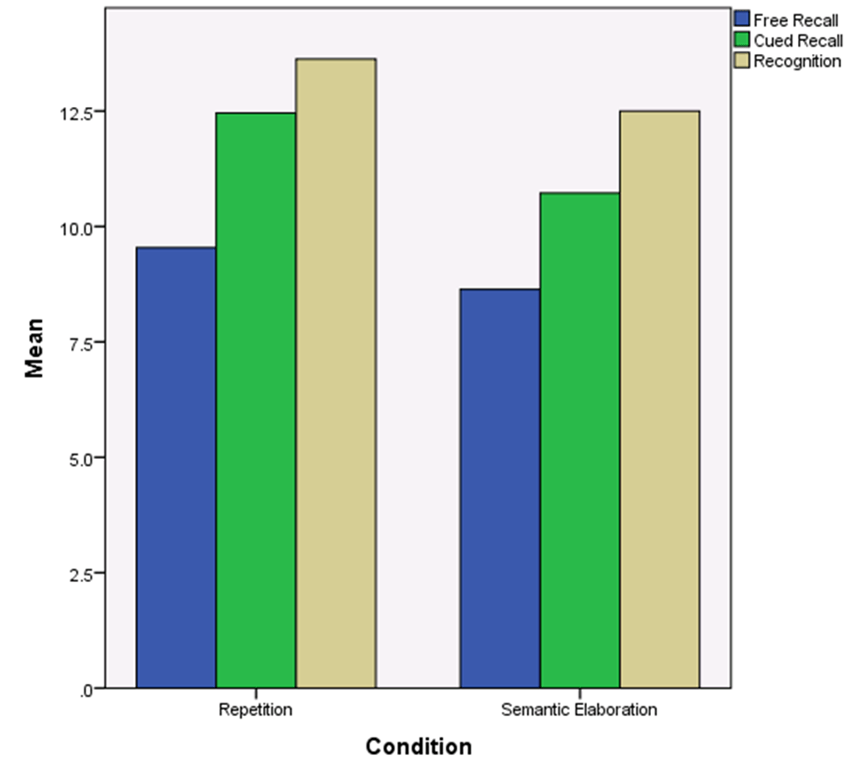
Data were analyzed using SPSS-PC version 22. An independent samples t-test was used to see if a difference in memory between participants who were exposed to word repetition and participants who were exposed to semantically elaborated sentence occurred. The results indicated no significant difference in memory between repetition (M=9.54, SD=3.43) and semantically elaborated sentences (M=8.64, SD=4.21) conditions when memory was measured using free recall, t(162)=1.471, p=0.143).  However, there was a significant difference in memory between repetition (M=12.46, SD=2.50) and semantic elaboration (M=10.72, SD=3.37) when memory was measured using cued recall, t(162) =3.621, p<0.001, and for memory between repetition (M=13.63, SD=1.54) and semantic elaboration (M=12.50, SD= 2.26) when memory was measured using recognition, t(162)=3.603, p<0.001. Based on these results, we can conclude our hypothesis was partially supported, as participants who memorized using word repetition recalled fewer words than participants who memorized using semantic elaboration when tested using cued recall or recognition measures, but not when they were tested using a free recall measure.

Discussion

As noted in the results section, a statistically significant difference was discovered between the results of the participants who participated in either the word repetition condition or the semantically elaborated condition. The results of this study partially support the hypothesis. Therefore, these results suggest the memory retention of words is best when given in a situation in which rich, concrete words are present. Making the word functional as opposed to merely repeating the word can help memorization. The results show what was anticipated: cued recall was the easiest for the participants. Free recall may have not had a significant difference due to the lack of stimuli, such as being presented with the line-drawn symbol in the cued recall portion of the experiment, to help with the retrieval process.

The results of this study are similar to those of Duyck (2003). In this study, participants were randomly assigned to one of three conditions. The three conditions were they were either given target words that were concrete, abstract, or non-words. The non-words were constructed to sound like real words. Once the experiment started, participants heard two words that consisted of one noun and one target word (either a concrete, abstract, or non-word). While the participants were being exposed to the words, they underwent articulatory suppression and repeated the word “the.” Upon the conclusion of the experiment, the participants then recorded the words they could recall.

Ultimately, Duyck (2003) found the participants who endured the articulatory suppression portion of the experiment still recalled a higher amount of words that were concrete. The non-words were recalled the least amount of times. Our studies are similar because both results support the connection between the richness of words used and memorization. While the participants in this particularly study did not undergo intentional articulatory suppression, experiencing articulatory suppression would undoubtedly cause a lapse in memory. However, although participants in Duyck’s study did recall less accurately in that condition, they still ultimately recalled more concrete words than the abstract and non-words. Therefore, Duyck’s study provides further support for our hypothesis.

Another study carried out by Madan (2014) looked into the connection between memory and high-manipulability words. The author hypothesized words were high in manipulability (i.e., words that signified objects that could be functionally interacted with) are easier to memorize than words with low-manipulability. Low manipulability words were described as words that represented nouns. Madan’s participants were undergraduate students. The participants were presented with eight word pairs, with each pair consisting of either two high-manipulability words, two low-manipulability words, or one of each presented in different sequences (HL, LH). As a distracter, in between presentation the participants had to answer simple arithmetic problems.

The results for Madan’s (2014) experiment supported his hypothesis. The words higher in manipulability were the easiest to recall for students. This was especially evident in the free recall portion of his experiment, which is different from the results from the current experiment. This is suspected because the free-recall portion of Madan’s experiment occurred after the cued-recall portion. In relation to this current experiment, Madan’s results support that automatic motor imagery influences memory. This is comparable to the results in the current study because the concept of semantically elaborated sentences improving memory is similar to high-manipulability words. In the semantic elaboration condition for the current experiment, the words were given context in the form of a sentence that related to the line-drawn symbol. Both encourage situations where relatedness is imperative, as well as elaboration.

While the hypothesis was supported for this experiment, there were several potential flaws in this experiment. One could be found in the sample of participants. Due to the sampling of college students, participants may have participated solely for the extra credit opportunity. In this case, data may be skewed due to disinterest in the study (Passer, 2014). The study may also have been performed quickly by the students without truly participating and putting forth the effort. The participants were also mostly female, which did not allow much diversity for gender within the study.

Another flaw is the experiment’s on-line nature. Because this experiment could be conducted from anywhere, environmental factors may take a toll on the participants (Passer, 2014). In some cases, if participants are at home they may have children or others around them that could cause a loss in concentration, which in turn would affect their memory ability. The participants also had the ability to read the background information of the experiment, which could allow the participants to understand the hypothesis. If the participants wanted to score well, they could easily have written down each word during the first phase of the experiment. This would result in a perfect score on the following three tests (free recall, cued recall, recognition), thus presenting false data. One final potential flaw was that although there was a relatively large sample of participants, only 70 of the 164 students were given the repetition condition. This means 93 students were in the semantically elaborated condition. This could explain why the average number of correct answers for the 70 students in the repetition condition was higher than those who were in the semantically elaborated condition.

In efforts to better this study in future cases, it may be beneficial to have participants come to a location where distractions can be eliminated. Monitoring the participants during the experiment would also be beneficial. If further studies are conducted, one may investigate getting a larger number of participants and having the conditions evenly distributed. However, maintaining the between-subjects design by only exposing the participant to one condition rather than both is critical to minimizing other confounds. This is because this particular experiment already contains three tests, and making the participant undergo each condition could result in fatigue or risk grasping what the hypothesis may be (Passer, 2014).

Because the hypothesis was supported in this study, further research on emerging programs that help children memorize words and learn to read more efficiently may be conducted. A new direction that may be explored could be creating experimental children’s books that specialize in teaching those who are between the ages of 1- to 3-years-old sight words. The books could use semantically elaborated sentences that focus on core words for children to know in order to effectively communicate with their caregivers. Because memorization of sight words is enhanced through these sentences, perhaps teaching toddlers these words could facilitate better learning skills — as well as discipline skills — as they age. Further studies may even evaluate the importance of learning sight words at an early age and the connection to the mastery of language in the later years of the child’s development.

This study’s hypothesis was supported by the data from the experiment.  The use of elaboration seems to be more effective with memory than repetition. Other research supports this hypothesis as well. Using these findings can be beneficial for many people including those in the teaching practice as well as parents. Further research may be done to enhance learning environments for developing children as well as for people of all ages.

References

Association Memory Test (n.d) Online Psychology Laboratory. Retrieved from http://opl.apa.org/Experiments/About/AboutAMT.aspx

Benson, E. (2003, July/August). Remembering right. Retrieved April 08, 2016, from http://www.apa.org/monitor/julaug03/remembering.aspx

Duyck, W. (2003). Verbal working memory is involved in associative word learning unless visual codes are available. Journal of Memory and Language,48(3), 527-541.

Jesse, A., & Johnson, E. K. (2016). Audiovisual alignment of co-speech gestures to speech supports word learning in 2-year-olds. Journal of Experimental Child Psychology, 145, 1-10.

Lee, B. Y. (2016). Facilitating Reading Habits and Creating Peer Culture in Shared Book Reading: An Exploratory Case Study in a Toddler Classroom. Early Childhood Education Journal.

Madan, C. R. (2014). Manipulability impairs association-memory: Revisiting effects of incidental motor processing on verbal paired-associates. Acta Psychologica, 149, 45-51.

Meltzer, J. A., Rose, N. S., Deschamps, T., Leigh, R. C., Panamsky, L., Silberberg, A., Madani, N. Links, K. A. (2015). Semantic and phonological contributions to short-term repetition and long-term cued sentence recall. Memory & Cognition, 44(2), 307-329.

Nilsen, E., & Bourassa, D. (2008). Word-learning performance in beginning readers. Canadian Journal of Experimental Psychology, 62,  110-116.

Passer, M. W. (2014). Research methods: Concepts and connections. New York, NY: Worth.

Figure 1. Mean number of words recalled in learning performance by the condition group.
 

Farewell to Darwin

Seraphim Hamilton

When I came to Summit ten years ago, I had just been “converted” to belief in evolution. In one sense, of course, all of us believe in evolution — it simply means life changes over time in predictable ways. What I came to believe in, however, was the Darwinian theory of evolution, namely, the idea all forms of life on this planet share a single common ancestor and the differences among these forms of life can be explained by random variation in an organism’s genome and higher rates of survival for those organisms that had acquired slight, beneficial variations. When I came to believe in evolution, I was an evangelical Christian. I didn’t know the Bible or theology very well, but I did believe in Jesus. At first, I saw no conflict between evolution and Christianity. After all, couldn’t God have created the world through evolutionary processes? Couldn’t Genesis 1 be an allegory, not unlike the parables of Jesus?

Since I didn’t see conflict between Christianity and evolution, I came to believe many people were turned off from Christianity because of the intellectual price of having to disagree with virtually the entire scientific community. Along with a natural desire to be right, this drove me to vigorously promote theistic evolution among my peers. Once everyone in my personal life was sick of hearing me talk about it, I started a YouTube channel (Kabane52) to promote evolution. Within a year, I had made over two hundred videos on the subject. It was my passion, as anyone who knew me at that time will remember.

Very soon, however, I began to realize evolution and Christianity were not as easily reconcilable as I thought. Not only that, I had found on the Internet all sorts of criticisms of Christianity. I had never considered the possibility I might be wrong about the Christian faith. Maybe evolution was true and Christianity wasn’t. Maybe the atheists were right. Such an idea terrified me, but multiple times, I came very near to atheism. In God’s providence, I soon discovered various Web sites and books devoted to demonstrating the historical believability of the claims of Jesus and the apostles about the Lord’s death and resurrection. If the resurrection was true, then Christianity must be true. I devoured Lee Strobel’s The Case for Christ and read a great many Internet articles about the subject. I began to debate the atheists with whom I had once made common cause against creationists. Christian apologetics became my new passion — but my questions about how to reconcile evolution with Christianity remained.

And they remained for years. Even after I had lost interest in evolution entirely, I still believed the evidence for it and against a global flood was very strong. I believed (and still believe) many popular creationist arguments against Darwinism were based on simple misunderstandings of the scientific data. So I stayed a theistic evolutionist. But time began to gnaw, and those questions kept coming back up. Here are three of the most serious issues that emerge in trying to reconcile Darwinian evolution and an ancient earth with Christianity.

First, there is the question of Scripture itself. Despite occasional claims to the contrary, the Church has always confessed the absolute inerrancy of the Bible, not only in doctrinal matters, but in historical details as well. St. Augustine, for example, says if he finds what looks to be a contradiction, he assumes he has either misunderstood the passage or there has been an error in copying one manuscript from another. St. Maximus the Confessor, one of the most influential theologians of the Eastern Church, goes so far to say the Bible expresses the truth of the eternal God as fully as text can express that truth. But the contemporary naturalistic account of origins doesn’t fit with what the Scriptures declare.

The most obvious conflict is between Genesis 1 and an ancient earth. Genesis 1 says God created the world in six evenings and mornings. With one or two exceptions, all commentators before Darwin took this passage historically. I tried to fit this passage with evolution in various ways. At first, I held a “day-age” view of Genesis 1. According to this view, the days described in Genesis 1 are not twenty-four hour days, but extended periods of time, comprising millions or billions of years. At a superficial level, this seems plausible. After all, the Hebrew word yom does occasionally mean “age” rather than “day.” In Genesis 1, however, this is an impossible reading. Each day is marked by an evening and a morning distinguished by periods of darkness and light. Moreover, the order of events in Genesis 1 do not follow the conventional scientific account of the world’s origins. For example, according to conventional science, birds appeared on the scenes long after land animals, having evolved from dinosaurs. Furthermore, the sun is created on the fourth day, after plants have been created. Conventional scientists, of course, say the sun existed before the Earth formed.

Some day-age interpreters attempt to argue the days are actually overlapping and the “creation” of the sun on the fourth day simply refers to it becoming visible after the dissolution of a permanent cloud-cover over the Earth. Frankly, such interpretations are so obviously strained it’s a wonder anyone can live with the cognitive dissonance. There’s no indication the days overlap, and that Israel’s work week is modeled on God’s proves definitively they do not. It would also be impossible to understand what constituted an evening and what constituted a morning on this view. So I had to abandon this view and try to find another.

The next view I took is a little-known reading of Genesis 1 known as the “Days of Proclamation” interpretation. According to this view, God’s own declaration of His intent to create occurs in six days, but the actual events of the creation occurred an indefinite time later. That is, it is a misunderstanding of the literary structure of Genesis 1 to see the actual events as transpiring within a single week. While this at first appeared to resolve the issues with the day-age interpretation, it soon became apparent to me this reading was fraught with even more problems. For one, it is clear in Exodus 20 the actual events of the creation took place within the creation week. The Lord does not simply say He “declared His intent to create” in six days before resting on the seventh. Instead, He states He actually created the heavens and the earth in six days and rested on the seventh. Additionally, it makes no sense to speak of a week of seven twenty-four hour days before the formation of the Earth within the framework of conventional science. This is because the days are marked as twenty-four hours in virtue of the Earth’s rotation. On the Days of Proclamation view, there was no such Earth to mark the days on the first day of the week!

The next view I took was a relatively new viewpoint, developed by evangelical biblical scholar John Walton. Walton’s view is ancient Near Eastern creation stories, including the story of Genesis, were not concerned so much with describing the material organization of the world. Instead, they were concerned with the ritual consecration of preexisting matter into a Temple. Walton notes in various ancient cultures, festivals for the dedication of the temple took six days, so the god would “rest” in the temple on the seventh day. He then reasons this is likely what is being described in Genesis 1. Out of the three explanations I have just listed, Walton’s is clearly the most defensible. Yet I realized even this view was massively problematic.

First, Walton’s strict distinction between material and ritual organization cannot be defended. Solomon’s Temple was built in seven years, clearly drawing on this pattern of seven for the construction of a temple.

Second, Walton’s view makes meaning ancillary to the actual world. For Walton, God creates the matter out of which the world develops ex nihilo and then allows it to develop according to the patterns he designed at the beginning of creation. However, it is not until God consecrates the world that created things are imbued with meaning. On the fourth day, we are told God made the heavenly lights in order to rule the day and the night and to mark festival times. This is why the Bible so frequently uses the symbols of heavenly lights to talk about political changes. Yet, this meaning is not artificial. God created the heavenly lights precisely to symbolize the rule of His Son over all things. Symbolism, then, is inherent in the world, not imposed onto it. This world is God’s world from top to bottom.

Third, and most problematically for Walton, the sequence of events in the speeches of Exodus 25-31 mitigate against his reading of Genesis 1. The tabernacle is a miniature world. Because of this, God dictates the instructions for the tabernacle in seven speeches, corresponding to the seven days of creation. Understanding these instructions can help us grasp the meaning of the creation days. We are told in Genesis 1 God created the “heavens and the earth” on the first day. The heavens refer to God’s throne room above the firmament, the earth refers to the matter God will organize in the six following days. If this interpretation is correct, then Walton must be wrong, because Genesis 1 describes the creation and organization of matter. In the first speech of the tabernacle instructions, all of the material for the building of the tabernacle is gathered together. In the six speeches that follow, this material is organized into a functioning sanctuary. Hence, Walton is incorrect. Genesis 1 refers to the creation of the material world.

Related to this idea is Meredith Kline’s “framework” view, that Genesis 1 is a literary framework designed to communicate the meaning of creation rather than to describe its history. In support of this contention, advocates of the framework view point to the literary correspondence of the first three days of creation with the second three. On the first day, God creates light, and on the fourth day, God creates heavenly lights. On the second day, He separates the skies from the oceans, and on the fifth day, God creates birds for the skies and fish for the oceans. On the third day, God creates grain plants and fruit trees, and on the sixth day, God creates man who will transform these plants into the sacramental foods: Bread, Oil, and Wine. The argument here, however, is a non-sequitur. I fully agree with the literary pattern I have just described. But this doesn’t mean the text isn’t historical! As I mentioned above, God is the God who created the world to reveal His truth. The meaning of the six days is contained in the historical creation itself, and the Holy Spirit inspired Moses to reveal this meaning in a rich literary structure.

As an analogy, consider the story of the resurrection of Jesus in John 20. According to John’s Gospel, Mary Magdalene looked inside the Tomb and saw two angels sitting on either side of the tombstone, and when she saw Jesus, she thought he was the Gardener. John doesn’t just tell us these things to give us brute facts. He is making a theological point. The order of the narrative of John follows the order of the furniture of the tabernacle, beginning with the Bronze Altar and Jesus identified as the sacrificial “lamb of God” and climaxing here, with the two angels in the Tomb corresponding to the two cherubim who carried God’s throne in the Holy of Holies. We are being told Jesus is the incarnate God who sat enthroned between two angels in the Temple. Likewise, we are told Mary thought Jesus was the Gardener because Jesus is, in fact, the Gardener. He is the true and Last Adam, the one who restores the Garden of Eden and glorifies it into a City. But neither of these theological truths mean the historical events didn’t occur! Mary really did think Jesus was a routine gardener, and there really were two angels inside the tomb. Because all history is God’s history, history itself contains theological meaning, and the biblical authors were inspired to reveal that meaning. This is why the Bible can teach us how to interpret the world and history.

These exegetical problems are true across the biblical text. A person who holds to conventional science cannot believe the Flood of Noah was global. Conventional geologists have supposedly refuted such an idea, and many Christian thinkers are trying to play catch-up. In order to reconcile conventional geology with the biblical text, I had to believe the Flood was local. The justification for this view was in the translation of the Hebrew word erets. This word is translated “earth” in Genesis 6-9, but it can be translated as “land.” Hence, it seems rather easy to make Noah’s Flood local. In reality, however, it is impossible. Not only does the text say “everything under the high heavens” was destroyed, its literary structure corresponds with Genesis 1, which no person doubts refers to the entire world. If one carefully studies the text, one will discover Genesis 7 actually reverses the creation week step by step, and it ends with the ark “floating on the face of the waters” just as the Spirit “hovered over the face of the waters.” Genesis 8, then, follows the creation days forward, starting with day one and ending with a Sabbath sacrifice offered by Noah. This literary structure reveals the meaning of the Flood story, but it also demonstrates decisively the Flood must be global.

On top of this, the long ages lived by the patriarchs of old contradict conventional scientific views of humanity. According to Genesis 5, before the Flood, it was normal to live to nearly 1,000 years old. In Genesis 11, those ages are cut in half, and then the Tower of Babel cuts these ages in half again. Since Peleg was named for the division of nations at Babel, we know the sudden shift in ages after Peleg corresponds with the Tower. After this, the ages gradually decline to present rates. Some have tried to limit the “problem” to Genesis 1-11, arguing there is a substantial difference in genre between Genesis 1-11 and the stories of Abraham, Jacob, and Joseph. In reality, however, if one rejects that which contradicts conventional science, then one continues to have problems in the patriarchal narratives. Abraham lives to 205 years old, and Jacob lives to 147! It is only with Joseph that ages begin to approach their present rates.

The basic conclusion is if one believes in the Bible, it is very difficult to agree with conventional science.

The problems, however, are not merely exegetical. They are theological. That is, they deal not just with the meanings of particular biblical texts, but with the structure of Christian theology itself. Christianity holds God created a world free of death and sin. Because all life comes only from God, in order for the creation to be free of death, it must be united with God. Man is the Image of God. That is, he reflects the glory and life of God into the world and the praises of the world back to God. The world was made as an infant world, but it was not made as a corrupt world. Man was supposed to grow in communion and relation with God and bring the creation up with him. Instead, Adam turned away from God, thereby cutting off the communication of life to the world. Hence, everything began to die, including man himself.

It is clear this poses a substantial challenge to the conventional account of Earth history. Evolution requires death to work. Certain individuals within populations must die selectively in order for beneficial genes to be passed on at higher rates. If there was no death for billions of years, nothing could have evolved at all. Furthermore, the fossil record is a record of dead things. If it was laid down before the creation of man, then death preceded the Fall. How does one explain death before the Fall if one believes in evolution and an ancient earth?

My first “solution” was simple: the death brought by Adam into the world was spiritual death, not bodily death. After all, salvation means for our soul to go to Heaven rather than for our bodies to. I soon discovered, however, this was a massive theological blunder. According to the Scriptures and the Christian faith, a human person is not just a soul. He is soul and body. This is why Jesus Christ was raised bodily from the dead. When He ascended into Heaven, He did not somehow abandon His human nature! Instead, by joining divinity with humanity, He made it possible for our whole persons to share in the life of God, body and soul alike. Thus, St. Paul speaks of our hope as the “redemption of our body” that will come at the return of Christ. Jesus speaks of us sharing in the “resurrection of life.” We shall have glorious bodies like His glorious body.

Death, then, must refer to bodily death.

The next solution was to try to argue the death described in Genesis 2-3 and Romans 5 was simply death for humans. The first humans would be apes to whom God gave souls, and they were promised immortality unless they sinned. This ignores, however, the fact Man is the Image of God. Because man is the Image of God, man reflects the life of God into the creation. The condition of man determines the condition of the world. This is why Paul says in Romans 8 the “creation waits with eager longing for the revelation of the children of God.” If man could live forever even while the world dissolved, why would it be any guarantee for the world that man will be raised from the dead? Paul’s argument only makes sense if man communicates the life of God to the world. If this is the case, however, then the curse of death pronounced on man necessarily includes the creation for the first time. Nothing died before man sinned. Nothing suffered before man sinned. Psalm 8 tells us man is the ruler of the cosmos. The hope of the cosmos is in man.

My final option was to argue man, indeed, is responsible for all the death and suffering in the world, even before his own existence. In order to argue this, I suggested Adam’s fall, in a sense, took place “outside of time.” When Christ returns, time will be transfigured into eternity, understood not as an endless sequence of moments, but understood instead as the instant reciprocation of all movements of love by one person to another. This is a technical theological point, but it has to do with the Trinity. God exists eternally, meaning not an infinite regress of sequential moments in the past, but the Son returns the love of the Father  as soon as the Father loves Him, and vice versa. Paul says in 1 Corinthians 15 God becomes “all in all” after the return of Christ. Everything becomes filled with Him, and this is the case with time itself. If this is the case, I reasoned, then it might be true the Fall does not stand in sequential relationship with death, but instead, stands “above it.” Adam’s mode of existence was different than ours and thus did not stand in the same relation with time. Unfortunately, this argument collapsed on account of its retrojection of eschatological time into the beginning. According to the Scriptures and Christian theology, God created the world to gradually grow up into His own fullness. This would be the case even apart from the Fall, since Adam and Eve were created naked: as spiritual babies. Eventually, they would become robed in glory just as God is robed in glory.

If this is the case, then, I could not argue Adam’s relation to time was the same as our own will be after the return of Christ. This would mean the world was in fact created mature, and our entrance into eternity is not only a feature of the world at its final stage. Since this is false, however, my account of Adam’s fall with respect to time must be incorrect.

One more set of theological problems emerged relatively late in my reflection on this issue. If one studies the cultures surrounding Israel, one will find they share many things in common with the worldview of the Old Testament. For example, all cultures surrounding Israel had temples and covenants. The temples often displayed profound similarities to Israel’s Temple in the Old Testament, including three sections referred to as a Courtyard, a Holy Place, and a Holy of Holies. The covenants made between nations and their kings read very much like the covenant between Yahweh and Israel recorded in the book of Deuteronomy. The difference, of course, was Israel was monotheistic while these pagan cultures were polytheistic and idolatrous.

The problem emerges as one considers how many conservative scholars interpret this pattern of similarities and differences. According to scholars like Wheaton professor James Hoffmeier, we need to see the Old Testament as a polemic against paganism. That is, God inspired the biblical authors to imitate the pagans in many things. The pagans were the first to offer sacrifices, the pagans were the first to build temples, the pagans were the first to make covenants. God is late to the party, as it were, and He imitates the forms of pagan culture. What this does, however, is render paganism to be the primary framework for human thought and religion. Paganism becomes primary, and the true pattern of religion and worship becomes secondary. This is a necessary way of viewing things if a person is a theistic evolutionist, because according to the conventional chronology of the ancient world, man began to build cities in 8000 BC, and Israel did not begin to exist until around 1700 BC with Abraham at the very earliest.

If one takes the Bible at its word, however, then the Tower of Babel occurred around 2000 BC, and Abraham was called only 200 years later. This necessarily means historians of the ancient world have incorrectly reconstructed ancient chronology. That is, they do not understand which people and events and cultures were contemporaneous with each other. A biblical view of history solves the problem described above, because we recognize Noah and his children knew the true God. There is much evidence people outside Israel continued to worship the true God, which I describe below. The similarities between Israel and pagan cultures is not because paganism came first. Instead, on a biblical framework, pagan religions are corrupted forms of the true religion given to Noah. Sacrifice began in Genesis 4, and Noah offered sacrifice. This is why people offer sacrifice not just in the Near East, but from ancient China to ancient America. Noah knew how to build a temple, and people across the world build temples with three parts: not just in Israel and its surrounding cultures, but as far away as Mesoamerica. Mesoamerican temples even display similarities with Egyptian and Near Eastern temples.

The only way, then, to vindicate the biblical view of human culture, where monotheism comes first and polytheism second, is to affirm a biblical and creationist view of history. As an evolutionist, I had no answer.

Thus, there was simply no solution at all to any of these problems. Theological problems were just as serious and insurmountable as exegetical problems. I was fully convinced of Christianity on other grounds, so I simply set the question aside, assuming there was an answer I had not yet discovered yet. I knew, however, I would have to deal with this eventually.

What first gave me real pause about the truth of conventional scientific theories as to origins was studying the theological writings of James B. Jordan. Jordan is not well-known, but I truly believe he is one of the greatest biblical scholars in the history of the church. Jordan understands the necessity of paying attention to all of the details in Scripture. Paul tells us not only is all Scripture is inspired by God, but also all Scripture is profitable for doctrine. Hence, every detail has theological meaning. What surprised me was Jordan was a young-earth creationist. Not only was he a creationist, but he affirms the importance of biblical chronology. The Bible, when it is carefully studied, actually gives us a complete chronology from the creation of the world to the coming of Jesus Christ.

Unfortunately, some Christians, even creationists, have stated there was no intent to provide such a chronology, and the genealogies of Genesis 5 and 11 might well have gaps. As Jordan pointed out, however, whether or not there are gaps in the generations, there are no gaps in the chronology, because the age of the father at the birth of his son is given. This makes it a chronological “lock.” But what struck me was how significant numbers theologically began to emerge when one took the chronology seriously. For example, exactly 3,000 years after the creation of the world, the Temple of Solomon was constructed. Exactly 1,000 years later, the Second Temple was destroyed in AD 70. The fall of the Second Temple marks the end of the Old Covenant, which began when God created Adam. The Old Covenant, in both its Noahic and Mosaic forms, was regulated by animal sacrifice, a central sanctuary, and distinctions between clean and unclean. When the Second Temple fell, this entire order ended, and the significance of this event is described in the symbolism of the book of Revelation, which mostly concerns this period. What is amazing is from the Creation to the fall of the Second Temple is precisely 4,000 years, or 100 generations. How could this be coincidence? God gave us this chronology so we can search out the meaning of history.

Even so, this discovery was nothing compared to what I found next. According to the Scriptures, Genesis 1-11 describe the history all humankind shares in common. If this is the case, one might expect all nations to have mythological traditions concerning this period of time. It had been my assumption this was not the case. It is widely known, however, Flood stories are one of the most pervasive features of mythological traditions. In a move of either ignorance or rank dishonesty, most contemporary biblical scholars explain the origin of the biblical flood story in terms of other flood stories circulating in the ancient Near East. For example, the Epic of Gilgamesh describes a global flood similar in many respects to the flood described in the Bible. Utnapishtim builds a boat, the gods flood the world, he sends a raven out near the end of the flood, and he offers sacrifice after he emerges from the ark. Noting these similarities, many biblical scholars say the story of Noah is derived from the story of Utnapishtim in the Epic of Gilgamesh.

If the Bible is telling a historical narrative, however, then one should expect other cultures to have memories of the global flood. There is a way to test which explanation is correct. If flood stories similar to the biblical story are distributed across the planet, then the best explanation is the flood is a historical event. It is common knowledge such stories are distributed across the planet, but the most common explanation is simply “floods happen everywhere.” What I discovered when I began to read the stories themselves, however, is this explanation is completely insufficient. If these many stories originated independently, then one should not expect detailed, particular similarities. But we find such similarities. For example, the Cree tribe of American Indians in Canada tell of a global flood, at the end of which the flood hero sent forth a raven and a wood pigeon, obviously similar to the story where Noah sends forth a raven and a dove. The Hawaiian tradition calls the flood hero “Nu’u” and describes how he offered a sacrifice to the gods after emerging from his ship, just as Noah did after emerging from the ark. The same is true of literally thousands of flood stories around the globe. The similarities are too specific and detailed to be the result of chance.

Recognizing this problem, some critics have attempted to explain the prevalence of flood stories around the globe by pointing to missionary influence. But this is clearly desperate. Some of the stories are far too paganized and corrupted to be the result of missionary influence, while still displaying similarities to the biblical story. One Mesoamerican flood story records some persons offered a sacrifice to the gods that displeased them, leading the gods to turn some people into monkeys. This is plainly a corrupted form of the original biblical story, but it is too corrupt to have been the result of hearing the story from missionaries. Furthermore, are we really to believe missionaries vigorously preached the story of the Flood across the globe, leading literally all cultures to tell stories of a global flood? This problem is intensified by the fact we know such stories were circulating before missionaries, even outside the ancient Near East. For example, we have an Old World Indian flood story from 700 BC, displaying many particular similarities to the biblical account.

Other difficulties abound. For example, across the Southeast United States, Indian tribes tell flood stories which feature, not a bird, but an otter emerging from the boat near the end of the flood. The otter descends to the bottom of the sea and brings forth land. This is true across hundreds of miles in the America Southeast. It is close enough to the biblical story to require some sort of genetic relationship, but explaining this relationship by missionary influence is impossible. In order for missionary influence to explain it, independent missions to many different Indian tribes would need to generate local variations on the narrative of the flood. Each of these tribes would then need to corrupt the story in the exact same way. This defies all probability. Much simpler is the explanation this particular “otter variant” of the flood story derives from a much earlier Native American account of the Flood that had changed the raven to an otter. As the tribes spread across the American Southeast, each carried this variant with them.

I was simply stunned at the force of this evidence. I had never truly grasped the weight of the argument from flood stories before. But there was even more to discover. I found this situation is true across the stories of Genesis 1-11. For example, the story of the Tower of Babel is remembered across the planet. Some Aboriginal Australian tribes, for example, tell of a story of a great tree which was blown over by a gust of wind, after which all nations were confused in languages and scattered across the planet. Native American tribes tell the same story, including the great gust of wind. Indeed, as one looks across the planet for stories of the origin of languages, one finds these two pervasive features: something tall, such as a tower or a tree, and something like a blast of wind. Interestingly, the blast of wind is not recorded in Scripture. Where, then, did it come from?

The Jewish historian Josephus independently transmits traditions about the biblical narrative not recorded in Scripture. He tells us one night, God sent a miraculous gust of wind that destroyed the Tower of Babel. When people awoke, they found they could no longer understand each other. We therefore discover not only do people groups remember the story of the Tower of Babel, but also the traditions they remember included additional historical information about the Tower not given to us in Scripture. The same is true of the creation of man: one Native American tribe remembers God made a woman from the dust of the ground, put her to sleep, and made a man from her side!

And the same is true of worship of the true God Himself. Winfried Corduan, in his book In the Beginning God: The Case for Original Monotheism, critiques the prevailing view of the origins of religion. Most anthropologists argue without evidence polytheism and animism precede monotheism. The evidence, however, indicates otherwise. When anthropologists study tribal cultures, they often find despite the practice of animism, the cultures transmit secret and highly guarded traditions of a creator God who is the supreme lord of the world and who once communicated with these tribal people. Sadly, they remember at one point he ceased communicating with them. Christian missionaries often find tribes have a prophecy of a day when missionaries will come and restore knowledge of the true God.

But it’s not just true in tribal cultures. When we study the ancient world, we find all ancient cultures originally worshiped the one true God. The original religion of ancient China focused on One God, whom they called Shang-Ti, the Emperor of Heaven. Shang-Ti was kind, loving, just, and merciful. This is significant, because pagan gods do not have these attributes. Pagan gods in many cultures are capricious and much more interested in themselves than they are in man. But this is almost never true for the high god in these cultures. When colonists arrived in the Americas, some of them found Algonquin tribes worshiped a person whom they called the “Great Spirit.” The Great Spirit loved mankind, commanded men to love one another, ordained one man and one woman marry for life, and had once send a flood to punish the world for its evil. Here is a story the Skokomish tribe of Washington state recites, as summarized by Mark Isaak, a critic of creationism:

The Great Spirit, angry with the wickedness of people and animals, decided to rid the earth of all but the good animals, one good man, and his family. At the Great Spirit’s direction, the man shot an arrow into a cloud, then another arrow into that arrow, and so on, making a rope of arrows from the cloud to the ground. The good animals and people climbed up. Bad animals and snakes started to climb up, but the man broke off the rope. Then the Great Spirit caused many days of rain, flooding up to the snow line of Takhoma (Mount Rainier). After all the bad people and animals were drowned, the Great Spirit stopped the rain, the waters slowly dropped, and the good people and animals climbed down. To this day there are no snakes on Takhoma.

Whenever we study tribal and cultural traditions, we find their own cultural memories correspond with the history described in Genesis 1-11. Genesis really does tell the true history of mankind, even though modern man has forgotten it.

Still, this left me with one issue, the most difficult of them all: namely, the scientific evidence. Contrary to the beliefs of some creationists, the case for evolution and an ancient earth is not stupid or worthless. Arguments for both deserve to be taken seriously. Even though I am a creationist today, I am still a critic of most creationist arguments, for the simple reason most creationist arguments are bad. It is very important for our credibility as Christians we be careful which arguments we use and which arguments we do not use. Consider one argument: evolution contradicts the second law of thermodynamics, because the second law of dynamics states “everything tends toward disorder.” This is problematic for a number of reasons. First of all, “disorder” is not being used in its colloquial sense, but in a technical sense meaning differences in temperature are exploited in order to accomplish motion, what physicists call “work.” Second, the law does not state everything tends toward disorder at the same rate. Instead, given the universe as a whole is a closed system (something which I do not accept), the order in the whole system will decrease. However, the distribution of energy in the universe changes constantly, so there can be localized increases in order.

Likewise, the concept the entire fossil record was laid down by the Flood of Noah is untenable. This does not explain the particular order of fossils we discover in the ground, especially for what paleontologists call Cenozoic, or Tertiary rocks. Paleontologists divide the Earth’s history into three periods, corresponding to three different layers of rock. There are Paleozoic, or Primary rocks. These contain fossils from the Precambrian and before. Above this are Mesozoic rocks, containing fossils from the Cambrian to the end of the Cretaceous, when the dinosaurs are understood to have gone extinct. Finally are Cenozoic, or Tertiary rocks, where we find mammals, most birds, and ourselves. The difficulty with the older creationist view that all of these rocks were laid down by the Flood is we only find humans at the top of the rock layers, and we find remnants of human civilization, which would be completely wiped out by a global Flood. Why do we only find humans at the top?

Two issues ought to be distinguished. First is the issue of evolution by means of mutation and natural selection. In contemporary science is a small movement of scientists following the “Intelligent Design” movement. These scientists do not necessarily reject common descent, but do believe life exhibits features of design. I found that, despite widespread criticism from mainstream scientists, many of these proponents of design make an excellent case. Michael Behe argues much cellular life exhibits evidence of “irreducible complexity.” That is, such life is composed of a great multitude of parts, but remove even one of those parts, the entire system ceases to function. Since natural selection operates by small, slight modifications, it is difficult to explain how such systems could have evolved directly.

Evolutionary scientists such as Ken Miller have noted ostensibly irreducibly complex systems such as the flagellum do have precursors, but those precursors did not operate as a flagellum. Miller cites the Type III Secretory System, which uses only ten parts of a forty-part flagellum. While it does not operate as a flagellum, it does function as a mechanism for injecting poison into other cells. Behe has responded in two ways. First, the evidence indicates the Type III Secretory System actually descends from the flagellum and not the other way around. Second, it is nigh impossible to explain how a system could move forward by natural selection if it changes function each time it acquires a new part. If selective pressure is refining a particular system, it is refining it with respect to a particular function. Miller’s argument, while sounding persuasive on the surface, has little depth. I found in actual debates with proponents of Intelligent Design, evolutionary scientists did not have as clear as an edge they claimed in the public square.

This still left the most significant scientific issue: the age of the earth. Sadly, many arguments for a young earth simply do not stand up to scrutiny, and are made by people with little to no familiarity with the scientific literature or the scientific evidence. We Christians need to have a better standard than this. We have no reason to fear. All truth is God’s truth. If we are rigorously committed to the truth, then we will find far better arguments than if we are not.

What I discovered, however, was a modern movement of a different kind of creationist scientist. These scientists are interested in doing science because they want to study God’s world in the light of what God has spoken in Scripture. Instead of being motivated by a desire to “refute evolution,” they were committed to formulating a coherent model that could describe the world in creationist terms, leading to productive insights. Furthermore, these scientists were critical of older creationist work which took a disrespectful, polemical tone against those who disagreed. Included in this group are scientists like Kurt Wise, Leonard Brand, and Todd Wood.

Kurt Wise, educated in paleontology at Harvard University, is one of the most creative thinkers in the modern creationist movement. He noted the sequence of plants in the fossil record was exactly what evolution would predict. Plants began at their shortest and least complex and gradually became taller and more complex. He noted, however, the order of plant fossils also described an order of plants that lived in the sea to plants that lived in the land. Asking whether any such ecological order was present in the modern world, he realized this order is exactly what one finds in “quaking bogs.” A quaking bog is a small, floating mat of plants that becomes thicker as one moves toward the center. In the center, one finds trees that actually grow on this mat and whose roots extend into the water. The roots, therefore, are not deep, but extend below the mat and expand outwards. Kurt Wise discovered the order of plants in the fossil record reveals before the Flood was a massive quaking bog the size of a continent, which Wise calls the “floating forest.” Indeed, the trees one finds in the fossil record are actually hollow, which made them lighter and more able to float on this large mat. While hollow trees are extinct today, other sorts of hollow plants have survived in quaking bogs. Furthermore, the well-known “fish-with-legs” fossils are found in this context. These appear to be, not evolutionary transitions, but animals that lived on the floating forest and were thus capable of walking around on the plant mat and swimming below its surface.

Scientists associated with the RATE project have also made substantial progress in understanding why radiometric dating methods tend to give old ages. Radiometric dating works by measuring the relative amounts of certain chemicals in rocks. “Radiometric decay” is one chemical gradually turning into another chemical over time. This occurs at a constant rate, so if one sees the relative amounts of the chemical in a rock, one should hypothetically be able to find when the rock formed. However, whenever radiometric decay occurs, helium is released into the rock. Helium is a leaky chemical, meaning it escapes the rock relatively quickly. A certain amount of radiometric decay will always generate a certain amount of helium. Hence, if all of this radiometric decay occurred millions of years ago, it should nearly all be gone. If it happened at a different rate a few thousand years ago, there should be a predictable amount of helium left in the rocks. What the scientists working on the RATE project did is to take these rocks and predict precisely how much helium should be left in them, given the creationist model. They published the predictions before receiving the results of the experiments, and then they sent the rocks to secular labs so secular scientists could do the experiments. The creationist prediction was confirmed with flying colors.

The same is true with respect to the decay of our magnetic field. Our magnetic field is decaying at a particular rate. Given the present rate of decay, the magnetic field would be prohibitively strong just 20,000 years ago. In order to deal with this conundrum, secular scientists have developed a “dynamo” theory of the magnetic field that allows for its strength to increase and decrease over time. Reversals of the polarities of the magnetic field, in this model, can only occur over a period of about a thousand years. Russell Humphreys, a creationist physicist, developed an alternative model for the magnetic field, based on a young age for the earth. According to Humphreys, the magnetic field is generated by the circulation of electrons in the mantle of the earth. Humphreys’s model allows for reversals of the field to occur in as little time as two weeks. When he developed the model in the 1980s, he predicted short-term reversals of the field would be observed. Only a few years later, his predictions were confirmed. Additionally, NASA published predictions about the rates of planetary magnetic fields given the dynamo model, which would then be measured by the Cassini-Huygens spaceprobe. Russell Humphreys published predictions based on his own model shortly afterwards. When the measurements were made, NASA’s predictions were falsified and Humphreys’s were confirmed.

I further discovered problems with older creationist models were not true of newer creationist models. Take the issue of the entire fossil record being laid down by the Flood. Contemporary creationists no longer believe this. Instead, they argue the Paleozoic layers were laid down before the Flood, largely on the third day of creation, the Mesozoic layers were laid down in the Flood, and the Cenozoic layers were laid down as the Earth rocked back from the geological upheaval of the Flood. This is evidenced by the fact many of the so-called transitional fossils are found in the Cenozoic. There is actually a good series of horse transitional fossils. However, creationist biologist Todd Wood has developed a model for extremely rapid diversification of animal and plant life after the Flood. According to Wood, God created all “kinds” (called a baramin in creationist literature) with natural potentialities for diversification. There are various “switches” in the animal that turn on and off certain features. God made life so it could develop and change, but the mechanism of this change is not primarily mutation and natural selection. Wood’s argument accounts for much of what we see in the late fossil record, and this newer model of the Flood solves many of the older problems with Flood geology.

None of this is to say creationist scientists have solved all of the problems with young-earth models. Not by a long shot. But it is to say the amount of progress made by traditional Christian scientists, given their small number and relative lack of funding, is impressive, and is very promising as to the ultimate profitability of a scientific model faithful to Scripture.

The paradigm shift I have experienced has been profound. While I most certainly believed in Jesus while I accepted evolution, accepting evolution prevented the full realization of a thoroughly Christian worldview. A fully Christian worldview accounts for beauty, and asserts the reason for the form of plants and animals is not simply survival value, but its aesthetic value. A fully Christian worldview does not make paganism primary. It asserts human history begins with true worship of the true God, and it begins again with the renewal of that worship under the Second-Father, Noah. Coming to accept creationism has led to a profound reconfiguration of my worldview, and happily, it has led to the dissolution of virtually all doubt about the truth of Christianity. The sun really shines, the birds really sing, God really loves me and Jesus truly rose to renew all things.

How glorious are thy works, O Lord. In Wisdom hast thou made them all.