Monthly Archives: May 2022

Twilight Struggle

Matthew Nalls

A work of true skill and inspiration, Twilight Struggle is a two-player board game that simulates the silent war between the two great superpowers of the United States of America and the Union of Soviet Socialist Republics. The illustrated board game incorporates events from the early stages of the Cold War to the later stages of the war during the course of the game in due chronological order.

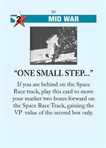
The game incorporates these events through action cards that are used to dictate the flow of the game. These cards can help or hinder each player, as some cards work toward the sole benefit of the USSR player, the US player, or both. Examples of such cards are “Allende,” “CIA Created,” and “‘One Small Step…”’ respectively. Allende, a Socialist physician, was popularly elected in the country of Chile to lead its first socialist government. When played, this card grants two “influence” to the USSR in the country of Chile on the map. Influence points determine control over the war and the regions on the board. Hence, the card is a USSR benefit card, as the card essentially gives USSR influence in the region. Likewise, “CIA Created” is a US-benefit card, as the card recounts the creation of the Central Intelligence Agency. This card allows the US to put one “influence” on the board, and see the opponent’s hand. This card works exclusively for the US, as the CIA was not a Russian organization. The converse would be considered for “Allende.”

Unlike these two kinds of cards, other cards benefit either player. On July 20th, 1969, Neil Armstrong became the first man to step foot on the moon. During this, he uttered the unforgettable phrase, “That’s one small step for man; one giant leap for mankind.” The “‘One Small Step…’” card signifies the work put in by NASA to catch up to Soviet technologies regarding the Space Race in order to land a man on the moon. This card allows the player to catch up two spaces in the Space Race part of the game. Therefore, it can benefit either player.

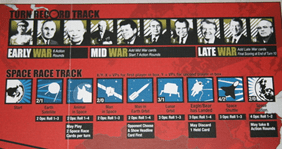
The Space Race is its own course made up of several achievements. These achievements include “Animals in Space,” “Man in Space,” “Lunar Orbit,” and ultimately “Space Station,” among several others. To move along this path, one must either discard a card or obtain a Space Race-specific card. These achievements benefit the player, as the majority give Victory Points to the first player to land upon them. These Victory Points ultimately decide the outcome of the game, as the first player to reach twenty Victory Points “wins” the Cold War. This is not as easy as it sounds. If the US player is at five Victory Points, and the USSR player earns five Victory Points, both players are not at five Victory Points. Rather, the USSR player has just reeled the US player back to zero Victory Points. This would be the same case even if the roles were switched.

Along with detailed and historically-accurate cards, Twilight Struggle also incorporates “initial influence.” For the US and the USSR, at the beginning of the game, both sides already boast influence in certain countries. This “initial influence” is a reflection of the power each side wielded in certain regions during the early stages of the actual Cold War. Furthermore, to preserve the chronological accuracy of the war, certain cards cannot be played until certain stages of the game. As Allende took power over Chile in 1973, his card is not available until the game progresses to the “Mid-War” stage of the game. Until such stage of the game, “Allende” and other “Mid-War” cards are not available for play. Similarly, “Late-War” cards are not available until the respective stage is met as well.

Regarding detail, historical and chronological accuracy, and incorporation of key events, Twilight Struggle sets high standards for other board games. Although not every part of the Cold War could be fit into the game, such is understandable and not unexpected. Twilight Struggle still provides a thorough retelling of the Cold War through the game-changing cards it does include.

As for the excitement and player enjoyment factors, I had the special privilege of playing renowned board game passionatus Mr. Rush in two exciting practice rounds. In both rounds, I opted to play the role of the USSR in their struggle against the “free” filthy capitalist pigs. The first practice round took time; however, this was understandable as it was necessary to become accustomed to the processes of the game. When grown accustomed, the game soon took off in a tense, back-and-forth exchange. Repeatedly, it became necessary for me to reel the US back to zero Victory Points during the round. The outcome of this round is not of importance.

The second practice round was one of emotions ranging from determination, excitement, disappointment, and disdain. At the tail end of the “Early-War” stage of the game, the US was boasting a significant lead in Victory Points. Fortunately for the USSR, I possessed a “scoring card” which would attribute numerous Victory Points to the USSR for domination in a region. During the beginning of the round, I strategically allocated certain amounts of growing influence in the South American region. With this scoring card in hand, I was prepared to return the war back to even terms. Unfortunately, a small-font, hidden, between-the-lines, tucked away rule prevented the USSR from a major comeback. This ultimately led to a miserably disappointing defeat, or so I thought. In blinding reality, my opponent ruthlessly cheated during our game, which was a key factor of this defeat. The “UN Intervention” card is a specialized card that can help either player. The card allows one to discard another card in his hand, and use the operation points from the card without triggering the event. My opponent misled me, and wrongly interpreted this respective card. Rather than nullifying a card in his own hand, he used “UN Intervention” to nullify a card I played that round, and mercilessly utilized its operation points. As a result of this, game-changing cards were nullified on several occasions, ultimately leading to the untimely demise of the USSR.

Nonetheless, upon the completion of our two enjoyable games, I had come to an appreciation for the game. Twilight Struggle boasts strategy, history, drama, and excitement all in one bundle. The game does not take hours to churn out an end result, nor does the game “zip by” before one realizes the game is actually completed. The game’s creators had the goal of enjoyment in mind, and they achieved this goal with marked skill and detail. My personal experience was so enjoyable I have taken up playing the game online with others across the globe on the website “Chantry.” I highly recommend this game for both casual and committed board game players, and especially for those looking for a fun and exciting, yet simple game.

19th-century Doctors of America

Matthew Coats

Doctors of the modern world have what doctors of the past would call a luxury. Doctors have offices in which to meet, unlimited access to tools to be effective at their job, and the knowledge of modern medicine, which makes their practice much easier to execute. Doctors of prior centuries would have dreamed of such “luxuries.”

Doctors of the 19th century mostly carried out their medical practice in private homes or occasionally an office. They had no status and received very little training. Although there were many hospitals, during the time of the Industrial Revolution, they were considered dirty and indeed they were. Although many would go to hospitals to be healed, many left with a new illness or died. Patients contracted diseases because doctors didn’t understand how diseases spread. Many who could afford it would have the doctor come to the privacy of their homes. Doctors worked everywhere and not just to the confines of their office or department. A doctor was expected to treat any illness including animals and travel on any terrain. This was highly inefficient. Because all doctors were expected to treat all the same things, they never specialized in anything. The idea of specialized doctors only came after about a century of this inadequate system. Although this system wasn’t very effective, doctors still continued to learn; specialized tools and procedures were developed leading to doctors eventually specializing in broad areas of medicine.

During the 19th century, doctors traveled by foot or horseback. Because of this, they were limited to the amount of tools and drugs one could carry in his hand-held bag or saddlebag.  Due to the combination of limited tools and drugs, and the expectation of a doctor to treat a wide variety of ailments, the quality of care was poor. Examinations and treatments were all done in the patients home. Examinations were general observations of the patient’s body using a stethoscope to monitor the condition of the heart, lungs, and digestive track. The most popular treatment available was called bleeding the patient. There were many ways to bleed a patient, and it was done repeatedly over a short period of time. Other principle treatments included specific diet instructions, rest, baths, massage, blistering specific areas of the body, sweating, enemas, purging through use of diuretics and emetics like ipecac, and prescriptions such as anti-inflammation creams or herbal pills.

Another procedure carried out in the patient’s home was surgery. Surgery was limited to the surface of the body and the tolerance of pain of the patient. Anesthesia was not commonly used and what was used was usually chloroform, which presented risk of asphyxiation. In addition to this, the risk of infection was extremely prevalent due to the environment. In the United States, anti-septic was not common until the turn of the century, so the risk of infection from any surgery was high.

19th century doctors, like today, charged patients per procedure. They may have charged more depending on if it was an emergency in the evening or if it was a childbirth. A big difference in 19th-century doctors and modern doctors is 19th-century doctors were not usually paid in cash but “in kind.” This was whatever produce or goods was available to the patient.

The doctors of the 19th century were not as well-off as modern doctors. Doctors who served the poor barely made a living and the doctors who served the rich made an average living. There were three different groups of doctors: the “orthodox,” homeopaths, and eclectics. Orthodox doctors practiced based on natural philosophy and experimental science. Most of their remedies were harsh like bleeding or high dosages of mercury, which today are deemed lethal. Homeopaths believed in administering drugs in small dosages. They believed diluting the drug would make it more effective. They strongly pursued medical research and scientific testing. The last group, eclectics, combined the practice of using herbal medicine with the traditional practices of orthodox doctors. Although they used some of the same treatments as orthodox doctors, they strongly opposed their methods.

Near the end of the 19th century, medicine started to solidify into a united organization. The American Medical Association was established for this purpose in 1847. The founders made it their main priority to establish minimum requirements for medical training. The minimum requirement was four years of high school and four years of medical school and passing a licensing test. Along with this, physicians started to take their job more seriously and took on more responsibility. The American Medical Association implemented the code of ethics. The underlying principle of the code of ethics is stated in chapter 3, section 4:

It is the duty of physicians to recognize by legitimate patronage to promote the profession of pharmacy on the skill and proficiency of which depends the reliability of remedies, but any pharmacist who, although educated in his own profession, is not a qualified physician and who assumes to prescribe for the sick, ought not to receive such countenance and support. Any druggist or pharmacist who dispenses deteriorated or sophisticated drugs or who substitutes one remedy for another designated in a prescription ought thereby to forfeit the recognition and influence of physicians.

From the start of the American medical association, medicine became what we know today. Medicine started to progress quicker, doctors were valued more, and the quality of research improved. Although 19th-century doctors didn’t have the luxuries of modern medicine, they paved the road to make modern medicine possible.

Bibliography

“19th Century Doctors in the U.S.” Melnick Medical Museum. 2009. Web. 02 Mar. 2016.

“Browse History.” Judy Duchan’s History of Speech. Web. 02 Mar. 2016.

The Argentine “Dirty War”: Emergent Themes Despite Heart-Wrenching Disappearances

Nicole Moore Sanborn

Argentina’s “Dirty War” began in 1976. Accounts of the “disappeared” have left a generation of Argentinians searching for answers. At the hands of General Videla’s regime, in camps such as “The Little School,” human rights violations reminiscent of concentration camps in Nazi Germany were forced upon “subversives.” The Little School by Alicia Partnoy heartbreakingly recounts her disappearance to and survival within “The Little School.” Despite the Videla regime’s rise to power, atrocities committed, and the regime’s effects today, powerful themes of humanity, suffering, consciousness, resistance, and compliance emerge from sources like the Mothers of the Plaza de Mayo and Partnoy’s work.

The Videla regime responsible for the “Dirty War” came to power through a coup. Peron, once a beloved president, fell from grace and was exiled, after which the military came to power. Two leftist groups, the Monteneros and the ERP, emerged from the urban sector to combat repressive military rule. In an effort to end the conflict, Peron returned to Argentina and was reelected. In 1974, Peron died, and Isabella (his third wife and vice president) rose to power. The military took advantage of Isabella’s inability to rule, and controlled her. In 1975, the military passed the “Annihilation Decrees” to allow the repression of left-wing subversives, such as the Monteneros and the ERP. The Argentine Anticommunist Alliance (AAA) was formed with the intent to search and destroy guerilla groups, starting state-sanctioned violence in Argentina. General Videla rose to power in 1976, and the “Dirty War” began. From 1976-1983 the military government gave themselves broad powers to “stabilize” the nation and “eradicate terrorism” by whatever means necessary. Videla’s regime, in an effort to eradicate subversive ideas, sanctioned the “disappearances” of anyone suspected of treason. The “disappeared” were taken to places like the Little School, concentration camps seeking to break people’s spirits and get information. The Monteneros and ERP were heavily targeted. The disappeared were usually young and usually male, but that did not stop the regime from taking pregnant women. Those seized were simply “disappeared,” and families had no way of knowing the state of their loved ones. Petitions were filed. The Mothers of the Plaza de Mayo formed. Approximately 30,000 people were “disappeared,” and now Argentina cries, “never again.”

The regime’s effects, especially of devastation and pain, are demonstrated in the film The Disappeared and in Partnoy’s accounts of her survival. Cesar, born in a concentration camp to a “disappeared” woman, tells his story in the film The Disappeared. Cesar was raised by the maid of a military leader and not told about his history, but he searched and found the truth. Cesar eventually found his extended family, which never truly forgave those who raised him. If Cesar had found his family sooner, he may have met his recently-deceased grandmother, a family member may not have battled addiction, and the family would have been more stable. Also, Partnoy dedicates her book to her brother Daniel, “for whom life became so absurd that he decided to take his own.” The regime altered the lives and families of countless Argentinians.

Despite a tendency for people to negate the humanity of captors and captives as a coping technique, Partnoy sheds light on their humanity. In The Little School, Partnoy writes of her conversations with captors and captives. She references the prisoners and guards by name. Many of the guards went by nicknames, such as Chiche, Abuelo, and Chamame. In “The One Flower Slippers,” Partnoy notes the “guffaws” of the guards at the concentration camp when they noticed Alicia did not have shoes. Partnoy records a conversation she had with Vasca, another captive, about her new slippers that only had one flower. Laughter and conversation are signs of life and humanity. Later, in “Benja’s First Night,” Partnoy notes how Vasca asked for water and was brought water, but when Benja asked, he was beaten, showing the prisoners’ basic human need for water. Partnoy hears guards beating Benja for simply asking for water, and she writes, “The guards feel almighty, yet for some reason I believe he’s afraid: deep down he must have some memory of justice.” Instead of brutalizing and dehumanizing the guard who beat Benja, Alicia acknowledges his emotions and memories. She believes the guards act almighty because they are scared of what the regime will do to them if they are disloyal, and wonders in her mind if they have lost their humanity and knowledge of justice. Partnoy reminds readers of the humanity of all involved in the Dirty War so people will never forget the atrocities humans are capable of inflicting on other humans and to deeply move readers.

The Little School juxtaposes resistance and compliance. The prisoners resist the torture and the breaking of their spirits and minds, but their bodies comply and break. “Telepathy” provides a clear example of Alicia’s resistance and compliance. Her mind resists the breaking of her spirit when she says, “The following day I tried it [telepathy] again…. I woke up alarmed because I couldn’t remember where I had left my child for her nap. I opened my eyes to a blindfold that had already been there for twenty days.” On the same page, she notes how she received so many orders, such as, “Lie down! Hurry Up! Get out!” and talks of peace. “I didn’t have any peace now either, just the hope that there still remained a share of air for me to breathe in a future freedom.” Her mind hopes for the future, and she attempts telepathy to communicate with her family, remember her daughter, and maintain her spirit. Partnoy’s body complies with guards’ orders, but her mind flies freely, away from her situation. The tormentors fail to break her spirit entirely. In addition, the “Madwomen of the Plaza de Mayo” text references the mothers’ resistance to their children “disappearing” by signing petitions to pressure Videla to bring their children back, yet they comply to police orders to maintain their peaceful, yet angry, protest by separating. Consistently, those who fought the Videla regime resisted in their hearts and minds, yet complied with police orders.

Suffering and consciousness are also juxtaposed in the film The Disappeared and in The Little School. Cesar remembers considering suicide at ages 9-10. Cesar lived with a constant fear of consequences for resisting his caretakers. From an early age, he was conscious he did not fit in with his family. His suffering and consciousness of his own identity ultimately bring him to uncover the truth and find his real family. In The Little School, one particular quotation stands out as Alicia recalls her suffering and consciousness. Partnoy writes in “The Small Box of Matches,” “I hope that what really matters to me is to be whole…meanwhile, I’m being destroyed.” Her body is being consistently destroyed through torture, lack of hygiene, water, proper food, and being blindfolded. Alicia’s small box of matches keeps her fake tooth, knocked out when she hit the iron fence at the Little School. She keeps her tooth, because it is a part of her, and she wants to be whole. Alicia is conscious of her intense desire to keep her tooth, and considers whether she is only holding onto it so she has a belonging, or if she truly and innately desires to be whole again. Consciousness and suffering are constantly juxtaposed in Partnoy’s text, as the prisoners’ bodies and spirits are suffering, yet they are consciously aware and occupy their minds with thoughts of better things, so as not to entirely succumb to the breaking of their spirits.

The Argentine Dirty War brings to light human rights violations and fierce atrocities. The film The Disappeared, Partnoy’s The Little School, and the “Madwomen of the Plaza de Mayo” all illustrate from first-hand accounts the atrocities of the Dirty War, revealing details historical overviews alone can never tell. The Dirty War, though painful to study, must never be forgotten. The effects of the Videla regime will continue forever for families of the “disappeared ones,” and we, as historians and as humans, must never allow such atrocities to happen again.

The Warsaw Ghetto Uprising

Chris Christian

Introduction and Thesis

Of all of the atrocities committed against the Jewish people throughout history, none can compare in magnitude, brutality, or is beholden of such hate as the Holocaust throughout the Second World War. It is also startling when taken into consideration of the fact the Jewish people met such hate with so little resistance, one could also say apathy, to their own fate. Through much of the Holocaust, the deportations, the concentration and death camps, the slave labor squads, the fear, torture, and death that surrounded all of these elements, almost nowhere except in Warsaw does one find resistance.

The rising in the Warsaw ghetto was not a nationalist movement on behalf of the Polish nation. It was not initiated by any patriotic sentiment, nor was it undertaken on the behalf of any state. The Jews in the ghetto did not rise on behalf of their Jewish faith, as many in the ghetto differed on particulars regarding this faith. The Jews who formed their own combat organizations for the uprising were desperate people caught in an unbelievably desperate situation, whose struggle for survival up until that point went on largely unaided and unheeded by any outside force or influence. These Jews, these people, human beings like we are human beings, were imprisoned in the ghetto by an outside force and left to die. Hate would be met by fear and then this fear would turn to anger. The rising was an attempt to strike back at an oppressor, to meet the hate with anger and hate. The goal was to hit back, as much as they were capable of doing so despite their desperate circumstances and against all odds.

Creation and Purpose of the Ghetto

The Warsaw ghetto was a creation of the Nazi leadership in occupied Poland. Occupied as early as the end of 1939, Poland’s new Nazi masters started to implement measures against the Jews just as they had similarly done to previously annexed countries, such as Czechoslovakia and Austria. The ghetto in Warsaw itself was evidently created to provide the Germans with a cheap, easy way to dispose of Poland’s Jewish population at the beginning of the war. “The Warsaw Ghetto was officially created on October 2, 1940 by a decree issued by Dr. Ludwig Fischer, Governor of the Warsaw Distrikt.”1 The German plan was to deposit Jews from around Poland into the ghetto, especially Warsaw’s own numerous Jewish population, and allow them to die of hunger, exposure, and extreme poverty by isolating the Jews. Emmanuel Ringelblum, a ghetto resident and leader in the uprising, in his notes from the ghetto asserts his own belief the ghetto served as a collection point for all of Poland’s Jews. “What was their motive in introducing the Ghetto? One opinion has it that they wish to concentrate all the Jews of Poland in four places: Warsaw, Crakow, Kielce, and Radom.”2 Ainsztein, in his book about the ghetto uprising, later supports this assertion and adds the Nazi’s purpose, which Ringleblum could have only guessed at from inside the ghetto:

The chief purpose of the Nazi policy of starvation was of course, the annihilation of the Jews imprisoned in the Warsaw Ghetto. Ludwig Fischer, the Warsaw District Governor, stated … “The Jews will die from hunger and destitution, and a cemetery will remain of the Jewish question.” … At a meeting of Governor-General Frank’s [the governor of Nazi occupied Poland] cabinet held on October 15 and 16, 1941, SS Brigadeführer Wiegand, the Warsaw Distrikt SS and Police Leader, pointed out that hunger prevented the Jews from thinking of resistance and [this view] met with Frank’s whole hearted agreement. 3

Not only was the method of isolated starvation assumed to be effective enough for the Nazis, but they also assumed that in such a state, the Jews caught in the ghetto would be unable to plan any sort of resistance to being imprisoned in the ghetto.

Population and Setting

Ainsztein provides us with population figures for the Warsaw ghetto both prior to the Great Liquidation, a period in which mass deportations of the ghetto’s population to the Treblinka death camp took place, and after this period just prior to the uprising. For now it is important to note the population figure prior to the mass deportations, along with who made up this population, and what conditions they faced at the ghetto’s onset. Prior to the Great Liquidation, Ainsztein reports “it is certain at its peak the ghetto population exceeded 500,000 — some put it as high as 550,000 — and that this total included in April 1941 as many as 150,000 refugees, many of them from Łodz, and entire communities deported by the Germans from the provincial towns and townlets of the Mazowsze Region [a region in central Poland].”4 The space comprising the ghetto at this time was not large, and would get smaller within the next two years as deportations took place until the rising occurred. By this time the ghetto was “[s]urrounded by a wall sixteen kilometers long and 3 meters high, which was topped by broken glass and barbed wire.”5 As Ainsztein has asserted, the population was mixed by region and even religious faith, but was predominately ethnically Jewish. For the Nazis, eligibility for transfer to the ghetto was based on ethnicity: “the ghetto became a concentration camp for Jews and also for several thousand Poles of Jewish origin that [sic] is for people who had cut off their connections with the Jewish people by becoming Christians or whose only link with the Jewish was a single Jewish grandparent.”6

The whole population was conveniently overseen by the “Jewish Police” on the Nazi’s behalf. Vladka Meed, a Jewish underground member who aided the uprising in the ghetto, provides insight on the Jewish Police’s role in the ghetto:

The Jewish police were now very important people in the Warsaw Ghetto. The Nazis relied on them to carry out their roundups, to control employment cards, and to load unemployed Jews into the wagons and transport them to the waiting railway cars. Obviously no one was very fond of the police; even in better days they had been known to badger and harass people in their daily lives by insisting on rigid adherence to the Nazi regulations, now they had become even more hostile and aggressive.7

The Nazis used the Jewish police inside the ghetto to do their dirty work for them, creating division and tension within the ghetto.

Food Rationing in the Ghetto

As time progressed, in an isolated state, the ghetto began to experience food shortage, just as the Nazis had planned. The Nazis had complete control over rationing to the ghetto, as well as the economic situation inside the ghetto. The Nazis purposely made food acquisition almost impossible on a day-to-day basis for people inside the ghetto. The Jews who legally resided in the ghetto were allotted two kilograms of bread (4 lbs.) and 250 grams of sugar (one-half pound) per person per month. This bread was usually of poor quality, containing sawdust or potato peelings. Any attempt to supplement the allotted food ration by purchasing extra food was almost impossible because the prices were fixed unfairly for Jews versus Poles and Germans. The Jew paid 5.9 zlotys per calorie, the Pole 2.6 zlotys, and German 0.3 zlotys. Typically a German received 2,310 calories a day, a Pole 634 calories, and a Jew in the ghetto, only 184 calories daily.8 The effects of the manipulation of rationing are made apparent in Janusz Korczak’s (Jewish doctor who headed a children’s orphanage in the ghetto) diary, where he touches on the monthly weigh-in results for the orphans at his orphans’ school:

The day began with weighing the children. The month of May has brought a marked decline. The previous months of this year were not too bad and even May is not yet alarming. But we still have two months or more before the harvest…. And the restrictions imposed by official regulations, new additional interpretations and overcrowding are expected to make the situation still worse.9

The population of the ghetto would face gradual starvation just as the Nazis had planned.

Class Divisions in the Ghetto

Food shortage and rigged economics also enabled the Nazis to count on various segments of the ghetto population to cooperate with them more fully. The divisions between the cooperative few and left out majority clearly became class divisions. Those who were on the Germans’ good side got to eat, the rest did not. As Ainsztein asserts, the several thousand Jews who ran workshops for the Germans, and several hundred smugglers or others who had deals with the Nazis or Poles, were viewed by the rest of the ghetto population as corrupt. They were able to afford the high prices for food, even on luxuries like grapes and oranges.10 Further divisions arose between German Jews and people of Jewish origin who were not practicing or orthodox in their views concerning their faith. “The divisions inside the ghetto were further exacerbated by the presence of 6,000 Poles of Jewish origins, many of them renegades and Judaeophobes, and German Jews, who showed a general propensity for regarding themselves as being in temporary exile from their fatherland. A number of them were used by the Gestapo as informers.”11 Jewish cooperation was an absolute necessity for the Nazis in intelligence gathering, as it was only through cooperative contacts with those inside the ghetto that roundups could effectively take place in order for Jews to be deported.

Effects of Epidemics in the Ghetto

Another significant tool in the Nazis’ arsenal against the Jews, conveniently heightened by conditions in the ghetto, were epidemics, particularly of typhus. Ringleblum expressed his concerns in regard to typhus’s increased appearance within the ghetto and the amount of deaths he had heard the typhus had been responsible for:

Another subject that has been absorbing our attention for a long time, is that of epidemics, particularly typhus. … Instead of combating typhus, the “sanitation columns” [columns of laborers who disinfected the ghetto] spread it … the lice move freely all through the Ghetto. The overwhelming majority of typhus cases (some people maintain that there are about four or five thousand such) are concealed. The German health department speaks in terms of some 14,000 cases. The houses [where the typhus cases are concealed], are not disinfected; the lice carry the typhus from there all over Warsaw.12

The typhus, along with starvation, was expected by the Nazis to do their work for them, but in case starvation and disease were not enough the Nazis had another alternative, deportation.

Labor in the Ghetto

Deportation ultimately meant death at a death camp outside the ghetto and Warsaw. The main grounds for deportation, besides being Jewish, or suspected of being Jewish, included being unemployed. If you weren’t able to retain legal employment in some fashion useful to the Nazi war machine you faced the fearful and uncertain prospect of being deported. Vladka Meed (a member of a Jewish resistance group in the ghetto) spent much of her time throughout the Great Liquidation searching for legal work along with all of the rest of the population in the ghetto. The obstacle they faced in acquiring work in order to avoid deportation was the Germans were more interested in deporting as many Jews as possible, as opposed to employing as many as possible, therefore the Germans made it almost impossible for Jews in the ghetto to acquire jobs.

Every Jew who wished to remain in Warsaw, or in other words simply wished to survive, must be legally employed. “Each morning after the curfew had ended, lines formed at the closed factory gates. The earlier you got there, the closer you got to the door, the better your chance of being admitted. Those not waiting in line scurried about in search of a job — any job — the key to survival. Every day new workshops were opened — sometimes without a permit.”13 The Germans used employment cards to control the number of legal employees possible throughout this period.

They also controlled the work areas themselves. The number of work places available was tightly controlled despite early Jewish attempts to open workshops in order to provide work for everyone possible. The Jews also attempted to forge employment cards to sell to one another. Meed describes the effects of the forged cards: “As soon as anyone put a few sewing machines into a couple of vacant rooms and began issuing employment cards, Jews stormed the doors. We snatched at straws. Scalpers forged employment cards and sold them at exorbitant prices. A job was a precious commodity to be sold to the highest bidder.”14 The reason jobs were bought and sold was because there really weren’t enough jobs to go around. Scalpers and forgers made money to supplement their rations by selling employment cards. Business and workshop owners would have been interested in producing a product for the Germans to buy from them and provide jobs at the same time. The goods they produced earned these business and workshop owners the money they needed to buy extra food and survive.

The German answer to these Jewish counter tactics was liquidation of Jewish workshops and factories, which were replaced by a few tightly-controlled German factories. Meed’s account describes this liquidation:

Private Jewish factories were systematically liquidated and their workers deported. Some employment cards, including many of those issued by the Judenrat [German appointed council over the Jewish population in the ghetto], were no longer recognized by the Germans. The cards I had obtained became worthless within a few days. Only persons employed in German factories were eligible to remain in the ghetto. All other Jews were now required to appear at the point of embarkation when ordered to do so.15

The Nazi goal was to employ as few Jews as possible in these German factories and workshops and to deport as many Jews as possible without jeopardizing the German establishments.

The Great Liquidation

Meed was present in the ghetto throughout the Great Liquidation period, which roughly began in late July and early August of 1942 and did not end until mid-September of 1942. It was a harrowing time for her as she searched for work, experienced the loss of her sister and mother, as well as many friends, all of whom were sent to their deaths at Treblinka. Meed accounts the systematic liquidation of the ghetto, which was preceded in each stage by decrees declaring when and where in the ghetto specific populations were expected to move to the Umschlagplatz, the point of embarkation to Treblinka:

The “Little Ghetto” [the smaller southern portion of the ghetto] was to be “liquidated”; all Jewish inhabitants of the southern section beginning with Chlodna Street [a street on the north end of the “Little Ghetto”] were ordered to vacate their homes within the 24-hour period between August 9 and 10, 1942. Only those without employment, including relations of those working for the German firms, were ordered to report to the Umschlagplatz on Stawki Street. Anyone without a job found in the Little Ghetto after the deadline would be shot on sight.16

After liquidation of this small southern section of the pre-uprising ghetto the Germans targeted the industrial sectors of the ghetto, liquidating the competing Jewish firms, so only the German ones with their Jewish slave workers remained. This move was also preceded by a decree “ordering everyone to vacate certain streets by August 20. German workshops were to be concentrated in certain sectors, where the workers would be provided with living quarters. Employees of German enterprises were not permitted to leave the areas assigned to them. If they were found elsewhere, they would be ‘resettled.’”17 Without any Jewish firms to supply unemployed Jews with jobs more Jews in the ghetto would be unemployed and therefore useless to the Nazis. Any Jew in the ghetto who was unemployed was a prime target for potential deportation.

Meed also asserts the Jews of the ghetto had some ideas as to where the deportations ultimately led. Word leaked into the ghetto about Treblinka and similar death camps and the fact these camps were the destinations for deportees. Meed describes the general attitude at first amongst the Jews as being solely a nervous fear, almost anxious, in regards to “resettlement” and “deportation.” Most seemed inclined to take measures to avoid being caught and ride it out:

Hour by hour, the Nazi dragnet spread out, until it had reached nearly every house in the ghetto. Gone was the illusion that the deportations would soon end; no longer was there talk of a limit of sixty or seventy thousand Jews. At first we had counted the days, hoping forlornly that the deportations would shortly be over. But now we accepted as fact that the harsh decree would not be rescinded.18

Meed and her fellow Jews met the deportations with an “every man for himself” attitude, an attitude stifled by the time of the rising. Soon after the first several roundups, people in the ghetto began to figure out what was really going on from escapees who had jumped from the trains. There were even people specifically sent to find out what was going on and where everyone was being brought. Ringleblum notes Treblinka as a destination for deportees along with what was happening there: “Treblinki — the news about the gravediggers…the Jews from Stok who had escaped from the wagons…the unanimous description of the ‘bath,’ the Jewish gravediggers with yellow patches on their knees. — The method of killing: gas, steam, electricity.”19 Rumor was spread throughout the ghetto concerning where deportation really lead, and with this rumor went fear.

Aftermath of the Great Liquidation

The idea of resistance would sadly not begin to enter in the minds of those trapped in the ghetto until the Great Liquidation began to come to an end. This caused a considerable problem for them regarding the number of people available for resistance. When the Jews of the ghetto did begin formulating plans for resistance, they realized their numbers were now much fewer than they had been before the Great Liquidation, subsequently it was debated amongst them whether resistance could be effectively undertaken at all. Ainsztein reports The Great Liquidation officially ended on the twelfth of September in 1942. It is estimated roughly 310,332 Jews had been rounded up and sent to their deaths at Treblinka. Besides these, it is believed 5,961 Jews were murdered outright inside the ghetto during the Great Liquidation. On the Day of Atonement it is believed an additional 2,196 people died, after having been packed into cattle trucks and driven straight to Treblinka’s gas chambers. The Germans conducted a census of the ghetto in October of that year in which 35,639 Jews registered, but it is believed there were probably really as many as 60,000 Jews still left alive in the ghetto.20 This new population figure shows a big difference from the previous population figure of roughly 500,000 in April of 1941. Ainsztein believes on top of these figures, one could add a further 10,000 people. These additional 10,000 people factor in later refugee additions that arrived in the ghetto in November and December, along with additions in the form of escapees from the death camp trains. This would mean the population would have been at roughly 70,000 people just before the uprising.21 The Warsaw ghetto was also significantly smaller in size after the Great Liquidation. Scholars like Ainsztein generally divide it into three separate areas for this time prior to and throughout the uprising. There was the central ghetto or Rhestghetto (German for Remnant Ghetto). There was also the Brush Workshops, an area unto itself due to its being comprised of the Brush workshops and the living quarters found in the quadrangle formed by four separate streets. There was also the Factories Area, where the firms of Toebbens, Schultz, Roerich and Schilling were situated, along with their living quarters and factories.22 The smaller size of the ghetto, viewed from a military standpoint, would make any military operation’s window of opportunity smaller for the Jewish fighting organizations than it would for the might of the German war machine. It also stood to benefit the Jews, however, as it was easier to figure out what was going on in different parts of the ghetto, and made defensive operations and getting from place to place easier.

Formation of Resistance Organizations

There were two main fighting organizations in the ghetto. By the end of October 1942, the various parties that had laid aside their political and religious differences to form the Anti-Fascist Bloc had met and formed the Zydowska Organizacja Bojowa (Jewish Fighting Organization or ZOB). The ZOB was composed of members of Hashomer Hatzair, Dror, Gordonia, Akiba, Poale Zion (various Jewish political and religious groups) and even members of communist groups. The Anti-Fascist Bloc also formed a unified controlling committee for the ZOB, the Zydowski Komitet Narodowy (Jewish National Committee or ZKN).23 For this paper’s purposes it is only necessary to focus on the ZOB fighting unit, as it was the largest and most important of the two. Despite being made up by political entities and members of various political groups, it was clear from the ZOB’s written declaration concerning its function that neither formation was pursuing any set political end. The formation of combat groups was done to provide Jews with an alternative to meekly meeting their deaths and make the Nazis pay for their actions. The declaration on ZOB function and purpose ran as follows: “(1) Resistance in case of another deportation under the slogan: ‘We will not surrender a single Jew.’ (2) Terrorist actions against the Jewish Police, the Jewish Communal authorities and the Werkschütze (factory police). (3) An active struggle against the workshop managers, foremen and known and secret Gestapo agents in the name of the defense of the Jewish masses) [sic].”24 Essentially, for these organizations and their members, one another’s defense mattered before any state, political ideal, religious faith, or specific tenet of Judaism. Resistance would be carried out by those who wanted to make the enemy pay as dearly as possible on the behalf of as many others as it was possible for these groups to do so.

Arms Acquisition

Having formed a secret army of dedicated volunteers, the ZOB needed arms to carry out its operations. Arms could only be acquired by purchase, usually through underground contacts from the Polish underground resistance forces. In order to purchase arms the Jews in the ghetto needed cash. Ainsztein reports the ZOB first acquired its cash resources through donations from wealthy backers in the form of cash, jewels, and other goods. As these donations proved to be not enough, the ZOB resorted to confiscation of such items from the corrupt ghetto police, smugglers, and oppressive factory owners.25 The ZOB even resorted to threats and violence to get its funding: “When Maksymilian Lichtenbaum, the Chairman of the Judenrat [governing council for Jews overseen by the Nazis] who was known for his hostility to the underground organizations, refused to pay a contribution of 50,000 zlotys, the ZOB took his son hostage and released him only after his father paid up.”26 While Ainsztein provides only one such example, probably only known to him due to its audacity and daring, he does indicate how much was collected for arms purchase from the Polish resistance, putting it at about 10,000,000 zlotys by the time of the rising.27 Although a considerable sum in Poland during those days, it had little purchasing power, especially if such money was in the hands of Jews. According to Ainsztein, standard prices for arms differed between what the Polish Home Army paid and what the Jews paid, with the Jews shelling out more for each weapon and the ammunition available for sale than did their Gentile Polish counterparts. Typically, for example, the Home Army paid roughly 3,000 zlotys for a pistol and a clip of ammunition, for the same the Jews were asked up to ten or even twenty thousand. The Home Army paid less for rifles (4,000 zlotys, for the Jews 20,000-25,000), grenades (100 zlotys, for the Jews 1,000-1,500), and heavy machine guns (12,000 zlotys, for the Jews 40,000).28 The impressive sum gathered by the ZOB dwindled rapidly, with little received in return for their money.

Previous Jewish Apathy

It is a reasonable question to ask, why did the Jews in the ghetto not resist from the outset, or at least when the Great Liquidation began in earnest? The answer is not simple, but some explanation can be provided by Alexander Donat, who was trapped in the ghetto with his family and was present during the rising in 1943. Donat survived to face the tragedy that befell the ghetto after its first successes in resistance. Donat and his wife and son miraculously survived the Great Liquidation, the rising, and the rest of the Holocaust to be equally miraculously reunited after having been separated. Donat describes the general Jewish response to the Nazis in the ghetto:

The feeling we had for the Germans cannot be oversimplified into hatred. Hatred we felt, but the chief emotion was terror. We couldn’t think of the Germans as human beings. They were mad dogs unaccountably loosed from the chains of history and morality. You don’t hate a beast of prey, you feel loathing and terror. We feared the Germans with a dreadful, paralyzing panic stronger than the fear of our own deaths.29

This absolute terror can explain, to some extent, one’s apathy toward suspected or certain death, as well as the deaths of those around him, to the point hiding or avoiding the Germans and the terror they brought seemed preferable to resistance. As things normalized in the ghetto after the Great Liquidation, this feeling acquiesced, being replaced by more hate and anger. Meed accounts for this dramatic change in attitude amongst those who survived the deportation period: “A spark had been smoldering even during the ‘peaceful’ days of the ghetto. Now it began to glow, slowly, tentatively at first, then ever more fiercely: ‘If it is our fate to die anyway, then let us die with dignity! Let us resist and make the enemy pay dearly for our lives!’”30 This spark did in fact glow, and the anger made people determined such a thing as the Great Liquidation would not occur to them again without a fight.

Preliminary Resistance and Defiance

Before actual pitched battles took place, the ZOB thought it expedient to attempt elimination of certain key players in their enemy’s system of operations. They selected targets they could reasonably hit. On August 25, 1942, Israel Kanal, a member of Akiba, (a group part of the Anti-Fascist Bloc) also at this time a member of  the ZOB, broke into the head of the ghetto police’s home, a notorious man named Szerynski, and shot him in the shoulder with a revolver. Szerynski survived the shooting, but later committed suicide in the hospital during his recovery.31 Along with this assassination attempt, later in September, on the sixteenth, members of Hachmer Hatzair and Dror, (groups part of the Anti-Fascist Bloc) now incorporated into the ZOB, fired several warehouses full of war materials the Jews of the ghetto had been making for the Germans.32 Meed accounts on both occurrences, as such things were followed closely by the population in the ghetto: “…cases of arson in the German warehouses were becoming more frequent…. More electrifying was the attempt on the life of Yosef Szerinski, commandant of the Jewish Police, a man utterly detested in the ghetto.”33 Meed also accounts for another assassination attempt: “An attempt to kill Schmerling, a German collaborator of the Jewish Police, also failed. But the first signs of active Jewish resistance had emerged.34 And so they had, but further momentous action would not take place until January of 1943:

On the night of January 17th, acid was thrown at a German Werkschützmann [factory policeman] at Hullmann’s furniture shop. The guards there arrested a young worker, Zandman, who belonged to the Fighting Organization [ZOB]. They found a bottle of acid on him, and were about to turn him into the Gestapo when a group of masked men…entered the shop. At gun point, they bound the guards and destroyed their records, then left with Zandman….”35

These are just some of the examples of Jewish preliminary resistance and defiance.

Nazi Response to Defiance

Fiercer resistance occurred as deportations were again attempted by the Germans, and actual battles occurred between ZOB groups and police, German soldiers, or guards. Meed describes one such battle:

That was when the shooting began. The mass of deportees fell upon the German troopers tooth and nail, using hands, feet, and elbows. There was shooting and a pitched battle ensued. The Germans were caught off balance, became confused. By the time they realized the seriousness of the situation, and had increased their fire, practically all of the group of deportees had escaped and found shelter in the nearest buildings.36

This was the first battle of the rising, successful in that most of the deportees had escaped, so caught by surprise were the Germans at the fact they were actually being resisted. Ainsztein argues this action by the deportees sparked reaction by the Nazis. It would be decided complete liquidation of the entire ghetto would now be certain and necessary. Himmler (head of the SS) chargeed Krueger (head of SS in Poland) with the task of deporting all the remaining Jews in the ghetto. Krueger appointed Dr. Ferdinand von Sammen-Frankenegg with the completion of this task directly. SS and police commanders developed a plan that called for low amounts of force to be utilized in their efforts to keep German interests in the ghetto safe.37 Ainsztein further argues this plan, with its use of low force measures for deporting the remainder of the ghetto did not sit well with Krueger. Krueger ended up selecting a special expert on partisan warfare to aid Frankenegg. Krueger selected SS Brigadenführer Jurgen Stroop to utilize brutal force in the ghetto to perform the roundups. Stroop had gained his experience by going through the ranks of the SS, starting out as a sergeant, and serving as Colonel of Police in the Sudetenland (eastern region of Czechoslovakia) after the German annexation of Czechoslovakia. Stroop saw experience in initiating terrorist activities to cow submission of dissidents in Poznan-Poland (a city in Poland) after its occupation.38  For these reasons Stroop was selected, his expertise in terror more fully in line with Krueger’s concept of the deportations. Sammern-Frankenegg’s new plan (formed with Stroop’s assistance) was much different, undertaking the appearance of a full-scale military operation. “After surrounding the ghetto walls with machine-gun positions and stopping the movement of trams in the ‘Aryan’ streets bordering the ghetto walls, Sammern-Frankenegg planned to move into the ghetto with a strong force, establish himself with his men in Zamenhoff Street and from there send small detachments into the other streets with orders to round up the inhabitants.”39 The new plan was simple and direct and conducted accordingly.

The Warsaw Ghetto Uprising

The subsequent resistance faced by the Germans occurred from the onset of the new rounds of deportations. The Jews were cognizant of what was about to take place in the ghetto. The Nazis were seemingly incompetent enough to let the Jews know their plans by various means. The Jewish intelligence was effective in determining German plans, but only because the Germans were betrayed by those working for them, and because they remarkably betrayed themselves. Ainsztein makes this claim about the Nazi intelligence failure:

Jewish intelligence sources outside the ghetto were able to discover what was being prepared by the Germans because not only the special extermination force, but the entire German garrison in Warsaw had been alerted to deal with a possible general uprising…. Furthermore, the Polish friends of the ZZW [a smaller Jewish combat organization that often collaborated with the ZOB] had their agents in the Polish police, which had been mobilized to take part in the liquidation of the ghetto, and from there they were able to get detailed information on the plans of the Nazis.40

The Germans also betrayed themselves and their intentions further when, as Donat accounts, Himmler himself came to the ghetto. “On January 9, Heinrich Himmler [head of SS] and his staff inspected the Ghetto. An armed group of SS officers led by Police Chief Odilo Globocnik, protected by small armored cars bristling with machine guns, escorted the SS Chief as he raced through the streets. His inspection took only minutes, but we all knew what it meant: Himmler had last visited the Ghetto in July.”41 Donat fell ill during much of the period before the rising, but he sums up the events that had occurred in January in his memoirs. Donat points out the changes in the attitudes of the Jews in the ghetto about how to face the threat they constantly faced from day to day.

Six thousand people perished in the January roundups, but this time the Germans paid in killed and wounded. We were a changed people now. We had no more illusions about German plans for us. … Ghetto dwellers made proud pilgrimages to places where blood on the snow marked scenes of successful Jewish resistance. The self-pity and resignation which had marked us after the cauldron was burned away; we were now living torches of revolt.42

Up until this point, the resistance staged by the Jews in the ghetto was mostly defiant in nature. This resistance did save lives and live up to the stated purpose of the ZOB, but it was not resistance against an organized foe. The resistance quickly became such, as the Germans became determined to stifle such defiance with brutal force. Under Stroop, the Germans implemented their plan to deport and exterminate the remaining population of the ghetto. Jewish intelligence gatherers outside the ghetto walls, as well as sources from the police, warned the ZOB about this attack launched on April 19, 1943.43 Gutman reports the German force during the campaign, met with the uprising of the ghetto’s inhabitants, amounted to 2,054 troops and 36 officers daily throughout the uprising. They were accompanied by 381 SS troops, 335 Ukrainian troops, and Polish policemen. They were armed with rifles, light and sub machine guns, heavy guns, an artillery piece, and three armored cars.44 Gutman also provides figures for the Jewish forces. The forces made up by the Jewish resisters amounted to roughly 750 combatants from the ZOB and other organizations that operated in concert. These forces met the Germans with revolvers; each fighter carried a few hand grenades, and carried about ten to fifteen rounds of ammunition. They had at their disposal ten rifles, some two thousand Molotov cocktails (a hand-thrown incendiary, usually of homemade make), and a couple of submachine guns captured from the Germans.45 The Germans were surprised by the resistance they encountered, usually in the form of surprise attacks by stubborn Jewish defenders firing from buildings or makeshift bunkers. Donat describes the attack on the ghetto:

They [the Germans] put rows of Ghetto police [Jewish Police] in the front ranks, convinced that the defenders would not fire on fellow Jews…. Our fighters let the Jewish police go by, but when the German troops passed, they let loose a barrage of bullets, grenades, and Molotov cocktails…. One homemade incendiary set a tank afire, burning the crew alive, and spreading panic and disorder among the Germans.46

Donat also describes how the Germans had to bring artillery to bear: “The field artillery…opened fire on the Ghetto from no man’s land, and the shelling continued throughout the day.”47 Donat also accounts for the second repulse of German forces, this time by well-armed Jewish fighters of the ZZW (a small combat organization acting in concert with the ZOB), who met the Germans with fire from a well-positioned machine gun and with rifles and grenades. This attack occurred  the second afternoon of the uprising, and resulted in the Germans withdrawing in the early evening with heavy casualties.48 Having faced the Jewish combat groups twice in an effort to enter the ghetto in force, the Germans had to withdraw to more secure areas on the fringes of the ghetto. The Germans decided instead of facing the armed groups of Jews in a street-by-street encounter, they would simply burn them alive in the ghetto. Donat describes how the Germans went about this: “Wehrmacht [German Army] engineers were brought in and moved methodically from house to house, [as they had been captured from Jewish defenders] drenching the ground floors and wooden staircases with gasoline and setting fire to them while simultaneously hurling explosives into cellars and basements.”49 The Jews of the ghetto would face extermination by fire. Donat also movingly and sarcastically describes the Warsaw populations’ reaction to the final end of the ghetto. The rising was winding down to its final moments, and by Easter Sunday, April 23,1943 the ghetto was in flames:

Mass over, the holiday crowds poured out into the sun drenched streets. Hearts filled with Christian love, people went to look at the new unprecedented attraction that lay halfway across the city to the north, on the other side of the Ghetto wall, where Christ’s Jewish brethren suffered a new and terrible Calvary not by crucifixion but by fire. What a unique spectacle! Bemused, the crowds stared at the hanging curtains of flame, listened to the roar of the conflagration, and whispered to one another, “But the Jews — they’re being roasted alive!” There was awe and relief that not they but the others had attracted the fury and the vengeance of the conqueror.50

Conclusion

The Warsaw Ghetto Uprising and the defiant resistance prior to the uprising were direct reactions to brutal Nazi hate. The Jews of the ghetto did not rise on behalf of Poland. They did not rise on behalf of their Judaism. Their Jewish religion and, more importantly for the Nazis, their Jewish ethnicity were simply the reasons they were imprisoned there. The Jews of the ghetto rose to strike back at an oppressor. As Meed had earlier asserted, the Jews rose to die, but to die with dignity and make their enemies pay.

The Jews of the ghetto banded together despite their differences. They overcame political differences with the formation of the Anti-Fascist Bloc. They unified despite religious differences concerning Judaism. This is evident in the formation of both the Anti-Fascist Bloc and the ZOB statement of purpose, which underlined its function to protect all Jews in the ghetto. The Jews of the ghetto were unified because of their oppression, stayed unified throughout the conflict to which they had committed themselves, and died in unity with dignity and weapons in their hands.

Endnotes

1 Ainsztein, Rueben. The Warsaw Ghetto Revolt. New York: The Holocaust Library, 1979. 1.

2 Ringleblum, Emmanuel. Notes From The Warsaw Ghetto: The Journal Of Emmanuel Ringleblum. New York: Schocken Books, 1974. 124.

3 Ainsztein, The Warsaw Ghetto Revolt, 3-6.

4 Ibid., 2.

5 Ibid., 2.

6 Ibid., 1.

7 Meed, Vladka. On Both Sides Of The Wall: Memoirs From The Warsaw Ghetto. Trans. Dr. Steven Meed. New York: The Holocaust Library, 1979. 26.

8 Ainsztein, The Warsaw Ghetto Revolt, 2.

9 Korczack, Janusz. Ghetto Diary. New York: The Holocaust Library, 1978. 117.

10 Ainsztein, The Warsaw Ghetto Revolt, 6.

11 Ibid., 6.

12 Ringleblum, Notes From The Warsaw Ghetto, 12.

13 Meed, On Both Sides Of The Wall, 15.

14 Ibid., 16.

15 Ibid., 31.

16 Ibid., 52.

17 Ibid., 52.

18 Ibid., 21.

19 Ringleblum, Notes From The Warsaw Ghetto, 320-321.

20 Ainsztein, The Warsaw Ghetto Revolt, 55.

21 Ibid., 55.

22 Ibid., 55-56.

23 Ibid., 59-60.

24 Ibid., 60.

25 Ibid., 68.

26 Ibid., 68.

27 Ibid., 68.

28 Ibid., 68.

29 Donat, Alexander. The Holocaust Kingdom: A Memoir. New York: The Holocaust Library, 1978. 102.

30 Meed, On Both Sides Of The Wall, 69.

31 Ainsztein, The Warsaw Ghetto Revolt, 59.

32 Ibid., 59.

33 Meed, On Both Sides Of The Wall, 70.

34 Ibid., 70.

35 Ibid., 121.

36 Ibid., 120.

37 Ainsztein, The Warsaw Ghetto Revolt, 95.

38 Ibid., 95-96

39 Ibid., 95.

40 Ibid., 96.

41 Donat, The Holocaust Kingdom, 117.

42 Ibid., 122-123.

43 Gutman, Israel. Resistance: The Warsaw Ghetto Uprising. New York: Houghton Mifflin Company, 1994. 177.

44 Ibid., 204.

45 Ibid., 204.

46 Donat, The Holocaust Kingdom, 141.

47 Ibid., 142.

48 Ibid., 143.

49 Ibid., 151.

50 Ibid., 152-153.

Bibliography

Ainsztein, Reuben. The Warsaw Ghetto Revolt. New York: The Holocaust Library, 1979.

Donat, Alexander. The Holocaust Kingdom: A Memoir. New York: The Holocaust Library, 1978.

Gutman, Israel. Resistance: The Warsaw Ghetto Uprising. New York: Houghton Mifflin Company, 1994.

Korczack, Janusz. Ghetto Diary. New York: The Holocaust Library, 1978.

Meed, Vladka. On Both Sides Of The Wall: Memoirs From The Warsaw Ghetto. Translated by Dr. Steven Meed. New York: The Holocaust Library, 1979.

Ringleblum, Emmanuel. Notes From The Warsaw Ghetto: The Journal Of Emmanuel Ringleblum. Edited and Translated by Jacob Sloan. New York: Schocken Books, 1974.


Refuting Stereotypes: Occupations, Legal Rights, and Honor Among African-American Slaves in Latin America

Nicole Moore Sanborn

As a result of the system of plantation slavery in the United States and the absence of legal rights for African-American slaves, modern perception of slavery is very specific. The American school system teaches of one form of slavery, the one that operated in the United States until the late 19th century. As a result, students typically apply their perceptions of slavery in the United States onto Latin American slavery. Despite the modern stereotypes African slaves in Colonial Latin America were solely plantation slaves who lacked legal rights, the wills of Joaquin Felix de Santana and Colonel Manuel Pereira da Silva and Felipe Edimboro’s court case refute the modern perception of how slavery operated.

Slavery can take many forms. Typically slavery is associated with agricultural slavery, especially on plantations in the southern United States. Due to the system of slavery in the United States and mining operations and sugar plantations in Latin America, perceptions of slavery continue to fixate on the idea of slavery usually meaning plantation slavery. However, slaves in Latin America could also take on urban roles. Felipe Edimboro, a slave for Sanchez, was the butcher of Sanchez’ cattle. Sanchez also entrusted Edimboro to be the overseer of his 1,000-acre San Diego plantation, including over 800 cattle, 30 horses, and 30 slaves while he went away on business. Edimboro did work for a plantation owner, but his position was not a field worker. He presumably had enough leadership and business skills to be entrusted with such a large operation while his owner was away. Although the will of Captain Joaquin Felix de Santana and does not specify what he did as a slave, after manumission he served as a judge three times and worked as a counselor at the chapel of Our Lady of the Rosary. Colonel Manuel Pereira da Silva was the commander of the segregated black militia regiment, the highest government post available to a black man in Brazil. Although Santana and Silva served at these posts after manumission, if they had solely been agricultural slaves lacking in interpersonal communication, leadership, and business skills, they would not have been qualified to serve as judges and military commanders. Edimboro’s position during slavery and Santana and Silva’s roles after manumission question the idea of Latin American slaves working on agricultural plantations.

In the United States, slaves lacked legal rights, where African-Americans still struggled for civil rights well into the 20th century. In Latin America, however, slaves were awarded a number of legal rights. Spanish law awarded slaves legal rights including the right to own and dispose of property, buy their freedom, buy their family members freedom, and initiate legal action against their owners.

When a slave initiated a legal action against his owner, it was called coartacion. Coartacion required determining the slave’s “just price” by assessing his abilities (based on sex, customs, and skills). The slave then had to make a down payment to become a coartado, and received notarized manumission once paying his assessed sum in full. In the case of Edimboro, slaves’ rights were properly executed. Edimboro bought his freedom through initiating legal action against his owners and was properly represented according to law. Edimboro first chose Miguel Ysnardy to be his interpreter, then his assessor. Ysnardy was replaced with Manuel Rengil as Edimboro’s interpreter, at the request of Sanchez. Edimboro was assessed at 500 pesos, of which he paid 312 pesos on a down payment. The court granted Edimboro don Bartolome de Castro Ferrer (a public attorney) as legal counsel, who won the case for him despite Sanchez’s opposition. Three wills read from the Colonial Lives book showed instances where slaves bought their manumission from their owners. Joaquim Felix de Santana’s will included information on who he was owned by and declares he gained freedom from being a slave of Captain Felix da Costa Lisboa, paying him 135$000. Monetary amounts are denoted in the exact fashion as in the text. Colonel Manoel Pereira da Silva owned his own slaves, and in his will he declares upon his death, his slave Anonia would be assessed at 100$000 to give to his heir, with a period of one year to pay. Each of these men exercised legal rights.

Edimboro owned and disposed of property, and he as well as Colonel Manuel Pereira da Silva attempted to buy their family members’ freedom. Colonel Manuel Pereira da Silva’s first executer, Anastacia Pereira da Silva, was his natural child and slave, whom he purchased to freedom. He conferred her freedom through a letter of manumission April 25, 1796. Natural children were children born of parents who were not married but were legally able to marry at the time of their relationship. Edimboro originally sued for the freedom of himself, his wife Filis, and their young son. However, the marriage was not seen as legitimate before the court because they practiced it in private according to the Protestant tradition instead of being officially married into the Catholic tradition. It is unclear whether Edimboro successfully acquired the freedom for his wife and son in this court case. Slaves could earn money and thus buy property through a jornal and the journalero system, in which slaves could work outside jobs apart from their owners and receive a payment for this work. However, the slaves had to pay a certain portion of this jornal to their masters. Edimboro’s 312 pesos were saved up from the jornal money he and his wife saved. The best description in Edimboro’s court case of the jornal system is in Sanchez’s accusations of Filis (Edimboro’s wife) not paying her jornal to him. Through Edimboro’s court case and the wills of Joaquin Felix de Santana and Manuel Periera da Silva, it is clear slaves did have legal rights and could own and dispose of property, as these men exercised their legal rights.

Slaves in Latin America were not powerless but had the ability to shape their lives. Although it was difficult to acquire enough money to pay for manumission, it was legally possible. Telling this story and challenging the power structure in classrooms is tricky. The best ways to tell these stories are to look at court cases and wills, but this is rarely done outside of a college classroom. Textbooks tell of the encomienda system and indigenous people dying off but rarely mention African conquistadors or even seriously discuss African slaves, though the primary slaves were Africans. In Bahia, the province of Brazil the will documents originated, 40% of the population consisted of slaves, mostly Africans. Challenging power dynamics not only complicates students’ images of the past, but it also forces the United States to come to terms with the harsh realities of their slavery system. Modern stereotypes of slavery originate from students’ understanding of the slavery construct in the United States, one where African-Americans are not seen as equal under the law and were treated brutally. There was no jornal system and slaves could not own property.

While there were a few key white Spanish and Portuguese players in control, colonial Latin America had a system in place that allowed for slaves to buy manumission and saw them as people in the eyes of the law. Manuel Pereira da Silva rose to power and held a high militia position. Edimboro, though he had to take legal action, was able to purchase his manumission because the courts recognized his humanity and saw freedom as a natural state. It is up to future historians to paint a more accurate picture and challenge the social constructs in history books and find documents that show the lives of the less powerful people in Latin America.

Modern Science Disproves Darwin

Daniel Flittner

Charles Darwin wrote a book entitled On The Origin of Species, using his observations from the Galapagos Islands. He observed multiple species of birds and other species of grass and plant life and compiled his research into one of the most influential manuscripts the world has ever read.

Darwin bases much of his theorem on his observations, but also on his belief in the genetic changes that happened. In his book, he spends quite a bit of time in the first few chapters explaining his assertions on how plant life changes. He makes many claims in those chapters, but there seems to be a distinct lack of evidence, or anything besides repetition, outside a few distinct species which he refers to multiple times. He then moves on to talk about natural selection, a process by which the dominant animals will slowly take over a species and their dominant traits will eventually manifest themselves in the species, causing the strongest to develop these traits and become a better, different species.

At the time of Darwin’s release of his book it seemed very plausible. People knew very little about genetics, and many were searching for an alternate belief about the world separate from the church and denied the existence of a creator. People were also questioning the variety of the animal kingdom, which had previously been poorly explained scientifically in a way that appealed to the intellectual man. The science of the time was still dominated by the church, and this heavily dissatisfied many of the up and coming free thinkers of the era, especially in the scientific world. They wanted to be free of the “superstition” of the church. They wanted their own hard cold evidence and discovery driven theory. In Darwin’s book they got what they had been craving and it was even written in the way that flattered their intelligence.

Darwin’s assertions were lightly supported at best in his opening chapters. However, the next set of claims he makes, while practical possibly in his time, should be rethought in modern times under the lens of the discoveries of genetics and its dominant and recessive traits. Darwin’s overall claim is titled Natural Selection, and he bases the rest of his theories off of it. This means any conclusion drawn from it will be falsified if their basic idea is undone.

Natural Selection is manifested in multiple different ways. One such way is through the fight for survival, in which multiple species are forced through time and under the direction of nature to duke it out until a victor emerges. This theory, excluding the mention of Nature as if it consciously chooses which species survives, is one most scientists agree exists. It is evidenced in most environments as different species struggle to live, eat, and carve a niche for themselves in the food chain. His other claim, however, must be brought under scrutiny for his use of genetics to prove himself right. In his supposition, he claims new species are developed, not discovered, and they are constantly evolving. Macroevolution is the name of the theory that states animals are continually in a state of flux. It states they are never in their final form as a species and can, through the work of time and Nature, in reference to the one with a seeming personality and conscious ability to choose, change their looks and be not only changed but split into two separate species, while the dominant ones evolve without the weaknesses of the former. This will allow new species to constantly adapt and be born and the weak ones die out as they are replaced. Their genetics will change over the course of time creating new ones as they go and changing their entire genetic makeup, so they will eventually become the ultimate species for their part of the world. This is very different from the belief in microevolution, which states species will change within themselves to adapt but will never leave their species or change to a separate genus or subspecies. It is impossible because of their genetic makeup.

Genetics and DNA were discovered many years after the publication of Darwin’s work. In fact, Darwin was long dead by the time its discovery was widely known. He never had the privilege of knowing what we currently know about the world and its workings, as well as our own inner workings. He wrote his theory without any knowledge of the way traits present in our bodies are passed on through many generations. Evidence shows how humans have changed within their own species by the various people groups around the world, but there has never been a movement away from our species to a more advanced species without our genetic shortcomings such as our lack of four legs or with two heads and three arms. All of these would be beneficial to the human race as they would empower us to be faster, smarter, and more efficient. Yet, throughout the thousands of years of human history, we have recorded only the occasional human born with genetic differences. What is even more intriguing is the fact the ones born with these differences are not referred to as superior in the least. Instead they are labeled as having disorders and are generally less able to function in society. We have not slowly eliminated the diseases that plague our species, and we have not genetically evolved to better be immune permanently. We are still affected by some of the very same diseases that plagued the people of Darwin’s time. Chicken pox was just as big of a deal back then as it is now, we just have medicine to combat it, not the genetic makeup superior to them. There is no proof of such massive genetic change in our single species much less any species in the world. Cats have not evolved a thinking conscience or the ability to talk and according to evolution they have been around even longer than humans.

Humans are said to have evolved from the apes, and by the theory of natural selection, once a species evolves from the one before it the ones with the worse genetics will slowly die off through the course of the fight for survival. However, there are still many different subspecies of apes thriving in the wild. Neither species as a whole is in any threat of becoming extinct leading to one of two conclusions: either we evolved from some other undiscovered extinct beast, or there is no such thing as vast dramatic genetic change.

In genetics are things called traits extant in every person. Two types are present in every person’s genetic makeup, dominant and recessive. They are activated in the creation of the person in her mother’s womb. These traits determine things such as skin complexion, eye color, hair type, height, and other key characteristics of the person. These are handed down generation by generation, and should, by Darwin’s theory, quickly be narrowed down to the few best in each category while the weaker ones are eliminated. Characteristics like blue eyes should have long ago been eliminated as they let in more light and are therefore a threat to the species’ survival at critical moments. Others should have been eliminated by Nature as well long before man became sophisticated, such as curly hair as it is more likely to get caught on a branch when running through the forest. Humans should have developed a transparent covering for our eyes to protect from wind and such while still being able to see, instead of having to resort to making one physically.

These are only major changes inside the species; it is even more impossible for species of their own accord to become a totally new species over the course of time. First of all the transition period for species would see them eliminated by themselves before they even got killed off by other greater species. Giraffes would have flooded their own brains with blood killing them instantly whenever they bent down to drink while in the in-between stage of developing a long neck and a powerful enough heart to pump blood up it, and developing the sponge that soaks up the blood and prevents an overflow into their skulls whenever they put their heads bellow their heart level. Even more so, it is genetically impossible for them to develop new characteristics and the same with humans. The human race cannot suddenly develop a totally new gene type that benefits them, it is just impossible. The pattern observed with genetics does not allow for it. Species do not simply change into other species. Our species has not eliminated the negative genes continually present from the beginning of human records and neither have they added any new genes other than the ones scientists pencil into their theories and forge into their archeological evidence.

Scientists pride themselves as being the best source of discovering our origins, but it is surprising they still continue to ignore the evidence of genetics under constant research in modern times. It continues to consistently add nail after nail into the coffin of evolution. The root of all sin is pride, and many men are arrogant enough to believe they can simply reject God and His teachings, which provide the answers to our origin, and is in fact backed up by science. The reason there is no way for new genetic characteristics to be added is because there’s no need. God created the animals and man. He created them the way they are with the ability to adapt within themselves to their surroundings, not to change themselves to become greater and move themselves up the food chain a few rungs. Man denies God and His teachings because he does not want to be held responsible for his actions. Many intelligent men have narrowed their minds not to see the facts plainly laid out for the same reason they have rejected God. They want to believe what they want and live the way they want, and despite all the evidence in the world to the contrary they will continue to cling to what they value as it gives them an excuse. Darwin never knew of genetics, and therefore while he still rejected God, his theory for the time seemed plausible if not very possible in their minds. Modern scientists and men in general have no excuse to hold onto this theory anymore, however, as the very thing they put their trust in betrays their view and shows it to be obsolete.

An Outdated Theory

Jocelyn Gunter

The book On the Origin of Species was the spark of the theory of evolution. This book single handedly uprooted people’s ideas on science and how the world came to be. Although Darwin’s ideas were not accepted the moment the book was released, it became a huge influence in the world of science. It also challenged many people’s ideas, values, and thoughts on science, and also religion. Evolution is science without a Creator, unless one wants to call fate a god. It challenged the long-standing Christian creation and denied God. With the rise of evolution came the rise of atheists and the absence of God in everyday life. Evolution is still very influential today. It is a staple in public school science, and many scientists and scientific communities are evolutionists and atheists. They are now so popular if one does not conform to their ideas, he is threatened and shunned by the scientific community.

The Origin of Species covers Darwin’s ideas and thoughts on evolution through his studies on the Beagle and other past experiences. His evolution eliminated the need of a divine being to create new species. He believed new species came about through species adapting constantly and constantly evolving to their environments. His main points of major focus in the science community are of natural selection and survival of the fittest. Darwin believes Nature selects the species best at surviving and has the best character traits to continue on. This idea applies to all organisms. These ideas stood the test of science when they were published because modern science did not know much about DNA and genes. However, today much is known by DNA and genes are more is being discovered and researched daily. The study of genomes has shown some holes in Darwin’s ideas.

First, nature may have a sort of influence on the survival of animals, but it can’t control DNA. DNA is hereditary and an offspring could have numerous combinations of the parents’ chromosomes. One parent could have several dominant and recessive genes and the offspring could end up with some or none. Sometimes, depending on the gene, the parent could carry a disease that has never affected them but affects the offspring. An example of this is diabetes. Parents can carry the gene that causes Type 1 Diabetes in their genome, but it may never affect them during their life. The child, however, may be passed this gene and the gene affects him. This gene could only affect every other generation, yet the gene stays within the family line. If natural selection was real, then nature would have removed that gene or the gene would not be passed on to generations. The gene passes on, so natural selection does not apply. Nor does survival of the fittest, because someone with diabetes may not be the fittest, yet they can survive and pass on the gene to their descendants.

The genome shows holes in his reasoning. Modern medicine does this also. Today, one can get a cure for a disease and survive, but she is not the fittest. A cancer patient can survive through drugs like chemotherapy, but the outcome usually is the lack of an immune system. This leaves the person very vulnerable to disease, but she survives. Or another example, like the diabetes gene, would be a family’s tendency to have a type of cancer. Despite cancer killing off some of the family tree, the trait carries on and it is not the trait of the physically fittest. Those who are not the fittest continue to thrive and survive, disproving Darwin’s theory.

Another example of how evolution does not apply today through modern science is people born with mental illnesses. They are not the fittest, yet they survive and pass on the trait of the illness. Nature does not pick out the trait or pick off the weaker being, because if that was the case, wouldn’t the world be a perfect race? No one would have diseases, illnesses, or messed up genes. The human race, the animals and plants, would all be perfect or coming closer to perfection, but instead people find ways to keep around those who are not as fit as themselves. Human kind has become like Nature, by being able to decide who lives, who dies, and what a child will look, have, and act like. Natural selection is definitely not prominent in today’s society and is outdated compared to today’s science.

Another reason Darwin’s evolution is not relevant or right is how Darwin believes animals, such as wolves, fight against one another to survive and eat. In actuality, wolves live in a pack and hunt, eat, and survive together. They only fight between other packs, but they are not on their own for survival. They have a whole pack behind them. It is not one-on-one like Darwin seemed to express.

Another example of how evolution is not right is no one can prove Darwin’s ideas on how the organic, sentient world began. He believed everything came from a single cell. Scientists cannot prove how everything could have come from a single cell, nor can they explain or prove where the single cell came from.

The last argument of proof could easily be thrown against creation, but no one, not even science can explain exactly how everything was made, because no human was there. Rather than fake proof, Christians just trust in their faith and in Genesis 1. It may not be “factual” enough for science, but the story of the event is from the canonical Bible, which has been proven to be very factual by history and science. It is a better source of proof than failing to explain how everything came from nothing on its own means.

Besides evolution being an outdated theory in today’s world, it has always been a harmful theory to Christianity. Before evolution, the explanation of how everything came about was God. When evolution began to take the world by storm, God was pushed out of and banned from science by the majority of the scientific community. This was because Darwin was one of the first people to outwardly speak on the theory there was and is no need for a Creator to create new species. Nature took God’s place and role, and the world came about from nothing and then magically from a single-celled organism. Because of things like the rise of evolution, God and Christianity are rapidly being banned from daily staples in America. Teachers at public schools cannot teach Creationism or pray or really talk about God. Christian students are banned from praying in school, but Muslims can stop to perform their daily call to prayer during school. Since Darwin published his observations and theories, there has been a major shift in religion and morals and values in America.

This shift shows the direct correlation between how evolution is detrimental to Christianity and to the community. If one does not agree with evolution and the popular opinion in the scientific community, the person is shunned and discredited. It is also shown through students raised in public schools. If they have no Christian influence, then they grow up believing strongly in evolution and are nearsighted with their conclusions on the world because they have only been taught one thing their whole lives. They haven’t seen other views on the world and very rarely do these students do their own research. Many scientists who were raised this way only discovered another worldview and were led to Christ by their research. Actually observing and studying the world around can prove evolution wrong, but very few people, other than scientists, are willing to do their own research. This narrowmindedness taught through their high school education is a disadvantage to them in the real world. Unlike public school students, those of a private Christian school, like Summit, have the ability to explore other opinions and worldviews like evolution and make their decisions and judgements about the world because they have a broader and more in-depth view of the world. Evolution and the results of it in the community do not offer these experiences like a school where research on worldviews is encouraged.

Evolution has lost its touch with the modern world, science, and medicine. It should either be changed or thrown out. It makes no sense why it has the effect it still has today. The only explanation is the required teaching of evolution in the public school system. Evolution has hurt the community, education, and the morals of this country.  It is a theory with no actual proof behind it. They cannot prove the theory on the world coming from nothing and single-celled organisms just randomly appearing. They haven’t been able to find the right concoction that would have been available in space to create that first organism. Professor Louis Bounoure, the Director of Research at the National Center of Scientific Research, said the following about evolution: “Evolution is a fairy tale for grown-ups. This theory has helped nothing in the progress of science. It is useless.” Evolution is being proved more and more as a useless theory, especially because there is no scientific proof. On the other hand, Creationism has a proven history book behind it, the Bible. It is time for America and the scientific community to wake up and realize evolution is only a theory with no proof and is being discredited more and more as science and medicine progress.

Bibliography

Bounourne, Professor Louis. “Quotes against evolution.” BibleWheel.com. BibleWheel.com, 3 Sept. 2012. Web. 9 March 2016.

Are Fossils Really an Indicator of the Origin of Species?

Matthew Nalls

Published on the 24th of November, 1859, the study entitled On the Origin of Species gave name to a growing movement known as “evolutionism.” Written by scientist Charles Robert Darwin, an English geologist and naturalist, the study revealed what was interpreted as reasons for the differing traits and characteristics in animals. Essentially, the study “proved” the origin of species, and the origins of the differences in species, came through the process of evolution. Charles Darwin utilized several key arguments during this study. One of these arguments revolved around paleontology and the study of fossils. Darwin boldly claims paleontology (the study of ancient life, whether such life be animal, plant, or bacterial) amply supports the theory of evolution. Darwin explains: “On the other hand, all the chief laws of paleontology plainly proclaim, as it seems to me, that species have been produced by ordinary generation: old forms having been supplanted by new and improved forms of life, produced by the laws of variation still acting around us, and preserved by Natural Selection.”

Darwin also goes on to state through paleontology “[w]e can understand how it is that all the forms of life, ancient and recent, make together one grand system: for all are connected by generation…. Why ancient and extinct forms often tend to fill up gaps between existing forms.” Through recent discoveries in the realm of paleontology, this assumption made by Darwin has become absurd.

In The Origin of Species, Darwin explains there are some difficulties with his theory regarding paleontology. Through Natural Selection, it is implied each species is connected to a parent species. Consequently, implied by this idea is the fact there must have been an innumerable mass of links between extinct, ancient, and living species, Darwin acknowledges this implied truth, stating, “So that the number of intermediate and transitional links, between all living and extinct species, must have been inconceivably great.” Unfortunately for Darwin, the major animal groups of the time appeared complete in what were the earliest fossil records known in the 1800s. This layer of fossil was known as the Cambrian, also known as the Silurian. The Cambrian left no room for his vast amount of “intermediate and transitional links.” To counter this, Darwin claims his transitional links may have existed in strata deeper below the Cambrian stratum. As the Cambrian stratum is the lowest known fossil level at the time, nothing deeper than it is known. Darwin’s claims have no evidence, yet also have no contrary evidence, either. Darwin interestingly admits that, as a result of no evidence supporting his claim, “the case at present must remain inexplicable; and may be truly urged as a valid argument against the views here entertained.”

Quickly covering his tracks after such an admission, Darwin argues both Pre-Cambrian fossils and Cambrian were broken apart through sedimentary forces, and attacks the imperfections in the geological records of the time. First, Darwin claims shells and bones, specifically in the ocean, are destroyed constantly as opposed to the view such fossils were safe under oceanic sediment. Second, Darwin undertakes an assault on the geological record, and the notion only a small part of the glove has been “geologically explored with care.” This is where Darwin’s arguments have become absurd in light of recent discovery. Regarding the destruction of Pre-Cambrian and Cambrian soft-bodies, Darwin argues:

No organism wholly soft can be preserved. Shells and bones will decay and disappear when left on the bottom of the sea, where sediment is not accumulating. I believe we are continually taking a most erroneous view, when we tacitly admit to ourselves that sediment is being deposited over nearly the whole bed of the sea, at a rate sufficiently quick to embed and preserve fossil remains…. The remains which do become embedded…will when the beds are upraised be dissolved. I suspect that but few of the very many animals which live on the beach between high and low watermark are preserved.

Albeit in Darwin’s time, the earliest known world was the Cambrian era, Pre-Cambrian discoveries have been made. Encyclopaedia Britannica records:

The earliest evidence for the advent of life includes Precambrian microfossils that resemble algae, cysts of flagellates, tubes interpreted to be the remains of filamentous organisms, and stromatolites (sheetlike mats precipitated by communities of microorganisms). In the late Precambrian, the first multicellular organisms evolved, and sexual division developed. By the end of the Precambrian, conditions were set for the explosion of life that took place at the start of the Phanerozoic Eon (Windley).

Such Pre-Cambrian discoveries disprove Darwin’s first notion soft-bodied organisms would be instantly destroyed during the Pre-Cambrian epoch, whether covered in sediment or not. Flagellates, algae, and the remains of tubes are all parts of soft body creatures. The same must be assumed for the Cambrian era as well.

Regarding his second notion of the geographical record, Darwin claims the record is not nearly as extensive as necessary. He claims, “Only a small portion of the surface of the earth has been geologically explored, and no part with sufficient care…the number of both specimens and of species, preserved in our museums, is absolutely nothing compared with the incalculable number of generations which must have passed away….” Interestingly, Darwin is technically right. There is a problem for him concerning the geographical record; however, the amount of fossils unearthed was never the problem. Scientists have discovered a point of massive increase in the amount of unearthed fossils at a point in the Cambrian strata. This increase is known as the “Cambrian explosion.”

The problem itself is the fact without any genealogical records or DNA, linking extinct species to others is impossible. On top of this, intermediate species are still missing even in the Cambrian strata. Although there has been a recorded explosion in fossils, little to none of these fossils provide a visual representation of the process of evolution or show a direct correlation between living and extinct creatures. David B. Kitts, the Head Curator of the Department of Geology at the Stoval Museum, explains, “Despite the bright promise that paleontology provides a means of ‘seeing’ evolution, it has presented some nasty difficulties for evolutionists, the most notorious of which is the presence of ‘gaps’ in the fossil record. Evolution requires intermediate forms between species and paleontology does not provide them…” (Journey, par. 2). N. Heribert Nilsson, an evolutionist and professor at Lund University in Sweden, adds:

My attempts to demonstrate evolution by an experiment carried on for more than 40 years have completely failed…. The fossil material is now so complete that it has been possible to construct new classes, and the lack of transitional series cannot be explained as being due to scarcity of material. The deficiencies are real, they will never be filled (Journey, par. 3).

From these findings, although Darwin is correct in the idea there is a problem with the geological record, he believes there is a problem for the wrong reason. This different problem has severely injured Darwin’s claims. With a Cambrian fossil explosion, yet no room left for intermediate fossils to be discovered in completed animal phyla, there is subsequently no room for Darwin’s notions either. Intermediate fossils would not conform to completed phyla, and none have yet to be discovered.

Based upon discoveries made after the publishing of Charles Darwin’s study The Origin of Species, it is clear Darwin’s fossils are not indicators of the origin of species. Contrary to the belief of Darwin, Pre-Cambrian fossils do exist, including soft-bodies. Darwin’s intermediate fossils are not present in this stratum. Contrary to his beliefs again, his intermediate fossils are not present in the Cambrian stratum either. Although there was a fossil explosion, Darwin’s intermediate fossils were not a part of the party. Paleontology, as explained previously by David B. Kitts, offers no evidence for evolutionists seeking answers from paleontology. Rather, paleontology illustrates the lack of evidence of evolution, through being unable to locate Darwin’s “M.I.A” intermediate fossils.

Works Cited

Sunderland, Luther. “Problems with The Fossil Record,” The Journey. 3 March 2015. Web.

Windley, Brian F. “Pre-Cambrian Time.” Encyclopaedia Britannica. 3 March 2015. Web.

No Morals No Hope No Purpose

Destiny Phillips Coats

A popular question amongst people and a topic of much debate is “would the world be better off without religion?” As a believer, one would immediately scream “no” in response. Personally I ask myself why couldn’t there only be one religion, Christianity? Unfortunately, mankind will never be in a position of agreement on “God or no God” until Christ’s return. So the question remains. Three very distinct reasons I believe the world needs religion (Christianity) are because without it, there would be no moral standard, no hope, and no purpose to life.

Society teaches everyone knows right from wrong. They credit this “sense” to one’s conscience — internal awareness of a moral standard in the mind concerning the quality of one’s motives. Our moral code is actually attributed to our craftsman making us in His image. God gave Adam all the keys necessary to be good, but he chose an absence of God that lead to his new nature of evil. Society believes mankind is good. We are beings that strive to do the right thing and want to achieve perfection. This could not be more wrong. This goes not only in direct opposition to Scripture but also with the patterns of humanity. A lie is classified as an untruth. The truth is classified as a part of reality. At a young age, man is instructed on how to be good yet they fall short and act bad without being instructed to do so. Children are not taught to lie, they are taught to be honest; however, they lie anyway. When babies are born they do not think of others. They are selfish. As toddlers learning to interact with other children, they must be told to share. Children will fight over a toy instead of taking turns. These are both examples of how even at the purest form of life, we know how to be selfish and dishonest. We are naturally inclined to evil.

The oldest manuscripts are the Dead Sea Scrolls — Scripture. Regardless of whether people accept Christianity or not, basic moral beliefs were developed out of Scripture. The Ten Commandments are found in Exodus 20:1-17. Six of these 10 commandments are still the main part of humanity’s moral code. The only ones not followed by all of humanity are those that talk specifically of loving/honoring God. This is due to mankind’s desire to deny the existence of something bigger than itself to which it “might” be accountable. Genesis 6:5 — “And GOD saw that the wickedness of man [was] great in the earth, and [that] every imagination of the thoughts of his heart [was] only evil continually.”

Hope is defined as desire accompanied by expectation of or belief in fulfillment. Mankind does not look to the future without having some type of understanding of hope or faith. Without God humanity would not have a concept of hope. Mankind is a finite being with finite understanding. Hope does not fit within the confines of “reality.” Hope is enacted when something is unsure. Hope is a desire for something to occur. Hope is not just a desire/wish, but also it is a trust put in something. Hope is an action. Hope is something one does. One hopes for something because of something else — faith. Without faith we cannot hope. These two things coincide. They are married to each other. Society continuously tries to separate them time and time again because they do not want to follow the path hope and faith truly take them on. One cannot hope without faith, and faith does not exist without hope. Everyone puts faith in something and hopes for something. To say they don’t is a lie that would contribute to the evil of humanity. Atheists believe in something. That belief is their faith. The reason they say they have no beliefs/faith is because believing in nothing is a depressing reality they do not want to come to grips with. Mankind will always deny a truth to conform to its own desires because of selfishness and pride.

Without morals, without hope, why live? When a creator creates a creature, he creates that thing with its own purpose. To fulfill purpose, creatures must know why they exist; therefore, they must interact with their creator. The idea creation is here at random intimates there is no purpose to it. It just happened. Without purpose, why should man care about himself, others, animals, or the environment? Chance is not a logical phenomenon, it has no rhyme or reason, it is random.  Order does not follow chaos.

Self-worth is obtained only when that being understands its value. Value is determined by the craftsman. If we are the craftsmanship of chance and chaos, then we have no value. We are a byproduct of randomness. There is nothing exciting about that. This is the reality of Atheism — a life without self-worth, hope, or purpose. Unfortunately Atheists lie to themselves when they say they believe in nothing. They actually believe in chance. Chance logically takes you to a place where self-worth does not exist. If one does not value himself, he cannot truly value others; therefore, valuing others does not truly exist. Atheists would probably deny every claim in this paper about how they feel and believe; I would agree with them. This would probably shock them. I do not believe there is such a thing as true Atheism. Atheists do not believe in God or spiritual being, the only thing left for them to believe in is science. Science is the observation of things that can be observed. Science does not provide hope, values, morals, or purpose, yet Atheists think they understand these things. They don’t. This is because they deny religion (Christianity). God has created us in His image. No matter how much we try to deny His imprint on us, we can’t. Therefore, we all hope, we all value something, we all believe/put faith in something. The difference between Atheists and religious people is Atheists deny someone besides themselves is in control because they do not want to be held accountable for their evil. Deep down they know their “good” will never outshine the evil in their hearts, and for that they wish not to be punished.

To live in a world without religion would be to live in a world of chaos and darkness. The heart of man is full of evil. Children are not taught to be selfish, lie, disobey, complain, and manipulate. They are born knowing how to do these things. Man foolishly claims he is good because he does not want to be accountable for his obvious evil nature.

Coming to the conclusion you are evil is not an easy thing to do, but we must if we are to find a way to fix it. People say “if it’s not broke, don’t fix it.” This phrase only applies to things that are unbroken. We are broken beings! Instead of denying this fact we need to look for a way out of our broken state. God gives us that way out.

Book after book we have read this year in some way has torn down Christianity. The authors of these books think they have done a sufficient job of destroying a religious practice with their logical truths that are in fact fallacies. These authors wrote in a time of much human discovery and advancement. By observing “man’s abilities” they concluded “logically” over time man was the pinnacle of creation and the supreme being. The multitude of sins listed in this paper goes back to the initial sin that started it all with Adam — pride. Adam and Eve ate of the fruit because they desired to become more like God. Feuerbach, Marx, Engels, Nietzsche, Darwin and others were so proud of the ability of the mind they denied the Creator that gave them the ability to reason, think, value, love, and have purpose. A world without religion is a sad one. One I wish to not be a part of but at the rate of society’s decline, I very well may be.

The World Without Religion

Emma Kenney

There is a constant battle between the ideology belonging to atheists and that belonging to Christians. Author Robin Daverman states:

Religion may have accounted for a lot of wars in the Middle Ages, but in the 20th century, the biggest source of human disasters is actually pseudo-science. The biggest military disaster is WWII, which was triggered by Nazi ideology. The Nazi ideology borrowed heavily from Darwin’s “natural selection” and the nascent environmentalism. There were films made about “superior race” eugenics, and how those who were born less than perfect should just go kill himself. The whole “lebensraum” (German for “Habitat”) was about environmental carrying capacity — for humans. Total fatality from WWII ranges from 50 million to 80 million.

Why then do so many people say that the world would be better off without religion, specifically Christianity?

Many people think being an atheist leaves you with no connection to religion, but that is inaccurate. Author and director of the Henry Jackson Society, Douglas Murray states, “atheists tend to imply that there isn’t much work to do after discarding God. On the contrary, after discarding God, all the work of establishing morals is still before you — just as after demonstrating mankind’s need for ethics, the work of proving a particular religion is true remains before you.”

A question long pondered is “where do morals even come from?” According to Friedrich Nietzsche’s On the Genealogy of Morals, morals come from the clash of opposing social strata. However, how is it society can have long standing concrete morals if the clashes of society are always changing? In theory, shouldn’t that produce vastly changing morals instead of ones that stand concrete? That is not to say everyone agrees with or even acknowledges the same morals. There will always be a dispute over morals, but that comes from humanity’s sin nature and their inward desire to do only what is beneficial to them.

If humanity does indeed have concrete and never-ending morals it would involve a Divine being having placed them within the framework of each individual human themselves. It is simply just not something humanity can claim to have done. This therefore means morals come from religion, so by default, if you took away the religion you would be taking away the sense of morals. Man is simply too sinful to claim he (or she) is capable of always being morally upright just because he feels like it. There will always be the desire to and the act of sin within every human that is and ever will be.

Religion has also contributed greatly to charity within society, leading many organizations and fighting for many rights. Author Jonathan Sarfati says:

Christianity has been at the forefront of other humanitarian causes, such as literacy, hospitals, orphanages and abolition of child labour. The biblical teaching that all humans come from “one man/blood” (Acts 17:26) is the best antidote to racism, and science is catching up. It’s notable that Wilberforce was also an advocate of animal welfare. (Beware the confusion of animal welfare with animal rights. The former seeks to treat animals humanely, while the latter purports to give animals, e.g. the great apes, the same rights as humans.)

Even today, conservative Christians still give far more support to charities than do other people, as noted by a recent book, Who Really Cares, by Prof. Arthur Brooks. The data were a total surprise to Brooks, who had a socially liberal background. It showed that:

“Religious Americans are more likely to give to every kind of cause and charity, including explicitly nonreligious charities. Religious people give more blood; religious people give more to homeless people on the street.”

Christianity has also contributed to the scientific world as well, contrary to popular belief. In fact, Christian science is significant enough to even be considered by some as the beginning of all other sciences. Without it, the modern science of today might not be the same. Sarfati states:

Science is another area where the conventional wisdom puts it at loggerheads with Christianity. However, historians of science have pointed out that modern science first flourished under a Christian worldview while it was stillborn in other cultures. This is due mainly to two biblical teachings: (1) man had dominion over creation (Genesis 1:26–28), so had a duty to investigate it without praying to the “water spirit” or “forest god” or the like. (2) God is a lawgiving God of order, not confusion (1 Corinthians 14:33). So the early scientists had faith that God’s upholding of His creation in an orderly way could be described in terms of “natural laws.”

Author Alex Williams talks about Christian scientists in the medieval era, bringing up the fact many of the scientists whose theories we still acknowledge today were in fact Christians. He says the following:

Alchemy and astrology were highly developed in China, Islamic regions, India and ancient Greece and Rome, but only in medieval Europe did these become the sciences of chemistry and astronomy. “It is the consensus among contemporary historians, philosophers and sociologists of science that real science arose only once: in Europe.” The leading scientific figures in the sixteenth and seventeenth centuries were overwhelmingly devout Christians who believed it their duty to comprehend God’s handiwork.

Science began in the Christian universities under the influence of the devout scholastics. Copernicus was described by the infamous A.D. White as “a simple minded scholar” who “discovered” that the Earth revolves around the sun. More fudging. Copernicus was an eminent Christian scholar who studied at the Christian universities of Cracow, Bologna, Padua and Ferrera. He was taught the fundamentals of celestial mechanics that led to his heliocentric model. A long series of scholastic developments, including the demolition of Aristotle’s view of mechanics, made way for the modern version (via “impetus theory”), and it was biblical reasoning that guided the process.

But what was the Christian difference? India, China, Persia, Greece and Rome all had venerable traditions of scholarship but why did only Christian Europe develop science? Stark’s answer is simple but profound — the Christian God was rational, responsive, dependable and omnipotent and the universe was his personal creation in which his divine nature was put on display for man’s benefit and instruction. Among the passages most commonly cited by medieval scholars was: “Thou has ordered all things in measure and number and weight.” Christians believed that science could be done and should be done.

A world without religion would have serious consequences. It is best put by Sarfati, who says the following:

It is no accident that the greatest mass murderers in history were the atheistic communists like Stalin, Mao and Pol Pot; and the thoroughly evolutionized Nazi Germany. It has also been noted that when people cease believing in the true God, they don’t believe in nothing, but believe in anything. So it is not surprising that absurd God-substitutes abound.

It is evident a world without Christianity would not be a pleasant place, but would instead be a place with no morals, less charity, and less science. Many principles and discoveries known today might not have been known for years upon years after they were discovered if it were not for the Christian scientists and thinkers who devoted so much time to researching the world their God made. This shows if you don’t believe in something, indeed, you will fall for anything.

Works Cited

Daverman, Robin. “Would the World Be Better If Everyone Was an Atheist?” Quora.com. N.p., 27 Jan. 2015. Web.

Murray, Douglas. “Would Human Life Be Sacred in an Atheist World?” The Spectator. N.p., 19  Apr. 2014. Web. 10 Mar. 2016.

Nietzsche, Friedrich, Walter Arnold Kaufmann, and Reginald John Hollingdale. On the Genealogy of Morals; Ecce Homo; Friedrich Nietzsche. New York: Vintage, 1967. Print.

Sarfati, Jonathan. “What Good Is Christianity?” CMI Mobile. N.p., n.d. Web. 10 Mar. 2016.

Williams, Alex. “The Biblical Origins of Science.” CMI Mobile. N.p., n.d. Web. 10 Mar. 2016.