
Matthew Nalls
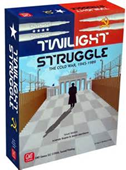
A work of true skill and inspiration, Twilight Struggle is a two-player board game that simulates the silent war between the two great superpowers of the United States of America and the Union of Soviet Socialist Republics. The illustrated board game incorporates events from the early stages of the Cold War to the later stages of the war during the course of the game in due chronological order.
The game incorporates these events through action cards that are used to dictate the flow of the game. These cards can help or hinder each player, as some cards work toward the sole benefit of the USSR player, the US player, or both. Examples of such cards are “Allende,” “CIA Created,” and “‘One Small Step…”’ respectively. Allende, a Socialist physician, was popularly elected in the country of Chile to lead its first socialist government. When played, this card grants two “influence” to the USSR in the country of Chile on the map. Influence points determine control over the war and the regions on the board. Hence, the card is a USSR benefit card, as the card essentially gives USSR influence in the region. Likewise, “CIA Created” is a US-benefit card, as the card recounts the creation of the Central Intelligence Agency. This card allows the US to put one “influence” on the board, and see the opponent’s hand. This card works exclusively for the US, as the CIA was not a Russian organization. The converse would be considered for “Allende.”
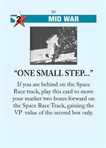
Unlike these two kinds of cards, other cards benefit either player. On July 20th, 1969, Neil Armstrong became the first man to step foot on the moon. During this, he uttered the unforgettable phrase, “That’s one small step for man; one giant leap for mankind.” The “‘One Small Step…’” card signifies the work put in by NASA to catch up to Soviet technologies regarding the Space Race in order to land a man on the moon. This card allows the player to catch up two spaces in the Space Race part of the game. Therefore, it can benefit either player.
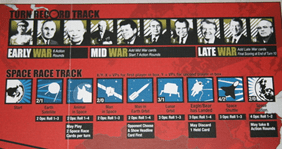
The Space Race is its own course made up of several achievements. These achievements include “Animals in Space,” “Man in Space,” “Lunar Orbit,” and ultimately “Space Station,” among several others. To move along this path, one must either discard a card or obtain a Space Race-specific card. These achievements benefit the player, as the majority give Victory Points to the first player to land upon them. These Victory Points ultimately decide the outcome of the game, as the first player to reach twenty Victory Points “wins” the Cold War. This is not as easy as it sounds. If the US player is at five Victory Points, and the USSR player earns five Victory Points, both players are not at five Victory Points. Rather, the USSR player has just reeled the US player back to zero Victory Points. This would be the same case even if the roles were switched.
Along with detailed and historically-accurate cards, Twilight Struggle also incorporates “initial influence.” For the US and the USSR, at the beginning of the game, both sides already boast influence in certain countries. This “initial influence” is a reflection of the power each side wielded in certain regions during the early stages of the actual Cold War. Furthermore, to preserve the chronological accuracy of the war, certain cards cannot be played until certain stages of the game. As Allende took power over Chile in 1973, his card is not available until the game progresses to the “Mid-War” stage of the game. Until such stage of the game, “Allende” and other “Mid-War” cards are not available for play. Similarly, “Late-War” cards are not available until the respective stage is met as well.
Regarding detail, historical and chronological accuracy, and incorporation of key events, Twilight Struggle sets high standards for other board games. Although not every part of the Cold War could be fit into the game, such is understandable and not unexpected. Twilight Struggle still provides a thorough retelling of the Cold War through the game-changing cards it does include.
As for the excitement and player enjoyment factors, I had the special privilege of playing renowned board game passionatus Mr. Rush in two exciting practice rounds. In both rounds, I opted to play the role of the USSR in their struggle against the “free” filthy capitalist pigs. The first practice round took time; however, this was understandable as it was necessary to become accustomed to the processes of the game. When grown accustomed, the game soon took off in a tense, back-and-forth exchange. Repeatedly, it became necessary for me to reel the US back to zero Victory Points during the round. The outcome of this round is not of importance.
The second practice round was one of emotions ranging from determination, excitement, disappointment, and disdain. At the tail end of the “Early-War” stage of the game, the US was boasting a significant lead in Victory Points. Fortunately for the USSR, I possessed a “scoring card” which would attribute numerous Victory Points to the USSR for domination in a region. During the beginning of the round, I strategically allocated certain amounts of growing influence in the South American region. With this scoring card in hand, I was prepared to return the war back to even terms. Unfortunately, a small-font, hidden, between-the-lines, tucked away rule prevented the USSR from a major comeback. This ultimately led to a miserably disappointing defeat, or so I thought. In blinding reality, my opponent ruthlessly cheated during our game, which was a key factor of this defeat. The “UN Intervention” card is a specialized card that can help either player. The card allows one to discard another card in his hand, and use the operation points from the card without triggering the event. My opponent misled me, and wrongly interpreted this respective card. Rather than nullifying a card in his own hand, he used “UN Intervention” to nullify a card I played that round, and mercilessly utilized its operation points. As a result of this, game-changing cards were nullified on several occasions, ultimately leading to the untimely demise of the USSR.
Nonetheless, upon the completion of our two enjoyable games, I had come to an appreciation for the game. Twilight Struggle boasts strategy, history, drama, and excitement all in one bundle. The game does not take hours to churn out an end result, nor does the game “zip by” before one realizes the game is actually completed. The game’s creators had the goal of enjoyment in mind, and they achieved this goal with marked skill and detail. My personal experience was so enjoyable I have taken up playing the game online with others across the globe on the website “Chantry.” I highly recommend this game for both casual and committed board game players, and especially for those looking for a fun and exciting, yet simple game.
 Redeeming Pandora