Christopher Rush
As you may recall, 2015 was partly about returning to books I have loved and enjoyed for many years, as well as a continuation through the ever-expanding (and recently dismissed) Expanded Star Wars Universe. Last time, I mentioned I would include this time the book reviews for my latest read-through of two favored series of my youth, the oft-rejected Jedi Prince series by Paul and Hollace Davids, one of the earliest YA Star Wars series before the hoopla of recent years (especially this one), and my favorite series of all time, The Chronicles of Prydain, included later in this issue. As always, these are not thorough treatments of the works but merely initial reactions and reviews — perhaps they will be profitable anyway. Enjoy.
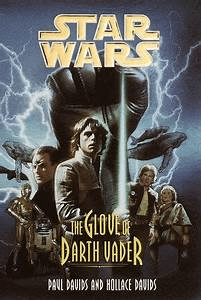
#1 — The Glove of Darth Vader ⭐⭐⭐
Sure, it’s a “kids” book, and the environmentalist push toward the end is in retrospect rather heavy-handed, but this isn’t all that bad. The dialogue is a bit goofy at times, but trying to capture famous characters is certainly a challenge, especially with so little material to base characterizations upon (3 movies is rather different from, say, 7 seasons of a TV series) — especially when intentionally watering their dialogue down for a younger audience. (Though the choice to transcribe Chewie’s and R2’s dialogue does get a bit annoying.) The book (and whole series) suffers from that “let’s only mention planets we’ve seen/heard of before” limitation, whether foisted upon the creative teams by the owning company or not, but if you can easily overlook that sort of thing, with the right attitude it adds to the familiarity of it all more than distracts. The time on Calamar is interesting enough while being fairly believable and credible for the Star Wars Universe (laying aside the notion a race intelligent enough to build large, powerful space craft should be able to overcome whaling).
The premise of the villain being a three-eyed mutant proclaiming to be the new Emperor feels initially goofy and “kid-book like,” especially when adding in the notion of “Darth Vader’s glove is indestructible and a symbol of power,” but those ideas are developed in rather impressive ways. The idea of Trioculus being the Emperor’s son may seem goofy, but it, too, is handled rather well when we find out it’s all a ruse concocted by the Grand Moffs who want to re-solidify their power and authority now that a large vacuum exists in the upper echelons of the Empire. This “kids’ book” has some rather intelligent components to it, such as the political machinations of the Grand Moffs as just mentioned, the glove of Darth Vader being useless for Trioculus since he isn’t a real Force user (and relies on technology that is killing him as part of the ruse), the Emperor’s real son is being kept locked away because he is supposedly insane — they may not sound like much here, but they do come together rather well, even with all the “kid book” goofiness (like the acronyms for everything and such). Still, this book has a fair amount of violence, death, threats, deception, and more, so its “kid book” status is somewhat dependent on your own maturity-level awareness. Not too shabby, after all — it has held up rather well.
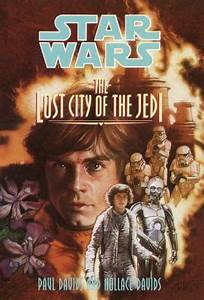
#2 — The Lost City of the Jedi ⭐⭐⭐
This installment threatens to diminish the re-enjoyability of the series by introducing a young teen character, and while that would certainly appeal to the basic intended audience, somehow the book manages to elude that deadly pitfall for the most part. Ken, the mysterious “Jedi Prince,” is not in the book all that much, fortunately, especially since his scenes are the worst of the book: a droid just for correcting homework? a fairly well-adjusted human who grow up solely among droids? a worrying companion droid named Chip? Rather painful, though I suspect it didn’t bother me too much the first time I read this twenty-some years ago. As I said, fortunately Ken and his droids are in it infrequently and more time is spent on Trioculus and his plans to take full command of the Empire
This installment’s “New Mother Nature” moment is the anti-slash-and-burn deforestation of tropical rainforests conflict toward the end, but that’s a good idea anyway (just like not killing whales is a good idea), so it isn’t intrusive. It is even worked into the main story better with the herbs and seeds Trioculus needs to heal his wounds are imperiled by his own destructive orders, causing him even more pain. The only really irritating part of the book is the rhyming botanist alien guy, but he’s not in it too much, either.
One of the more enjoyable aspects of the book is how well it picks up where the last one left off, continuing the basic storylines and character directions intelligently. Han’s desire to take a break from the Rebellion and restore a life and place for himself is rather believable, even when it conflicts with his love for Leia. It’s rather believable, considering his plans at the beginning of Episode V (it’s easy to overlook things like that). Trioculus continues his Glove of Darth Vader scheme of convincing the Dark Force Prophets to make him Emperor well, and the intelligent writing comes through again with the Prophets not being all that Force adept after all, relying more on trickery, spies, and technology more than actual Force skill. Episode IV did try to tell us Darth Vader was the last of the Force users (since the Emperor was keeping his secrets and all).
True, the “Lost City of the Jedi” doesn’t seem all that sensible, especially with the whole holocron thing taking over later, but it kinda works, I suppose. Why Luke wasn’t raised there instead of Tatooine, well, who knows. It’s just something you sort of have to go with. On the whole, it was much better than I remember it being, which may say more about my memory of books I read 20 years ago than the book itself, but there it is.
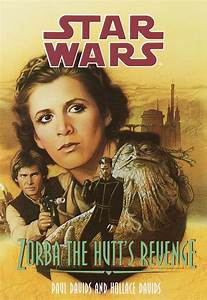
#3 — Zorba the Hutt’s Revenge ⭐⭐⭐
I am tempted to go for 4 stars with this one, even with its goofiness. It’s an impressively compact work with interesting conflicts primarily between the competing villains and interesting character developments (if somewhat far-fetched, even for Star Wars). Sure, the notion of Jabba’s dad getting revenge may seem juvenile, but not when you consider what Liam Neeson has been up to lately, movie-wise. The “Jabba’s will” plot device is also a bit goofy, but hey, it works fine for complicating the action quickly and efficiently.
Sending Lando packing seems far-fetched, but it’s not really inconsistent with Lando, at least if you take Neil Smith’s books as “true enough” for our purposes. Zorba’s and Trioculus’s fight over Leia is rather enjoyable, especially since it gives us a look at other stuff in the universe without having to focus on the good guys all the time. Han’s squashed hopes for being a homeowner are part of the goofiness, but it somehow fits rather well also, and I doubt he would have wanted to stay in Cloud City with Jabba’s dad as governor, anyway. The Mother Earth Crime of the Novel is the dangers of air pollution (braze = brown haze), and though it is much more prominent than in the earlier two novels, it fits far better throughout the novel with what happens and is not just a climax-plot-contrivance device as it sort of was before. Even the brief Ken episodes don’t get as silly and irritating as they could have. This was a surprisingly refreshing quick read. It almost makes one wish the “grown-up” Star Wars books didn’t have all that literary shilly-shallying.
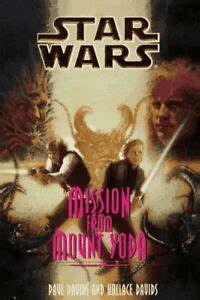
#4 — Mission from Mount Yoda ⭐⭐⭐
Kicking off the second mini-trilogy, Mission from Mount Yoda brings a new tenor to the series (as much as possible for a “kids book” series). The base of rebel operations moves from Yavin 4 to Dagobah, and the Empire is also making big changes. The Prophets of the Dark Side, seeing their opportunity to take control now that Trioculus is in carbonite, make a very drastic move and basically steal Trioculus’s body and destroy it, and Kadann declares himself the new ruler of the Empire. Time passes in a strange way in this series, but we get the basic sense enough time passes for information to get spread around where it needs to be spread. An interesting component of this entry is the antagonism between the Dark Prophets and Grand Moff Hissa, and while the whole Dark Prophets thing seems to contradict Tarkin in Episode IV (when he says Darth Vader is the last of the adherents to the Force, since he must not know the Emperor was Sith, too), it adds an interesting layer to the Empire, with the political moffs antagonistic to the Dark Force users. Hissa pays a heavy price for his loyalty shifts, but we almost feel sympathy for him, considering the terrible pressures upon him by all sides (almost).
Another engaging aspect of this story, so to speak, is the relationship of Han and Leia: the authors add some friction to their relationship, slowing down Han’s romantic fervor, even making him question his desire to marry her. While that sort of thing is usually irritating in a romantic comedy, its brevity and believeability come across very well, even for a “kids’ book.” It adds just enough of a twist to prolong things without being nonsensical, and the rest of the story adds enjoyable components and moments that make their relationship a bit richer.
Similarly, the “Ken is a teenager” subplot again threatens to diminish the enjoyable nature of this for older readers, what with the sort of inane “he has to start school” idea (inane considering he has been raised in the secret Library of the Jedi — the boy knows almost more than our heroes; he’s certainly had more formal education than Luke!), but it is again brief, ends quickly, and we get back to better action soon enough. At least the authors came up with some slightly plausible reasons for why he has to go to school, indicating his Jedi Library education didn’t cover everything (though, he is lacking in mostly practical things, which is a cautionary tale against the purpose of education).
The Environmental Problem of the Week is toxic waste dumping, and surprisingly our heroes cannot solve the problem this time. Instead, they aid the sufferers and rescue a civilization’s historic art treasures and basically abandon the problem. That gives the story a strange authenticity: they can’t just magically counteract decades of toxic waste dumping. Let this be a lesson to you, First World countries.
Finally, we meet Triclops, and his connection to Ken and knowledge of Ken’s secret past are hinted at well without dragging the story down. The authors do a fine job of wrapping up this story while setting up eager anticipation for what comes next. This series is rather impressive, I must say.
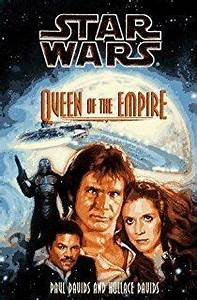
#5 — Queen of the Empire ⭐⭐⭐
I’d go with 2.5 stars, but I’m rounding up simply for sentimentality’s sake. This is certainly the weakest of the series, though some of it is understandable in that it is trying to be a bit lighthearted before the big slam-bang finish up next. In a way, though, structurally, this book is impressive since the beginning events and ending events mirror each other well — and though we just said it was the most lighthearted and goofiest of the entries, it begins and ends with rather serious occurrences. Another weakness is the dialogue, which has always been a bit of an issue for this series (and all Star Wars books, pretty much), but this time some of the characters say and do things that don’t always feel all that consistent. The coincidences of characters all showing up at the same place is another regular trope in this series, but here it feels even more forced and convenient than usual, especially with Ken and Luke just showing up in the nick of time at the end with the HRD and whatnot.
Finding Lando as an administrator of a new planet is a good part of the book, in that is shows us a little “passage of time” idea and how resourceful Lando is: he doesn’t depend on the Alliance for everything all the time. That was probably the best part of the book, even though it is tied in to some rather silly sorts of things (like Han and Leia eloping at a Hologram Amusement Park thing). The Triclops subplot gets a little momentum, and the Trioculus plot is taken in very unexpected directions, so those are good.
The Ecological Problem of the Week is barely mentioned, and rather weird, dealing sort of with the weather effects of having too many milk-producing bats or something like that. I’m not quite sure what it was, but it only affects the Falcon for a bit (cleverly tying in to moments of the last story, briefly) and our heroes don’t even bother trying to address it or consider it, and it’s over before the third chapter.
Overall, some good moments, and some rather shocking and surprising twists at the end, but despite some clever structure and Lando moments, it’s on the whole the weakest of the bunch (but, hey, one of them had to be).
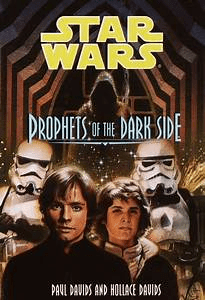
#6 — Prophets of the Dark Side ⭐⭐⭐⭐
I’m a bit confused by the antagonism for this book, especially considering what it is and when it was. I also don’t understand all the hagiographic idolatry of Peter Pan, but that just seems to encourage me I’m understanding things like reality better than a lot of other people. Let’s note four impressive things about this book: (a bit spoiler-filled here, sorry — skip this section if you want to read it yourself):
– The main villain of the series, Trioculus, is killed in the first few pages of this book. True, we did think he was killed earlier in the series, and he hasn’t caused all that much difficulty to anyone beyond air pollution and rain deforestation (not to ignore the ignominy he caused Princess Leia), but with all the times villains and heroes have been rescued and restored from death and seeming-death, the fact the main antagonist is finally killed in the opening of the final book of the series is impressive.
– The main supporting villain, Grand Moff Hissa, is also killed off in a manner cleverly foreshadowed earlier in the book, despite the fact he too has survived other near-death experiences in the series. He even is allowed a bit of nobility toward the end, and we come quite close to feeling sorry for him by the time of his demise.
– The long-running plot thread of Prince Ken and his mysterious origins is brought to a fairly satisfying conclusion, still with a bit of mystery open for exploring in further books or series (though totally ignored in other Star Wars adventures). What’s perhaps most impressive is the absence of any “reunion” scene: we could have expected the typical low-brow pre-teen father/son reunion with years of heartache and mystery erased in one hug and a paragraph, but we don’t get any of that resolution, giving us a perhaps more realistic (and grown up?) ending/non-ending. Ken now has to live with his origins and be his own man. Yes, it is similar to Luke’s story in Episodes IV-VI, but it is different enough to be worthwhile.
– Similarly, in the blink of an eye, Ken’s old life is effectively shut off from him perhaps forever — his youth and old home and droid friends/instructors are shut down and he basically can’t go back. Very few of us have had the access to our youth so wholly eliminated as Ken has at the end of the story. Yes, there is the unstated possibility of reactivating the Lost City, but all the characters sound like they have no intention of doing that, even if the trapped villains escape and leave us with no reason to keep the Lost City unplugged. That’s pretty tough.
It’s not Tolstoy, no, but considering what it is, from when it was, how well it wraps up so many of the threads from the first five books, leaves us with fairly shocking conclusions and open-ended non-resolutions (intentionally, not just forgotten components), this is an enjoyable and impressive finish to a far-more decent series than a lot of people seem to credit it.
 Redeeming Pandora