
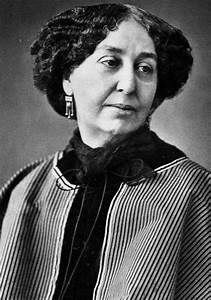
Elizabeth Knudsen
One’s chief interest in the life of any great thinker is to determine those influences which seemed to have had the greatest impact on their life and work. Considering this, this paper will only touch briefly on those influences which left a deep and lasting mark on George Sand.
Sand was born Amantine-Lucile-Aurore Dupin on July 1, 1804 in Paris, France. Notorious for her bohemian lifestyle in life, she is now hailed as representing the epitome of French romantic idealism. She demanded the freedom of living that was commonplace for men of her time for herself and for those of her own gender. Called Aurore in her youth, she was brought up at Nohant, near La Châtre in Berry, the country home of her grandmother. There she gained the profound love and understanding of the countryside that later informed many of her works. In 1817 she was sent to a convent in Paris, where she acquired a mystical fervor that, though it soon abated, left its mark. For while within the strict environment, Sand turned to reading. The long hours of girlhood with little companionship were filled with entirely unguided literary exploration. She filled her imagination with Montesquieu, Locke, Aristotle, La Bruyère, Pope, Milton, Byron, Dante, Bacon, Virgil, Shakespeare — but above all these her influence was Pousseau, that patron saint quoted and followed through many years. During her adolescence, an ever-constant quarrel over her between the noble grandmother and by no means stupid mother played a great part in her confusion of social standards.
She married in 1822 to a man far older, unintellectual, and overall vastly her inferior. As Providence would have it, separation came ten years later. Aurore, now Madame Dudevant, started for Paris, leaving her two children, along with years of unhappiness and moral struggle, behind her. Her unhappiness was never suspected by those around her. It is the opinion of some Sand married passively, as she did in all outward acts of her life. She seemed to pour more intimate musings of herself into her novels than she did in relationships. The modern reader, however, reading the early novels so full of domestic unhappiness cannot but doubt whether any imagination, no matter how vivid, could have produced them by untrained bitterness.
George Sand was particularly susceptible to her environment, particularly the influence of men in her environment. This produced a writer of many sides and with many wide and deep sympathies. Through her novels one can see a shift in style here, or a change in tone there that was influenced by whatever great mind she was surrounded by at the time. She admitted herself too easily influenced later in life, saying she had tired herself out by chasing too many ideas. Throughout all of her works, though, her key themes remain: 1) the independence of women, 2) the sovereignty of the people, 3) a deep religious faith, and 4) a profound love for nature and real art. It is often noticeable in defending these beliefs she tried so hard to promote Sand often grew tired of the struggle, and at these moments she returned to her ever-constant solace — her constant appreciation of nature and its God.
In January 1831 she left Nohant for Paris, where she found a good friend in Henri de Latouche, the director of the newspaper Le Figaro, who accepted some of the articles she wrote with Jules Sandeau under the pseudonym Jules Sand. In 1832 she adopted a new pseudonym, George Sand, for Indiana, a novel in which Sandeau had no part. That novel, which brought her immediate fame, is a passionate protest against the social conventions that bind a wife to her husband against her will and an apologia for a heroine who abandons an unhappy marriage and finds love. In Valentine (1832) and Lélia (1833) the ideal of free association is extended to the wider sphere of social and class relationships.
While her fame grew, so did the list of her lovers. It eventually included, among others, Prosper Mérimée, Alfred de Musset, and Frédéric Chopin. She remained unchanged by Musset’s skeptical views as well as Chopin’s aristocratic prejudices, while the man whose opinions she entirely agreed with, the philosopher Pierre Leroux, was never her lover. Despite these exceptions, however, most of her early works, including Lélia, Mauprat (1837), Spiridion (1839), and Les Sept Cordes de la lyre (1840), show the influence of one or another of the men with whom she associated.
Eventually, she found her true form in her rustic novels, which drew their chief inspiration from her lifelong love of the countryside and sympathy for the poor. In La Mare au diable (1846), François le Champi (1848), and La Petite Fadette (1849), the familiar theme of George Sand’s work — love transcending the obstacles of convention and class — in the familiar setting of the Berry countryside, regained pride of place. These are considered by some to be her finest works. Sand produced a series of novels and plays of impeccable morality and conservatism — ironic, considering her rather promiscuous early life. Among her later works are the autobiography Histoire de Ma Vie (1854–55; “Story of My Life”) and Contes d’une grand’mère (1873; “Tales of a Grandmother”), a collection of stories she wrote for her grandchildren.
George Sand’s novels portrayed a view that challenged the social norm of France. She believed women had just as much of a right to smoke and wear suits and have an opinion as men did. She believed there was much more to the women of the world than becoming a housewife and contenting themselves to be the wives of the world’s leaders and shakers instead of being the leaders and shakers themselves. This challenged the very Napoleonic Code in clause 213, which states “the husband is bound to protect the wife and the wife to obey the husband.” In 1800s France this didn’t mean the mild submission the popular view of complimentarianism promotes today. This meant subjection to the will of the husband in all things. Whatever dowry the wife brought was his. Whatever money the wife might earn was his. The French woman could hold no property, could not testify in a civil case, could not sign a legal document, had no chance at education except in convents, had no authority over the education of her children, and could obtain no divorce from her husband except on the grounds of extreme cruelty. In addition to these laws which established the legal inequality of women, there were also countless social boundaries and rules that also restricted her activity. Many literary and business endeavors were considered inappropriate for women, as well as many venues where they were unwelcome. And while women were not perceived as intelligent enough to pursue a career as a writer, men wrote about the fickleness of women all the time.
Ultimately, Aurore Dudevant wrote under the male pseudonym of George Sand for two reasons. The first, I believe, was because so many of the literary geniuses she surrounded herself with were men. Many of her treasured influences in her childhood as well as her adult life were men. It has been shown her literary style, as well, was influenced by her lover du jour. In some small part of her, she wanted to be like them, and being androgynous was one of the easiest ways for her to do so. The second reason was clearly because her views were so extremely controversial. Such blatant rejection of the established values would have never been accepted by society had she written under her female name. Politics were certainly not considered a women’s field, but Aurore clearly had the smarts to write about them. Today, she is considered not only an incredible novelist, but also as a key figure of the feminist movement. And now, a pseudonym such as hers is unnecessary for female novelists, perhaps in part thanks to her steps toward female equality in society.
Bibliography
Impromptu . Dir. James Lapine. Avante-Garde Cinema, 1991. Web. 15 Jun. 2011.
Jack, Belinda. “George Sand: A Woman’s Life Writ At Large.” The New York Times on the Web. The New York Times, 2000. Web. 9 Dec. 2015. <https://www.nytimes.com/books/first/j/jack-sand.html>.
Wernick, Robert. “A Woman Writ Large In Our History and Hearts.” Smithsonian. December 1996, 122-137.
 Redeeming Pandora