
Justin Benner
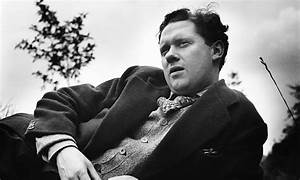
Dylan Thomas was born on October 27, 1914. He left school at age 16 to become a reporter and writer. His most famous poem, “Do Not Go Gentle into That Good Night,” was published in 1952. In 1931, at the age of 16, Thomas dropped out to become a junior reporter at the South Wales Daily Post. His position didn’t last long, since he quit in 1932 and turned his attention away from journalism back to poetry. Thomas soon found success in “And Death Shall Have No Dominion,” published in 1933 in the New English Weekly, marking his first international publication. This poem sent Thomas to England in 1933 to meet with editors of English literary magazines. His published efforts brought Thomas praise and honors, including the 1934 Poet’s Corner Prize. This period was also when his lifelong struggle with alcohol abuse began. To support his family, Thomas worked for BBC as a scriptwriter during World War II. He was exempted from fighting due to a lung condition. Even with this he still struggled financially. He was unable to keep up with taxes he owed. Even with Thomas in high demand for his animated readings, debt and heavy drinking took their toll. He died in New York City while on tour in 1953, at age 39.
“And Death Shall Have No Dominion” was Dylan Thomas’s international breakthrough. This poem has 3 stanzas with no definitive rhyming structure. This poem is definitely a perplexing one upon first read. My first guess as to what this poem was referring to was World War II. I couldn’t however put the pieces together on how it related. This link to World War II is shot down in the first stanza.
And death shall have no dominion.
Dead man naked they shall be one
With the man in the wind and the west moon;
When their bones are picked clean and the clean bones gone,
They shall have stars at elbow and foot;
Though they go mad they shall be sane,
Though they sink through the sea they shall rise again;
Though lovers be lost love shall not;
And death shall have no dominion.
There is no mention or link to World War II or any other war. It deals more with death than anything else. After doing some research as to the meaning, one possible explanation is such: “The title of the poem is derived from the biblical passage in Paul’s epistle to Romans, chapter 6 and verse 9. The poet showcases the reality of death and also gives it a good meaning. He lets us see the beauty behind death.… The dead persons who have gone ahead of us have timeless values. The memory of our dead loved ones lives with us” (poetandpoems.com). The author, following the logic of this explanation, is trying to tell us death has no victory over man; the loved ones we have lost will always be with us. It does not matter whether they are physically with us, what matters is they are in our hearts. This is a very biblical concept found in 1 Corinthians 15:55, which states “O death, where is your victory? O death, where is your sting?” (ESV). We even see in the 7th line the idea the dead shall rise again. “Though they sink through the sea they shall rise again.” These are very powerful words. This type of poetry would sooth very real hurt in WW2 Britain.
The second stanza is just as deep as the first stanza, yet it deals with seemingly the same issues but in a different aspect of war.
And death shall have no dominion.
Under the windings of the sea
They lying long shall not die windily;
Twisting on racks when sinews give way,
Strapped to a wheel, yet they shall not break;
Faith in their hands shall snap in two,
And the unicorn evils run them through;
Split all ends up they shan’t crack;
And death shall have no dominion
This stanza is dealing with the sea and presumably the navy. He is talking about all the souls lost at sea during, again presumably, WW2. But even here we see the theme of the dead returning to the living. Death has no dominion in the sea, and the sailors shall be freed from their sunken vessels and released from the temporary prison of death. They are “strapped to a wheel, yet they shall not break.” This stanza, while seemingly gloomy and dark at first, is actually quite the opposite. He is giving the families of the soldiers, and now the sailors, hope of their one day return.
The third and final stanza is more upfront with the reader. It talks about what happens after life.
And death shall have no dominion.
No more may gulls cry at their ears
Or waves break loud on the seashores;
Where blew a flower may a flower no more
Lift its head to the blows of the rain;
Though they be mad and dead as nails,
Heads of the characters hammer through daisies;
Break in the sun till the sun breaks down,
And death shall have no dominion.
Even in death the author proposes death has no dominion. Once we die, once “a flower may a flower no more / Lift its head to the blows of the rain,” we are free from death and its domain. The author’s point is death is only momentary; even in death we don’t lose our loved ones. We, the survivors of human conflict, will always hold the ones we loved close to our hearts, where death has no dominion. This is true regardless pf the circumstance of loss. This is true about grief. We as humans often refuse to give up on those we love; it is not in our nature to leave behind someone we love. We will defend them and their memory until we one day pass away, too. This is the point the author is making, that death has no dominion over the living, but also it has no dominion over the dead.
 Redeeming Pandora