
Professor Gilbert Murray
Editor’s Note: The following is excerpted from Gilbert Murray’s Euripides and His Age, published in 1946 (2nd ed.) by Oxford University Press. Despite Professor Murray’s occasional antagonism toward Christianity (especially a rather intendedly humorous ironic comment toward the beginning of this book about irrationality and religious sentiment), he was one of the finest classicists of the last century, and his work is highly recommended (again with the caveat of his periodically intrusive and irrelevant antagonism toward Christianity). The excerpt is essentially the final portion of Murray’s work on Euripides, a very useful and enjoyable treatment of the components of classical Greek tragedy especially as done by perhaps the greatest of the time, Euripides. He explains very knowledgably what the elements of classical drama are and why they were there (though, certainly, you should read the entire work). Some typographical and spelling changes have been done for the benefit of our American audience.
At the very beginning of a play by Euripides we shall find something that seems deliberately calculated to offend us and destroy our interest: a Prologue. It is a long speech with no action to speak of; and it tells us not only the present situation of the characters — which is rather dull — but also what is going to happen to them — which seems to us to spoil the rest of the play. And the modern scholastic critic says in his heart, “Euripides had no sense of the stage.”
Now, since we know he had a very great sense of the stage and enormous experience also, let us try to see what value he found in this strange prologue. First, no doubt it was a convenience. There were no playbills to hand round, with lists of the dramatis personae. Also, a Greek tragedy is always highly concentrated; it consists generally of what would be the fifth act of a modern tragedy, and does not spend its time on explanatory and introductory acts. The prologue saved time here. But why does it let out the secret of what is coming? Why does it spoil the excitement beforehand? Because, we must answer, there is no secret, and the poet does not aim at that sort of excitement. A certain amount of plot-interest there certainly is: we are never told exactly what thing will happen but only what sort of thing; or we are told what will happen but not how it will happen. But the enjoyment the poet aims at is not the enjoyment of reading a detective story for the first time; it is that of reading Hamlet or Paradise Lost for the second or fifth or tenth. When Hippolytus or Oedipus first appears on the stage you know he is doomed; that knowledge gives an increased significance to everything he says or does; you see the shadow of disaster closing in behind him, and when the catastrophe comes it comes with the greater force because you were watching for it.
“At any rate,” the modern reader may persist, “the prologue is rather dull. It does not arrest the attention, like, for instance, the opening scenes of Macbeth or Julius Caesar or Romeo and Juliet.” No; it does not. Shakespeare, one may suppose, had a somewhat noisy audience, all talking among themselves and not disposed to listen till their attention was captured by force. The Greek audience was, as far as we can make out, sitting in a religions silence. A prayer had been offered and incense burnt on the altar of Dionysus, and during such a ritual the rule enjoined silence. It was not necessary for the Greek poet to capture his audience by a scene of bustle or excitement. And this left him free to do two things, both eminently characteristic of Greek art. He could make his atmosphere, and he could build up his drama from the ground.
Let us take the question of building first. If you study a number of modern plays, you will probably find their main “effects” are produced in very different places, though especially of course at the fall of each curtain. A good Greek play moves almost always in a curve of steadily increasing tension — increasing up to the last scene but one and then, as a rule, sinking into a note of solemn calm. It often admits a quiet scene about the middle to let the play take breath; but it is very chary indeed of lifting and then dropping again, and never does so without definite reason. In pursuance of this plan, Euripides likes to have his opening as low-toned, as still, as slow in movement as he can make it: its only tension is a feeling of foreboding or of mystery. It is meant as a foundation to build upon, and every scene that follows will be higher, swifter, more intense. A rush of excitement at the opening would jar, so to speak, the whole musical scheme.
And this quiet opening is especially used to produce the right state of mind in the audience — or, as our modern phrase puts it, to give the play its atmosphere. Take almost any opening: the Suppliant Women, with its band of desolate mothers kneeling at an altar and holding the Queen prisoner while she speaks; the Andromache, the Heracles, the Children of Heracles almost the same — an altar and helpless people kneeling at it — kneeling and waiting; the Trojan Women with its dim-seen angry gods; the Hecuba with its ruined city walls and desolate plain and the ghost of the murdered Polydorus brooding over them; the Hippolytus with its sinister goddess, potent and inexorable, in the background throughout the whole play; the Iphigenia, with its solitary and exiled priestess waiting at the doors of her strange temple of death. Most of the prologues have about them something supernatural; all of them something mysterious; and all of them are scenes of waiting, not acting — waiting till the atmosphere can slowly gain its full hold. Regarded from this point of view I think every opening scene in Greek tragedy will be seen to have its significance and its value in the whole scheme of the play. Certainly the prologue generally justifies itself in the acting.
And when the prologue is over and the action begins, we need not expect even then any rapid stir or bustle. Dr. Johnson has told us a man who should read Richardson for the story might as well hang himself; the same fate might overtake none who sat at Greek tragedies expecting them to hurry at his bidding. The swift rush will come, sure enough, swift and wild with almost intolerable passion; but it will not come anywhere near the first scenes. We shall have a dialogue in longish speeches, each more or less balanced against its fellow, beautiful no doubt and perhaps moving, but slow as music is slow. Or we shall have a lyrical scene, strophe exactly balanced against antistrophe, more beautiful but slower still in its movement, and often at first hearing a little difficult to follow. Poetry is there and drama is there, and character and plot interest; but often they are unrolled before you not as things immediately happening, but as things to feel and reflect upon. It is a bigger world than ours and every movement in it is slower and larger.
And when the poet wants to show us the heroine’s state of mind his method will be quite different from ours. We should rack our brains to compose a “natural” dialogue in which her state of mind would appear, or we should make her best friend explain what she is like, or we should invent small incidents to throw light upon her. And our language would all the time be carefully naturalistic; not a bit — or, if the poet within us rebels, hardly a bit — more dignified than the average of diction of afternoon tea. The ancient poet has no artifice at all. His heroine simply walks forward and explains her own feelings. But she will come at some moment that seems just the right one; she will come to us through a cloud, as it were, of musical emotion from the Chorus, and her words when she speaks will be frankly the language of poetry. They will be nonetheless sincere or exact for that.
When Phaedra in the Hippolytus has resolved to die rather than show her love, much less attempt to satisfy it, and yet has been so weakened by her long struggle she will not be able to resist much longer, she explains herself to the Chorus in a long speech:
O Women, dwellers in this portal seat
Of Pelops’ land, looking towards my Crete,
How oft, in other days than these, have I
Though night’s long hours thought of man’s misery
And how this life is wrecked! And, to mine eyes,
Not in man’s knowledge, not in wisdom, lies
And know the right — for wit hath many a man —
But will not to the last end strive and serve.
For some grow too soon weary, and some swerve
To other paths, setting before the right
The diverse far-off image of Delight,
And many are delights beneath the sun.…
It is not the language any real woman ever spoke, and it is not meant to be. But it is exactly the thought this woman may have thought and felt, transmuted into a special kind of high poetry. And the women of the Chorus who are listening to it are like no kind of concrete earthly listeners; they are the sort of listeners suited to thoughts rather than words, and their own answer at the end comes not like a real comment but like a note of music. When she finishes, defending her resolve to die rather than sin:
O’er all this earth
To every false man that hour comes space
When Time holds up a mirror to his face,
And marveling, girl-like, there he stares to see
How foul his heart. — Be it not so with me!
They answer:
Ah, God, how sweet is virtue and how wise,
And honor its due meed in all men’s eyes!
“A commonplace?” “A not very original remark?” There is no need for any original remark; what is needed is a note of harmony in words and thought, and that is what we are given.
At a later stage in the play we shall come on another fixed element in the tragedy: the Messenger’s Speech. It was probably in the ritual. [Murray discusses the root of Greek tragedy earlier in the book as deriving a great deal from religious rituals.] It was expected in the play. And it was — and is still on the stage — immensely dramatic and effective. … Now for the understanding of the speech itself, what is needed is to read it several times, to mark out exactly the stages of story told, and the gradual rising of emotion and excitement up to the highest point, which is, as usual, near the end but not at the end. The end sinks back to something like calm. It would take too long to analyze a particular Messenger’s Speech paragraph by paragraph, and the printed page cannot, of course, illustrate the constant varieties of tension, of pace and of emphasis that are needed. But I find the following notes for the guidance of an actor opposite the Messenger’s Speech in an old copy of my Hippolytus. Opposite the first lines comes, “Quiet, slow, simple.” Then “quicker.” “Big” (at “O Zeus … hated me”). Then “Drop tension: story.” “Pause: more interest.” “Mystery.” “Awe; rising excitement.” “Excitement well controlled.” “Steady excitement; steady; swifter.” “Up: excitement rising.” “Up; but still controlled.” “Up; full steam; let it go.” “Highest point.” “Down to quiet.” “Mystery.” “Pause.” “End steady: with emotion.” These notes have, of course, no authority: as they stand they are due partly to my own conjecture, partly to observation of a remarkable performance. But they have this interest about them. They grow out of the essential nature of the speech and probably would, in their general tenor, be accepted by most students; and further, some very similar scheme would suit not only almost every Messenger’s Speech, but also, with the necessary modifications, almost very Greek tragedy as a whole. The quiet beginning, the constant rise of tension through various moods and various changes of tone up to a climax; the carefully arranged drop from the climax to the steady close, without bathos and without any wrecking of the continuity.
But there is another point about Messengers that can be more easily illustrated. Their entrance in Euripides is nearly always carefully prepared. The point is of cardinal importance and needs some explanation. In mere literature it is the words that matter; in dramatic literature it is partly the words, and partly the situation in which they are uttered. A Messenger’s Speech ought not only to be a good story in itself, but it ought to be so prepared and led up to that before the speaker begins we are longing to hear what he has to say. An instance of a Messenger’s Speech with no preparation is in Sophocles’ Oedipus the King. (I do not at all suggest that preparation is needed; very likely the situation itself is enough.) Oedipus has rushed into the house in a fury of despair, and the Messenger simply walks out of the house crying
O ye above this land in honor old
Exalted, what a tale shall ye be told,
What sights shall see and tears of horror shed….
Contrast with this the preparation in the Hippolytus (1153 ff.). Hippolytus, cursed, and of course wrongfully cursed, by his father, Theseus, has gone forth to exile. His friends and the women of the Chorus have been grieving for him: Theseus has refused to listen to any plea. Then
Leader of the Chorus
Look yonder! … Surely from the Prince ’tis one
That cometh, full of haste and woe-begone.
We are all watching; a man in great haste enters. Observe what he says:
Henchman
Ye women, whither shall I go to seek
King Theseus? Is he in this dwelling? Speak!
Our suspense deepens. The Leader evidently has hesitated in her answer; she wants to ask a question. … But at this moment the door opens and she falls back:
Leader
Lo, where he cometh through the Castle Gate.
Through the gate comes Theseus, wrapped in gloom, evidently trying still to forget Hippolytus. The Henchman crosses his path.
Henchman
O King, I bear thee tidings of dire weight
To thee, yea, and to every man, I ween,
From Athens to the marches of Trozen.
Will Theseus guess? Will he see this is one of his son’s servants? At any rate he shows no sign of so doing.
Theseus
What? Some new stroke hath touched, unknown to me
The sister cities of my sovranty?
Henchman
Hippolytus is. … Nay, not dead; but stark
Outstretched, a hairsbreadth this side of the dark.
The forbidden name is spoken; there is evidently a moment of shock, but how will Theseus take the news? Will he soften?
Theseus (as though unmoved)
How slain? Was there some other man, whose wife
He had like mine defiled, who sought his life?
Stung by the taunt the Henchman answers boldly.
Henchman
His own wild team destroyed him, and the dire
Curse of thy lips. … The boon of the great Sire
Is granted thee, O King, and thy son slain.
Will Theseus turn in fury on the speaker? Or will he even now soften? Neither.
Theseus
Ye Gods! … And thou, Poseidon, not in vain
I called thee Father. Thou hast heard my prayer.
The shock is heavy but he recovers his calm, and with it comes the horrible conviction his curse was just and the gods have struck dead a guilty man.
How did he die? Speak on. How closed the snare
Of Heaven to slay the shamer of my blood?
Then the Messenger begins his story.
Such preparations are regular in Euripides. In the Electra, Orestes has gone forth to find King Aegisthus, and if possible slay him. Electra is waiting in her hut, a drawn sword across her knees, sworn to die if Orestes fails. How is the Messenger brought on? First the Leader of the Chorus thinks she hears a noise in the distance; she is not sure. … Yes; a noise of fighting! She calls Electra, who comes, the sword in her hand. The noise increases; a cry; cheering. Something has happened, but what? The cheers sound like Argive voices. “Aegisthus’s men!” cries Electra; “then let me die!” The Chorus restrain her. “There is no Messenger; Orestes would have sent a Messenger.” “What, wait!” cries the Leader, holding her arm: and a man rushes in, shouting, “Victory! Orestes has slain Aegisthus, and we are free” (747-773).
That seems enough, but even now Euripides has not extracted his full effect rom the situation. Electra, steeped to the lips in fears and suspicions, recoils from the man. “Who are you? … It is a plot!” She must get the sword. … The Man bids her look at him again; he is her brother’s servant; she saw him with Orestes an hour ago. She looks, remembers, and throws her arms round the man’s neck. “Tell me again. Tell me all that happened.” And so the Messenger begins.
This art of preparation belongs, of course, to the modern stage as much or more as to the ancient. So do the similar arts of making the right juncture between scenes, of arranging the contrasts and clashes, and especially of so ending each scene as to make the spectator look eagerly for the next move. He must be given just enough notion of the future to whet his appetite; not enough to satisfy it. These are general rules that apply to all good drama. … In ancient times they were more developed by Euripides than by his predecessors, but that is all we need say.
Prologue; Set Speech; Messenger. There still remain two stumbling-blocks to a modern reader of Greek tragedies: the Deus ex Machina (or “God from the Machine”) and the Chorus.
About the appearance of the god we need say little. We have seen above an epiphany of some Divine Being or a Resurrection of some dead Hero seems to have been an integral part of the old ritual and this has its natural place in tragedy. His special duty is to bring the action to a quiet close and to ordain the ritual on which the tragedy is based — thus making the performance itself a fulfillment of the god’s command [as discussed earlier in the book]. The actual history of this epiphany is curious. As far as our defective evidence allows us to draw conclusions we can make out that Aeschylus habitually used a divine epiphany, but he generally kept it for the last play of a trilogy; he often had a whole galaxy of gods, and, with some exceptions, his gods walked the floor of earth with the other actors. … Sophocles, moving toward a more “natural” and less ritual tragedy, used the divine epiphany comparatively little. Euripides, somewhat curiously for one so hostile to the current mythology, intensified this ritual element in drama as he did all the others. And he used it more and more as he grew older. He evidently liked it for its own sake.
There is one view about the Deus ex Machina that needs a word of correction. It comes chiefly from Horace’s Ars Poetica (cf. Plato Crat. 425 d.). It takes the Deus as a device — and a very unskillful one — for somehow finishing a story that has got into a hopeless tangle. The poet is supposed to have piled up ingenious complications and troubles until he cannot see any way out and has to cut the knot by the intervention of something miraculous — in this case, of a machine-made god. Now devices of this sort — the sudden appearance of rich uncles, the discovery of new wills, or of infants changed at birth and the like — are more or less common weaknesses in romantic literature. Hence it was natural Horace’s view about Euripides’ god should be uncritically accepted. But as a matter of fact it is a mere mistake. It never in any single case holds good — not even in the Orestes. And there are some plays, like the Iphigenia in Tauris, in which, so far from the god coming to clear up a tangled plot, the plot has to be diverted at the last moment so as to provide an excuse for the god’s arrival. Euripides evidently liked a supernatural ending, and when he had to do without a real god — as in the Medea and the Hecuba — he was apt to end with winged chariots and prophecies. Can we in the least understand what he gained by it?
We must remember one or two things. The epiphany was in the ritual. It was no new invention in itself; the only new thing, apparently, was an improved piece of stage machinery enabling the god to appear more effectively. Further, if we try to put ourselves into the minds of fifth-century Greeks, there was probably nothing absurd, nothing even unlikely, in supposing the visible appearance of a god in such an atmosphere as that of tragedy. The heroes and heroines of tragedy were themselves almost divine; they were all figures in the great heroic saga and almost all of them — the evidence is clear — received actual worship. If Orestes or Agamemnon is present on the stage, it is not surprising Apollo should appear to them. It is, I think, chiefly due to the mistake of over-emphasizing the realism of Euripides that recent writers — myself at one time included — have been so much troubled over these divine epiphanies.
I suspect, also, we are troubled by a difference of convention about the way in which supernatural beings ought to speak. We moderns like them to be abrupt, thunderous, wrapped in mystery. We expect the style of ancient Hebrew or Norse poetry. Probably a Greek would think both barbaric. At any rate the Greek gods, both in Euripides and elsewhere, affect a specially smooth and fluent and lucid utterance.
And apart from the artistic convention there is a historical consideration we must never forget, though we are constantly tempted to do so. A well-educated Athenian of the fifth century before Christ was, after all, not as securely lifted above what he called “primeval simplicity” as a similar man in Western Europe in the eighteenth or nineteenth century after. He was just beginning, with great daring and brilliance, to grasp at something like a philosophic or scientific view of the world; but his hold was very precarious and partial, and when it slipped he fell unsuspectingly into strange abysses. A visible god in the theatre laid probably no more strain on his credulity than, say, a prophetic dream on ours.
However, the above considerations are only pleas in mitigation of sentence. They tend to show the Deus ex Machina was not in itself ridiculous to the contemporaries of Euripides; we must go further and try to see why he liked it. The best way is simply, with our antecedent prejudices removed, to read and re-read some of the best epiphany scenes; those, for instance, which close the Electra, the Hippolytus, the Rhesus or the Andromache. We have already seen in the Electra how the poet can use his gods for delivering his essential moral judgment on the story; the condemnation of revenge, the pity for mankind, the opening up of a larger atmosphere in which the horror through which we have just passed falls into its due resting-place. In the Hippolytus the sheer beauty of the Artemis scene speaks for itself and makes a marvelous ending. Notably it attains an effect which could scarcely be reached in any other way, a strange poignant note amid the beauty, where mortal emotion breaks against the cliffs of immortal calm. After many words of tenderness Artemis finishes (1437 ff.):
Farewell! I may not watch man’s fleeting breath,
Nor stain mine eyes with the effluence of death.
And sure that terror now is very near. …
(The Goddess slowly rises and floats away.)
Hippolytus
Farewell! Farewell, most blessèd! Lift thee clear
Of soiling men. Thou wilt not grieve in heaven
For our long love. … Father, thou art forgiven;
It was Her will; I am not wroth with thee. …
I have obeyed her all my days!
Of course the epiphany does not give what our jaded senses secretly demand, a strong “curtain.” It gives the antique peaceful close. The concrete men and women whom we have seen before us, striving and suffering, dissolve into the beautiful mist of legend; strife and passion and sharp cries sink away into the telling of old fables; then the fables themselves have their lines of consequence reaching out to touch the present world and the thing we are doing now; to make it the fulfillment of an ancient command or prophecy, to give it a meaning we had never realized; and thus we are awakened to the concrete theater and the audience and the life about us not with a shock but gradually, like one lying with his eyes half shut and thinking about a dream that has just gone.
I do not for a moment say the divine epiphany is the right, or even the best, way of ending any tragedy; I only plead if we use our imaginations we can find in it a very rare beauty and can understand why one of the greatest of the world’s dramatists held to it so firmly.
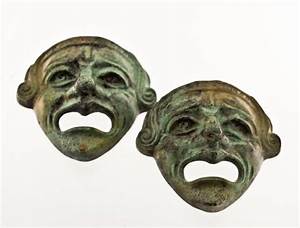
And lastly there is the Chorus, at once the strangest and the most beautiful of all these ancient and remote conventions. If we can understand the Chorus we have got to the very heart of Greek tragedy.
The objections to the Chorus are plain to any infant. These dozen homogeneous persons, old men or young women, eternally present and almost never doing anything, intruded on action that often demands the utmost privacy: their absurdity, on any plane of realism, is manifest. We need waste no more words upon it. Verisimilitude is simply thrown to the winds. That is, no doubt, a great sacrifice, and fine artists do not as a rule incur a sacrifice without making sure of some compensating gain. Let us try to find out what that gain was, or at least what the great Greek artists were aiming at. And let us begin by forgetting the modern stage altogether and thinking ourselves back to the very origins of drama.
The word “chorus” mean “dance” or “dancing-ground.” There were such dancing floors on Greek soil before ever the Greeks came there. They have been found in prehistoric Crete and in the islands. We hear in Homer of the “houses and dancing-grounds” of the Morning Star. The dance was as old as mankind; only it was a kind of dance we have almost forgotten. The ancient dance was not, like our ballets, rooted in sexual emotion. It was religious: it was a form of prayer. It consisted in the use of the whole body, every limb and every muscle, to express somehow that overflow of emotion for which a man has no words. And primitive man had less command of words than we have. When the men were away on the war-path, the women prayed for them with all their bodies. They danced for the men’s safe return. When the tribe’s land was parching for lack of rain the tribesmen danced for the rain to come. The dance did not necessarily imply movement. It might consist in simply maintaining the same rigid attitude, as when Moses held out his arms during the battle with the Amalekites or Ahure in the Egyptian story waited kneeling and fasting for Nefrekepta’s return.
Now if we consider what kind of emotion will specially call for this form of expression it is easy to see it will be the sort that tends quickly to get beyond words: religious emotions of all kinds, helpless desire, ineffectual regret and all feelings about the past. When we think of the kind of ritual from which tragedy emerged, the lament for a dead god, we can see how well a dance was fitted, in primitive times, to express the emotions we call tragic.
This dance gradually grew into drama; how it did so is an old story. Into the inarticulate mass of emotion and dumb show which is the Dance there comes some more articulate element. There comes someone who relates, or definitely enacts, the actual death or “pathos” of the hero, while the Chorus goes on as before expressing emotion about it. This emotion, it is easy to see, may be quite different from that felt by the Hero. There is implied in the contemplation of any great deed this ultimate emotion, which is not as a rule felt by the actual doers of it, and is not, at its highest power, to be expressed by the ordinary language of dialogue. The dramatist may make his characters express all they can properly feel; he may put into articulate dialogue all it will bear. But there still remains some residue which no one on the stage can personally feel and which can only express itself as music or yearning of the body. This residue finds its one instrument in the Chorus.
Imagine the death of some modern hero, of Lincoln or of Nelson, treated in the Greek form. We should have first a Messenger bringing news of the battle of Trafalgar or the pistol-shot in the Washington theater. The hero would be borne in dying; his friends would weep over him; we should hear his last words. But there would always remain some essential emotion or reflection — sadness, triumph, pathos, thoughts of the future from which this man will be lacking or of the meaning of this death in human history: neither Lincoln nor Nelson can express this, nor without falsity any of their human companions. In a novel the author can express it; in a modern play or a severely realistic novel it is generally not expressed except by a significant silence of some symbol. For realistic work demands extreme quickness in its audience, and can only make its effect on imaginations already trained by romance and idealism. On the Greek stage the Chorus will be there just for this purpose, to express in music and movement this ultimate emotion and, as Haigh puts it, to “shed a lyrical splendor over the whole.” It will translate the particular act into something universal. It will make a change in all it touches, increasing the elements of beauty and significance and leaving out or reducing the element of crude pain. This is nothing extraordinary: it is the normal business of poetry, at least of great tragic poetry. An actual bereavement is an experience consisting of almost nothing but crude pain; when it is translated into religion or poetry, into “Rachel weeping for her children,” or intro “Break, break, break,” it has somehow become a thing of beauty and even of comfort.
The important thing to observe is … a Greek tragedy normally proceeds in two planes or two worlds. When the actors are on the stage we are following the deeds and fates of so many particular individuals, lovers, plotters, enemies, or whatever they are, at a particular point of time and space. When the stage is empty and the Choral Odes begin, we have no longer the particular acts and places and persons but something universal and eternal. The body, as it were, is gone and the essence remains. We have the greatness of love, the vanity of revenge, the law of eternal retribution, or perhaps the eternal doubt whether in any sense the world is governed by righteousness.
Thus the talk about improbability with which we started falls into its proper insignificance. The Chorus in Euripides is frequently blamed by modern scholars on the ground “it does not further the action,” its presence is “improbable,” or its odes “irrelevant.” The answer is that none of these things constitutes the business of the Chorus; its business is something considerably higher and more important.
Of action and relevancy we will speak later. They are both closely connected with the question of verisimilitude. And as for verisimilitude, we simply do not think of it. We are not imitating the outside of life. We are expressing its soul, not depicting its body. And if we did attempt verisimilitude we should find that in a Chorus it is simply unattainable. In Nelson’s case a Chorus of Sailors would be every bit as improbable as a Chorus of Mermaids or Angels, and on the whole rather more strikingly so. If we try to think of the most effective Choruses in modern tragedies, I do not think we shall hit on any bands of Strolling Players or Flower Girls or Church Choirs or other Choruses that aim at “naturalness”; we shall probably go straight to the Choruses of Spirits in Prometheus Unbound or those of The Ages and The Pities in Hardy’s Dynasts. The Chorus belongs not to the plane of ordinary experience, where people are real and act and make apposite remarks, but to that higher world where, in Cornford’s words, “metaphor, as we call it, is the very stuff of life.”
With very few exceptions, Greek Choruses are composed of beings who are naturally the denizens or near neighbors of such a world. Sometimes they are frankly supernatural, as in the Eumenides, or half supernatural, as in the Bacchae; sometimes they are human beings seen through the mist of a great emotion, like the weeping Rachaels of the Suppliant Women; the captives of the Trojan Women or the Iphigenia; the old men who dream drams in the Heracles. Even if they start as common men or women, sooner or later they become transformed.
The problem of the Chorus to Euripides was not how to make it as little objectionable as possible; it was how to get the greatest and highest value out of it. And that resolves itself largely into the problem of handling these two planes of action, using now the lower and now the upper, now keeping them separate, now mingling them, and at times letting one forcibly invade the other. I cannot here go into details of the various effects obtained from the Chorus by Euripides; but I will take a few typical ones, selecting in each case scenes that have been loudly condemned by critics.
The first and most normal effect is to use the Chorus for “relief”; to bring in, as it were, the ideal world to heal the wounds of the real. It is not, of course, “comic relief,” as indulged in so freely by the Elizabethans. It is a transition from horror or pain to mere beauty or music, with hardly any change of tension. I mean, if the pain has brought tears to your eyes, the beauty will be such as to keep them there, while of course changing their character. It is this use of lyrics that enables the Greek playwright to treat freely scenes of horror and yet never lose the prevailing atmosphere of high beauty. Look at the Salamis Chorus in the Trojan Women immediately following the child’s death; the lyrics between Oedipus and the Chorus when he has just entered with his bleeding eyes; or, in particular, the song sung by the Chorus in Hippolytus just after Phaedra has rushed off [stage]. We have had a scene of high tension and almost intolerable pain, and the Chorus, left alone, make certainly no relevant remark that would not be an absurd bathos. They simply break out (732 ff.):
Could I take me to some cavern for mine hiding,
In the hill-tops, where the sun scarce hath trod,
Or a cloud make the home of mine abiding,
As a bird among the bird-droves of God. …
It is just the emotion that was in our own hearts; the cry for escape to some place, however sad, that is still beautiful: to the poplar grove by the Adriatic where his sisters weep for Phaethon; or, at last, as the song continues and grows bolder, to some place that has happiness as well as beauty; to that “strand of the Daughters of the Sunset.”
Where a sound of living waters never ceaseth
In God’s quiet garden by the sea,
And Earth, the ancient Life-giver, increaseth
Joy among the meadows, like a tree.
And the wish for escape brings an actual escape, on some wind of beauty, as it were, from the Chorus’s own world. This is, on the whole, the most normal use of the Choric odes, though occasionally they may also be used for helping on the action. For instance, in the ode immediately following that just quoted the Chorus gives a sort of prophetic or clairvoyant description of [Phaedra’s impending death].
But the Greek Chorus does not only sing its great odes on an empty stage; it also carries on, by the mouth of its Leader, a certain amount of ordinary dialogue with the actors. Its work here is generally kept unobtrusive, neutral and low-toned. When a traveler wants to ask his way; when the hero or heroine announces some resolve, or gives some direction, the Leader is there to make the necessary response. But only within certain carefully guarded limits. The Leader must never become a definite full-blooded character with strongly personal views. He must never take really effective or violent action. He never, I think, gives information which we do not already possess or expresses views which could seem paradoxical or original. He is an echo, a sort of music in the air. This comes out clearly in another fine scene of the Hippolytus, where Phaedra is listening at the door and the Leader of the Chorus listens with her, echoing and making more vibrant Phaedra’s own emotion (565-600).
At times, in these dialogue scenes, an effect is obtained by allowing the Chorus to turn for a moment into ordinary flesh and blood. In the Iphigenia in Tauris (1055 ff.) the safe escape of Iphigenia and Orestes depends on the secrecy of the Chorus of Greek captives. Iphigenia implores them to be silent, and, after a moment of hesitation, because of the danger, they consent. Iphigenia, with one word of radiant gratitude, forgets all about them and leaves the stage to arrange things with her brother. And the captives left alone watch a sea-bird winging its way towards Argos, whither Iphigenia is now going and they shall never go, and break into a beautiful home-sick song. Similarly in the splendid finale of Aeschylus’ Prometheus the Daughters of Ocean, who have been mostly on the unearthly plane throughout the play, are suddenly warned to stand aside and leave Prometheus before his doom falls: in a rush of human passion they refuse to desert him and are hurled with him into Hell.
At other times the effect is reached by emphasizing just the other side, the unearthliness of the Chorus. In the Heracles, for instance, when the tyrant Lycus is about to make some suppliants leave the protection of an altar by burning them — a kind of atrocity which just avoided the technical religious offence of violating sanctuary — the Chorus of old men tries for a moment to raise its hand against the tyrant’s soldiers. It is like the figures of a dream trying to fight — “words and a hidden-featured thing seen in a dream of the night,” as the poet himself says, trying to battle against flesh and blood; a helpless visionary transient struggle which is beautiful for a moment but would be grotesque if it lasted. Again, in the lost Antiope there is a scene where the tyrant is inveigled into a hut by murderers: he manages to dash out and appeals to the Chorus of old men for help. But they are not really old men; they are only ancient echoes or voices of Justice, who speak his doom upon him, standing moveless while the slayers come.
These examples enable us to understand a still stronger effect of the same kind which occurs in the Medea and has, until very lately, been utterly condemned and misunderstood. It is an effect rather reminding one of the Greek fable of a human wrong so terrible it shook the very Sun out of his course. It is like the human cry in the Electra … which shook the eternal peace of the gods in heaven. There is something delirious about it, an impossible invasion of the higher world by the lower, a shattering of unapproachable bars.
Medea has gone to murder her children inside the house. The Chorus is left chanting its own, and our, anguish outside. “Why do they not rush in and save the children?” asked the critics. In the first place, because that is not the kind of action a Chorus can ever perform. That needs flesh and blood. “Well,” the critic continues, “if they cannot act effectively, why does Euripides put them in a position in which we instinctively clamor for effective action and they are absurd if they do not act?” The answer to that is given in the play itself. They do not rush in; there is no question of their rushing in: because the door is barred. When Jason in the next scene tries to enter the house he has to use soldiers with crowbars. The only action they can possibly perform is the sort that specially belongs to the Chorus, the action of baffled desire.
Medea is in the house; the Chorus is chanting its sublimated impersonal emotion about the Love that has turned to Hate in Medea, and its dread of things to come (1267 ff.):
For fierce are the smitings back of blood once shed
Where Love hath been: God’s wrath upon them that kill,
And an anguished Earth, and the wonder of the dead
Haunting as music stil. …
when a sudden cry is heard within. The song breaks short, and one woman speaks:
Hark! Did ye hear? Heard ye the children’s cry?
Another
O miserable woman! O abhorred!
Voice of a Child Within
What shall I do? What is it? Keep me fast
From Mother!
The Other Child
I know nothing. Brother! Oh
I think she means to kill us.
One of the Chorus
Let me go!
I will! – Help, help! And save them at the last!
Child
Yes, in God’s name. Help quickly or we die!
The Other Child
She has almost caught me now: she has a sword.
One sees the Women of the Chorus listening for the Children’s words; then they break, as it were, from the spell of their own supermortal atmosphere, and fling themselves on the barred door. They beat in vain against the bars and the Children’s voices cry for help from the other side.
But the inrush of violent horror is only tolerated for a moment. Even in the next words we are moving back to the realm of formal poetry:
Women Beating at the Door
Thou stone, thou thing of iron! Wilt verily
Spill with thine hand that life, the vintage stored
Of thine own agony?
Others
A woman slew her babes in days of yore,
One, only one, from dawn to eventide. …
and in a moment we are away in a beautiful remote song about far-off children who have been slain in legend. That death-cry is no longer a shriek heard in the next room. It is the echo of many cries of children from the beginning of the world, children who are now at peace and whose ancient pain has become part mystery and part music. Memory — that Memory who was mother of the Muses — has done her work upon it.
We see here the justification of the high formalism and convention of Greek tragedy. It can touch without flinching any horror of tragic life, without failing in sincerity and without marring its normal atmosphere of beauty. It brings things under the great magic of something which is hard to name, but which I have tried in these pages to indicate; something we can think of as eternity or the universal or perhaps even as Memory. For Memory, used in this way, has a magical power. As Bertrand Russell has finely put it in one of his Essays, “The Past does not change or strive. Like Duncan in Macbeth, ‘After life’s fitful fever it sleeps well.’ What was eager and grasping, what was petty and transitory, has faded away. The things that were beautiful and eternal shine out like stars in the night.”
This power of transfiguration belongs in varying degrees to all poetry, but it belongs in special force to Greek Tragedy; and Greek Tragedy attains it in part by all its high religious traditions and severities of form, but most fully by means of its strangest convention, the Chorus; the band of half-embodied emotions and memories, the lyric song and the dance expressing things beyond speech. It is through this power that tragedy attains its peculiar quality of encouragement and triumph. We must not forget that Aristotle, a judge whose dicta should seldom be dismissed without careful reflection, distinguishes tragedy from other forms of drama not as the form that represents human misery but as that which represents human goodness or nobleness. If his MSS. are to be trusted he even goes so far as to say tragedy is “the representation of Eudaimonia,” or the higher kind of happiness. Of course he fully recognizes the place of death and disaster in it, and he prefers the so-called “unhappy ending.” The powers of evil and horror must be granted their full scope; it is only thus that we can triumph over them. Only when they have worked their uttermost will do we realize there remains something in man’s soul which is forever beyond their grasp and has power in its own right to make life beautiful. That is the great revelation, or the great illusion, of tragedy.
It is achieved, apparently, by a combination of two extremes; in matter of full facing of tragic facts, and in form a resolute transfiguration of them by poetry. The weak artist shirks the truth by a feeble idealism; the prosaic artist fails to transfigure it. Euripides seems to me to have gone further than any other writer in the attempt to combine in one unity these separate poles. In this lies, for good or evil, his unique quality as a poet. To many readers it seems his powers failed him; his mixture of real life and supernatural atmosphere, of wakeful thought and dreaming legend, remains a discord, a mere jar of over-wrought conventions and violent realism. To others it is because of this very quality that he has earned the tremendous rank accorded him by Goethe, and in a more limited sense by Aristotle, and still stands out, as he stood over two thousand years ago, “even if faulty in various ways, at any rate clearly the most tragic of the poets.”
 Redeeming Pandora