
Justin Benner
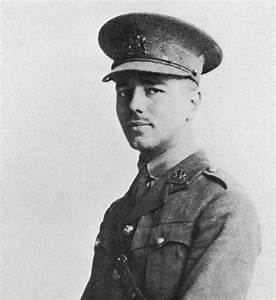
Wilfred Owen is recognized as the greatest English poet of the First World War. Wilfred Owen from the age of 19 knew he wanted to be a poet and therefore immersed himself into authors like Keats and Shelley. In late October 1915 he enlisted into the British Military being persuaded by propaganda. He was deployed to France in 1916 and fought on the front lines. He slept 70 yards away from a heavy gun that fired almost every minute. Within a month he had officially seen the worst of the war, and it truly changed his perspective. This rapid change of perspective led him to write war poetry. In October 1918 he received the Military Cross but died only a month later near the village of Ors. He wrote 46 war poems in all in his lifetime (warpoetry.co.uk).
One of his most famous poems is “Anthem for Doomed Youth.” This short and rather gloomy poem talks about the horrors of trench warfare on the front lines. Since he enlisted at 19, this poem almost has the ring of a warning poem, trying to keep other young men away from the battle. The opening line says: “What passing bells for these who die as cattle?” These passing bells are exactly what they sound like: they are bells rung after someone passes away. He is comparing the trench warfare in France to the slaughterhouse for cows. He is making a very vivid comparison. “Only the monstrous anger of the guns. Only the stuttering rifles’ rapid rattle can patter out their hasty orisons.” He sets a very descriptive picture up here. He is describing the sound of the battlefield with the anger of the guns and the stuttering rifles. This clearly doesn’t mean rifles stutter, but rather there are simply so many guns on the field shooting at once it sounds like a few stuttering rifles. Then he says only this extremely loud and unending noise silences their hasty orisons. Or in other words, it’s so loud you can’t hear the soldiers’ hasty prayers. “No mockeries now for them; no prayers nor bells; Nor any voice of mourning save the choirs, The shrill, dementedchoirs of wailing shells; and bugles calling for them from sad shires.” Here he is trying to convey the idea there will be no funeral or mourning for those lost but rather just a loud chorus of bombshells falling. There is such a bleak outlook on life presented in there lines. It’s almost as if Wilfred Owen doubts he will make it home alive.
“What candles may be held to speed them all? Not in the hands of boys, but in their eyes shall shine the holy glimmers of goodbyes. The pallor of girls’ brows shall be their pall; their flowers the tenderness of patient minds, and each slow dusk a drawing-down of blinds.” These last few lines really have to do with the effects the war has at home. The candles refer to the candles one would see at a funeral. He then switches from the physical candle to the light in a young boy’s eyes as they stare in disbelief at an empty casket. He is really hitting close to home for a lot of people during this time. Most if not all men were off fighting in the war, leaving mostly woman and younger men at home to deal with all the domestic problems. The very last line “and each slow dusk a drawing-down of blinds” is Owen bringing the poem and the metaphorical day to a close. On the battlefield the end of the day is symbolized by the sun setting whereas at home it’s symbolized by the blinds being closed. This poem was one of the first he wrote almost immediately after enlisting. His distaste for the war and the devastation it brought upon Europe is very apparent.
 Redeeming Pandora