
Destiny Phillips Coats
When one thinks of the Wild West, many different components come to mind like bison, Indians, farms, horses, whiskey and more. Film after film and novel after novel have been made that try to capture the perfect idea of the West and what it brings to viewers and readers everywhere. The most famous constituent of the Wild West is most definitely the cowboy. In the hearts and minds of children everywhere, they see cowboys as strong handsome men who herd cattle, live on farms, and fight the Indians. The question is, however, who were cowboys really and how have they influenced literature and film?
The cowboy was a term coined for the cattle herder in Texas during the era of the open range and great cattle drivers of 1886-1896. Due to the scarcity of cattle up North, the Texans saw promise in the economic value of selling cattle. In Texas of 1886, a steer worth 4 dollars was valued at 40 dollars in the North. Cowboys began taking cattle up north to the train station in Sedalia, Missouri to send to their new business partners.
The adventurous and dangerous lifestyle of the cowboy came from the travelling aspect of their job. With the migration of their cattle, the cowboy crossed over farm land and Indian Territory. Confrontation indeed arose from the cattle trampling crops and the homelands of the Indians. These conflicts were inspiration for the stories that portrayed cowboys as lawless and adventurous men who fought the Indians and lived freely in the Wild West.
Merriam Webster says the cowboy is “a man who rides a horse and whose job is to take care of cows or horses especially in the western U.S.” This definition can seem boring in light of our connotation with a cowboy being much more dreamy and adventurous. Where does the strong, handsome, courageous, and dreamy cowboy come from? The answer to that question is literature.
The Virginian by Owen Wister, written in 1902, was the first novel that portrayed the cowboy as what we see him today. This novel about a cowboy who falls in love with an eastern school teacher started a revolution in American literature about the cowboy and his adventures. Owen Wister was from Philadelphia and graduated from Harvard College. Experiencing the freedom of the West on a hunting trip inspired him to write The Virginian. The way he portrays the beauty and free mind of the western citizen inspired others to create stories to take readers on an adventure of the cowboy in the “land of the free” and “home of the brave.” Countless other books have been written that express the meaning of our connotation of the word “cowboy.” They include Lonesome Dove, Riders of the Purple Sage, Hondo, All the Pretty Horses, and so many more. As technology advanced and film making became a part of media, cowboys leaped off the pages onto the big screen.
Cowboys came onto the film scene in 1903 with the making of The Great Train Robbery by Edwin S. Porter. Cowboys have taken on so many roles and influenced the hearts and minds of Americans for generations. TV shows like Bonanza; Walker, Texas Ranger; and Gunsmoke are just three examples of the numerous western TV series with main characters of cowboys.
The explanation of why cowboys are so amazing and great characters for literature and media is said perfectly in the following excerpt.
The men who worked the cattle in the treeless expanses of the West, at least one-fourth of them blacks, became known as cowboys. The image of the courageous, spirited horseman living a dangerous life carried with it an appeal that refuses to disappear. Driving a thousand to two thousand cattle hundreds of miles to market; facing lightning and cloudbursts and drought, stampedes, rattlesnakes, and outlaws; sleeping under the stars and catching chow at the chuckwagon — the cowboys dominated the American galaxy of folk heroes.
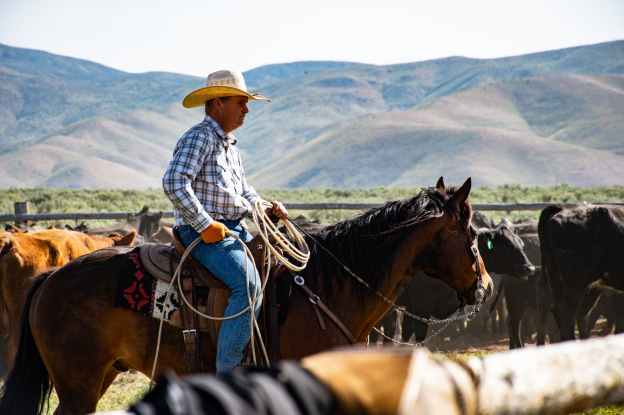
More than just the spirit of the cowboy influenced literature and film. The cowboy’s distinct yet necessary dress has penetrated the realm of American fashion. Each article of clothing had a purpose for the cowboy. From the soles of his feet to the top of his head, the cowboy took every opportunity to make use of what he had on the vast plains of the Midwest. The boots with thick heels and spurs made it easier to rest their feet in the stirrups on horseback and dig into the ground while catching a calf. The flannel or wool shirt kept him warm during the cool days and nights on the western terrain. The vest was worn for protection from cold nights in the vast plains of the west. A bonus to the vest was the many pockets it had, which often carried tobacco. The bandana often seen in western movies around their necks was used to cover their mouths and noses from dust that circulated in the flatlands. The wide flexed rim of the hat blocked the hot sun, held water, and even worked as a pillow during a night’s rest on the flat surface of the Midwest earth. Flannel shirts and cowboy boots have been a fashion trend since the time of the cowboy in 1886-1896. With the strong influence the West has had on who Americans are and our heritage, cowboy fashion will never go out of style.
With all the portrayals of brave men who love and ride hard in novels, film, and fashion, how do we separate who they really are versus how we see them? We can’t and we won’t. The cowboy we love so much has become an American hero, and changing how we see them would be taking a part of our history away. They are a symbol of American pride and adventure. They are representative of the free spirit and beauty of the west. They are inspiration for so many wonderful characters, from Woody in Toy Story to Walker in Walker, Texas Ranger. Cowboys will never be forgotten. They were important to society then, now, and forever.
So who is a cowboy? He is an American hero.
Bibliography
“Cowboys.” History.com. A&E Television Networks, n.d. Web. 04 October 2015.
Merriam-Webster. Merriam-Webster, n.d. Web. 07 Oct. 2015.
“The Ways of the Cowboy.” Ushistory.org. Independence Hall Association, n.d. Web. 04 Oct. 2015.
 Redeeming Pandora