
Christopher Rush

In Love with Norma Loquendi, William Safire ⭐⭐⭐
That was a whole lot of Safire, that’s for sure. It was good, but the heft of it all gets to you somewhere in the middle and you realize why people would read this day by day in the paper (or week by week — it’s not really clear, since it was published at a time when everyone just knew it, very unhelpful for posterity) and not all in one lump sum. His cleverness and facility with language are enjoyable, certainly, which is likely why he had the various positions in society he held for so long. Sadly, much of it is rather dated, especially the political entries, which may be a significant drawback, especially to people younger than me (which accounts for most of the world’s population, apparently). Many of the entries deal with people whose time on the world stage ended almost 25 years ago (I was about to type “15,” but, yeah, well…), so their currency has dwindled. How many Secretaries of State from the 1980s can you name? Exactly. Many names rang the tocsins of long-distant memories, but that’s about it (not to be confused with “toxins”). Some may enjoy this for the response letters included, hearing from such used-to-be-famous people such as Jacques Barzun, George Carlin, Colin Powell, Mrs. John Steinbeck, and others you may or may not recognize. I enjoyed many of the linguistically-driven entries, of course, being me, and I’m glad I read it, but it’s a total package that today may be slightly less than the sum of its parts, no disrespect intended to Mr. Safire who is today, years after he died, still far more intelligent than I am.
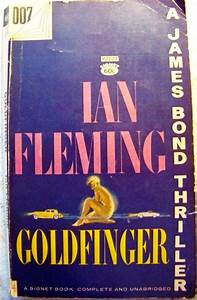
Goldfinger, Ian Fleming ⭐⭐⭐
Most of the book deserves a 2.5 stars, perhaps maybe just 2, but the intensity of the last few chapters and the double-ending motivated me to round it up a bit. The book is mostly dull. There’s a lot of watching Bond do fairly simple, almost routine things: he’s driving, he’s golfing, he’s checking out a house, he’s doing office work. Yes, there’s a patina of tension and suspense and intrigue, but it’s also very rough going for much of the middle. Once again Bond is the big hero thanks to a good deal of coincidence, happenstance, and luck. Also, his attitudes are far less admirable in this than in Doctor No (which gets too much flack for this issue): he’s quite a bit racist and misogynistic in this one, and Fleming’s take on Ms. Galore and her “turn” to Bond at the end is likely rather cringe-worthy (and not just because “it’s the 21st century”). Yes, Tilly Masterson does help bring about her own demise, but Fleming also transmogrifies her from a competent, intelligent woman to a panicky dolt just before her end, which was disappointing.
The eponymous character certainly steals the show, especially in the latter half of the story. We don’t necessarily want Goldfinger to win or get away, but Fleming does present him as a worthwhile opponent for Bond (who has apparently become very famous and even his secret code number is recognizable all over America, which seems a bit detrimental to a secret agent!). His self-made empire is nearly impregnable, especially with his second-in-command, Oddjob. The resurgence of Smersh doesn’t really add anything, especially since most of us would prefer SPECTRE instead of Smersh, but there it is. The real highlight is certainly the end, and the pacing helps make it even more impressive (even if it is a tough slog to get there), especially in the way it ends twice. The double ending helps us forgive the almost outlandishly fortuitous nature of how Bond single-handedly (sort of) crumbles Operation Grand Slam (thanks to the timely nature of the airport cleaning service and the uber-fortunate travel plans of Felix Leiter). The real ending is top-notch Bond (other than the Ms. Galore stuff), even, ironically, in the way he has to become totally unlike himself (as he’s had to do that for most of it) to get the job done. The psychological component of whether Bond is responsible for all the Fort Knox deaths or not (could he have done more?) is also a refreshing component to this mid-career Bond adventure. Does it completely erase all the flaws? No, not at all, but it does salvage the entire work well.
 Redeeming Pandora
Pingback: Summer Reading 2015 | Redeeming Pandora