
Christopher Rush
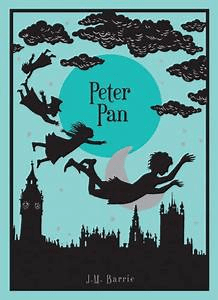
Peter Pan, J. M. Barrie ⭐⭐
Peter Pan is a big jerk. The narrator is a bigger jerk, though. What did Barrie mean by “heartless”? Does he mean “cruel and thoughtless”? or did it mean something more gentle to him? Are we supposed to be amused by Peter and his antagonism to mothers, especially since the narrator seems to present mothers as part of “the problem” anyway? or are we to shake our heads at Peter and Wendy and John and Michael and encourage our own children to grow up “the right way”? I didn’t like this book all that much, and my daughter didn’t like it either, though we disliked it for different reasons. She was disappointed Jake and Cubby and Sharkey and Bones weren’t in it. I was disappointed because of the violence, the indecisiveness of Barrie’s narrator (or Barrie himself) as to which side is being presented as the “proper” side, and how repetitious and tedious it was. This is probably a “classic” because of the “ideas of Peter Pan and Neverland,” not the actual content — which is fair, since that is likely why people are enthusiastic about Allan Quatermain. The movie versions have salvaged both of these “classics,” rescuing the worthwhile ideas buried under the morasses of tendentious Victorian rambling. And don’t get me wrong, I am an ardent enthusiast of quality Victorian writing: Tennyson, Arnold, Newman, Ruskin, et cetera, et cetera. Certainly the list of great Victorian writers, authors, poets, critics could go on for dozens of entries. But Peter Pan the novel is not very good. Children are presented as idiots. Parents are presented as idiots. The narrator is too cynical for his/its own good. Now we know.

The Wonderful Wizard of Oz, L. Frank Baum ⭐⭐
As with Peter Pan, the reading of this American Classic was a bit disappointing from this side of childhood. My daughter seemed to enjoy it well enough, which was fine, and she wasn’t scared by the Wicked Witch’s demise (primarily because she made me tell her what happens to her before we started the book), which was another nice aspect of this reading. The book, however, is chock full of cynical asides and unhumorous commentary. The characters are monolothic and shallow. Dorothy is not impressive as a heroine. The Scarecrow, Tin Woodman, and Cowardly Lion just magjickally get their own kingdoms to rule just because. There’s nothing “wonderful” about the Wizard: he has his people just as enslaved as the Witch does. Plus, the plot is very dull — the events are more disconnected than the adventures Huckleberry Finn has. I acknowledge this is all for the benefit of children, but it seems almost antagonistic to children to give their imaginations such shallow fodder upon which to feed. Perhaps if the ideas were developed longer instead of meeting such diverse characters for five pages then never seeing or hearing about them again, the discordancy of the work may have been ameliorated, but oh well. It’s basically the literary version of an episode of Sesame Street: every five minutes something new and flashy with very little time to explain, ponder, digest, evaluate. Sure, you’re thinking “children can’t do that!” Not if we treat them that way, that’s for sure. Am I saying this is a bad book? Not really. It’s just one of those books with lots of interesting potential, but it has no desire to develop any of the intriguing ideas. If the children are supposed to do that themselves, great, but why read this book, then? I know, I know: it’s a classic. We should all love it. Better still, love the idea of it, and then shake your head with irritation at all the cynical moments.
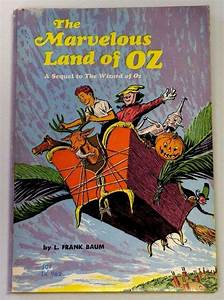
The Marvelous Land of Oz, L. Frank Baum ⭐⭐
Once again the “ideas” of Oz are more important than what actually happens in the story. I certainly don’t fault Mr. Baum for going in a slightly different direction, though that direction becomes rather similar to what we’ve already seen before too long. Once again a young person meets some bizarre characters, and they go on a trip to someplace only to turn right around and go somewhere else then turn right around again and go back to where they started. This time, the purpose of the journeys are far less significant than in the first book, the political satire is so sexist it couldn’t even be funny back in the day, and the characters are poor imitations of the original crew (including the returning characters, yes). Then the super-big-surprise twist at the end, which, blah blah blah, is as predictable as it is banal and uncomfortable. It does have a few humorous moments, but the inexplicable anger of the wooden horse, especially in his antagonism with Jack and others, the puns and such of the Woggle-Bug, the nonsensical wish scene and jackdaw scene (why not just wish to be back where they want to be?), the whole Jinjur stuff and the Jellia Jamb stuff … this book is more tedious than enjoyable (for grown-ups … kids may still like the weirdness of it all).
 Redeeming Pandora
Pingback: Summer Reading 2015 | Redeeming Pandora