
Christopher Rush
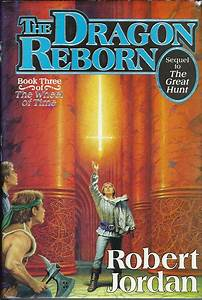
The Wheel of Time #3: The Dragon Reborn, Robert Jordan ⭐⭐⭐⭐
WHY DO THESE “HEROES” NEVER TELL EACH OTHER ANYTHING?!? That said, I really liked this book. It could quite easily be my favorite of the whole series, though I’ll have to read 11 or so more books to find out for sure. The series really gets going with this third installment, which, I admit, is rather a misleading thing to say, since Book 1 (The Eye of the World) ends with this heavy ominous sense of “this marks the beginning of the end of the world,” but over 1,000 pages and two books later, “the end of the world” is still slowly building, chapter by chapter, month by month. It has been a few years since I read Book 2 (The Great Hunt), but Mr. Jordan does a great job of recalling to our mind the major events and characters from the previous installments (though mainly the ones that affect the current novel — some significant supporting characters/happenings may be overlooked if consequences don’t directly affect the book in hand), so I could quite easily get back into the main flow of it all.
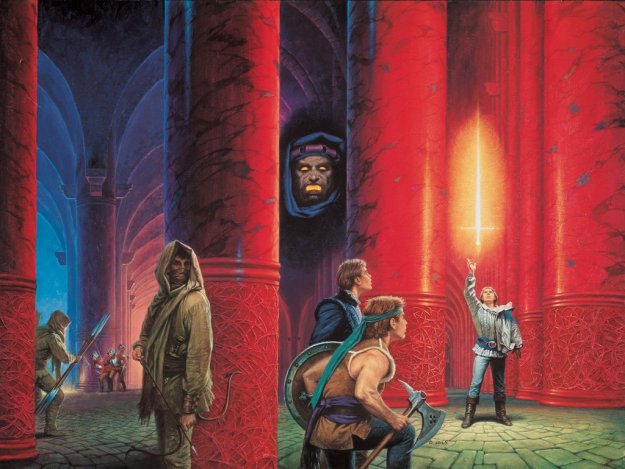
One element I really enjoyed is the almost complete absence of Rand, our main “hero.” It’s not that I dislike Rand, but he is in a very bizarre place now, still coming to grips with whether or not he is The Dragon Reborn, what that may mean, what he’s supposed to do, what that means for his friends (are they even still friends? can you be friends with the Destroyer of the World?) — and leaving him out of the spotlight until he gets to a spot of truly significant and interesting movement, letting us spend time getting to know the ever-expanding cast of supporting and other top-tier characters, really is a highlight of the book. I liked how his presence was more felt than seen, as the main core of focus characters are tracking and following him, so we see the effects of Rand’s progress to the next big event, which, when he returns and does his thing, is pretty exciting.
Another enjoyable aspect of the book is the dearth of negative things. It does have the requisite Trolloc attack toward the beginning, a couple of sad minor character deaths, and Nynaeve and the girls get roughed up toward the end, but on the whole it’s a generally positive book. Perrin has some rough moments, sure, but I’m pretty sure it will get worse for him later. Thom is still suffering from his loss from Book 2 (quite reasonably), but he adjusts as the book develops. Mat, finally, is an interesting character again, after being mostly sick and dying and irritating for much of The Great Hunt (if memory serves). He is finally back to health toward the end of the book, and he gives us some very humorous moments. That is part of the enjoyment of this book: it has genuinely funny moments throughout, which will likely be few and far between as the seriousness of the time and events increases.
Not everything in the book is enjoyable, but it is far better than much (if not most) of the criticism against it warrants. I was told over a decade ago it was around this point in the series it gets a bit more sexual, and that is true. Mr. Jordan does tend to add unnecessary sexual comments here and there (and there’s more in Book 4, from what I’ve read so far), which is disappointing and unnecessary, but hopefully that will go away soon.
The main irritation for me was the continuing commitment of these heroes not to tell each other anything, as I mentioned at the beginning. Moraine is certainly the most guilty of this, but her taciturnity is developing into an interesting part of the other characters’ growth. These Two Rivers characters are no longer the simple, backwaters hicks she found and rescued at the beginning of Book 1: they have grown and developed in the intervening months, and she can no longer bully and control them, though she would not likely consider herself doing that. The real irritating thing about everyone’s silence is the basic fact they are all supposedly united against the Shadow, you’d think they’d pool their resources and confide and help each other out, but no — they all keep to themselves, they all carry their own burdens, they all stop trusting each other bit by bit. A bit irritating, not because it’s badly written (which some people think, for no good reason) but simply because we want these heroes to get their acts together and knock off the silliness.
Yet, the mistrust issue is what helps separate this series from what many mistakenly think is basic Fantasy stereotyping. The Wheel of Time intentionally uses familiar ideas and characters (that’s the point!), but it is not typical: Mr. Jordan crafts it all in palpably distinct ways. Rand is not “the hero who can do no wrong.” In short order, his childhood friends can no longer trust him, because he may very well be The Dragon Reborn, a great hero of old who may very well defeat the Dark One and save the world, but he is potentially someone who will perhaps slay all those close to him and destroy the world while saving it. That’s no Aragorn. The Aes Sedai are here to help, right? But the Reds are willing to destroy even our heroes, and the Blacks are aligned with the Dark One, and Moraine … well, whose side is she really on? Lan would not be with her if she were truly bad, definitely, but if she is fighting for good, why does she keep everything secret? Why does everything have to be done her way? The Amyrlin Seat, likewise, gets the opportunity to show off her strengths in this book. The Aes Sedai are no Bene Gesserit knockoff.
The prophecies and hints and dreams and things may get a bit tedious and tiresome, but a positive spin on them shows there are bigger and bigger things ahead, another distinction from lesser fantasy series. One of the other interesting, distinct aspects of this is how long we stay with each narrative group. Many times at the end of certain chapters, we think “oh, that was neat, where are we going next?” and then the next chapter is following the same group two seconds later. Basically, we follow each group until that group is about to leave whatever town it is in, so the narrative jumpcuts are fewer. This series really delves into the details of these characters and these events. That’s certainly part of why it is so long, and why it may turn off so many, but if you really want a series that gives us a great deal of time with the characters, this is that series. We are with them far longer than we think we will be, but that should appeal to fans more than it should irritate. The only irritating thing is we switch points of view when things are really about to explode, saving the big explosions (literally, in this book) for the slam-bang finish … which Moraine then says is small potatoes compared to what’s coming next.
As I said, the sense of Doom and Destruction hangs heavy, but somehow Mr. Jordan gives us slow, steady progress from key moment to key moment. Most of the books seem to be primarily progressing to the slam-bang finish, but you can’t overlook the important foreshadowings, character developments, introductions of new characters, love-relationship progressions (they all have to get married sometime, even with the destruction of the world looming), humorous scenes, returns of forgotten friends and foes … there’s a lot going on. For its humor, its mostly-safe story-line progressions, the growths of the characters (certainly not as quickly as we may want), this was a very good book in the series, and it will likely propel your interest even further, easily overcoming the feeling of “oh no, 11 more!” Tish and pish. This is a very enjoyable series and is getting better all the time (so far, yes).
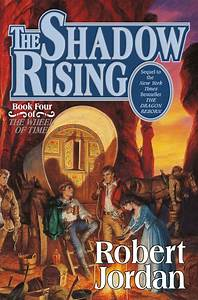
The Wheel of Time #4: The Shadow Rising, Robert Jordan ⭐⭐⭐
Pacing, pacing. This book has a lot of words in it, and while that may be a deterrent to some, it is worth it if you like the series, which is a bit of a tautology, I admit. The Shadow is definitely rising in this one: the bad guys make some significant and somewhat surprising strikes throughout — it’s not nearly as funny or happy as the previous book, though significant positive things happen as well. Book three ended so well, most will likely be frustrated by the beginning of this book: instead of continuing the general positive feelings from where we left off, most of the characters find ways to get mad at each other and fakey sequel/20-minutes-left-in-the-Romantic-Comedy discord that is totally nonsensical and only irritates the patient audience. Unlike the 15 minutes it takes Romantic Comedies to resolve that (about two minutes before the credits role), it takes TWoT about 350 pages (or more) to resolve the initial character silliness (in this instance, about 650 pages).
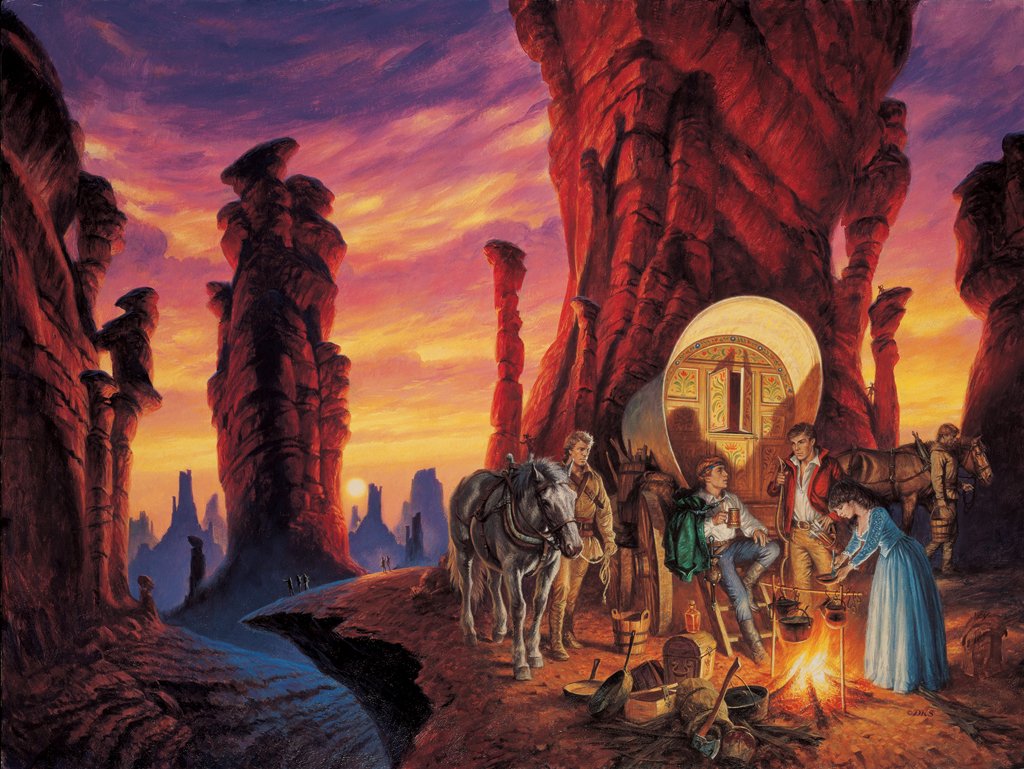
Some very sad things happen in this book, especially things to Perrin and the good Aes Sedai. Irritating things happen with some of the supporting characters, especially Gawyn and Galad (but definitely Gawyn: he does some mind-boggling things in this one, totally destroying an interest we had for him). Mat makes a slight return to Irritating Mat, in that he could have finally spoken his mind/heart and told Rand things and such, but of course he doesn’t, and while he does some fairly semi-heroic things, he still is waffling, which is fairly irritating (more so with the absence of the humorous moments we so enjoyed in book 3). Rand, likewise, does some irritating things, but this is probably the most enjoyable book of him so far, as he grows in acceptance of his role, identity, and such (even if he, too, is too tacit about things — none of these “sure, we’ll save the world!” heroes communicate nearly enough). The ending duel this time around is different enough to be engaging, as it propels us all down a new path (as usual).
What were the positives of this? We learn more about the Aiel, who are becoming far more significant than we thought a book or two ago; great movement occurs in the White Tower (not positive, certainly, but it is definitely significant change); Perrin finally finds love; Mat and Rand are slowly coming around to heroism (in their own ways, naturally); old characters come back and are helpful; the ladies are growing in their Aes Sedai skills (finally); and though I don’t necessarily like it, it’s “positive” for the sake of the grandeur of the book we have some different enemies now (some may not like it, saying “why wouldn’t all the humans just team up and stop the Trollocs and Dark One?” but life isn’t like that now). Another interesting aspect of this is the glimpses into the past of the world, as misty and unclear as they were (they used to have rocket cars?).
This is worth the lengthy trek.
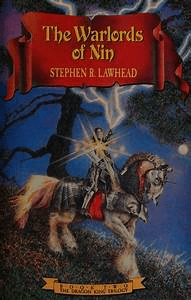
The Dragon King #2: The Warlords of Nin, Stephen R. Lawhead ⭐⭐⭐
I wanted to give this a higher rating, in part because it has a lot of impressive surprises and fine moments, but I couldn’t quite bring myself to do so, so let’s call this a 3.5 rounded down, howabout. Instead of picking up where we left off from the first volume, Lawhead skips us ahead 10 years, which is more helpful than not, except that many of the characters don’t give us the impression they, too, have aged or matured in 10 years. Quentin, our hero again, is more mature for much of it, though he does go through his existential crisis for awhile over whether he is really hero material, which is a bit annoying, and you can guess where he finally ends up (even though we don’t get a whole lot of evidence to support his heroic nature, just his basic decency). Most of the other characters seem 10 years younger: Durwin, Theido, Toli, and Ronsard don’t seem to have aged at all. Durwin, especially, is far feistier than he used to be. Only Biorkis, really, has seemed to age. He, and King Eskevar, who has more withered than aged, but that is tied in to the main plotline. King Eskevar is an intriguing part of this book: we didn’t see him all that much in the first one, but we feel we know him well, and when this book starts, he is basically at death’s door, not because he is weak but because he loves Mensandor (the country) so much and can feel his country’s pain. This is one of the positives of the book, but it is also a weakness, because while many characters say they are aware of Eskevar’s psychic connection to his country and its pain, they also seem to forget it and just think he is weak and crazy by the end.
The main storyline is the world’s great despot (of whom no one has heard), Nin, has arrived on the shores simply because he, like locusts, loves to conquer and absorb everything. He is considered a god, he has thousands under his command, and 4 main warlords who rule over 4 sub-armies. We only meet 1 of them, briefly, though we are given a glimpse of all of them early on. They are all very terrifying and impressive, but most of the suspense of this mighty army’s slow march to Askelon (the main capitol) is narratively distant from these 5 villains. Lawhead does a fine job of making them powerful and dangerous, almost Borg-like in their unstoppability, but, then, like “Best of Both Worlds, pt. 2,” the good guys have to win out so they just do. Because. That is one of the main irks of this: after 200 pages of slow-building menace and destruction, with 20 pages left we think “this must be part one,” but suddenly it’s all over and we’re wondering what happened.
Some of the other irksome aspects of the book are the dropped storylines: we spend some time with the Dekra ruling council early on, giving us the impression this old mighty town and its fate is connected to the story, but soon we never see them again and all the action takes place elsewhere. Similarly, Biorkis is somehow defrocked and excommunicated from the priesthood, which is a really big deal, considering they seem to be the only main priests in the entire continent, but no mention is ever made of the fact bad people have now taken over the nation’s priesthood — and it wasn’t even a necessary plot point to get him from the monastery to the castle. He could have just as easily been visiting the castle without the other components (it was like early Discworld books without the humor). All of these ideas are fine, but considering they never go anywhere or get resolved, especially considering so much time is spent on other things that could have easily been trimmed (like the protracted mining scene so late in the book), it’s a bit annoying. Likewise, a big deal is made (almost in an attempt to give Eskevar something to do in the middle of the book) about the other lords and rulers joining Eskevar’s ride against the onslaught, and when some lords don’t join the fight (a bit sketchy why some wouldn’t join up — it’s a bit forced, I felt), Eskevar is all upset, naturally, and they ride out to meet the enemy … only to retreat the same day and come right back to the castle! All that hemming and hawing about needing to ride out and attack, and nothing. (The passage of time among the three different character groups toward the end is also irksome and unwieldy.)
Perhaps the weakest aspect of the book is its treatment of the female characters. In the first book, Queen Alinea was a ball of fire: active, witty, together, all despite the fact her husband was a captive and potentially dead. Here, after 10 more years of peace and happy marriage she likely shouldn’t have gotten, she is a wreck. Now, her husband’s death is imminent, and her emotions are valid and true and all that, but she comes across as weak and soppy throughout, which was a disappointment. Additionally, Lawhead brings in another new character simply because “Toli needs a girlfriend,” not really for any other plot reasons. The seemingly necessary plot movements Princess Esme brings in the beginning are soon erased because all the info she brings is also brought more meaningfully by other characters. The female characters midway through the game have lost all luster and identity. A bit of a shame, since the first book and the beginning of this one had real women characters.
On the whole, it was good, though the many flaws (and Lawhead’s “medieval language” style is in full bloom, like pollen) prevent it from making it great. It has impressive things, as I said: Lawhead does things in here you wouldn’t expect in book 2 (a book 3, maybe, but not a book 2). The book gives us insight into the fact there is a whole rest of the world out there beyond this country (a world with many cultures and nations, apparently). Quentin’s faith becomes substantial here, finally (what was he doing for 10 years?). Other people come to a genuine faith in The Most High God in believable, subtle ways (Lawhead again does a fine job of working faith into it smoothly and realistically and not heavy-handedly). It has flaws, as I enumerated, it drags on for quite a bit in the middle, but it has some very impressive and exciting scenes. It has humorous and warm moments early on. It has very touching moments toward the end. It probably deserves at least a 3.5 after all. This series has impressed me a lot more than I thought it would thus far.
The Complete Fighter’s Handbook, Aaron Allston ⭐⭐⭐
Considering what this is, for what it was intended and such, this is a fairly helpful resource. It’s not “literature,” so giving it 3 stars doesn’t mean I think it’s a better “book” than others I’ve given 2 stars (necessarily), but for a supplement on making your AD&D fighters more interesting, experienced, and “realistic,” it’s a very good resource. Obviously if you are not interested in playing AD&D you aren’t going to look for this, and obviously if you are not playing as a fighter in your AD&D experiences you aren’t going to look for this either, but if you fit the (rather small) niche, this is for you. Likely you already have it or had it, so it’s not going to be a surprise to you in that sense, either. Among the more helpful aspects of this are the additions of fighting style proficiencies, weapons and armor for geographic fighters (such as samurai), and fighting techniques and specialization ideas (especially helpful for those actually role-playing as a fighter, not just silently soloing modules like I do inside my imagination).
I was pleasantly surprised by the affability of the author/narrator/voice whomever who is occasionally directly addressing the reader, in that so many times we are encouraged “if you don’t like this part, don’t use it; if you like it, use it.” I suspected it would have a stricter attitude to some things like “if you want to use this, you have to then add this, that, and this,” but there’s none of that. It’s really a collection of potentially helpful/interesting ideas to make the gaming experience better for those who want it.
I may be somewhat chronologically mistaken about this, but I believe this originally came out toward the beginning of the 2E resource glut (from that magic time of around ’89 to ’97 or so), so the proofreading/editing attention did not seem a high priority, especially toward the end of the handbook (which certainly doesn’t help the general perception of the public toward AD&D players), but these things happen (especially in the 2E resources glut). On the whole, though, it’s a fine resource for pre-3E AD&D fighters.
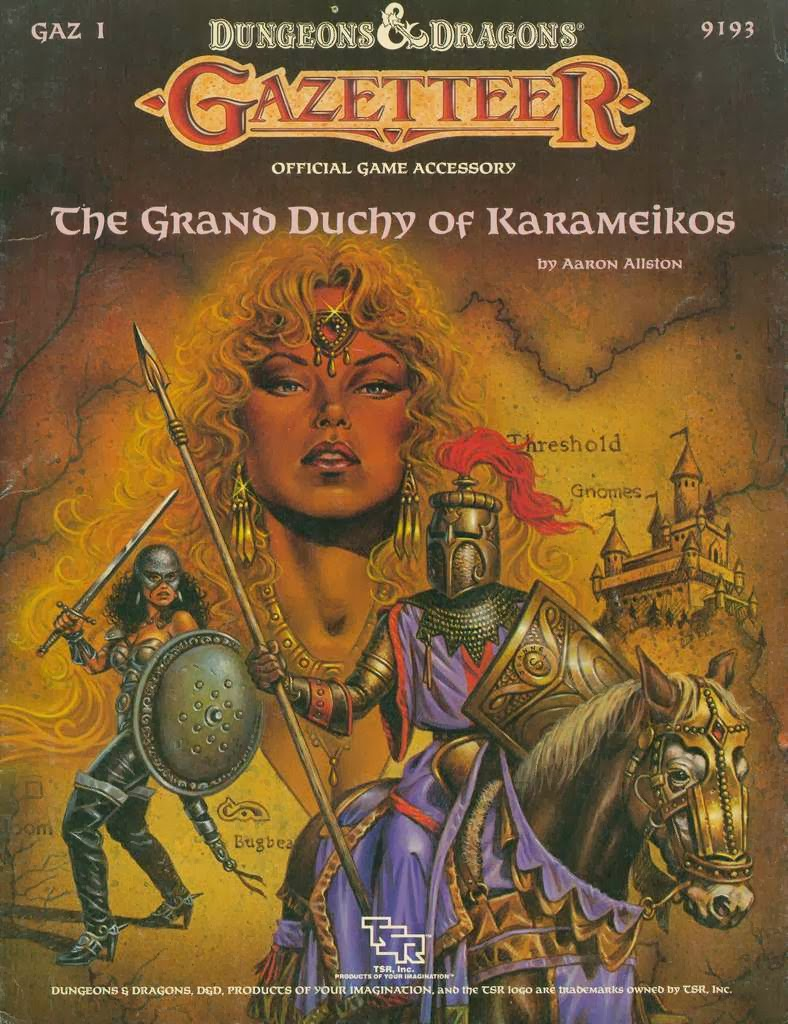
The Grand Duchy of Karameikos, Aaron Allston ⭐⭐⭐
We can all agree, I believe, all of our reviews for these 2E supplement-type things can begin with the basic caveat of “within the limits of its purpose and intended audience….” So feel free to think that at the beginning of the rest of my 2E resource reviews (if any more are forthcoming). This rather intriguing idea for a resource line (as so many of the 2E Golden Age Glut resources were) gives us great detail about the families, organizations, ins and outs, and other whatnots of Karameikos life. Those who may think the creative team has spent way too much time making up this sort of thing for people who don’t really exist are certainly not going to pick this up anyway (or, likely, any other work of fiction), so there’s no need to be bothered by that. Since most of my early AD&D experiences were in Mystara (though I didn’t know First Quest was Mystara at the time), this peals that nostalgia bell loudly and crisply. If there are any drawbacks to it, it is the lack of references to the novels featuring Mystara/Karameikos and these characters, though it’s possible none of those were written when this came out, so that may be more of an anachronistic drawback. It does list the modules featuring Karameikos, which is rather helpful, but it does highlight the potential frustration in that there weren’t more Mystara “official” Karameikos modules at the time, yet it is also one of the highlights of the time: instead of dictating everything that was acceptable to be done in this world, DMs were rather free to take these interesting NPCs with interesting relationships and intrigues and do what good DMs did/do — create and be imaginative. True, someone’s Karameikan campaign could clash with what some future story or module did with the characters, but that would be easily remedied by a good DM. For the players, this module doesn’t have too much other than backstory and NPC info, but it does provide some helpful stats on character generation for Karameikan native characters. This is, I believe, the shortest of the Gazetteer entries, and perhaps the broadest, and thus also perhaps the most helpful. I liked it.
The Castle Guide, Grant Boucher, Arthur Collins, Troy Christensen ⭐⭐⭐
Probably should be 2.5 stars, but I rounded up just because I wanted to be more generous to this, in part because of all the really lousy stuff I’ve been reading lately (in the year I was to read mostly good stuff; oh well). Coming at a time when AD&D 2E was flooding the market with seemingly non-stop manuals, worlds, modules, accessories, and everything else, we see with this part of the problems of so much content being generated so quickly by so few. The first 75% of it (or more) features at least 1 typo per page. It gives us the impression “proofreading” was not a high priority. I don’t want to be too harsh on this point, having published more than my share of accidents and oopsies, but I wasn’t charging $15 for my hastily-edited material. The tone at the beginning, likewise, gives us the sense we aren’t supposed to be taking this all that seriously. And while that is certainly true, we shouldn’t take RPGs very seriously, indeed, the tone at times dances between “yeah, it’s just a fun game, take it easy” and “you are into this? you weirdo.” I know that’s not the intention, certainly, but even with the HQ mandates of getting things out quickly, the creative staff should certainly be respectful enough to the audience and consumer. Still, it’s not terribly frequent, and it gets much better a couple of chapters in.
I wanted to rate this higher, but structurally it ends up being far less helpful than it should have been. If ever a handbook/guide needed appendices of “here are all the ‘how to design and build an AD&D castle’ charts and diagrams we gave you” charts and diagrams, this was certainly it. But no such appendices exist. Thus, in order to find the particular kind of idea, design, material, weather, whatever you want, you have to skim and skim and flip through and flip through and dig and search and almost end up reading it again. It’s not very user-friendly. The charts are sort of helpful, and it is certainly replete with ideas on castle building (morale of construction workers, weather/terrain/calendar effects, magic item assistance, and much more), but the sheer absence of helpful structure and accessibility is counterproductive and ultimately destructive to the enterprise.
The main drawback (if what I just said wasn’t the main drawback, which it actually may be) is the voluminous amount of material discussing not really Castle Design and Building but “Castle Destroying.” So much of this volume is a lengthy follow-up to their Battlesystem … system, one gets the impression the design meeting went something like “Chief, we have too little Castle Design info to make it a full volume, and we have too little Siege Warfare Supplement for Battlesystem to make it a full volume,” to which Chief said, “Put it ’em together, doesn’t matter if they are for different audiences. They’ll buy anything. It’s 1992.” (Ah, that was a magical time, indeed.) Truly, two halves of this present guide are for two different purposes and two different audiences, but here they are combined into one less-useful-than-one-would-hope-it-would-be volume.
The sample castles are likewise not as helpful as you might think, unless you basically copy one you like, but it does have a lot of good ideas you might not otherwise have thought about. And that’s why this should get at least 2.5 stars, typos and (very lengthy) irrelevancies aside. It gives you a great deal of DM creative castle building context and ideas without giving you the sense of “you have to do this a certain way or you are doing it wrong.” It still gives you, DM or player, really, a good deal of control. I would certainly have liked far less Battlesystem stuff and far more “here are ideas on how to design and build a good castle,” but it does give some good historical info, plenty of good (if terse) ideas, and at least one decently helpful sample castle. Could have been better, but it’s better than nothing.
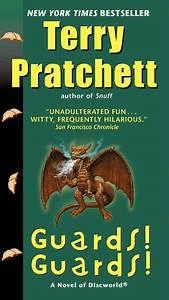
Guards! Guards!, Terry Pratchett ⭐⭐⭐⭐
This was a much more enjoyable entry than Pyramids, which was a welcome relief for me. The humor is more constant, even though it is slanted to a few kinds of jokes and patter toward the end. Some of it is ambiguous and a bit confusing (why would a two-foot swamp dragon court a 6-storey regular dragon successfully? and why would that suddenly solve everyone’s problems?), but one of the general traits of Discworld is things just sort of happen because they need to happen (and sometimes it’s up to us to turn that trait into a treat, sometimes Sir Pratchett does that for us). Here we are introduced to some more likable characters (in their own Discworld way): Sam Vimes, Carrot Ironfoundersson, especially, though other readers may like other characters. Finally we have some interesting time with the Patrician, whether we agree with him or not, giving us a peek into what makes him tick. I don’t know too much about the later books (since I haven’t read them yet, mainly), but I vaguely know a lot of these characters come back, which is a welcome change from the parade of spotlighted characters who never return or may be mentioned briefly in passing three novels later. The Villain-of-the-Novel follows many of the same in his spot from previous books, so there is a growing amount of sameness in these books, but the rest of the book is so fast-paced and enjoyable, especially Vimes’s growth/rebirth (interesting how the book starts off giving us the impression Carrot is going to be the new focus, but then Vimes takes over and that works out rather well), so overall it’s a very enjoyable read (despite the saltiness). Is this the first appearance of CMOT Dibbler? I dunno, but it’s a good book.
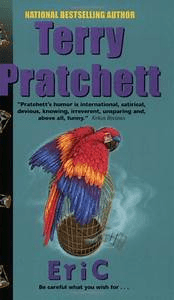
Eric, Terry Pratchett ⭐⭐⭐
More Discworld? Hooray! Rincewind’s back? Double-hooray! Rincewind is enthralled by a promiscuous 14-year-old-boy? Um … boo. Overt Faust parody? Well, okay. At least this is short, I suppose. Poor Josh Kirby, gets some credit for something in some places but not in others. The litany of Discworld books tells us Josh Kirby was partly responsible for this book, but nowhere in the printing of the book itself is that contribution acknowledged. Either HarperCollins is getting lazy in their old age, or some alternative scenario to make this hypothetical dichotomy workable. Speaking of HarperCollins, their latest batch of printing editions of Discworld books is pretty horrendous. The size is taller than the older editions, which is ludicrous in itself, the font is comparatively gargantuan, and the prices are so high I thought it was published on Mir. $7.99 for barely 100 pages of an over-sized paperback? Disgusting. Making it worse, whomever is in charge of the back cover write-ups for these Discworld novels either hasn’t read the books or doesn’t care about presenting things accurately and meaningfully, or likely some combination of those two. The back cover for Guards! Guards! was especially execrable. Eric, as a book, is clever at times but generally tedious, though that, too, is saved frequently by the rapid pacing of the book and its general shortness. It’s great to see Rincewind, especially for so long in the book, but Eric is annoying, the parrot is super annoying, and the obvious Faust parody gets too heavy. Yes, I know that’s the whole point, but still, it wears thin very quickly.
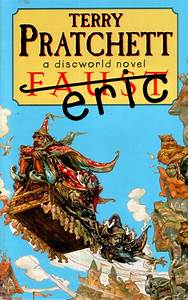
Somehow, though, Sir Pratchett makes it worthwhile as a whole, and it was enjoyable (mainly, though, because it was such a fast read).
 Redeeming Pandora
Pingback: Summer Reading 2015 | Redeeming Pandora