Monthly Archives: May 2022

“Jimmie has fancy plans!”: A Guide to Spring Break

Christopher Rush

Over the years we have suggested a number of high-quality things you can do and enjoy during summertime and Christmastime. but we have hitherto neglected to address the important Spring Break.  Part of the reason, I’m sure, is Spring Break tends to be shorter than those other breaks, and with its brevity comes a sense of panic, desperation, and obduracy — counterproductive to a mini-vacation, that’s for sure.  Perhaps these brief suggestions on high-quality fancy experiences tp enjoy during the brief-yet-important Spring Break can help propel you through the doldrums of fourth quarter and whet your appetite for Summer Break 2016!

  1. Watch Babylon 5 from the beginning (the only way to do it).
  2. Go to the park for a nice, relaxing picnic lunch.
  3. Play a fun board game or two, like those suggested in the last issue.
  4. Walk to the nearest ice cream store, eat a large multi-topping ice cream treat, then walk back home.
  5. Research and plan out your 2016 Yard Sale schedule.
  6. Call up the Encyclopedia Britannica people and negotiate for one of the remaining Great Books of the Western World sets they still have in one of their secret warehouses.
  7. Watch NewsRadio from the beginning and find out why Jimmie has fancy plans … and pants to match (it’s actually “Jimmy,” but you’ll soon find out why the switch).
  8. Start reading The Wheel of Time.  It’s never too late.
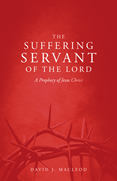
  9. Read the brand-new instant classic by the great Dr. MacLeod, The Suffering Servant of the Lord, on sale now from ECS Ministries (www.ecsministries.org).
  10. Watch Babylon 5 again.  You’ll be glad you did.

See, plenty of great things you can do in just one relaxing week of Spring Break.  Until next time, friends!  See you for our big 20th issue!

On the Same Playing Field: Milton’s Usage of Mythology and Similes in Paradise Lost

Katie Arthur

John Milton’s time was one during which the religious attitudes and atmospheres were in a constant shifting flux.  The Roman Catholic Church had been challenged, the newly-founded Anglicans were being put on trial for their inauthenticity, and each man had to decide for himself where he stood.  John Milton, true to his nature, decided to stand half-heartedly with the Puritans while faithfully maintaining every single one of his own personal beliefs and conforming to none of theirs with which he did not entirely agree.  He was stubborn in his own views, to the point he did not believe in the complete sacredness of the written Scriptures.  In his long treatise outlining all of his fundamental Christian beliefs, he describes what he understands to be a “double scripture.”  The written Scriptures are a valuable thing, but only insofar as they give instructions on salvation.  The rest of the content of the Bible, because it has been handed down from generation to generation of flawed mankind, is subject to flaw itself.  There is another, more authoritative scripture, though, he says manifested in the heart of the individual believer as the promised Holy Spirit.  He is the ultimate guide, again, for each individual believer, to real Truth, found in either the Bible, or merely divinely inspired.  Along with this rather demeaning position he gives to the written Scriptures, Milton also holds in rather abnormally high regard the ancient literature of his classical education.  He in a sense treats both the sacred literature of his deeply-rooted religious beliefs and the mythical tradition literature with the same veneration, using both simply as pointers to the Truth revealed to him by the Holy Spirit.  (See Austin Woolrych’s article).  Rebekah Waltzmann says in her dissertation very prettily,

for him, the Bible was the book of paramount importance but by no means the only one.  His love of literature took him far beyond the confines of religion, and the Bible is supplemented and enriched by the classics.  While the Bible contained spiritual truths, stories, poetry, and numerous examples that could be used within his work, Milton found within the myths an artistic and moral resonance that could provide him with elements the Bible could not (71).

As he is writing Paradise Lost, which is such a richly religious story, Milton supplements the truth found in the dull words of the Scripture with the beautiful language patterns of the mythical writers.  In particular, he uses the epic simile.  He speaks of biblical truths, for example, the Garden of Eden, in reference to mythological stories, for example, the field in which Proserpine is abducted by Pluto.  Similes used in the way Milton uses them in Paradise Lost are very particular to classical epic poetry, and he makes this allusion quite consciously and unapologetically.  The combination of his rather demeaning position on Scripture, and his blatant passion for pagan mythology gives us leave to wonder about his true opinion of the Scriptures.  He claims they are important, but in his day-to-day living and writing, the way he treats them will show us to what degree he truly values God’s Word (and beyond that, perhaps, God’s authority in his life).  I have chosen to focus on Milton’s epic similes, and, in particular, the comparison he draws between the Garden of Eden and Proserpine’s field of flowers.

First, it will be important to understand a little bit about the way a simile can function formally in a text, and the way Milton uses these formal functions in his poem.  Shane Gasbarra, in his doctorate dissertation for Yale University, says there are four things a simile can do.  First, it can add to what the reader sees, either explaining the narrative subject more fully, in words and images familiar to the reader, or by simply saying it again, giving a mental picture of the narrative subject to the reader, almost acting as a relieving break for the mind that has been at high attention as the author unfolds the narrative.  Second, the simile can be of a form called “multiple-correspondence.”  This is really a sub-purpose of the first, explanatory purpose, but a bit more significant, because in the multiple-correspondence simile, “each detail in the simile must answer some detail in the main narrative” (8).  Obscure nuances of the narrative can be brought out with ease and literary gracefulness by significant things within the simile.  On the other hand, there is the danger searching for one-for-one correspondence within a simple simile can be misleading, or trying to create a one-for-one correspondence can cause the simile to become strained and disgracefully pieced together.  C. A. Martindale, though, says we as readers of Milton are safe to treat all his similes as multiple-correspondence, and should assume any detail we draw out of his similes was intended to be drawn out of the narrative.  Third, a simile can also act as an antagonistic parallel, a contrasting comparison.  The simile can present opposing images to throw into greater relief the virtues of the narrative image.  Fourth, the simile can act as anticipation for events to come later on in the main narrative.  While one detail of the simile image parallels specifically with an image in the main narrative at the very moment of the simile’s presentation, another aspect of the simile may parallel something not yet presented in the main narrative.  The author can use the simile to slip in an almost subconscious suggestion to the reader of what is to come.  So Milton, when he writes his similes, draws on all his classical influences, but because he is John Milton, surpasses them in usage even as he depends on them for his content.  Martindale says some aspects of his similes are like Homer’s and in some aspects they are like Virgil’s, but in every case, he outdoes them.  The important question for us now, is, “why?”  Why does he go to such lengths, displaying his breadth of knowledge and writing capability?  Is it simply to show off, proving he could out-write even the best?  Milton was known to be uncommonly confident in his own superiority.  Or, is it to elevate by antagonism the subject and the characters he is treating in this deeply religious epic poem?

In order to answer that, we must first understand what Milton is drawing from, so we can compare his treatment in his simile to the original treatment.  Milton would have grown up studying all the classical authors: Ovid, Homer, Virgil, Hesiod, Claudian, etc.  The Proserpine simile from Paradise Lost alludes to a myth many of these authors recorded.  In Book IV, Milton is setting the scene for Adam and Eve to be introduced to the reader, painting an extensive picture of the lavish beauty of the Garden in which these two first perfect beings are to dwell, and he says the beauty of this Garden is greater than even that of Proserpine’s field of flowers.  Who was Proserpine?  Good question.  Claudian, in the 5th-century AD, wrote the most complete version of the story Milton would have been familiar with, in his De Raptu Proserpinae (The Rape of Proserpine).

The basic storyline starts with Pluto, the god of the lower regions, and he brings a complaint against Jove, his brother and authority, saying he deserves a wife.  Jove decides that is probably a fine idea, and chooses Ceres’s beautiful maiden daughter, Proserpine, for his brother.  Meanwhile, unaware of the plans made for her daughter, Ceres is fending off hoards of unfit suitors who are looking to win Proserpine’s hand in marriage, and, fed up with the whole process, Ceres hides Proserpine away in Sicily, in a beautiful castle where she will be away from her relentless pursuers.  But Venus, sent by Jove, comes to Proserpine’s castle, saying with sweet words of friendship, she should venture outside the castle every once in a while, her mother is being unfair to her keeping her shut up in the castle, and there is a lovely field of flowers just waiting for her to come and enjoy.  Proserpine is convinced.  She goes, and much to her dismay, finds the beautiful narcissus flower she has just picked was placed by Jove to lure her to the place where Pluto waits to snatch her away in a foggy cloud of violent fury.  Ceres finds an empty castle when she returns to greet her daughter, and in the attempt to find her, flies over the whole earth in despair, asking everywhere for her precious child, spreading her knowledge of agriculture to mankind as she goes.  She happily discovers after much searching Pluto has taken her to be his wife, but because Proserpine has unfortunately eaten the pomegranate he gave her, she is bound to him.  Ceres can take her up to the heavenly regions for part of the year, but she must remain with Pluto for the rest.  Traditionally, this is the explanation given for the changing of the seasons: Spring and Summer are when Proserpine is with her mother, and Ceres is happy and blessing the earth, and Winter and Fall are when she must return to Hades.

The first interesting thing we must note is the context in which Milton brings up this story.  Milton is talking in Book IV of Paradise Lost about the beauty of the Garden, and he brings in this allusion.  The Proserpine myth is not about the field where she picks flowers at all.  Claudian’s account does not mention anything about the field except it has flowers in it.  Of course, we can assume because Ceres found it a fit place to put her beloved daughter, it was beautiful, but Claudian does not dwell on that point the way Milton dwells on the beauty of his Garden.

… Not that fair field,

Of Enna, Where Proserpine gathering flowers,

Herself a fairer flower by gloomy Dis

Was gathered, which cost Ceres all that pain

To seek her through the world

… might with this Paradise

Of Eden strive (IV.268-275).

Milton uses this simile as explicit antagonism here.  He says Proserpine’s field was beautiful, of course, but it comes nowhere near to being as beautiful as the Garden of Eden.  It seems interesting he should pull out so obscure a detail from the myth to compare to his narrative, but as we look closer, we must give in to the brilliant piece of literary construction Milton creates here.  There are certainly more popular beautiful places in mythological tradition Milton could have chosen to compare to the Garden of Eden, but there is none that plays host to a story as similar to the rest of Milton’s Fall narrative as the story of Proserpine which plays itself out in “that fair field of Enna.”  While seemingly talking only about the beauty of the Garden, Milton lets his simile also do some anticipation here, subtly foreshadowing the entire narrative he is about to unfold.

Milton chooses Proserpine’s story because she herself is a representation of Eve, or more broadly, of mankind in general, whose innocence is taken by evil.  Proserpine allows us to understand more of Milton’s Eve because of both who she is and the situation in which she finds herself.  Proserpine is a child, innocent, but learning how to make decisions on her own.  Eve, we remember, is just newly created, and must learn how to make decisions on her own in keeping with the pleasure of her loving Creator.  Proserpine is the daughter of Ceres.  Eve is the daughter of God.  They are both supremely beautiful, which, in many minds, flawed logic aside, invites ideas of supreme virtue.  It must be pointed out, though, each one-to-one correspondence Milton creates here between the two women is a sort of diagonal parallel.  Each of Proserpine’s characteristics must be positioned in our minds slightly lower than Eve’s corresponding characteristics because Milton says explicitly the Garden of Eden, and naturally, the whole situation he is discussing in the narrative, is more impressive than that of Proserpine’s field.  Proserpine is the daughter of Ceres, but Eve is the daughter of the Lord God Almighty.  Proserpine was an innocent young lady, but Eve was created without flaw, the pinnacle of a perfect creation from the mind of a perfect Creator.

The situation each woman finds herself in is a sort of diagonal parallel as well.  The Garden and the Field are places of both beauty and of potential.  What does it matter, though, that the Garden and the Field are beautiful?  And beyond that, what does it matter that the Garden of Eden is more beautiful than Proserpine’s field?  The magnitude of the beauty snatched from Proserpine and Eve represents the magnitude of the beauty of peace and virtue they lose as well.  But interestingly, Claudian never says Proserpine’s field is a place of innocence.  He presents Proserpine’s field as a sort of neutral ground, full of potential, not necessarily off limits to her, but potentially exposed to danger.  As long as Persephone is without the influence or the presence of anything really corrupting, she is innocent in this place, free from guilt, and she can take full advantage of all the beauty around her with confidence and joy.  But as soon as there is something evil with her, the beauty is snatched from her.  Milton makes the same statement, showing the massive beauty Adam and Eve have access to, but always allowing them their free will, allowing their potential to be corrupted, even in this place of beauty.  But we will notice, like Proserpine, they maintain their innocence until something comes into the beautiful place from outside to corrupt them.

This diagonal parallel Milton sets up between his narrative and his simile is an encouraging indicator of his attitudes toward Scripture.  It cannot be denied that often, the written Scriptures are dull and dry in their verbiage.  Even C.S. Lewis, who of course, loved the Lord and venerated the Scriptures very highly said “it will not continue to give literary delight very long, except to those who go to it for something quite different.”  The Bible was not intended to be read as beautiful literature, but as Truth.  That Milton does not simply compare the Garden of Eden with Proserpine’s Field is significant.  If he had said “The Garden where the blesséd pair was found, was as beautiful as That fair field of Enna, Where Proserpine gathering flowers, etc.,” his language would assume the preexistence of the Field, setting the Field as the first and ultimate standard of beauty.  But he does not say that.  He says the Garden, the reality we find within the written Scriptures is more beautiful.  The myth here is simply a familiar supporting comparison for our minds’ understanding.  Milton does value the Scripture over the pagan texts.  He has looked to them for his source of Truth, and has let the rest of his learning fall into place underneath them.

Bibliography

Claudianus, Claudius. The rape of Proserpine, from Claudian. In three books. With the story of Sextus and Erichtho, from Lucan’s Pharsalia, Book 6. Trans. Jabez Hughes. London,  [1714]. Eighteenth Century Collections Online. Gale. James Madison University. 5 Dec. 2015.

Gasbarra, Shane Stuart. “Conceptions of Likeness in the Epic Similes of Homer, Virgil, Dante, and Milton.” DA9117619 Yale U, 1991. ProQuest. Web. 15 Nov. 2015.

Lewis, C. S. “Literary Impact Of The Authorized Version.” London Quarterly And Holborn Review 186. (1961): 100-108. ATLA Religion Database with ATLASerials. Web. 12 Dec. 2015.

Martindale, C. A. “Milton and the Homeric Simile.” Comparative Literature 33.3 (1981): 224-38. ProQuest. Web. 15 Nov. 2015.

Waltmann, Rebekah. “Don’t Take Orpheus without the Lyre: The Intricacies of using Pagan Myths for Christian Purposes in ‘the Divine Comedy’ and ‘Paradise Lost’.” 1510326 Liberty University, 2012. Ann Arbor: ProQuest. Web. 1 Dec. 2015.

Woolrych, Austin. “Milton’s Political Commitment: The Interplay of Puritan and Classical Ideals.” Wascana Review 9 (1974): 166-88. ProQuest. Web. 4 Oct. 2015.

Not a Man, pt. 3: Magnus Flyte

Elizabeth Knudsen

Magnus Flyte is the author of the New York Times  2012 bestseller The City of Dark Magic — and is a pseudonym for not just one, but two female authors: Christina Lynch and Meg Howrey.

Christina Lynch is  a novelist, television writer, journalist, book coach, and writing instructor. A former Milan correspondent for W and Women’s Wear Daily, she has written on staff for television shows such as The Dead Zone, Encore! Encore!, Unhappily Ever After and Wildfire. She is also a devoted educator and teaches television writing for UCLA Extension, how to revise your own writing for Antioch University LA, and composition at College of the Sequoias. She is a passionate advocate for higher pay and better working conditions for all adjunct instructors.

Meg Howrey was a dancer and actress who performed with the Joffrey, City Ballet of Los Angeles, and the Los Angeles Opera. In 2001, she won the Ovation Award for Best Featured Performance by an Actress for her role in the Broadway National Tour of Contact.

All books the two write together are written in the same style. They alternate chapters, relay style, and they do no rewriting until they finish the book. In the revision process there is a lot more discussion but there is no “this is my chapter and you can’t touch it.” By the end, they say they have trouble remembering who wrote what, and many paragraphs and even single sentences end up a combination of both writers.

But why did they choose to originally write under a male pen name? In an interview, they replied that pen names could arise from many things — a desire to escape gender stereotyping, anonymity, sheer whimsy. They had also heard men avoid books by women, so they decided to choose a male pseudonym to reach both genders. In a society where gender inequality is one of the most prominent pop culture issues, can it be true the concept of gender even affects what book one picks off the shelf?

In a survey by The Daily Mail, ninety percent of men’s fifty most-read books were written by men. Similarly, most books read by women were written by women. While most claimed they don’t go to the shelf specifically looking for an author of their own gender, both admitted they believed their gender would write a book more appealing to them. Another survey by The Guardian suggested the statistics show men are favored in the writing industry. In Britain, men are the subjects of nearly two times as many literary reviews as women. In America, the difference is even larger.

So while Lynch and Howley’s ruse was revealed rather quickly, it is safe to assume their motives for wanting to use a male pseudonym were justified. In a industry in which one’s livelihood depends on how the public likes what one does, and depending hugely on whether or not people know about it, it’s not a bad idea to try to appeal to the literary critics of the day. And it seems male authors have a step up on that score.

Although such imbalance does not exist everywhere in the literary world, it is disappointing to find anywhere. But studies do show several publishing outlets are paying more careful attention to what is being published and are attempting to ensure both men and women are equally represented in the writing industry.

Bibliography

Ball, Magdalena. “Interview with Christina Lynch and Meg Howrey (Magnus Flyte).” The Compulsive Reader (2013): 17 pars. Web. 3 Mar. 2016. <http://www.compulsivereader.com/2013/11/20/interview-with-christina-lynch-and-meg-howrey-magnus-flyte/&gt;.

Harding, Eleanor. “Why men prefer books written by male authors: Study reveals stark gender divide in our reading habits.” Daily Mail News. Daily Mail, 26 Nov. 2014. Web. 3 Mar. 2016. <http://www.dailymail.co.uk/news/article-2851186/Why-men-prefer-books-written-male-authors-Study-reveals-stark-gender-divide-reading-habits.html&gt;.

Howrey, Meg. “Meg Howrey.” The Los Angeles Review of Books. The Los Angeles Review of Books, 2016. Web. 3 Mar. 2016. <https://lareviewofbooks.org/contributor/meg-howrey&gt;.

Lynch, Christina. Christina Lynch. Ed. Christina Lynch. N.p., 2010. Web. 3 Mar. 2016. <http://www.christinalynchwriter.com&gt;.

Page, Benedicte. “Research shows male writers still dominate books world.” The Guardian. The Guardian, 4 Feb. 2011. Web. 3 Mar. 2016. <http://www.theguardian.com/books/2011/feb/04/research-male-writers-dominate-books-world&gt;.

Help! I Shot My Drinking Buddy!

Justin Benner

Thomas Hardy was born on June 2, 1840, in Dorset, England, where his father Thomas (1811–92) worked as a stonemason and local builder. His mother Jemima was well-read, and she educated Thomas until he went to his first school at Bock Hampton at eight years old. He attended Mr. Last’s Academy for Young Gentlemen in Dorchester. He learned Latin and showed academic potential. Hardy’s family was poor, and he couldn’t afford a university education. He became “homeschooled” and his formal education ended at the age of sixteen. This is when he became apprenticed to James Hicks, a local architect. Hardy trained as an architect in Dorchester before moving to London in 1862; there he enrolled as a student at King’s College London. Here he won awards from the Royal Institute of British Architects and the Architectural Association. He made the switch to poetry later, according to poets.org:

He trained as an architect and worked in London and Dorset for ten years. Hardy began his writing career as a novelist, publishing Desperate Remedies in 1871, and was soon successful enough to leave the field of architecture for writing. His novels Tess of the D’Urbervilles (1891) and Jude the Obscure (1895), which are considered literary classics today, received negative reviews upon publication and Hardy was criticized for being too pessimistic and preoccupied with sex.

Hardy wrote quite a few war poems based off of World War 1 and The Boer Wars. “The Boer Wars was the name given to the South African Wars from 1880-1881 and 1899-1902 that were fought between the British and the descendants of the Dutch settlers (Boers) in Africa” (spartacus-educational.org). One poem he wrote based of these two wars was “The Man He Killed.” This is a relatively short poem at only five 4-line stanzas. The meaning of the poem says much more. The first stanza reads:

Had he and I but met

By some old ancient inn,

We should have sat us down to wet

Right many a nipperkin!

He starts out by introducing two characters. We have no names, all we really have is they exist. As a whole this first stanza is pointing out a more appealing outcome than what we are most likely going to get. He is saying here if these two had simply met in a bar they could have been drinking buddies and had a blast. But we can see from the tone of this stanza this will not be the case.

But ranged as infantry,

And staring face to face,

I shot at him as he at me,

And killed him in his place.

Hardy immediately cuts to the chase in the second stanza and reveals what the relationship between these two men actually is. They are both in the infantry. They are in the lowest possible ranks of the infantry since they are staring the enemy in the face. This tactic of literal lines of battle was extraordinarily common at the time. It was, however, on the decline since the American Civil War saw the introduction of trench warfare. So we see these two men are on opposite sides of the battlefield staring at each other. Then in lines 3 and 4 we see Hardy shoots at the other man and kills him. It is interesting to note Hardy mentions the fact the other man also shot. He could have said “I shot and killed him,” but instead he says he shot and the other man shot, too. Either man could have won the engagement, but it is really a role of the die — a very accurate statement for the period seeing as the rifled or smooth-bore musket would have been the weapon of choice when he wrote the poem.

I shot him dead because —

Because he was my foe,

Just so: my foe of course he was;

That’s clear enough; although

In this stanza we begin to see Hardy have a mental crisis. It’s reasonable to believe he is asking himself questions like “why did I shoot?” or more specifically “why was he my foe?” You can see him questioning himself in the manner in which the 1st and 2nd lines are written. The dash separating a repetition of the word “because” shows Hardy is questioning his motivations. Even in lines 3 and 4 we see him reassuring himself that yes, he was a foe, of course he was. This is exactly how we sound when we’re reassuring ourselves of something.

He thought he’d ’list, perhaps,

Off-hand like — just as I —

Was out of work — had sold his traps —

No other reason why.

We see here instead of arguing over whether he was actually a foe, he is trying to humanize his enemy. He starts off by thinking maybe he enlisted just because he could. Then in the latter lines he argues this guy he shot enlisted because he had no job and had no money. All he is doing is listing the possibilities for why a dead guy enlisted.

Yes; quaint and curious war is!

You shoot a fellow down

You’d treat if met where any bar is,

Or help to half-a-crown.

He finishes off the poem by a drastic understatement. He describes killing another person as old-fashioned and curious. This is quite the statement for someone who took 3 stanzas to figure out why he killed someone and then why they were in the battle in the first place. To summarize the last three lines, he is basically saying in war you kill people that at a bar you would buy a drink and become friends with. This is the true irony of war. We can see historical examples of soldiers overcoming this “kill or be killed” instinct. One is Christmas Day in WW1 when there was a temporary ceasefire to have Christmas. Perhaps too often we see everyone around us as enemies.

Web Sites Referenced

To Be Heard One Must Speak

Kasamira Wojcik

Everyone wishes to be heard and recognized as their own distinct person. They also wish to have the freedom to be themselves without hindrance from anyone else. Zora Neale Hurston shows this desire in her book Their Eyes Were Watching God through her character Janie. Janie is a black woman with a very independent spirit who goes through her days looking for the right person to love and who will help bring out the real her. She has her ups and downs, at first finding one man she hopes will be that special person, but ends up not being the one. Later, she successfully finds the special person, but then after some time, has to see this person pass away. All of these trials, though, help to develop and cultivate her independent spirit and help her learn she has a voice of her own.

The first man Janie is with is Jody. He at first seems good and kind, but after a while, it becomes clear he wants to control Janie’s actions because it makes him feel more powerful and in control. As a result, Janie is never allowed to speak out, which is hard for her because she has so much to say. The following quotation helps give an idea of what Janie’s thoughts are like. “There is a basin in the mind where words float around on thought and thought on sound and sight. Then there is a depth of thought untouched by words, and deeper still a gulf of formless feelings untouched by thought.” This shows how deeply Janie thought, but all of it was suppressed by Jody, which hindered her from being who she truly was.

Another quotation that shows how Janie is forced to suppress herself is as follows: “she starched and ironed her face, forming it into just what people wanted to see.” She has to conceal who she is for the sake of others. She is, in reality, a vibrant person who feeks strongly about different things, but she is unable to show this. The main reason she suppresses these thoughts and feelings is because she wants to please Jody, even though he is only making her be silent for his own selfish reasons.

Over time, though, Jody’s suppression becomes too much and she slowly begins to break away from his oppressive hold. The beginnings of this process can be seen in the following quotation:

“Then one day she sat and watched the shadow of herself going about tending the store and prostrating itself before Jody, while all the time she herself sat under a shady tree with the wind blowing through her hair and her clothes. Somebody near about making summertime out of lonesomeness.”

Janie feels as though the shadow of herself is in the world with Jody, while in her mind she is somewhere else. In her mind, she is free in nature with the wind blowing in her hair; she is free to feel the way she wants to feel.

“She had an inside and an outside now and suddenly she knew how not to mix them.” This shows how Janie begins to recognize there are two separate Janies, the one she puts up for others and the real one she keeps hidden away. She is careful not to mix them or show the real her to others, especially not to Jody. This is still because she wishes to please him, not yet realizing why he is so insistent upon her keeping quiet and staying out of the way. She still thinks what he is having her do is for her own good and he does it  because he loves her.

But, in Jody’s case, all good things must come to an end. Janie eventually cannot take having herself cooped up and being unable to express herself. “She tore off the kerchief from her head and let down her plentiful hair. The weight, the length, the glory was there.” Janie’s hair is one of the main symbols in Hurston’s book. It represents the youth, beauty, and untamableness of Janie’s spirit. Janie’s hair is always long and beautiful no matter how old Janie grows. As a result, it makes her more attractive and Jody, therefore, has her put it up and keep it out of sight. He does this not only to keep other men’s eyes off of it because of his own jealousy, but also because it reminds him of his own aging and how Janie still seems young and beautiful. It makes him feel less powerful and in control. This quotation shows one of the first main breakaways Janie has from Jody’s control. It represents her letting herself out and being who she really is instead of keeping herself contained like Jody wants.

This final quotation shows where Janie stands by the end of the book. “Two things everybody’s got tuh do fuh theyselves. They got tuh go tuh God, and they got tuh find out about livin’ fuh theyselves.” It is mainly from the second man Janie is with she learns this lesson. His name is Tea Cake. Tea Cake does not try to suppress Janie at all. Instead, he encourages her to try new things, speak her mind, and do things the way she wants to do them. Tea Cake helps Janie learn how to live for herself and not let anyone control her like Jody had done.

No one should ever try to suppress who they really are, and oftentimes it is not even their own fault if they are doing it. Sometime it is their peers or others closer to them who convince them not to speak their minds. People always want a voice and what they fail to realize is if they want to be heard, then they need to speak out no matter what others are telling them. Janie did not realize this at first. She was still trying to figure out how life worked and where she fit into it. It was not until she found the right person who helped bring out her independent spirit that she really started to be herself. Sometimes, that is what it takes, just finding the right person to bring out someone’s voice so they can be heard for who they really are.

Works Cited

The Bluest Eye, Analysis of Major Characters. Sparknotes, n.d. Web. 29 Nov. 2015.

The Bluest Eye, Context. Sparknotes, n.d. Web. 29 Nov. 2015.

The Bluest Eye, Plot Overview. Sparknotes, n.d. Web. 29 Nov. 2015.

The Bluest Eye Quotes. Goodreads, n.d. Web. 6 Dec. 2015.

The Bluest Eye Race Quotes. Shmoop, n.d. Web. 29 Nov. 2015.

The Bluest Eye, Themes, Motifs, and Symbols. Sparknotes, n.d. Web. 29 Nov. 2015.

Morrison, Toni. The Bluest Eye. New York: First Vintage International, 1970. Print.

Overlooked Gems: The Beach Boys in Concert

Christopher Rush

Continuing our haphazardly ramshackle survey of ’70s-era Beach Boys albums, we come to the only official live album of the decade from America’s band.  The album also brings to a close the short-lived Blondie Chaplin/Ricky Fataar era (though they have since reappeared sporadically with the Boys), a dynamic and energetic maturing phase in the life of the Beach Boys, as we have said earlier.  Unlike frequent contemporary versions of concert compact discs that pretend to be authentic recreations of actual live concerts in their entirety (which is usually a hollow deception, either as a smash-up of multiple-evening recordings and/or excluding various tracks for either copyright purposes or future box-set money-grabbing “bonus track” release purposes … or worse), this album does not pretend to be a faithful recreation of a particular evening of the tour.  Instead, it unashamedly presents a fabricated selection of songs and performances garnered from a few evenings in a producer-decided album order.  Despite its artificiality, which is said scientifically and not critically, the album creates a very enjoyable tour through some of the then-contemporary sounds of the Boys and their early work done both authentically (as authentically as possible without Brian and the studio) and freshly reworked for a new time, style, and lineup.  Though the title and cover are terribly unappealing, the concert itself is a very enjoyable album.

The first three songs are a very interesting combination: two positive (at times languid) sailing songs (“Sail On, Sailor” and “The Trader”) from Holland surround the less-enthusiastic-about-sailing song “Sloop John B” from Pet Sounds.  This bizarre collocation of eras and attitudes somehow works very well, in part because of the enthusiasm evident throughout the live performances.  Another Pet Sounds tune, “You Still Believe in Me,” follows, perhaps an unknown track to those of us only familiar with the “greatest hits” of the Beach Boys.  Perhaps someday I will attempt to analyze Pet Sounds, but I know I am not capable of doing it justice, so don’t hold your breath for that one.  “You Still Believe in Me” should convince you to listen to it on your own anyway.  Following this is perhaps one of the Boys’ most known songs, “California Girls.”  This version is a fine example  of the freedom the Boys must have felt at this stage (whether away from some of the managerial constraints of the ’60s or what, I certainly have no authority to say): it is not a “faithful” rendition, as live versions rarely are, but it is close and lively and feels like a classic, even though at the time it was but six or seven years old (a long time in the life of the Beach Boys … perhaps even more bizarre when one considers The Beatles only released albums together for about seven years).

“Darlin’” from Wild Honey is next, a very up-tempo song for a band that doesn’t, when one looks attentively at their oeuvre, have a whole lot of what one could call “fast” songs.  The only So Tough song on the tour album is next, “Marcella,” but that’s not terribly surprising since it’s one of the few songs from that album that likely could be done well live on stage.  Though, some rumored version of the concert album yet unreleased (as far as I know, and remember I’m no Beach Boys expert) contains a few more So Tough songs … I would be very keen on getting a copy of that to hear more So Tough songs done live.

Another Pet Sounds favorite, “Caroline, No,” follows, as the manufactured album slows down a bit.  In tempo, yes, but not in beauty.  “Caroline, No” deserves its accolades.  It’s not just famous “because it’s on Pet Sounds.”  It helped make Pet Sounds Pet Sounds (if you can emphasize/pronounce that correctly in your head).  A couple of fine Holland tunes, the beautiful “Leaving This Town” and groovy “Funky Pretty,” sandwich the opening track of Smiley Smile, “Heroes and Villains.”  This version of “Heroes and Villains” (perhaps one of the most reworked, revised, reconstructed songs in the Beach Boys canon) is a prime example of the vibrancy of the time: you can tell the Boys had a lot of fun with this song on stage.  Their version of “Funky Pretty” does not quite match the enthusiasm of “Heroes and Villains,” but it become a good transition into “Let the Wind Blow,” another from Wild Honey.  Now, I’m a big fan of Wild Honey, but if I could only choose two songs from it of which I’d like to hear live renditions, I would not have picked “Let the Wind Blow.”  I would possibly have chosen “Darlin’,” but I’d probably prefer one of the more up-tempo songs such as “I Was Made to Love Her,” “Here Comes the Night,” or “How She Boogalooed It,” but that’s just me.  It’s a lovely song anyway.

Three classic Beach Boys numbers follow in very recognizable forms: “Help Me, Rhonda,” “Surfer Girl,” and “Wouldn’t It Be Nice.”  According to Mike Love in the liner notes in the album, one of the goals of the selection process for this album was to survey the dynamic history of the Beach Boys, and this panoply of even by then recognized standards surely succeeds.  Perhaps the real gem of the album follows this trilogy: the only authentic release of the Holland outtake, “We Got Love.”  Maybe it’s the enthusiasm of the live performance, but the vigor and vitality of this song (both in its quintessential Beach Boy Romanticist lyrics and Fataar-Chaplin-era musical groove) make us scratch our heads in wonder: why was this song deemed unworthy of inclusion on Holland?  Yes, Holland is one of the longest Beach Boys albums, but surely they could have squeezed five more minutes onto it? (proving to you how little I know about vinyl album manufacturing in the 1970s).

The final four songs on the album are certainly among the gold standard for Beach Boys tunes and a great way to end a concert: “Don’t Worry Baby,” about as beautiful as the Beach Boys get (which is saying quite a lot), though this live version has perhaps a bit of a harder edge than we are used to from the quietude of the studio version; “Surfin’ U.S.A.,” undoubtedly an unmistakable Beach Boys standard; “Good Vibrations,” a “mature Beach Boys” classic number (considered by many to be their most important number, and I’m not one to disagree), here it is done quite differently for the live performance than the technically-refined studio version (out of sheer necessity, I’m sure, even if Brian were with them) — this live version again exudes the atmosphere of performing joy the Boys were having.  The album ends with “Fun, Fun, Fun,” a classic, rollicking, enthusiastic way to round out the show.

Taken all in all, this album is a great compilation of their heritage with which they were coming to terms (in a world that had rapidly abandoned “the ’60s”) and maturing artistic freedom they were clearly enjoying in the early 1970s.  The only real downside to this live collection (aside from the cover and nondescript title) is it is not longer than it is.  I suspect the concerts of the era lasted even longer than the 78-some minutes presented here, and the only thing that could be better than this 20-track delight would be a 26+-track version.  But that’s just me being selfish, as usual.  If you are a casual Beach Boys fan, this is a great album to add to your collection and perhaps spur you on to enjoy the artistic direction the Boys had taken in the early years of the ’70s.  It is a fun, fine memorial to the end of the 2nd Age of the Beach Boys.

8 ½: Art as an Act of Love within Cinema’s Quintessential Künstlerroman

Julian Rhodes

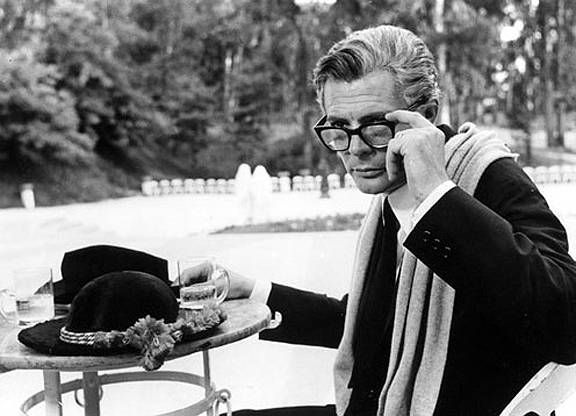
It’s hard to think of an Italian director on the same level of fame and influence as Federico Fellini, and though a good number of modern filmgoers may not be familiar with him by name, it’s quite likely they’ve experienced him secondhand through the countless modern filmmakers he’s inspired. Elements of his style can be seen in the witty social commentary of Terry Gilliam, the surreal imagery of David Lynch, and the emotionally conflicted dialogue of Charlie Kaufman, while other films are just shameless exercises in homage, such as Kaufman’s own Synecdoche, New York, Woody Allen’s Stardust Memories, Paolo Sorrentino’s The Great Beauty — even that ending scene from Big Fish. And for good measure, I guess I should throw in that one short film Wes Anderson directed for Prada. Fact is, without this guy, we wouldn’t even have the word paparazzi, which comes from the character Paparazzo, a photographer from his 1960 classic La Dolce Vita, arguably the most well-remembered of his works. And while La Dolce Vita’s cinematic beauty and iconic status may have won it the rank of #39 on the BFI list for the top 50 greatest films of all time, 8 ½ surpasses it by miles, ranking within the top #10 on the same list.1 So, the question is … why? Why is 8 ½  considered to be such a great film — and, more specifically — why is it an important film for the film lovers of today’s audiences? The answer is simple. It is because 8 ½ remains to this day not only the definitive film about filmmaking but also quite possibly the definitive film about the life of the artist in general. Unfortunately, this is the kind of answer that only raises more questions, so let me explain exactly why I believe that to be true.

But before I move on to some of the film’s deeper themes, I have to take a moment to talk about exactly what kind of a film this is. In his 1947 film Bicycle Thieves, Fellini-contemporary Vittorio di Sica shows us the human condition through the struggle of a simple, innocent lower-class man driven to desperation. Fellini shows us the same kind of desperation, but in an entirely different environment, as he chooses instead to focus on the depravity of Italy’s lavish upper class. Here are the people who have everything the starving families of Bicycle Thieves lack, even to excess, and yet they’re entirely corrupted, left empty, searching for a sense of purpose and meaning that ultimately evades them. La Dolce Vita and 8 ½  both carry across these themes and ideas, but they do so in entirely different ways. La Dolce Vita is a stinging social commentary on celebrity lifestyle, a journey through seven days and seven nights of sin and debauchery. Not surprisingly, it happens to be the second saddest film I’ve ever seen — the saddest film I’ve ever seen being the aforementioned Synecdoche, New York, a story about a neurotic self-absorbed genius who begins an artistic project so grand and expensive it consumes his life entirely and physically and emotionally estranges him from everyone and everything he really cares about. Not coincidentally, this is also the exact same plot of 8 ½ . But going back to Fellini, I’d like to point out though 8 ½  and La Dolce Vita both produce entirely different feelings in the audience when each film ends, both films keep the same emotional tone for a majority of their respective narratives. Their endings really are the only thing that separate them into the genres of comedy and tragedy — whereas, on the whole, Fellini’s writing style floats in a balance between the two, so each film can reasonably be seen as a tragicomedy. Now 8 ½  is surprisingly funny, but note that with the amount of distressing dramatic content within the story, Fellini found it necessary to consistently remind people it was supposed to be funny, to the point where he had “ricordati che e un film comico” taped under the viewfinder of every camera: “remember that this is a comic film.”2 To pull something like this off — this interplay of painful realism with absurd humor — requires a series of emotional maneuvers of which only the most skilled writers are capable. Fellini is able do this by masking painful information beneath clever wordplay and snappy and detached delivery — which again, brings us back to Kaufman, who does this so often it you may as well consider it his trademark. The effect of this balance is though the entire film could be seen as one man’s psychological breakdown, the movie’s light tone and airy music keep you from being too worried about what you’re seeing on screen — except, of course, for those few moments when Fellini really wants you to be worried.

One of the first things you’ll notice with this movie is its use of bizarre imagery — even from the very first shot, it seems to be speaking its own kind of symbolic language. Fellini’s biographer Tullio Kezich writes at toward the middle of his life Fellini became fascinated by the writings of psychoanalyst Carl Jung and his respective theories on the subconscious — the director began to keep a dream journal and subsequently his films began to illustrate qualities of the oneiric.3 Oneiric film theory aims to interpret film in a way that emphasizes the parallels between the film and the dream, so the film can literally be seen as a dream shared by the artist and the audience — as French critic Roland Barthes beautifully points out, do we not walk out of the movie theater feeling almost as if we had just awoken from a long sleep?4 While it’s true not every film lends itself to this kind of psychoanalysis, many directors who view the medium in this way will deliberately work surreal elements in their movies as a means of guiding the audience to reconsider the film from this perspective, and many films are better enjoyed and understood when you watch the film as if it were a dream, the product of our collective subconscious. Films that operate on this idea can be found everywhere you look. such as Martin Scorsese’s After Hours, Stanley Kubrick’s The Shining, and pretty much everything by David Lynch — and yet when it comes down to it, all of these directors’ uses of surrealism can be traced straight back to Fellini.

The symbols we see in Fellini’s dream sequences are by no means arbitrarily chosen. In fact, the fears and desires symbolically present in the opening scene are carried throughout the rest of the film, and just as much can be said for the reappearing visual motifs. In the first sequence we see Guido trapped between the glass windows of a car, just as his dead father is shown to be trapped within the glass mausoleum within the second dream sequence; the steamy bath house also refers back to the steamy car from the same opening scene. When I first saw the film, I was amazed when I first saw the sheer magnitude of Guido’s film set — unaware I had actually seen it within the first three minutes of the movie! And it’s hard for anyone to miss the unsettling similarities between Guido’s harem fantasy and his childhood memory of the wine bath. Within the dream, the environment is understood as a manifestation of the character — how that character interprets his own reality, and what he or she sees as important. Yet with Fellini ensuring the lines between dream, reality, fantasy, and memory stay blurred, the audience is forced into a deeper level of involvement with what they’re presented with — you have to figure out what’s going on in any given scene.

At the center of 8 ½ , is of course, Guido — dreamer and director. Guido is interesting because he is at once likable and repulsive. The movie introduces him as someone beset with stress, surrounded on all sides by producers and actors who never cease to barrage him with questions, and we can immediately relate to his frustration. But just when we feel we like this guy, the movie suddenly begins to explore in depth every single one of his flaws — contemporary critic Alberto Moravia describes Guido as “obsessed by eroticism, a sadist, a masochist, a self-mythologizer, an adulterer, a clown, a liar and a cheat.”5 He is a charlatan, attempting to mount his magnum opus at a time when he is, as Roger Ebert writes, “artistically bankrupt,”6 perhaps not unlike Fellini before the film entered development. When Guido begins working on his film, it is a story about a nuclear apocalypse, about a rocket-ship and mankind’s evacuation of a dying world — and yet when we see the screen tests, all of the characters are simply mirror images of the key players in his own life. In choosing to make the film, he desires to do something important, something beautiful, something to be remembered, but as he retreats into himself further and further, his massive science-fiction epic eventually devolves into self-gratifying autobiography. Here is a man who hides behind his sunglasses because he is afraid of the world around him, afraid of women, afraid of vulnerability, afraid of being disappointed and afraid of being a disappointment. Thus Guido creates art as a means of controlling a reality beyond his control, processing reality through his artwork in the same way dreams process our reality in a way we can understand. But in doing this, he distorts reality and ultimately loses touch with it. Guido’s very character is constantly defined by lies and deception, but more damaging than any of the lies he feeds the other characters are the lies he feeds himself, to the point where even he, and therefore the audience, can no longer distinguish between reality and fabrication.

In the midst of his trials, Guido seeks for answers in his wife’s medium friend, Rosella. He is free, she tells him. Free to do what, though? Free to choose, perhaps? For certainly, the entire ending of the film seems to hinge on one climactic choice — where he crawls under the table at a press conference, pulls out a gun, and points it towards his head. A gunshot is heard, but we see nothing. And though there is some level of ambiguity, most are convinced this doesn’t imply he kills himself — no, the upbeat optimism of the film’s final images conflicts with that idea too strongly. According to Fellini analyst Frank Burke, what Guido shoots is not himself, but his ego.7 When we encounter Guido at the film’s beginning, he is making art for himself — not exposing his weaknesses, but to hide them — even though what Guido primarily desires is a relationship built on vulnerability without judgment. He craves true self-expression, but also true acceptance. What he discovers at the end is the love he was searching for, almost unconsciously, and when he puts his own pride and selfishness to death, he discovers a glorious afterlife where he is able to live in harmony with everyone he has wronged. The film’s ending then redefines art as a gift to others, a bridge to unite artist and audience — so that the artist is noblest when he is most honest. Art is no longer, then, a burden or a duty. Art is an act of love.

Endnotes

1 “The 50 Greatest Films of All Time.” Sight & Sound. British Film Institute, September 2012. Web. Retrieved on 24 September 2015.

2 Walter, Eugene. “Dinner with Fellini.” The Transatlantic Review, Autumn 1964. Print.

3 Kesich, Tullio. Federico Fellini: His Life and His Work. London: Faber & Faber, 2007. Print.

4 Barthes, Roland. “En sortant du cinéma.” Communications, 23. 1975. pp.104-107. Print.

5 Moravia, Alberto. L’Espresso. 14 February 1963. Print.

6 Ebert, Roger. “Fellini’s ,” Chicago Sun-Times, 7 May 1993.

7 Burke, Frank. “Modes of Narration and Spiritual Development in Fellini’s .” Literature Film Quarterly. 1986. 14:3. p. 164-170. Print.

Justinian and Theodora: Managers of an Empire – The Reign of Justinian and Theodora

Chris Christian

Introduction

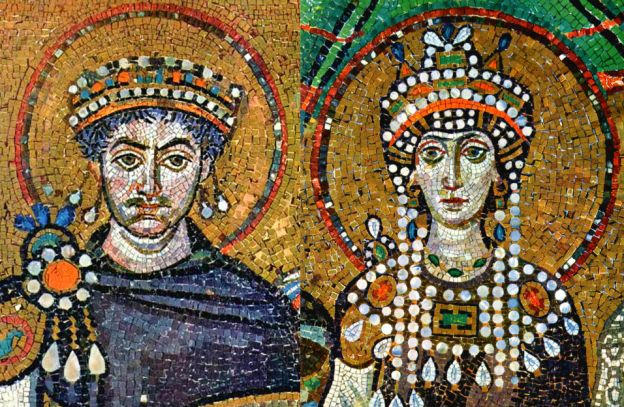
Justinian was the last Roman emperor to sit on a Roman throne. Justinian spoke Latin, just as his uncle Justin had, and thought like a Roman thought. Throughout his reign Justinian attempted to restore Rome and Byzantium to their former glory under the auspices of the glory of Ancient Rome, and used his inherited Empire of Byzantium to attempt that restoration. Justinian desired to restore to the Empire the idea of the Empire as it was before, and had not been seen since Constantine the Great. Justinian wanted his Empire to be thoroughly Christian, retaining only the glory of the former pagan Rome. Justinian wanted to incorporate the east and the west in terms of territory, faith, and law. Justinian wanted his Empire to look and feel Roman, and the restoration of that look and feel could only happen with uniformity of Byzantine architecture. There was already a Byzantine style, but Justinian would spread it throughout the Empire in a building campaign the like of which had not yet been seen.

To accomplish his ambitions, Justinian had to be a capable manager and administrator of his Empire. Justinian perhaps best earns his title Justinian the Great because of his managerial capabilities. Justinian possessed a talent for surrounding himself with people who could accomplish want he wanted them to accomplish. It did not necessarily matter if they possessed character or acted with proper discretion, so long as they got the job done efficiently and to his specifications. This work is dedicated to presenting Justinian’s accomplishments along with those of his Empress Theodora in light of their talents as managers and administrators. The best way to deal with such a topic is to focus on Justinian and Theodora’s personal and domestic accomplishments, what great things they were able to do for the people of their Empire, who they used to implement them, and how they accomplished what they were able to accomplish.

Justinian Ascends the Throne

Justinian, also known as Justinian the Great, ascended the throne after his uncle Justin’s death in 527 A.D. Justin had immigrated to Constantinople from Thrace, a peasant who rose through the ranks of the army to become commander over the Excubitors, or palace guards for the emperor. When the emperor Anastasius died in 518 A.D. Justin had acquired his position in the Excubitors, and his soldiers backed him up when his name was put forward for the throne by the Senate.1 When Justin died, Justinian acquired the throne and would later incorporate his wife Theodora as joint ruler and Empress as well. Justinian presided over his empire as a capable manager. He was not a military genius. Nor was he necessarily a tyrant. Justinian was a manager who delegated tasks, and oversaw their completion in accordance to his vision of what a Roman Empire should look and feel like.

Later Roman Government

All the government of the Empire was conducted from Constantinople, a city it seems, that was made for this one unique purpose: to govern an empire. The bureaucracy was the major employer in the city, and its offices were open to all different ranks in society by selection of the emperor. There were 5,500 guards for the palace, these being known as the Scholares, but they were more for show than actual defense of the emperor. The task of defense was left mainly to the Excubitors who were much better trained.  The commander of the emperor’s bodyguard, his secret police forces, and ordinance factories was the Magister Officiorum (Master of Offices). This was perhaps the most powerful office in the palatial service. There was also the Quaestor Sacri Cubiculi (Minister for Legislation and Propaganda) who drafted legislation and approved it. The three individuals who made up the Comes Sacrarum Largitionum (Count of The Sacred Largesses) were responsible for imperial finances and the Comes Rerum Privatarum (Count of the Private Fortune) looked after the imperial revenue derived from the imperial possessions.2

The Provincial System

The provincial system divided the Empire into various provinces, each presided over by civilian and military officials. Most of these provinces were small and were governed by praeses (governors) who made certain taxes were collected and the judiciaries dispensed justice in accordance with Roman law. All of the provinces were grouped into dioceses headed by vicars and then these dioceses were grouped into prefectures each with a praetorian prefect over them.

Justinian would do away with the dioceses but retain the prefectures. Prefectures oversaw the collection of taxes in kind, or goods and produce, and set quotas for the agrarian economies present in each prefecture.3 Cities, towns, and villages in this system were taxed by a pargarch, usually an official who was held responsible for the taxes he was supposed to collect, but some towns and villages, those overseen or owned by nobles, small free landowners, or nobles who were patrons of coloni (serfs) had the right to collect taxes on their own and send them directly to Constantinople, and not through the middleman form of the pargarch.4 This meant the landowners could collect taxes for themselves, and send the requisite quota required to the capital without being answerable to a pargarch.

The military affairs for each province were overseen by a dux (duke) who had command over the troops allocated to each province. The dux was not answerable to the praeses; the two offices were now separate by Justinian’s time. The dux was a military office and the office of the praeses was a purely civilian office.5

The Army

Justinian used the army to attempt to restore former Roman territory to Byzantium. Justinian waged a series of offensive and defensive wars designed to wrest back former Roman lands and provinces and return them to their proper fold within a Roman Empire. Justinian’s wars did achieve part of these aims. Justinian would recover vast portions of former Roman territory both east and west of Constantinople. Justinian doubled the territory of the empire, recovering most of Italy, what is now modern day Algeria and Tunis in North Africa, and the southeastern portion of what is now Spain. Justinian also recovered Dalmatia, Sardinia, Corsica, Sicily, and the Balearic Islands. Justinian was not able to conquer the western half of North Africa, what is now France, formally the Roman province of Gaul, and the territory north of the Alps, nor did he recover the Pyrenean peninsula.6  Although Justinian achieved much of his territorial goals, his wars left the Empire with major problems. The amount of territory was simply too vast to keep firmly under Byzantine control. The wars had been costly as well, draining much of the treasury that had been collected by previous emperors, including his uncle Justin and the emperor before Justin, Anastasius. The army would be sacrificed fiscally to make other economic ends meet and to lift the oppressive tax burden off of the population of the Empire.7 Justinian’s plans with his Empire’s army just weren’t realistic in consideration of the resources at his disposal. To his credit, it should seem amazing he accomplished what he accomplished at all. Justinian spread the existing army too thinly over his newly-conquered territories, and this thin spread of the army across the Empire made it difficult to police and control all of the newly-won territory. It has been estimated Justinian had around 150,000 men to begin with in the imperial army. It has been further estimated as the wars went on, this force would have been gradually decreased by about 25 percent throughout Justinian’s reign.8 Even with such a modest attrition rate, that would leave very few troops assigned to all of the newly-conquered portions of the Empire.

As time progressed, the army would reduce in number for various reasons. In 531 A.D. Justinian allowed slaves to join the army, which was usually only allowed during times of crisis. This could indicate a shortage of what was normally available in terms of manpower. Plague also broke out in the empire in 542 A.D., which further reduced the numbers of available manpower. Justinian began to rely on foreigners to make up the holes in the ranks of his Empire’s armed forces.9 According to Teall’s article about the barbarians enrolled in the ranks of Justinian’s army there were numerous foreigners of diverse ethnic backgrounds. The commanders Sittas, Mundus, and Chilbudius were all of foreign origins, and along with them there came to the army troops and commanders from Armenia, Slavic troops from Slavic lands and Goths and Franks who would join the previously-mentioned foreign commanders’ forces and the Armenians who had come before the wars of restoration.10 Essentially there were people from all over the Empire, and from outside the Empire, even from among the Empire’s enemies, that would come to fight for Justinian, especially during his wars of restoration. There were Armenians, Slavs, Romans, Greeks, Goths and Franks, and even Iberians. The army of Justinian would become diverse because of the shortage of manpower necessary to control his expanded Empire.

The Church

Throughout western civilization’s history the church has greatly influenced politics, even as throughout the world’s history, religion in general has influenced or asserted its dominance over affairs in politics. During his reign, Justinian assumed the responsibility of being head of the Empire’s Church and used his position as a divinely-appointed emperor to justify his dabbling in Church affairs. In other words, Justinian exerted his dominance over the Church and not the other way around. As Ostrogorsky asserts in his history, “Justinian was the last Roman Emperor to occupy the Byzantine throne. He was at the same time a Christian ruler filled with the consciousness of the Divine source of his imperial authority. His strivings towards the achievement of a universal Empire were based on Christian, as well as Roman, conceptions.”11 Justinian was certainly aware of his divine authority, especially as head of the church. Justinian even used his authority to purge the Empire of pagan teaching, practices, and ideology. “No ruler since Theodosius the Great had made such an effort to convert the Empire and to root out paganism. Though numerically the pagans were not strong at this time, they still had considerable influence in learning and culture. Justinian therefore deprived them of the right to teach, and in 529 he closed the Academy in Athens, the centre of pagan Neoplatonism.”12 Justinian’s power over Church affairs was unsurpassed, and no wonder, for it seemed from his actions to the Academy he was the Church’s greatest champion. Justinian would also be seen as its greatest secular master. “In Justinian the Christian Church found a master as well as protector, for though Christian, he remained Roman to whom the conception of any autonomy in the religious sphere was entirely alien. Popes and Patriarchs were regarded and treated as his servants.”13 Justinian’s dabbling in Church affairs knew few bounds. A great deal of the affairs concerning the Church were ultimately decided by him. Ostrogorsky claims:

He [Justinian] directed the affairs of the Church as he did those of the State, and took a personal interest in details of ecclesiastical organization. Even in matters of belief and ritual the final decision rested with him, and he summoned church councils, wrote theological treatises and composed church hymns. In the history of the relations between Church and State, the age of Justinian is the high-watermark of imperial influence in religious matters, and no other Emperor either before or after had such unlimited authority over the Church.14

Justinian’s piety was such he even quelled popular secular doctrine of his day. The philosophy, ideas, and thinking of the pagan Greek scholars were still taught in Athens at the Academy. Justinian banned such teaching. John Malalas, in his chronicle, recounts Justinian’s special decree, which would obviously have benefited the church, as it would stem the flow of any opposing secular ideals or thought from being spread throughout the Empire, especially any leftover pagan philosophy. As Malalas accounts: “… the emperor [Justinian] issued a decree and sent it to Athens ordering that no-one should teach philosophy nor interpret the laws;….”15 Watts, in his article discussing this closing, asserts Malalas is here specifically referencing the closing of the Academy, although it should be noted in Malalas’ account of the edict to Athens, no specific Academy is mentioned at all. Watts asserts all other primary accounts and sources to date do not reference the event of the Academy’s closing at all.16

The closing of the Academy in Athens is important because it shows how far Justinian was willing to go in order to promote the Church of which he was undoubtedly the head. The Academy itself was a scholarly community that thrived on the teaching of pagan Greek philosophy. It was founded in the late fourth century by a politician named Plutarch and then taken over by Syrianus and then Proclus, all high-standing citizens of Athens with ties to powerful pagans in Athens’s local government. The Academy attracted students from all over the Empire. To keep the Academy safe from growing Christian influence and potential opposition, the heads of the Academy kept their powerful political ties with their pagan patrons, but these eventually died off or converted themselves under increasing Christian pressure. The support for the Academy had begun to wan by the time Justinian came to the throne.17

By this time the Academy had adopted the teachings of Damascius, the head of the Academy responsible for the Academy’s new approach to Neoplatonic philosophy, which ran counter to the teachings of Hegia, a previous head of the Academy. Damascius replaced the older philosophy with newer teaching. This newer teaching was still inspired by the ancient Greek fathers of philosophy Aristotle and Plato. This new teaching was the foundation of Neoplatonic thought.18 By banning such pagan-influenced teaching within the empire, Justinian would have found greater support from the Church, or at the very least he could have pointed to the edict as evidence of his championship of the Church.

Justinian also waded in the mire of Christological disagreements that plagued the present Empire. The essential disagreement among Church clergy in the Empire concerned the nature of Christ. Ostrogorsky best summarizes this disagreement, simplifying its complexity for those not familiar with arguments concerning Church doctrine of the time or disagreements about such doctrine among the faithful of the time.

In response to the challenge of Arianism the Church formulated the doctrine of the complete Godhead of the Son and His consubstantiality with the Father; the question now at issue was the relation of the divine and human natures in Christ. The theological school of Antioch taught that there were two separate natures coexistent in Christ. The chosen vessel of the Godhead was Christ, the man born of Mary….19

This view was one side of the disagreement, but was opposed by those known as Monophysites. The followers of this sect, whose teachings hailed from Alexandria, taught that Christ’s natures, both human and divine, were united constantly.20 In 451 A.D., at the Council of Chalcedon, a special Church council called to meet the Monophysite doctrinal challenge, the council set the new tone for doctrine on the nature of Christ for the Empire. The council “formulated the doctrine of the two perfect and indivisible, but separate, natures of Christ. It condemned both the Monophysites and the Nestorians. Its own dogma stood as it were midway between the two; salvation came through a savior [sic] who was at the same time Perfect God and perfect man.”21

Despite the decision at the Council of Chalcedon, Monophysite influence still spread throughout the eastern portions of the Empire. Later on, after the council, the tension between the two came to a head as a void began to grow between the western and eastern halves of the Empire over the issue. In 482, emperor Zeno published the Henoticon (Edict of Union) in an attempt to find a compromise between the two sides regarding the dual nature of Christ. Zeno set out to forge the compromise by avoiding the numerical terminology of either one or two concerning the term “nature.”22 This ad hoc compromise did little to heal the rift between the spiritually-divided Empire.

By the time Justinian was overseeing imperial affairs under his uncle Justin, Justinian found himself facing a serious problem. The Monosophyte sect had essentially blanketed the eastern part of the Empire and held the powerful ecclesiastical cities of Alexandria and Antioch under its influence. Only Palestine proper, and Constantinople, the meeting place of the Chalcedonian council and capital of the Empire, were Chalcedonian in outlook. These seats of Chalcedonian thought were also not enough to sway any help from Rome proper, whose Pope and clergy did not view the Church of Constantinople as being doctrinally sound simply due to their acceptance of the compromise edict issued by Zeno.23

The problem of unifying the faithful under Chalcedonian belief in Christ’s dual nature was important for Justinian for two reasons, the first was he himself supported the Chalcedonian view and the second was in order for his conquest of Italy to succeed, it would be helpful for Justinian if his Empire were Chalcedonian in the belief concerning Christ’s dual nature, just as the Church in Rome was Chalcedonian in belief regarding Christ’s dual nature. Justinian actively sought for a means to reconcile the Christian sects within his Empire: Chalcedonians, Monophysites, and the Roman Catholics in Italy after its conquest.24 Justinian forced the current patriarch of the Orthodox Church in Constantinople to accept his attempts at unity with the papacy in Rome. Justinian issued an edict in 543 A.D. that specified the patriarchs’ position within the empire as being second to the pope in Rome, and there were to be five patriarchs who would oversee the affairs of the church, but all of these would be answerable to the Emperor. Justinian faced opposition for his edict from the clergy and laymen of each sect, which created trouble for Justinian in the long run.

Justinian believed his authority as a divinely-appointed emperor gave him the necessary power to unite the faithful and different sects under himself. Justinian believed he was the head of the Church, then Rome, then the Patriarch of Constantinople, and then the other three patriarchs in their proscribed order as laid out in the edict.25 It is interesting to note even with this ordering system, Justinian still had Constantinople at the top of the religious ranking system.

Justinian had to make himself head of the Church in order to meet his ambitious goals, unification of the faithful, and the successful conquest of Roman Catholic Italy.  This move helped with the problem of Roman acknowledgement of the Orthodox Church’s Chalcedonian views, but what of the Monophysites? Justinian could change the leadership positions of the Church, but he could not directly force changes in doctrine. Justinian acknowledges this by encouraging discussion among Chalcedonian groups to come to a compromise, one that would satisfy dissension within their ranks and provide a rebuttal to Monophysite assertions about Christ’s dual nature. Meyendorff in his article about Justinian’s relationship with the Church  describes the dilemma:

Justinian himself and his theological advisers soon understood that the Monophysite criticisms would not be met with either negative or authoritarian answers alone. They became painfully aware of the fact that Chalcedon, as an independent formula, was not a final solution of the pending Christological issue: that its meaning depended on interpretation. They had to have recourse to constructive interpretations of Chalcedon….26

Justinian and his theologians encouraged theologians to come up with varying interpretations of Chalcedonian precepts to answer Monophysite arguments and hopefully influence some, if not all, to accept some form of Chalcedonian belief concerning Christ’s dual nature.

This compromising over doctrine and reinterpretation of doctrine ended up posing more problems for Justinian with the Roman Catholic Church in the West, whose leadership were not happy with Justinian’s policy of compromise with the Monophysites, nor with his attempts to persuade them to accept Chalcedonian beliefs by leaving them open to interpretation. Justinian would have to resort to force. Justinian responded to the Western Church by attempting to replace the Pope with the former Orthodox Patriarch Vigilius, which was resisted vehemently for six years until the West gave in and recognized Vigilius as Pope.27

As Ostrogorsky asserted, Justinian exercised authority over the Church like few other secular rulers in history ever would. Justinian found it necessary to do so in order to meet his ambitious aims and solve problems he saw as potentially devastating to his concept of what the Empire should be. Justinian used force, reinterpretation of doctrine, edicts, and Church councils in order to meet his ends, to manipulate the Church in order to manipulate the people.

Justinian’s Court

To be as effective a manager as Justinian was, he needed to have surrounded himself with capable people who could carry out his projects and tasks. Justinian’s ambition knew few bounds, and it was for this reason the people who made up his court and were his councilors had to be reliable individuals who could get things done.

Justinian seems to have relied on three key individuals in order to get things accomplished. One of these was John of Cappadocia, an interesting individual whom Justinian relied upon to bolster the treasury. Justinian relied upon John for financial support for his broad projects and he served as Justinian’s finance minister.28 Barker paints a simple yet complete picture of the man: “John was at the very least, a vivid personality: of great physical strength, he was also bold, outspoken, shrewd, endlessly resourceful; but unscrupulous, cruel, ruthless, sadistic, depraved and insatiably greedy. Nevertheless, these qualities were subordinate, or contributory, to the one essential virtue which commended him most to Justinian; he could raise money.”29

Justinian also seems to have relied upon John to head various projects, even placing him in charge of the first committee tasked to recode the law. John drove the committee to complete the massive project in under a year. The project had been implemented just seven months after Justinian’s uncle Justin’s death.30

Another member of Justinian’s court who proved both useful and influential would have to have been Tribonian. Tribonian, a lawyer by training, served the emperor with respect to Justinian’s legal projects. Justinian made Tribonian Quaestor, the top position within the Empire’s judicial system. As Barker asserts in his history, Tribonian was shrewd, highly educated and therefore seemed to have been an excellent choice for such a position.31 Justinian assigned Tribonian the task of codifying the law a second time, after John’s attempt at codification. In the twenty months since the first codification, Justinian had purged all of the pagans from among his bureaucracy. Justinian wanted Tribonian to condense the previous codification and court records into a more tangible form, which could be readily applicable by the Christian judicial bureaucracy that remained.32 Tribonian is the man largely responsible for the product of this commission.

The last member of the court to be considered would have to be Peter Basymes. Peter was a favorite of Justinian’s Empress Theodora. He was made a Count of the Sacred Largesses which made him a secretary for the treasury. Like John, Peter proved himself useful in the acquisition of funds, a commodity highly useful to Justinian.33

There were other individuals Justinian counted upon within his court to conduct his affairs. One important individual, often away from court due to his position and Justinian’s schemes, was Belisarius. Belisarius was the commanding general-in-the-field of Byzantium’s armies engaged in the re-conquest of former Roman territory. Barker is also capable of summarizing a picture of the man: “This is Belisarius, the outstanding general of the age, and one of the remarkable commanders of history. He was an extremely able field commander, a skillful tactician and strategist, and a capable administrator. His particular genius lay in accomplishing maximum results with minimum resources.”34

Barker further asserts that unlike Justinian’s closer courtiers, Belisarius was an upstanding man, a true Roman as it were in the stoic sense although not in an ethnic one. “Though he shared an Illyrian peasant background with Justinian, he was quite different from his master in his simple and straightforward personality. As circumstances showed, he was capable of cunning and deception, but he had the advantages of an upright character, unimpeachable morals, and unwavering loyalty.”35

All of these capable people along with others in the bureaucracy aided Justinian in fulfilling his agendas, or in the attempt of fulfilling them, for not every task undertaken by Justinian was entirely successful or beneficial to the Empire. Like any manager in any managerial setting, Justinian had the vision and the will to decide what could or should be done and then after ascertaining that vision, Justinian then delegated various tasks to others, or seek the advice of others on how to get it done. Justinian strived for unsurpassed excellence, in as efficient and timely a manner as was possible, for each project he had set about on. This aspect of his management can be seen in each aspect of his reign, his dealings with his court, his building program, and his dealings with the army and church. Justinian strove for things to be in accordance to his vision of what the Empire should be, and to be close to Justinian meant you also had to be useful to him.

Theodora

No work on Justinian can be justifiably complete without dealing with Justinian’s Empress, Theodora. Theodora came from a lowly background just like her husband Justinian. She was the daughter of an animal keeper for a circus in Constantinople, one Acacius, who having died, left behind Theodora, her mother, and two other daughters. Her mother later remarried to a certain Asterius, an employee of the same political faction as Acacius, but who had been much higher up the ranking ladder of the Greens (a political faction made up of the lower orders spawned from and often represented at the games in the Hippodrome by teams that bore their colors. The Blues were made up of and represented the nobility; the Greens the common people). Asterius became Theodora’s stepfather, and her family was under his protection throughout her childhood.36

Theodora received an education of sorts through the environment her family provided her. They worked for the circuses and theaters in Constantinople, and Theodora had access to these theatres and to the Hippodrome. She saw the Greek works, the mythologies, tragedies and comedies.37 As Cesaretti asserts:

Antiquity — the mythical, miraculous antiquity — would be revealed to her not in papyrus rolls or parchment volumes but through tales, images, and visions. She was attentive and curious enough to grasp all of this. She developed her own, unique education, more visual than verbal, through what she saw even before what she heard, on the stages of the Hippodrome, the Kynêgion, [similar to Rome’s Coliseum, used to stage hunting games or displays with large beasts as prey] and the theaters: her open, outdoor libraries.38

Theodora’s mother initiated Theodora’s career onto the stage. Theodora performed with her older sister Comito, dressed as a boy and following Comito around on stage. Both sisters were reportedly beautiful and this beauty apparently signified the acting career as one suitable for the sisters by their mother.39 As Theodora approached womanhood, she became a full-fledged actress. No longer in her sister Comito’s shadow, Theodora acted in shows in her own light but still in supportive roles. Theodora danced in shows as part of a group, but was not very adept at it, or at acting in general. Theodora was, however, exceptionally beautiful, and it was this singular beauty that made her mother decide Theodora was more conducive to the role of a courtesan, along with her inability to sing or dance, at least in proportion to her beauty.40 Theodora became, for all intents and purposes, a prostitute.

Theodora was not pleased with this career path; she sought something more stable, something that offered her protection and not exploitation. She put her beauty to work for her and managed to become the mistress of Hecebolus, an official, who took her to North Africa with him when he was appointed governor of a province there. The relationship went sour, and Theodora managed to flee from it to return to Constantinople. She stopped at Alexandria where she was introduced to the Monophysite sect of Christianity and was converted from her previous ways of life. Upon her return home she lived close to the palace and spun wool for a living.41 Although considered on the borderline of midlife at this time, Theodora must still have been exceptionally beautiful and her experiences with life, along with her previous educational experiences from the theater, provided her with all that was necessary to attract her neighbor the emperor. Browning summarizes what Theodora must have been like at the time of her acquaintanceship with Justinian: “She was still strikingly beautiful by all accounts, though her countenance bore the marks of her eventful life. Nature and experience had given her a quick and ready wit, an unfailing memory, and a talent for public appearance. Her self confidence was boundless, and she feared no man. Somewhere, somehow, she had acquired a wide, if superficial, culture….”42  Of course that culture had to have come from her introduction to theater and her life experiences among the people in the theaters and the Hippodrome. Justinian was an older man when he met Theodora, but he could offer her what no other man at that time could. By marrying Justinian, Theodora would have what she had desired: security and freedom from her past.

Justinian when he met her was about fourty, [sic] of medium height, with a rather heavy, somewhat florid face. On the surface rather a cold man, approachable but not sociable, he was a compulsive worker at state papers, with a meticulous attention to detail and a remarkable capacity for going without sleep. His ambition was boundless, his patience endless, his plans laid carefully for years ahead …. Theodora was his ideal complement. She had every social grace, she lived for the present, and she never lost her head in a crisis. He was devoted to her, and their confidence in each other was absolute.43

Browning succinctly sums up what Theodora ultimately meant to a man like Justinian. She completed Justinian, and after their marriage, and her ascension to power with him, they would be partners.

Partners in Power

Despite their being married in the day and age in which they were married, Justinian did not end up being an overlord to Theodora. Rather, their reign can be seen as a partnership. Justinian supported Theodora even when they did not see eye to eye. As has been previously touched upon Theodora was a Monophysite, and Justinian was an ardent Chalcedonian. Despite their religious differences, they cooperated and shared their power together. Theodora was an advocate of Severus, a Monophysite theologian who lived and worked in Alexandria.44 Hardy asserts Justinian and Theodora’s partnership despite their religious differences in, surprisingly, his article about Justinian’s policy towards Egypt. Hardy claims: “While Theodora’s Monophysite loyalties were genuine, and her influence not to be underestimated, it does seem that Justinian intentionally tolerated her pro-Monophysite actions, including the amusing support of a Monophysite monastery in the palace of Hormisdas, as a means of keeping in contact with a party which he could not completely suppress.”45

Theodora’s influence can also be seen in other aspects of Justinian’s management of the Empire as well, including the interesting removal of John of Cappadocia from court. Justinian highly valued John of Cappadocia’s work regarding the allocation of funds for Justinian’s projects. Unfortunately for John, Theodora hated him for his influence over Justinian and she further despised John because his fundraising methods were destructive to the general public.46 Theodora undertook in 541 A.D. to attempt to trick John into joining a sham conspiracy against Justinian. Theodora used political spin, intrigue, and deception to convince John to commit to the fake conspiracy and to get others to believe he was involved. Justinian reluctantly agreed to exile John, and during that exile Theodora pursued him with her agents, seeking his death in order to assuage her hatred. John was summoned from exile after Theodora’s death in 548 A.D. but he would hold no position of power.47 This might possibly have been due to Justinian’s respect for his deceased wife, and partly to the possibility John, having been a marked man by the Empress was not to be trusted in political circles.

Procopius

It is necessary here to discuss Procopius, an invaluable source for scholars working with Justinian who also happened to be a member of Justinian’s court, in that he was General Belisarius’ secretary. Procopius first appeared in written history when Justinian mounted the throne in 527 A.D. and left it around 560 A.D.48 It is necessary to discuss Procopius because he is one of the few exhaustive sources for the period of Justinian’s reign. It is also necessary because Procopius’ works, especially The Anectdota, may need to be taken with a grain of salt, or are exaggerated in their accounts.  Evans seems to support this in his short work on Procopius, saying it seems paranoid in nature and Procopius’ treatment of Theodora does not match treatment of her by Byzantine tradition.49 Evans also claims Procopius might have written the scandalous things about Theodora written in The Anectdota in order to “titillate his readers.”50 Cameron’s work on Procopius also comes to a similar conclusion regarding his writings about Theodora. Cameron claims Procopius was suspicious of women in power, and he bore hostility toward Theodora because she gave protection to women under Byzantine law.51  It is for these reasons Procopius’ accounts in his Anectdota should be met with some skepticism, especially as they regard Theodora.

The Nika Riot

The Nika Riot of 532 A.D. is crucially important in consideration of Justinian’s management for several reasons: first, it demonstrates near failure in his management; second, as the riot progresses to its shocking conclusion, it shows Justinian as a triumphant victor as the manager of his Empire; lastly, it shows how deeply Justinian and Theodora were partners in that management. One can find accounts of the Nika Riot in primary form from both John Malalas and Procopius.

Malalas’ account begins with the arrest and hanging of various members of the two main political factions represented at the races in the Hippodrome, the Blues and the Greens. Malalas’ account claims two men survived the hanging, one a Blue and the other a Green, and having been found by certain monks, were taken by these monks to St. Lawrence, a church that offered sanctuary to those who sought it. The current prefect besieged the two men as they were kept inside the church.52 The Hippodrome held races three days after the hangings, and during the races members of both the Blues and Greens appealed to Justinian, who was present, to release the two escapees. Justinian did not answer the appeal and the two factions united temporarily in revolt, using the Greek term Nika (“conquer”) as a watch-word, to know who was for them or against them. The rioters demanded the release of the escapees, but Justinian, having refused to answer, was now faced with a full scale revolt in his capital.53 The rioters set fire to the Church of Holy Wisdom (Hagia Sophia) and to the praetorium where the prefect worked. This fire also destroyed portions of the palace. Malalas’ account also claims the rioters called for the dismissal of John of Cappadocia and Tribonian along with the current prefect Eudaimon. They were dismissed, and Malalas’ account claims Belisarius was sent to quell the rioters. Malalas’ account claims the rioters began to kill people indiscriminately after Belisarius was dispatched to quell the riot.54 Justinian presented himself to the people at the Hippodrome and made a proclamation to them backed by an oath to follow its contents. Malalas’ account claims a portion of the rioters then claimed Justinian as their emperor, while others claimed one Hypatios, who, when Justinian had left, seated himself in the emperor’s place at the Hippodrome. Malalas’ account claims after this blatant act of rebellion, the Magistri Militum was sent to the Hippodrome to slay all who opposed Justinian, and Hypatios was put to death. Malalas claimed 35,000 people were slain in the Hippodrome.55

Procopius’ account differs from Malalas, as he includes more detail on the causes of the riot and the palatial goings on during the riot. The vital importance of Procopius’ account is he includes Theodora’s role during the revolt, and her influence over Justinian is credited by Procopius for Justinian’s confrontation of the people as accounted for by Malalas. Procopius’ account of the riot claims Justinian contemplated fleeing from Constantinople by sea, but Theodora convinced him to stay and confront the people.56 Theodora delivers a speech to stir her husband and partner in power to confront the people. Her speech is impassioned, and in it she acknowledges she does not wish to lose her position, nor does she wish for her husband to lose his. According to Procopius Theodora said in her speech:

My opinion then is that the present time, above all others is inopportune for flight, even though it bring safety. For while it is impossible for a man who has seen the light not also to die, for one who has been an emperor it is unendurable to be a fugitive. May I never be separated from this purple, and may I not live that die on which those who meet me shall not address me as mistress. If now, it is your wish to save yourself, O Emperor, there is no difficulty. For we have much money, and there is the sea, here the boats.57

This speech would have probably appealed to Justinian’s pride, and anyway, Procopius asserts it produced the results Theodora desired. Procopius claimed the speech placed new heart in all who heard it and they made ready to meet the challenge before them, even Justinian.58 This speech was the necessary motivation for Justinian to confront the people and meet their challenge to his authority with force.

Bury makes an interesting observation concerning the two accounts in his old yet informative article on the Nika Riot. Bury points out Malalas’ account of the riot and Procopius’ account of the riot may be different because they involve two different perspectives. Bury asserts Procopius’ account was taken from the perspective of one being inside the palace, observing what the emperor and his court heard and saw. Bury also asserts Malalas’ account came from the perspective of an eyewitness to events as they would have occurred in the streets of Constantinople.59 This would account for the differences in various aspects of their accounts of the Nika Riot. The important thing to note from the riot, however, is Justinian and Theodora chose to meet the threat in partnership. In the end 35,000 people may have died, and while this points to a failure on Justinian’s part as a manager, things could have possibly gone worse were he to have fled as he had first desired, or have allowed someone else like John of Cappadocia to take matters in their own hands.

Justinian’s Building Program

Up to this point, Emperor Justinian’s remarkable management of the empire in all of the domestic aspects dealt with by this work have been made manifest by the results the Empire received as a result of such management. Justinian has shown himself to have been a remarkable manager and administrator. Justinian selected qualified people to whom he could delegate work and it was done. The same management skills Justinian exercised with the domestic cogs and wheels of his Empire he devoted with even greater zeal to his building program.

Justinian changed Constantinople’s landscape dramatically, emptying the treasury of the empire to do so as his dealings with John of Cappadocia and his constant need of him should assert, just as effectively as his ineptly determined wars to expand the Empire did as well. Justinian built shrines and churches to saints, hospices, monuments, and numerous other public works on a massive scale. It is perhaps because of this massive public works building campaign Justinian is regarded as Justinian the Great.

Constantinople appears to have seen the greatest recipient of the huge public works building campaign Justinian waged throughout his reign. This makes perfect sense being the capital of the empire of course. According to Downey, Procopius was specially selected by Justinian to write a written record of these works. Procopius was ordered to produce an official work on the entire building program, which he must have written between 559 and 560 A.D. This work was first titled On the Buildings of the Emperor Justinian, but later copies are titled Buildings.60 The first portion of Buildings details the churches of Constantinople. The later portions discuss other edifications throughout the empire, mostly fortifications and aqueducts.

The Hagia Sophia

Perhaps Justinian’s greatest accomplishment of his building campaign was the reconstruction of the Church of Holy Wisdom, the Hagia Sophia, after its partial destruction during the Nika Riot. Procopius implies the destruction of the Church was allowed by God in order that Justinian could rebuild it more glorious than ever:

Some men of the common herd, all rubbish of the city, once rose up against the Emperor Justinian in Byzantium, when they brought about the rising called the Nika Insurrection…. And by way of showing that it was not against the Emperor alone that they had taken up arms, but no less against god himself, unholy wretches that they were, they had the hardihood to fire the Church of the Christians, which the people of Byzantium call “Sophia” an epithet which they have most appropriately invented for God by which they call his temple; and god permitted them to accomplish this impiety, foreseeing into what an object of beauty this shrine was destined to be transformed.61

Evidently Justinian thought the same, for as Procopius accounts, the church was rebuilt more grandly than before and perhaps more grandly than any other church of its time had been built.

Justinian assigned two craftsmen to design and oversee the construction of the new church. Justinian hired Anthemius of Tralles, whom Procopius describes as a highly educated man unsurpassed in the art of construction and architecture, and his associate Isidorius, another master builder and architect with great talent and expertise. Both architects delegated tasks to their workmen, and as Procopius asserts, Justinian and his two architects spared no expense on the construction of the new and improved Hagia Sophia.62

Procopius also points out Justinian’s great penchant for surrounding himself with capable and qualified people was the major reason for his success with Hagia Sophia’s reconstruction, as has been seen in other aspects of Justinian’s reign.

Indeed this also was an indication of the honour [sic] in which God held the Emperor,  that He had already provided the men who would be most serviceable to him in the tasks which were waiting to be carried out. And one might with good reason marvel at the discernment of the Emperor himself, in that out of the whole world he was able to select the men who were the most suitable for the most important of his enterprises.63

This penchant, which Procopius evidently believed was God given, was to guide and prove highly resourceful for Justinian throughout the beginning of his reign. This has been evident before, but Procopius also was aware of its presence in Justinian’s management technique throughout the building program.

The Hagia Sophia is described in great detail by Procopius, from its height, its views to the city and from the city to the church, its decoration inside and out, and so forth. Procopius gives his readers a picture of the Church as it would have looked brand new. Procopius describes the church with passionate emotion, as if he were quite proud himself of Justinian’s achievement, perhaps even considering it Justinian’s greatest work. Procopius declares the impossibility on his part to do the church justice in its description:

But who could fittingly describe the galleries of the women’s side, or enumerate the many colonnades and the colonnaded aisles by means of which the church is surrounded? Or who could recount the beauty of the columns and the stones with which the church is adorned? One might imagine that he had come upon a meadow with its flowers in full bloom. For he would surely marvel at the purple of some, the green tint of others, and at those on which the crimson glows and those from whom the white flashes, and again at those at which Nature, like some painter, varies with the most contrasting colours. And whenever anyone enters this church to pray, he understands at once that it is not by any human power or skill, but by the influence of God that this work has been so finely turned.64

Procopius would match few others of Justinian’s works with such praise and impassioned description in his own works. It is the very first work accounted for in Buildings due to its importance in Procopius’ eyes, and, in terms of Justinian’s accomplishments, it was deemed necessary to likewise render Hagia Sophia’s reconstruction a prime position in this work as well.

Church of Eirenê, and the Houses of Isidorius and Arcadius

There is also the Church of Eirenê, which Justinian also rebuilt. Procopius accounts this church was also destroyed during the Nika Revolt and was rebuilt by Justinian so that it was second in the city and by default the rest of the Christian world only to the Hagia Sophia. Unfortunately Procopius says little about its appearance, other than it lay next to the Hagia Sophia.65

Justinian’s public works of a pious nature do not halt there. Justinian built large numbers of saints’ shrines and churches throughout the region around Constantinople. Two other interesting works accounted for by Procopius are the Hospices of Isidorius and Arcadius. Procopius refers to them as the House of Isidorus and the House of Arcadius, being two buildings erected by both Justinian and Theodora to serve as hospices to the people in the city of Constantinople.66 There are many other churches and shrines likewise rebuilt or built by Justinian within the capital city proper. Procopius accounts for each specifically in his account in the Buildings, including the church of St. Anna, the shrine of Pegê, the shrines of St. Sergius and Bacchus; many others are accounted for both as works by Justinian as emperor and as an administrator during the reign of his uncle Justin.67

The Bay: Justinian’s Healings

Along the shores of Constantinople, all along the shores of the three straits that divide the city from Asia to the east, north, and south of the city, Justinian built similar religious and public and private works. Procopius accounts for many of these particularly along the bay to the north of the city. It is on the shores of this bay Procopius accounts for two very interesting churches. They are interesting because both involve the healing of the emperor Justinian of serious illness or ailment.

Healing at Saints Cosmas’ and Damian’s Shrine

The first site of healing was a shrine dedicated to St. Cosmas and St. Damian. Procopius accounts Justinian lay at this shrine so ill he was taken for dead by his attendants and personal physicians. In a vision, both saints miraculously raised Justinian from his illness, and to recognize these saints for their miraculous work and as an act of faithful thankfulness, Justinian reconstructed the church holding their shrine.68

Healing at the Church of the Martyr Eirenê

Remarkable in and of itself, Procopius will also account for another healing upon the person of the emperor Justinian in the same coastal area. Justinian had reconstructed the Church of the Martyr Eirenê in this area. During excavation in the area for stone to build the church, the masons discovered the remains in a chest of forty holy men, believed to have been legionnaires who had served in Armenia in the Twelfth Legion long before. Up to this time Justinian had been suffering severe pain in his knees, for which Procopius asserts was due to weakness brought on by a harsh, self-inflicted fast Justinian was enduring during the period of fasting before Easter. When Justinian heard the relics had been found, he took it as a sign from God, that God was pleased with his church and Justinian in particular, so Justinian called for the relic to be brought to him and placed upon his knee. According to Procopius, because of Justinian’s faith in God, God caused the pain to cease immediately, and the chest overflowed with oil that soaked Justinian’s royal tunic, which was preserved to prove the event did indeed transpire and Justinian had been healed by God.69

The Convent Repentance

One of the more interesting of Justinian’s pious related public works was the Convent Repentance. Procopius claims both Justinian and Theodora set out to free the oppressed women bound to a life of prostitution by their state of destitution by setting up a convent where such women could flee, seek remission for their sinful pasts, and receive shelter within the convent. Procopius claims brothels were banned within the empire that plied the trade of prostitution, and the convent was funded and maintained by Justinian and Theodora. Any woman who came could stay, in order that she could remain free from a life supported by prostitution.70

The Palace and Senate House

Justinian also built his own palaces, and even reconstructed the entire palace area after it had been destroyed. Procopius does not give details about the palace, but states simply which portions were the works of the emperor Justinian: “this Emperor’s work includes the propylaea of the Palace and the so-called Bronze Gate as far as what is called the House of Ares, and beyond the Palace both the baths of Zeuxippus and the great colonnaded stoas and indeed everything on either side of them as far as the market-place which bears the name Constantine.”71 Procopius also asserts the entire residence of Justinian himself was completely brand new. Procopius implies its size and grandeur defy description, so he does not attempt to describe it, only its entrance. Procopius claims the entrance, called the Chalkê, is formed by arches that support its ceiling, upon which are pictures viewed from below of Justinian’s military victories won for him by his general Belisarius.72

The Basilica Cistern

Malalas’ account reports Justinian, after sacking John of Cappodocia and appointing Longinus as the new prefect in his place, also paved the central hall of the Basilica Cistern and built its colonnades in 542 A.D. Essentially Malalas’ account gives Justinian credit with either all of the construction for the Basilica or at least for its completion.73

Most of the rest of Procopius’ accounts concern fortifications built to guard the boundaries of his now far-flung Empire or aqueducts built to quench his thirsty cities. Procopius even asserts at the end of his Buildings there were many more structures Justinian was responsible for building, so much so it would be necessary for another to write of them.74

Conclusion

Justinian it would seem justifies the assertion he was indeed a capable manager, in the respect he was capable of attempting to carry out implementation of and, more often than not, completion of his vision for the Empire. This aspect of managerial talent displayed by Justinian and empress Theodora can be clearly seen through his restoration of lost Roman territory, his dealings with the Church to secure necessary religious and political ends for his vision of a unified Christian Empire, and with their joint handling of the Nika Riot, which expresses their partnership in power.  Justinian’s building program alone would have required considerable managerial skills to oversee its undertaking to the scale Justinian attempted. Justinian’s military accomplishments may have been superfluous for his Empire, but his domestic accomplishments are extraordinary, especially when one considers they were all undertaken within the same period, along with the series of wars he waged. An Empire constantly at war under Justinian was still able to accomplish and build so much. It would only have been possible under managers like Justinian and Theodora.

Endnotes

1 Evans, J. A. S. The Age of Justinian: The Circumstances of Imperial Power. New York: Routledge, 1996. 11-13.

2 Evans, J. A. S. The Emperor Justinian and the Byzantine Empire.  Westport: Greenwood Press, 2005. 41-42.

3 Ibid., p. 5.

4 Bell, H. I. “An Egyptian Village in the Age of Justinian,” The Journal of Hellenic Studies 64, (1994): pp. 21-36. http://links.jstor.org., pp., 22-24.

5 Evans, The Emperor Justinian, 5.

6 Vasiliev, A. A. History of the Byzantine Empire, 2nd ed. vol. 1. Madison: UWP, 1964. 138.

7 Ibid., 141-142.

8 Evans, The Age of Justinian, 51.

9 Ibid., 51-52.

10 Teall, John L. “The Barbarians in Justinian’s Armies,” Speculum, 40, no. 2, (Apr., 1965): pp. 294-322. http://links.jstor.org, pp. 297-301.

11 Ostrogorsky, George. History of The Byzantine State, trans. Joan Hussey. New Brunswick: Rutgers UP, 1957. 70.

12 Ibid., 70-71.

13 Ibid., 71.

14 Ibid.

15 Malalas, John. The Chronicle of John Malalas, ed. and trans. Elizabeth Jeffreys, Michael Jeffreys, Roger Scott, and Brian Croke. Melbourne: Australian Association for Byzantine Studies: Department of Modern Greek, University of Sydney, 1986. 264, 18:47.

16 Watts, Edward. “Justinian, Malalas, and the End of Athenian Philosophical Teaching in A.D. 529,” The Journal of Roman Studies, 94, (2004): pp. 168-182. http://links.jstor.org, p. 168.

17 Ibid., 169.

18 Ibid., 169-170.

19 Ostrogorsky, 53-54.

20 Ibid., 54.

21 Ibid., 55.

22 Ibid., 59.

23 Meyendorff, John. “Justinian, the Empire, and the Church,” Dumbarton Oaks Papers, 22, (1968): pp. 43-60. http://links.jstor.org, p. 47.

24 Ibid., 47-48.

25 Ibid., 47-51.

26 Ibid., 56.

27 Ibid., 57-59.

28 Barker, John W. Justinian And The Later Roman Empire. Madison: UWP. 1966. 72-73.

29 Ibid.,73.

30 Evans, The Emperor Justinian, 23.

31 Barker, 72.

32 Evans, The Emperor Justinian, 23.

33 Barker, 74-75.

34 Ibid.,75.

35 Ibid.

36 Ceasaretti, Paolo. Theodora: Empress of Byzantium, trans. Rosanna M. Giammanco Frongia. New York: Vendome Press, 2001. 25-41.

37 Ibid., 60-61.

38 Ibid., p. 61.

39 Ibid., 62-63.

40 Ibid., 72-73.

41 Browning, Robert. Justinian and Theodora. New York: Thames and Hudson Inc., 1987. 39-40.

42 Ibid., 40.

43 Ibid., 42-43.

44 Hardy, Edward R. “The Egyptian Policy of Justinian,” Dumbarton Oaks Papers, 22, (1968): pp. 21-41. http://links.jstor.org, p. 31.

45 Ibid., 31-32.

46 Barker, 74.

47 Ibid.

48 Evans, J. A. S. Procopius. New York: Twayne’s World Authors Series: Twayne Publishers, Inc., 1972. 15-16.

49 Ibid., 87.

50 Ibid.

51 Cameron, Averil. Procopius: and the Sixth Century. Berkeley: U of California P, 1985. 81.

52 Malalas, 275.

53 Ibid., 275-276.

54 Ibid., 277-278.

55 Ibid., 278-280.

56 Procopius, History of the Wars, book 1. vol. 1, Procopius trans. H.B. Dewing. Cambridge: HUP, 1979. 231.

57 Ibid., 231-233.

58 Ibid., 233.

59 J.B. Bury, J.B. “The Nika Riot,” The Journal of Hellenic Studies 17, (1897): pp. 92-119. http://links.jstor.org, pp. 93-94.

60 Downey, Glanville. Constantinople in the Age of Justinian. Norman, Oklahoma: U of Oklahoma P, 1960. 94-95.

61 Procopius, Buildings, vol.7, Procopius trans. H.B. Dewing. Cambridge: HUP, 1979. 11.

62 Ibid., 11-13.

63 Ibid., 13.

64 Ibid., 27.

65 Ibid., 37.

66 Ibid.

67 Ibid., 39-57.

68 Ibid., 63.

69 Ibid., 65-69.

70 Ibid., 75-77.

71 Ibid., 81.

72 Ibid., 83-87.

73 Malalas, 286.

74 Procopius, 393.

Bibliography

Agathias. The Histories. vol. 2. Trans. Joseph D. New York: Walter De Gruyter Press, 1975.

Barker, John W. Justinian And The Later Roman Empire. Madison: UWP. 1966.

Bell, H. I. “An Egyptian Village in the Age of Justinian.” The Journal of Hellenic Studies 64, (1994): pp. 21-36. http://links.jstor.org.

Browning, Robert. Justinian and Theodora. New York: Thames and Hudson Inc., 1987.

Bury, J.B. “The Nika Riot.” The Journal of Hellenic Studies 17, (1897): pp. 92-119. http://links.jstor.org.

Byron, Robert. The Byzantine Achievement: An Historical Perspective, A.D. 330-1453. New York: Russell & Russell Inc., 1964.

Cameron, Averil. Procopius: and the Sixth Century. Berkeley: U of California P, 1985.

Ceasaretti, Paolo. Theodora: Empress of Byzantium. Trans. Rosanna M. Giammanco Frongia. New York: Vendome Press, 2001.

Downey, Glanville. Constantinople in the Age of Justinian. Norman, Oklahoma: U of Oklahoma P, 1960.

Evans, J. A. S. “Justinian and the Historian Procopius.” Greece and Rome, 2nd Ser., 17, no. 2 (Oct., 1970): pp. 218-223. http://links.jstor.org.

—. Procopius. Twayne’s World Author’s Series. New York: Twayne Publishers, 1972.

—. The Age of Justinian: The Circumstances of Imperial Power. New York: Routledge, 1996.

—. The Emperor Justinian and The Byzantine Empire. Westport, Connecticut: Greenwood Press, 2005.

Hardy, Edward R. “The Egyptian Policy of Justinian.” Dumbarton Oaks Papers, 22, (1968): pp. 21-41. http://links.jstor.org.

Honoré, A. M. “Some Constitutions Composed by Justinian.” The Journal of Roman Studies, 65, (1975): pp.107-123. http://links.jstor.org.

Lee, A. D. “Procopius, Justinian, and the Kataskopoi.” The Classical Quarterly, new ser., 39, no. 2, (1989): pp. 569-572. http://links.jstor.org.

Lopez, Robert Sabatino. “Silk Industry in the Byzantine Empire.” Speculum, 20, no. 1, (Jan., 1945): pp. 1-42. http://links.jstor.org.

Mainstone, Rowland J. “Justinian’s Church of St. Sophia, Istanbul: Recent Studies of Its Construction and First Partial Reconstruction.” Architectural History, 12, (1969): pp. 39-49 and 102-107. http:/links.jstor.org.

Malalas, John. The Chronicle of John Malala. Eds. and trans. Elizabeth Jeffreys, Michael Jeffreys, Roger Scott, and Brian Croke. Melbourne, Australia: Australian Association for Byzantine Studies: Department of Modern Greek, University of Sydney, 1986.

Mitchell, Stephen. A History of the Later Roman Empire: A.D. 284-641. Malden, Massachusetts: Blackwell Publishing, 2007.

Moorehead, John. Justinian, Ed. David Bates. New York: Longman Publishing. 1994.

Meyendorff, John. “Justinian, the Empire, and the Church.” Dumbarton Oaks Papers, 22, (1968): pp. 43-60. http://links.jstor.org.

Norwich, John Julius. Byzantium: The Early Centuries. New York: Alfred A Knopfe Inc., 1989.

Ostrogorsky, George. History of The Byzantine State. Trans. Joan Hussey. New Brunswick, New Jersey: Rutgers UP, 1957.

Procopius. History of the Wars. Book 1. vol. 1, Procopius. Trans. H.B. Dewing. Cambridge, Massachusetts: HUP, 1979.

—. History of the Wars. Book 2. vol. 1, Procopius. Trans. H.B. Dewing. Cambridge, Massachusetts: HUP, 1979.

—. History of the Wars Book 3. vol. 2, Procopius.  Trans. H.B. Dewing. Cambridge, Massachusetts: HUP, 1979.

—. History of the Wars. Book 4. vol. 2, Procopius. Trans. H.B. Dewing. Cambridge, Massachusetts: HUP, 1979.

—. History of the Wars. Book 5. vol. 3, Procopius. Trans. H.B. Dewing. Cambridge, Massachusetts: HUP, 1979.

—. History of the Wars. Book 6. vol. 3 and 4, Procopius. Trans. H.B. Dewing. Cambridge, Massachusetts: HUP, 1979.

—. History of the Wars. Book 7. vol. 4 and 5, Procopius. Trans. H.B. Dewing. Cambridge, Massachusetts: HUP, 1979.

—. History of the Wars. Book 8. vol.5, Procopius. Trans. H.B. Dewing. Cambridge, Massachusetts: HUP, 1979. 292pp.

—. The Anecdota. vol.6, Procopius.  Trans. H.B. Dewing. Cambridge, Massachusetts: HUP, 1979.

—. Buildings. vol.7, Procopius.  Trans. H.B. Dewing. Cambridge, Massachusetts: HUP, 1979.

Rosen, William. Justinian’s Flea: plague, empire, and the birth of Europe. New York, 2007.

Russell, Josiah C. “The Earlier Plague.” Demography, 5, no. 1, (1968): pp. 174-184. http://links.jstor.org.

Teall, John L. “The Barbarians in Justinian’s Armies.” Speculum, 40, no. 2, (Apr., 1965): pp. 294-322. http://links.jstor.org.

Theophanes the Confessor. Chronographia: A Chronicle of Eighth Century Byzantium. vol. 1, Sources of Isaurian History, 2nd ed. Ed. Anthony R. Santoro. Gorham, Maine: Heathersfield Press, 1982.

Ure, Percy Neville.  Justinian and his Age. Baltimore Maryland: Penguin Books Ltd., 1951.

Vasiliev, A. A. Justin The First: An Introduction to the Epoch of Justinian the Great. Cambridge, Massachusetts: HUP, 1950.

—. History of the Byzantine Empire. 2nd ed. vol. 1. Madison: UWP, 1964.

Vyronis, Speros. Byzantium and Europe. Norwich, Great Britain: Jarrold and Sons Ltd., 1967.

Watts, Edward. “Justinian, Malalas, and the End of Athenian Philosophical Teaching in A.D. 529.” The Journal of Roman Studies, 94, (2004): pp. 168-182. http://links.jstor.org.

Whitby, Michael. “Justinian’s Bridge over the Sangarius and the Date of Procopius’ de Aedificiis.” The Journal of Hellenic Studies, 105, (1985): pp. 129-148. http://links.jstor.org.


“Broken Curses” and “The Princess and the Curse”

Melissa Yeh and Tarah Leake

For their Honors English task, Melissa and Tarah created their own fairy tale in two versions: Melissa told it in the traditional style, and Tarah told it in a contemporary Disney fashion.

“Broken Curses,” Melissa Yeh

In a quiet kingdom just beyond the distance, there lived a princess.  She possessed all the characteristics of an ideal maiden; she was beautiful, graceful, and as delicate as a flower.  At least that is what the kingdom painted her to be.  In all reality, she was just as any other girl.  The only difference was the tragic turn in her life.  At sixteen, a dreadful curse fell upon her, a misfortune resulting in the devastation of the king and queen.  Two years.  That is what her disease entitled her to.  Fully aware of everything that had suddenly become of her life, the princess paused, furrowing her brows, closing her eyes, and then sighing deeply.  She decided she would simply accept it and make the most of it.  However, the king, queen, and the rest of the kingdom thought differently.  They became overly sensitive around the princess, putting up masks of synthetic happiness in attempt to comfort her. The entire kingdom pitied her, all except two people.  These two were her handmaid and a blacksmith’s apprentice.

Although to anyone else they were royalty, a servant, and a commoner, to themselves, they saw three of the closest friends, inseparable to all costs.  The trio shared all secrets and kept all secrets.  The friendship rooted from as young as little children to all the more closer for those last two years.  The princess’s life was beginning to close, and the other two felt it as well.  They spent their final years going the distance, ignoring forced sympathies that had become ritualistic chants lacking emotion.  They followed only the setting sun on the horizon, leaving worries and regrets in the last room.

This time they had wandered into the forest just beyond the castle walls.  The boy apprentice held a sword he had recently finished making, swinging it around as if in a dance, cutting through the wind.  The maid sat on the ground against the trunk of a tree watching the boy.  The princess perched herself above the maid on a tree branch near the edge of the cliff with a view of the whole kingdom before her.  She was staring into the afternoon sky.  The sunlight filtered through the leaves and the branches, scattering spotlights here and there.  She marveled at the warmth of the sunlight mixed with the coolness of the shade.  Silence, absolute silence between the three slowed time, the kind of silence that held comfort.

“Remember,” the princess began, still looking at the sky, “the rose cake?”

The maid glanced up, and the boy lowered his sword, both smiling.

A very young princess enters the scene, along with a young maid in training, both the same age.  The princess had snuck out once again, this time, climbing out of a castle window.  After running through the streets, they had stopped at the sight of an enormous rose cake.  As if in a trance they were drawn to it immediately.  The delicacy and the fragrance tempted the young girls.  The maid then shook her head, grabbing hold of the princess’s arm.  Just as they were about to leave, a boy spoke behind them.  Startled, the two girls spun around facing a boy they had never seen before.  The young maid prepared for the girls’ escape, should the boy call out. To their surprise, he waltzed up to the enormous cake, which, when compared next to each other, were about the same size.  He stood up on his tiptoes, taking out three chunks of the dessert.  He proceeded to shove one of them into his mouth, while holding the other two out to the princess and her maid.  The girls turned toward each other, hesitated for a moment, then grabbed the cake from the boy’s hand.

After a little while, the three were sitting on the floor lost in laughter and cake.  The boy asked for the names of his new friends, and when the princess told him, he nodded and continued as he had no clue the princess was right beside him.  An hour later, the baker came in with a couple and found the children asleep on the ground, curled up next to each other.  He nearly fainted from the fact the wedding cake had been half eaten, and also from the fact the very princess of the kingdom had somehow appeared in his bakery.

“Then the castle guards brought me in as if I was some horrendous criminal,” the boy recalled.

“You couldn’t stop crying for three hours,” the princess added in laughter.

“I had to explain everything to the king and queen for you,” the maid mentioned, shaking her head.  She stopped and leaned forward,  “Do you remember the bear?”

The princess at the age of twelve sat staring at the field outside the castle library distracted from the book she had in hand.  Her maid was seated across from her, focused on her story.  Out of nowhere, the boy appeared in front of them, a sly grin painted across his face.  At once the girls dropped their novels, jumping up to accompany the boy on each side.  That day they secretly went backstage of the traveling circus that had been visiting the kingdom.  They roamed through the tents meeting and casually talking to the members.  Eventually they found themselves in the area with all the animals in their cages, where no one else seemed to be around.  They stood up close to the metal bars, watching the different behaviors of the animals, completely fascinated.  Each animal seemed to amaze the three children more than the last one.  Approaching one corner, they noticed a cage was empty.  At first they joked around: the princess stood inside the cage, pretending to be an animal, until the maid noticed a sign hanging off sideways on the other side.  Peculiarly, the words had been faded and three lines were marked across the words.  It resembled a claw.  She squinted, her stomach dropping as she realized it read: bear.

The boy, who stood next to the maid, also recognized the words on the sign.  He heard a low growl behind him and saw the princess’s eyes completely widen.  Immediately he grabbed the maid’s hand and dragged her into the cage with the princess, shutting the door.  The trio backed to the far end, farthest from the large brown bear clawing at the cage.  They clung to each other, each quivering in absolute fear.

Eventually, relief flooded through them as they heard multiple voices behind the bear, luring it away from the cage.  The men that appeared, halted, shocked to see the princess and two others had been trembling in the bear cage at a circus.

“After that we agreed never to enter a circus again,” she noted.

All of the sudden, the princess swung forward, falling off the tree.  The boy rushed forward, just in time to break her fall; he leaned her against the tree as she had fainted.  She was sweating and feverish, though she had showed no signs of it before.  The maid dropped to her knees checking her forehead.  Looking up urgently, she felt the princess’s breath become slow and start to fade.  But the boy and the maid did not move an inch.  For this situation had happened before.  The first time, they darted back to the castle with the princess in the boy’s arms.  A few minutes later she was back to normal.  The next time they were in the library, when the princess passed out; yet before the physician even arrived, she had returned to normal.  The same happened another time, then another, then almost every week.  The trio, however, refused to acknowledge that any day now, they would lose her.  For losing her meant losing a part of them, a relationship broken and never to be repaired again.  Their souls were woven together and tightened through the fact that she was quickly going, but at the same time would completely wreck them in the process.

They waited. Five minutes went by.  Then ten went by.  The boy began pacing to and from the tree, back and forth between the sunlight.  “We should take her back to the castle,” he said restlessly.

“This happened last time,” the maid insisted, holding the princess’s hand tightly.

“I don’t think we should stay here, I mean, better safe—”

“You’re just overthinking it.”

“Perhaps you’re underestimating it.”

“Are you giving up on her, then?”  The maid stared, making direct eye contact with him.

“Giving up?” the boy frowned.

“Can’t you wait just another moment?  Or are you just waiting for the moment she finally gives?” the maid snapped.

“How could you assume that?” his voice rose in anger.  “I don’t want this any more than you do, but we can’t do anything about it and—”

“We should be trying to do something about it.  We’ve ignored it for long enough.”

“We’ve gone over this.  The princess specifically decided no one would try to look for a cure; she knew this was inevitable.”

“You would just sit there uselessly without even trying to solve the problem whatsoever?”  She got up on her feet, facing him with the princess in the grass in between them.

“You would disrespect her wishes?”

“Listen to yourself, talking as if she has already left us.”

“Yet you talk as if deaf to everything that has been going on.  It’s pointless, your words are only a maid’s speculation,” he finished, sharply.

The maid looked crestfallen.  “As if someone like the princess would acknowledge someone as lowly as a blacksmith’s apprentice.  To think that must be the only reason you’re here; if I had this curse, no one would give a second look,” her voice cracking as she felt anger and heartbreak rush through her body.

The boy raised his hand and slapped her across the face.  “You’re right,” he hissed, making direct eye contact with her.

The maid completely drowned out all other rational decisions.  Noticing the boy’s sword next to her, she snatched it up with both hands.  Only seeing red, she plunged the sword deep through the boy.  Her stomach plummeted as she looked up to see the princess’s face.  The princess’s face, stained with tears, displayed disappointment and sorrow.  Realizing what she had done, the maid let the sword fall from her hands.  She had been right; the princess’s collapse was just like any other time.  When the princess awoke to hear the argument and see the sword, she pushed herself in time to shove the boy out of the way.  The boy cried out in agony when he saw the ailing princess and what the maid had done.  The boy noticed the princess begin to fall backwards over the cliff.  In an attempt to save her, the boy grabbed her arm to pull her back.  However, it was too late, as he misjudged the distance, sending both of them over the cliff, plunging down a long drop.  The maid reached her hand out, screaming and sobbing.  Her head collapsed into her hands.  The curse had broken.


“The Princess and the Curse,” Tarah Leake

Once upon a time there was a beautiful kingdom called Merryland. All those in the kingdom were pleasant, kind folk. All helped one another and sought to bestow no harm. None was fairer than the young princess, Evangeline. Evangeline was anything but selfish and carried no hate in her heart. Her two closest friends were Millie, a maid of the castle, and Will, a boy apprentice. The three were the best of friends, but Will always cared for Millie in a fonder way. However, he was far too shy to mention it.

One bright day in Merryland, a sudden darkness enveloped the kingdom.  The people, frozen in fear, heard a stern voice call from the skies. A shapeless figure declared, “Within one year’s time, before the princess of your kingdom turns sixteen, she shall die at the hand of one she trusts the most.” The darkness dispersed. The frantic Merrylanders ran to the palace to seek comfort and explanation. The king assured the people the princess would be protected and never harmed. The people felt calmed, but Evangeline feared the worst.

And so, Evangeline was kept locked away in the palace for one year. She was not permitted to leave nor accept visitors. Even Millie and Will were prohibited from seeing their dear companion. Millie and Will made several attempts to sneak into the castle and see Evangeline, but time and time again they failed. After a while, Millie and Will accepted the fact they might never see Evangeline again.

Evangeline trusted no one, for the threat had made her paranoid. She refused to eat food made by any cook she knew the name of. She refused her music lessons, her father’s goodnight kisses, and her mother’s lullabies. Evangeline shut herself away from everything and everyone, for she was destined to die at the hand of someone she loved. This rejection and fear had upset not just herself, but her mother as well. The beloved Queen Elvina fell ill and tragically passed in her sorrow.

The night before Evangeline’s sixteenth birthday, Millie and Will sat in the fair forest and shared stories of their time together. The three met when they were simply toddlers running around the palace courtyard. Millie was one year older than Evangeline, but that made no difference. They spent every moment together as if they were sisters.

On a bright spring day, the adolescent Millie and Eve were playing when suddenly they discovered a rose cake. It was a beautiful cake made for a beautiful couple. Young Evangeline cared not to whom it belonged, rather, she went for a bite. Millie grabbed her arm and with a stern glance proclaimed, “We can’t eat this. It’s not for us!” Suddenly, a third voice was heard from behind the shadows, “Sure it is!”

“Who’s that? Who’s there?” Millie inquired. A young boy stepped into the light.

“I’m…” he paused and looked at the names on the cake, “Groom.” He finished.

“Really, you’re name is Groom?” Evangeline giggled.

“I’m Bride,” Millie began to play along, “Look here is a cake for ‘The Bride and Groom.’ That must be for us!” she declared. The three began devouring the cake, when in walked the baker and King Gregory himself. Outraged, King Gregory made the three apologize to the baker. Millie, however, had to scrub the bakery from floor to ceiling. The three were friends ever since, but Will always noticed that when they got into trouble, Millie would receive stricter punishments from the King. King Gregory never seemed to be fond of Millie, but Will figured the King wasn’t fond of either of them.

“Ahhhh yes,” Millie sighed. “I remember the rose cake.”

“That wasn’t even as much fun as the fair!” Will continued.

When Evangeline was twelve, she requested Millie, Will, and herself be allowed to attend a fair in the neighboring kingdom. King Gregory, cautiously, agreed. The three ran around, giving the nanny a frightful headache. They had sweets of all kinds and saw things they’d never seen. At one point, they found themselves by an open cage and the nanny was nowhere in sight. Evangeline stepped inside the cage and began acting like an animal. Will joined in, but Millie stood staring idly at the sign on the cage. It was old and scratched up, but she could barely make out the words, “B-Be-Bar….”

“BEAR!” Evangeline screamed. Will grabbed Millie’s arm, pulling her into the cage, and closing the door. The bear clawed at the children between the bars. Millie looked at Will in amazement and gratefulness. “Thank you,” she whispered, withholding her tears. Will smiled and Evangeline continued screaming until someone came and lured the bear away and freed the kids.

“I was so scared,” Millie recalled, “but somehow you made me feel safe.”

Will smiled, “That’s why we’re such good friends. We always look out for each other.”

“We can’t just sit around!” Millie exclaimed. “It is Evangeline’s birthday, and she is just as much our friend!”

“You’re right,” Will prompted. “We have to find a way into the castle to see her.”

“I think I know how…” Millie smirked.

Millie’s mother was the head maid at the castle and was a beautiful and loving person. Millie and Will had not asked for her help before because they couldn’t bear to get her in trouble, but tonight they had no such worries. Millie explained to her mother they simply had to celebrate Ev’s birthday. With a concerned smile, her mother let the friends into the castle. They entered the kitchen and Millie explained she could climb up the laundry chute into Evangeline’s bedroom. Millie’s mother warned the children to be careful, for there were extra guards, since this was the forsaken night. Millie climbed up the chute and Will followed behind.

Millie reached the top. The room was dark and she could not focus her eyes on any one thing.

“Evangeline?” she whispered quietly, “are you here?” Suddenly, a quick, piercing pain shattered through Millie’s lungs. The lights turned on and Evangeline stood holding the dagger.

Will hopped out of the chute, “Happy Bir…” he stopped staring at Millie’s body on the floor. He collapsed. “Wh…How could you do this?!” Will screamed at Evangeline. She was staring, in shock of what she’d done.

“I’m…I’m sorry…I was so worried and I heard someone coming up the chute…I didn’t think it would be you two!” Evangeline cried. King Gregory and the guards came rushing in along with the servants, led by Millie’s mother, Wendolyn. She screamed at the sight of her beloved daughter.

“You monster,” she screamed, not at Evangeline, but at King Gregory, “This is all your fault!”

Everyone turned to look at the King for a due response. “Evangeline, Will, there’s something you need to know….” Wendolyn’s voice shook while her hands curled into fists.  She explained before Evangeline had been born, the king was in love with her. When Millie was born, the king had already been engaged, so he rejected Wendolyn and his illegitimate daughter and made them servants in his own castle. The curse was meant for his daughter, the eldest heir to the throne. The kingdom assumed it was Evangeline, but by blood the curse fell to young Millie.

The King looked down, ashamed of his actions, and admitted Wendolyn’s story was true. The guards took King Gregory to the jailhouse, for it was a terrible crime to lie in the kingdom of Merryland. Evangeline cried while holding her sister’s hand. Will looked at Wendolyn, “Is there anything I can do?” he begged, but Wendolyn shook her head.

“True love’s kiss!” Evangeline shouted. “Will! You must. True love’s kiss breaks all curses and evil.” Will was silent with wide eyes. “Come now,” Evangeline grinned, “I’ve been friends with you for too many years not to pick up on these things. Please, Will, you are her only chance.” Will held Millie’s head and stroked her long, blonde hair. He leaned close to her young, porcelain face.

“Millie,” he whispered, gently, “Come back to me,” and with a kiss more romantic and powerful than any had seen before, Millie’s porcelain skin returned to her sun-kissed color, her cold, blue lips became pink and plump, and her green, sparkled eyes opened.

“How could I ever leave my true love and best friend?” she smiled. The whole event was explained to Millie and the kingdom. Evangeline reformed her friendship with the two, and Evangeline and Mildred co-ruled the kingdom with more grace and kindness than any other before. At age eighteen, Queen Mildred and Will wedded, demanding a rose cake with “Bride and Groom” written on it for the wedding. Merryland was at peace once more. The three companions were together at last. And all lived happily ever after.

Me and Michael Wood Down by the Schoolyard

Christopher Rush

As you probably know by now, the great Michael Wood and I are practically best friends, though admittedly in a rather tenuous way.  We have never met, but we have exchanged correspondence, and in the 21st century that’s saying rather a lot.  I am eternally indebted to Class of 2012’s own Mackenzie Carlson for secretly instigating such correspondence, covertly writing to Mr. Wood, ostensibly about my affinity for the man and his work, prompting Mr. Wood to write her back and writing me a hand-written mini-letter with an autographed picture.  Shortly after that, upon conclusion of the “Intro. to Archaeology” elective in 2012-2013 (effectively a Michael Wood elective), I wrote back to Mr. Wood and told him of our successful elective watching many of his series: Legacy, Conquistadors, In the Footsteps of Alexander the Great, In Search of Myths and Heroes, and The Story of England.  My, what good times.

My knowledge of Michael Wood began several years ago when I was given a copy of his book In the Footsteps of Alexander the Great.  A couple of years later, dissatisfied with showing Hallmark’s lengthy version of The Odyssey to 10th grade, I went searching (if you’ll pardon me) for a more educational, intellectual replacement: by the Providence of God, undoubtedly, I discovered the recently-released on digital video disc series In Search of the Trojan War, Michael Wood’s second-but-career-making series exploring Homer’s poem, world, and, almost as interestingly, the then-skeptical “expert” world of Homeric scholarship in the early 1980s.  As many of you recall, Michael Wood’s top-notch historian/archaeological training (combined with his generous Romanticist tendencies) rejected the naysayers and doubters of the day, willing instead to actually believe what Homer said was true.  Archaeology since his series has indeed proved Michael Wood true, and the doubting “experts” before him false.  As soon as I watched that series for the first time, I knew here was a man whose ideas and works must be heeded and enjoyed, since he clearly wants us to enjoy learning about history and what it means for us today.

I don’t agree with everything Michael Wood ever says, mind you.  The very first sentence of his Legacy: A Search for the Origins of Civilization, for example, is not true.  I doubt he is a born-again Christian, given some of his other conclusions and statements in various books and television series he has done over the years, but that’s no reason to ignore him or revile him.  Some of my other best friends (whom I’ve actually met in real life) aren’t Christians either (though I’m working on it).

The last few years have been very exciting for Michael Wood fans, as a number of his older series have been released on digital video disc and available for the first time in decades.  Art of the Western World, for example, just showed up in time for Intro. to Humanities in 2012.  Just recently, I learned his very first television series, In Search of the Dark Ages, was released on digital video disc in 2015 … but only in Region 2 as of this writing.  Disappointing, indeed.  It is practically enough of a reason to buy a Region 2 digital video disc player, adapter plugs and all.  We can hope his production company Maya Vision International will continue to make his yet-unreleased classic material available to his friends and fans across the pond, as the kids say.  If his Beowulf series, especially, is released, you can be sure that will become a staple of 12th Grade British Literature.  A great number of his television series and specials have not been released yet, and the man is still working, writing, searching, and making the world a better place for us all.

In the meantime, check out the series already available (though, don’t watch In Search for Shakespeare until we watch it in 12th grade, please).  Additionally, read his several books, many of which are available in mass market paperback editions:

In Search of the Dark Ages (1981)

In Search of the Trojan War (1985)

Domesday: A Search for the Roots of England (1988)

Legacy: A Search for the Origins of Civilization (1992)

The Smile of Murugan: A South Indian Journey (1995)

In the Footsteps of Alexander the Great (1997)

In Search of England: Journeys Into the English Past (1999)

Conquistadors (2000)

Shakespeare (2003)

In Search of Myths and Heroes (2005)

India: An Epic Journey Across the Subcontinent (2007)

The Story of England (2010)

(If it seems Michael Wood takes any chance he can to visit India, you are correct in your observations.  He has said in multiple places India to him is a second home.  His two daughters are Indian, or, at least, have Indian-like names.)

I have most of his books myself.  I acquired a number of them several years ago in Powell’s City of Books (an experience all book lovers should have at least once) in Portland, Oregon for very reasonable prices.  I even got one in Mermaid Books in Williamsburg — Michael Wood from coast-to-coast.  Finding a Michael Wood book in a used bookstore, like finding a Barbara Tuchman book or Father James V. Schall book, instigates competing reactions within me: robust exultation tempered by irritated incredulity — how could someone get rid of a book by the great Michael Wood?  I then proceed to encourage my soul by convincing myself some other open-hearted generous person, having read it several times, has given it to the bookstore trusting the right person will come along to get it next, namely me.  I haven’t read all of his books yet, but if all goes according to plan, 2016 will be a year in which I get a number of them read.  Look for some reviews next volume.

If I haven’t sold you yet on the quality, depth, and diversity of the intellect and quality of Michael Wood and his work, let him convince you himself.  Get one of his books and read it; watch one (or four) of his series and find yourself learning about important things and enjoying the experience at the same time.  Such is the greatness and wonder and magic of world-renowned author, presenter, historian, medievalist scholar (and my buddy, ish) Michael Wood.