Monthly Archives: April 2022

White Bean Chili

Mrs. Lang

Recently, the generous parents at Summit Christian Academy brought in some yummies for us to enjoy at a very special luncheon.  Certainly the highlight of the event was the delicious slow cooker full of white bean chili.  I only got two bowlfuls, likely because some of my colleagues were being somewhat selfish and not eating all that delicious salad I didn’t take, but such is life.  Fortunately, Mrs. Foster in her infinite wisdom requested the recipe from Mrs. Lang, and I am passing it on to you, without her permission.  Please don’t tell her.  Enjoy it anyway.

Prep Time: 30 minutes

Soak: overnight

Cook: 2 hours and 20 minutes

N.B.: once you try this cheesy white bean chili, you may never go back to the red stuff.

Ingredients

  • 1 pound dried Great Northern beans
  • 2 medium onions, chopped
  • 1 tablespoon olive oil
  • 3 (4.5-ounce) cans chopped green chilies, undrained
  • 4 cloves garlic, minced
  • 2 teaspoons ground cumin
  • 2 teaspoons dried oregano
  • 6 cups chicken broth
  • 5 cups chopped cooked chicken breast
  • 3 cups (12 ounces) shredded Monterey Jack cheese with jalapeño peppers
  • ½  teaspoon salt
  • ¼  teaspoon pepper
  • ¼  cup chopped fresh cilantro (optional)

Procedure

· Sort and rinse beans; place in a large Dutch oven.  Cover with water 2 inches above beans; let soak overnight.  Drain; set beans aside.

· Sauté onion in hot oil in Dutch oven over medium-high heat until tender.  Add green chilies and next 3 ingredients; cook 2 minutes, stirring constantly.  Add beans and chicken broth.  Bring to a boil; cover, reduce heat, and simmer 2 hours or until beans are tender, stirring occasionally.

· Add chicken, 1 cup cheese, salt, and pepper.  Bring to a boil; reduce heat and simmer, uncovered, 10 minutes, stirring often.  Stir in cilantro, if desired.

· To serve, ladle chili into individual soup bowls.  Top each serving with remaining 2 cups cheese.

Yield: 13 cups

Per 1-cup serving:

  • Calories 359
  • Fat 12.3g
  • Cholesterol 71mg
  • Sodium 984mg

The Fall and Rise of Great Detectives

Christopher Rush

Two of the greatest literary detectives are assuredly Rex Stout’s Nero Wolfe and Bob Kane’s Batman (or, Bruce Wayne, when hosting in his stately manor).  Both have very little in common beyond their basic commitment to right wrongs and bring perpetrators to justice, considering Wolfe will usually only bring justice when he is paid for it and rarely leaves his home and Batman prefers anonymity and patrolling the streets practically constantly.  Both do have a certain moral malleability, even with Batman’s commitment never to kill (something we are occasionally led to believe Wolfe has done in his youth, if for a certain kind of justice), but we are never far from the firm conviction these great detectives are valuable assets to the fight against crime — certainly never for very long, at least.  One significant thing they do have in common, as with most great literary detectives and epic heroes of other ilks, is their catabasis and anabasis, requisitely occurring because of their nemeses.  Of course, Batman has more arch-nemeses than the shore has sand, but no one has taken him to his nadir as one behemoth of a villain: Bane.  Nero Wolfe, having managed to offend and upset everyone from Serbian diplomats to the head of the Central Intelligence Agency, likewise, has no dearth of enemies—but no one has so altered and affected his life like the scourge of the underworld: Arnold Zeck.  Within recent memory, I have read the three collections of Batman’s epic encounter with Bane and its aftermath and the three novels detailing Wolfe’s brief but cataclysmic history with Zeck.  In an effort not to spoil too much of the mystery, action, adventure, plot, and (most important of all) great character moments, I include hear my brief reviews after I read them.  I refrained from spoiling too much in hopes you will pick them up and read them for yourself, if for nothing else than to have some great reading experiences.  We begin with the three Nero Wolfe adventures written by Rex Stout and conclude with the three recent-ish TPB collections of Batman’s fall and rise in the mighty Knightfall Saga, mostly written by Chuck Dixon.

And Be a Villain ⭐⭐⭐

If I call this “another satisfactory addition” to the Nero Wolfe canon, you should realize that is no slight against this book.  It would be impractical to require each Wolfe novel to be an innovative, life-altering humdinger.  This is another enjoyable Wolfe story, which dallies with tedium at times but refrains from indulging too much (even more successfully than Too Many Women) and provides nice moments both of tension and humor.  We are treated to a surprising rare scene in this story: Wolfe gives Cramer all he knows before the murder is solved and asks him to effectively take over.  While this is a genuine offer, Wolfe returns to form by the end, effectively blackmailing the police to get what he wants (though, nicely, not at Cramer’s personal expense).  The mystery itself is a nicely complex puzzle: not only is it a “whodunnit,” but also it develops into a “was that the right victim?” investigation.  Most Wolfe fans probably remember it for the first Arnold Zeck story, who will apparently become Wolfe’s arch-nemesis, but I don’t know much about that at this point.  It does add a sense of tension to the story that feels a little off, like Psych’s Yin-Yang series (despite being a series about murder/mayhem, it’s usually much lighter than having an “arch-nemesis”) — but still, it adds some spice and freshness, even if it’s not something fans really clamored for.  And Be a Villain isn’t a knockout, but it has some engaging twists and turns and those moments we enjoy.

The Second Confession ⭐⭐⭐⭐

Though all Wolfe stories are different to some degree, this was clearly the most distinct in the canon thus far: Wolfe not only leaves his house (which he has done in other stories, to be sure), but his house is attacked by the mysterious person quickly becoming an arch-nemesis to Wolfe.  The pacing is much more rapid than most Wolfe books: we have a sense of urgency from the beginning that drives through the first half of the novel.  Even when the pace slows down around the ¾ mark, we still feel along with Wolfe and Archie things are not as “back to normal” as they may superficially appear.  Thus, for once, the slowing down section just before the rapid tortuous conclusion is a welcome relief.  Another unusual stylistic flavor in this entry is the almost episodic feel to the early chapters.  It is almost as if the chapters were serial entries in a magazine, or the classic serialized shorts from Columbia Pictures, each ending with a shocking, unexpected twist.  It almost “feels” like it is not Stout writing these chapters, but we are confident and assured this plot is in the hands of the master.  There is not as much humor in this one as many of the others lately have had, but there is a far more convincing romance between Archie and the female “lead” than in, say, “Before I Die.”  The lack of humor is not a problem, though, since the fast pace, the political undercurrent (which does not stay “under” for long), and the palpable tension distract us enough to make this atypical Wolfe adventure one of the best yet.

In the Best Families ⭐⭐⭐

I strongly suspect this is a unique book in the Wolfe series for many reasons, many of which will not be mentioned to avoid too much plot spoiling.  As one of those “wholly different” episodes, like the brownies episode of Barney Miller or “Dreams” in M*A*S*H, the feel is totally different and thus “off” for most of the book.  It starts off fairly typically, but it’s not long before the drastic changes happen quickly and in full force: Wolfe disappears, the orchids go to Hewitt, Fritz goes to Rusterman’s, and Archie gets his own office.  I certainly do not begrudge Rex Stout for doing something different — it is good to break out of a routine once in a while, no matter how salubrious the routine.  I’m glad he did it; I’m glad Wolfe had an arch-enemy after a fashion (most of their “relationship” being phone conversations); I’m glad it ended after three stories — too many more stories would have felt dragged on.  Still, the differences make this work, even in its necessity, less enjoyable than the “usual” stories.  Many no doubt love this even more because of its distinctions, and they are welcome to that affection.

For me, the irritation of this book is Archie’s true feelings about his housemates: once it seems like that 10-year-some phase of his life is over, Archie has mostly negative things to say about Fritz, Theodore, and Wolfe.  Being a romantic, sweet person, I naturally assume Archie and Fritz are friends: apparently they aren’t, even though Fritz cares for him.  It’s almost reminiscent of Huck and Jim’s relationship, with Fritz as the caretaker role more than friend.  Archie comes off as a pretty big jerk in this one, and one almost wants Cramer to actually beat him up when the situation arises.  Stout does a good job of getting us to feel the long passage of time without slowing the story down too much (far better than in Too Many Women), and though the story does drag a bit, it picks up with good alacrity toward the smashing conclusion.  It ends nicely, fittingly, and the suspense is well done.  It likely won’t make you think less of Archie, but be prepared for some harsh honesty from the characters in this one, understandably brought about by the harsh edginess of the situation.

Knightfall, vol. 1 ⭐⭐⭐⭐

Finally, after all this time, it’s come out in a nice TPB, and I have read it.  Without all the preliminary prologue stuff, non-Batman readers might be a bit lost for a time, such as who Jean-Paul is, why Bruce is already beleaguered, when Bane fought Killer Croc, for examples, but it shouldn’t bother people too much.  Bane’s origin is dark, but he doesn’t do much except wait throughout the TPB, other than the entire Arkham thing and breaking Bruce Wayne’s back.  It’s not nearly as boring as that sounds, since he is a fairly intelligent villain, though the addiction to Venom diminishes him somewhat, since it’s not just about his personal strength and intellect.  Anyway, the inevitable backbreaking isn’t the climax of the story, which is more impressive than I thought it might be — the real story is the destruction of Batman, the idea, the symbol.  As Bane says toward the end, J-P as the new Dark Knight (emphasis on the Dark, not the Knight) does more to destroy Batman than he did, since he just broke Bruce Wayne: turning Batman into no better than the evil he conquers, Jean-Paul becomes perhaps a worse nemesis for Bruce Wayne than even Bane is, but we’ll see what happens in part two.  The pacing is an odd thing for a 19+ part series, depending on whether you add the non-numbered parts of the story: sometimes issues take place immediately after each other, sometimes days pass, but all of it is fairly rapid in the beginning, following Batman and Robin’s attempts to recapture the inmates from Arkham, though Batman doesn’t treat Robin all that well whether he is Bruce or Jean-Paul.  Even so, one doesn’t need to pay too much attention to the time factors, since the breakdown of Bruce Wayne is the central idea of volume one, and the creative teams do a fairly fine job with it.  The clash of ideas (the nature of good, for example) are highlighted at times, though they take a backseat to the action more often than not, but it’s still a good read that holds up after all these years.

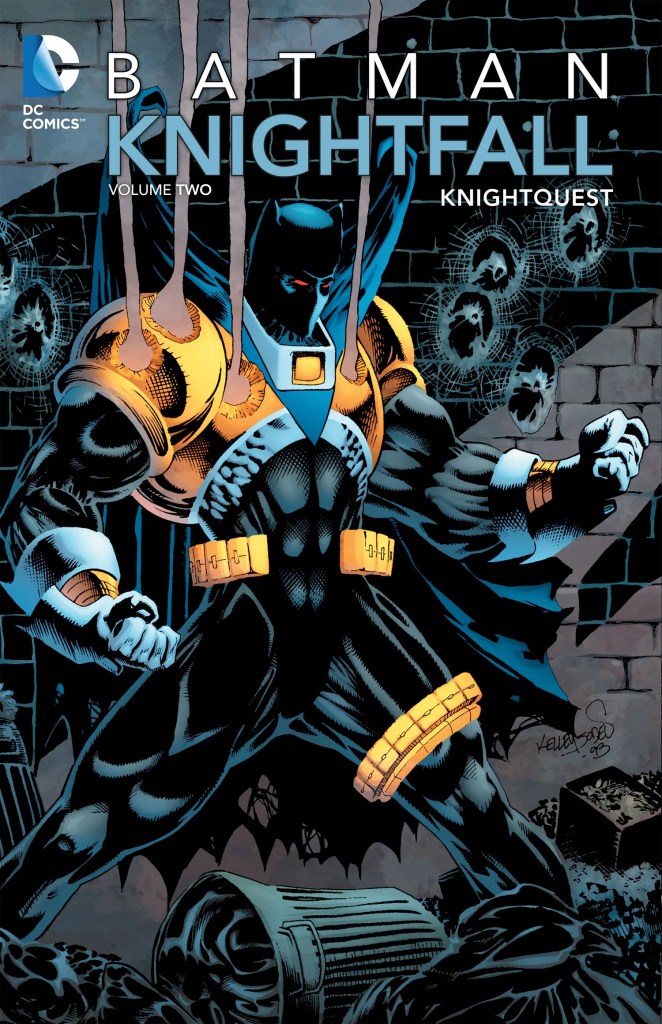
Knightfall, vol. 2: KnightQuest ⭐⭐⭐

This middle volume is a little bit of a letdown, though that isn’t too surprising, considering where it falls in the spectrum of the whole major arc.  The good news of this volume is it collects for the first time a lot of the issues involved in this period.  Fans of The Search may be disappointed, since it does not have any of those issues (and probably should), but by this point no one should be surprised this collection is missing them, and those who are interested in this storyline will find enough to be interested anyway.  Fans of the real Batman may not need this collection, though Azrael/Jean-Paul Valley fans will certainly be glad this collection exists, even if the stories aren’t all that meaningful for most of the collection.  It does have some highlights here and there, but it does take a fairly long time to build up any steam or interest, especially to the casual Batfan.  The only really interesting thing going on for most of the collection is J-P’s internal conflict: is he an Angel of Death, a heartless assassin like his father wanted him to be; or is he an Shadow Instrument of Good, a noble defender of the poor who has to take the grime of corruption upon himself?  This culminates in one of the darker issues of the collection — some may say “especially for 1993!” but dark is dark, regardless of what year it is published.  The other “highlight” of the collection is Gordon’s increasing despair with the new Batman.  It’s not enjoyable to see him realize he is now all alone, but his character moments are great in its way.  The culminating panel of Gordon destroying the Bat signal should have received a bigger space for such a drastic event.  Completists will most likely want to pursue the diasporic issues (lists of which are available elsewhere), if they don’t already have them, but those who are only interested in the major Knightfall Saga will be more than satisfied by this 20-year reunion collection.  It’s not as good as the first, but it was good to finally read what the KnightQuest was all about.

Knightfall Vol. 3: KnightsEnd ⭐⭐⭐⭐

Finally, I have completed this journey started almost 20 years ago.  I know the trades don’t include every single tie-in, and perhaps some day I’ll try to track those down, but I am quite satisfied (for the most part) with the way this story concludes.  The first half of the collection, KnightsEnd (or Knight’s End, perhaps) resolves the issue of Bruce Wayne vs. Jean-Paul Valley in an unexpected yet predictable way, as the basic story does what Keats says true art does: being both surprising and familiar at once, giving us the impression “but of course, it couldn’t have happened any other way,” which is about as close to calling this “literature” as anyone will likely get.  Some may be disappointed the climactic confrontation between Jean-Paul and Bruce does not end in the knock-down, drag-out fight we are expecting, but as Batman has always been about more than just fighting, a detective who thinks things through, performing the impossible with relative ease, the highly-symbolic conclusion is truly moving and fitting.  The only real problem with the end (as with the epilogue Prodigal storyline’s conclusion) is its abruptness.  We could have used another page or two (no need for more), at least of J-P walking away into the fading darkness as Bruce returns back to the dawn.

Similarly with Prodigal, the main point of contention between grown-up Dick Grayson and Bruce Wayne is they never talked it over, never discussed their rift and differences, never discussed Dick’s hurt over being apparently rejected in favor of Jean-Paul as the replacement Batman: here the authors recognize a key aspect of these characters, and instead of giving us a wonderful un-sappy heart-to-heart between these two veterans, we get a few panels of sort-of-obvious semi-platitudes, a different scene, and then a final resolution of implied “well, it’s all okay now.”  Had they given us a genuine dialogue of authentic resolution, this would definitely have been a 5-star review, missing tie-ins and all.  Do these stories have some goofy moments? some confusing references to pieces not missing?  Sure it does.  Most TPBs do.  Is the final page of the TPB an odd way to end a 1,900-some-page odyssey of identity, especially with Batman in shadow?  Indeed.  Could we benefit from learning what Bruce did while he was away, allowing Dick to don the cape and cowl for a time?  Sure.  But that’s not really what this is about.  In one sense, it’s about trust and the “idea” of “Batman.”

The pacing of KnightsEnd is quite impressive, even if the sensations it evokes are compressed as each issue is rapidly accessible in the TPB form instead of waiting a couple of weeks for the next installment.  Bruce Wayne, on his quest to recapture his mantle, goes to the world’s deadliest killer to re-hone his martial skills, getting metaphorically to the edge of killing while he literally gets to the edge of Gotham’s highest point, still unwilling to let go of his failures and fly free again.  The inevitable climax of Robin and Nightwing seeing Bruce “kill” someone (and the proper reveal of the truth) brings Bruce’s personal rehabilitation to a fitting conclusion, enabling his appropriate symbolic conclusion with Jean-Paul later.

Prodigal is a similar kind of story, with a surprising number of “light” moments between Dick and Tim running a mansion without Alfred.  That they are both youngish and enjoy (to an extent) going out and fighting crime brings for a few brief issues a vitality the usually-dark Batman-as-man-on-a-mission feel doesn’t give.  This doesn’t last, of course, as Dick starts to evaluate his life of (from his perspective) mostly failures, culminating in Bruce’s giving the mantle to Jean-Paul instead of him.  As stated above, the absence of a lengthy conversation between the two of them at the end was a real failure on the creative staff, but such is life.  Perhaps the saddest thing of the storyline is just as Dick starts to get the hang of things, just as he starts to find his place, poetically having defeated Two-Face alone, Bruce returns yet again to resume the cowl.  In the missing conversation, we are to assume Dick is mollified by Bruce considering him a son enough to resume his role as Nightwing and truly be content being his own man with his own superhero identity.  Fair enough.

Lastly, a word should be said for poor Commissioner Gordon.  What is he, the whipping boy of the DC Universe?  Can nothing go well for this defender of justice?  Here was another missed opportunity for a great conversation between secret-keeping heroes.  Dick knows Gordon knows he’s a different Batman; he could quite easily have said “I used to be Robin.  You can trust me.”  It’s all about trust, after all — why not bolster Gordon’s trust in him?  Ah, well.

All in all, it’s a satisfying conclusion to a full, good story.  If one is tempted to consider this corny and lacking in enjoyable violence, one should be tempted to step back and reflect about life, morality, and what is important.  The benefits of this experience outweigh the detriments, especially for the cost and convenience of these TPBs.


There you have it.  You can destroy their possessions, you can break them physically, but you cannot keep good detectives down.  It’s comforting to know some heroes will always be there to right wrongs and promote justice (even if doing it for money or while dressed as a bat).  If I haven’t made these stories sound all that appealing, please remember these reviews are intentionally light on the good stuff so as not to spoil your enjoyment of them when you get the chance to read these treasures.  Go out and get a copy of the fall and rise of these great detectives — you’ll be glad you did, especially if it entices you to read even more Nero Wolfe or Batman adventures.

The Wild Bunch Revisited

Christopher Rush

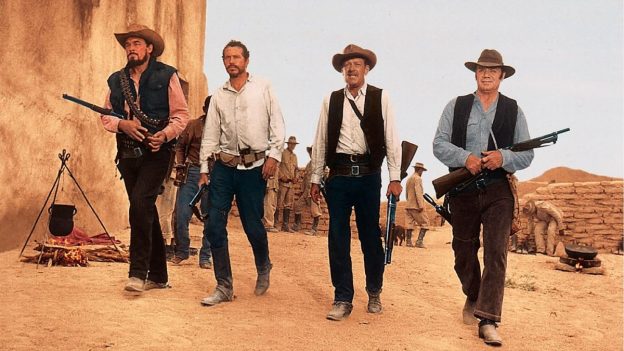
This is a violent movie.  It also has some moments of explicit adult content, in both language and visual imagery.  Most of the characters are coarse, greedy men struggling to live up to a moral code of their own devising.  But still.  This is a good if not great movie.  Now, please don’t get the impression we are tired of recommending family-friendly classics here at Redeeming Pandora.  We aren’t going to extol the merits of Pulp Fiction or A Clockwork Orange in my lifetime (only one of which I’ve seen).  I was planning on writing a little something about Wild Bunch even before Daniel Blanton submitted his treatment of Fight Club last time, and since I advertised it I wanted to follow through.  I wouldn’t want to be disloyal.

Speaking of which …

Loyalty is a dominant theme of this movie, and it’s certainly the ideas discussed and explored by this film that makes it so impressive.  Loyalty is connected to humanity: the less loyal you are, to your friends, your mission, your values, the less human you are, the closer you are to animals.  The whole climactic finale of the movie is driven by the bunch’s inability to obviate their failure to uphold this value.  Many who dislike the movie I would imagine liken the characters to animals anyway, since they are fairly rough and course for much of it.  They do steal, kill, and cavort their way through what passes for life.  And yet.  William Holden’s character, especially, tormented by the moments of disloyalty in his life (those he’s suffered and those he’s dispensed) drive him to cling to one vestige of his long-moribund humanity, loyalty to those with whom he travels.

The movie’s other theme, the death of the “ol’ West,” a popular subject for director and co-writer Sam Peckinpah, is a fitting companion to a story of men trying to cling to something — yet it is impressively ironic as well, since the Wild Bunch aren’t trying to cling to the way things used to be.  They are tired of living this sort of life, and with a new world of automobiles, international finance, and the disappearance of open ranges, they are attempting to adapt to the new ways of life.  They only embark on the major plot thread of the movie because their supposed “last big score” turns against them at the beginning of the film.  After all, one needs money if one is to retire and embrace a new way of life in the “modern world.”  Of course, with all the odds against them, the chances of this old group of ragtag gunmen, whose moral code is as elusive as their financial solvency, achieving a successful adaptation into a new world is unlikely.  The only thing they know is how to be themselves.  And that tension makes for a great movie.  (I guess I do think it’s great after all.)

The stellar cast (William Holden, Ernest Borgnine, Robert Ryan, and more) definitely helps the film excel as well, especially with some actors in roles that don’t surprise us and some that do.  Is this movie for you?  As I said, it’s got a good deal of asperity: coarse language, brief nudity, and violence that may make Quentin Tarantino blush.  For the kids out there, put it on the back burner until you’re a little older and wiser.  For the adults out there, I’d say give it a try.  You can be bothered by the rough stuff (I certainly am — I don’t excuse it at all), but what’s underneath all that is as intriguing a complex of ideas and characters and values worth fighting (and dying) for that make for a great movie.  As they say in the film, in one of the best “realization moments” of any film I’ve seen, “why not.”

When Sci-Fi Becomes Sci-Fact

Chris Glock

We’ve all read a science fiction story and thought about how great it would be if some of these inventions existed.  The genre of science fiction is full of unbelievable seemingly impossible inventions that would make everyday life so much easier.  Sometimes these inventions actually turn out to be feasible; many of our gadgets today were once just part of someone’s imaginary future world in a story.

Part of the reason science fiction has so many fantastical inventions is because of the freedom of imagination the genre has.  In the future in a different world anything is possible, allowing for authors to imagine endless amounts of devices and gizmos.  With all of these inventions, though, it’s only a matter of time before some of them are implemented in real life, right?  Well, some already have been.  Older novels have been predicting our current technology for years.

Earbuds, a common part of everyday life.  Earbuds are an invention used so often people rarely think about their complexity.  Even though they had bulkier headphones, earbuds weren’t around in 1953 and wouldn’t be for roughly half a century.  But when  Ray Bradbury published his dystopian classic Fahrenheit 451, he was able to conceive such an invention.  Though  he did not go into great depth, the “little Seashells in her ears, the thimble radios tamped tight, and an electronic ocean of sound, of music and talk” are unmistakably an idea of our modern earbuds.

Arthur C. Clarke predicted using geostationary satellites for telecommunications, namely television signals, 20 years before the first commercial satellite was launched.  He mentioned this in the magazine Wireless  World in 1945.  At the time, geostationary satellites were already being widely talked about as potential for radio communications.  A geostationary satellite is “a satellite in an equatorial circular orbit at a distance of approximately 42,164 km from the center of the Earth, i.e., approximately 35,787 km (22,237 miles) above mean sea level [at] a period equal to the Earth’s rotation on its axis (Sidereal Day=23h56m) and would remain geostationary over the same point on the Earth’s equator.”

Not impressed?  Well, Jules Verne predicted the moon landing a full century before it happened.  In his story From Earth to the Moon, he tells about the journey of three men completing the first manned space flight to the moon.  While parts of it are pretty far off, such as the vessel being launched from a cannon, other details are uncannily close.  For example in Verne’s novel the launch from Florida predates the Kennedy launch site by more than a century.  While his science was obviously flawed, many of his calculations referring to outer space travel are surprisingly close.

While it isn’t “literature,” Star Trek predicted many inventions we have today.  While ours isn’t quite as advanced, our modern 3-D printers are similar to the replicator used in Star Trek.  And our iPads are almost identical to the PADD (Personal Access Display Device), and the virtual display used by the Dominion bears a striking resemblance to Google Glass.

With the growing number of science fiction works and increasing dependence upon technology, it’s inevitable some authors would have gotten some stuff right.  They’ll probably continue to predict stuff correctly as well.  And while there are many of these predictions that came true, there is an even greater amount that didn’t.  However, we’re still progressing and may one day see teleportation or the hoverboards promised to us by Back to the Future.

Euclid’s Logical Architecture

Jared Emry

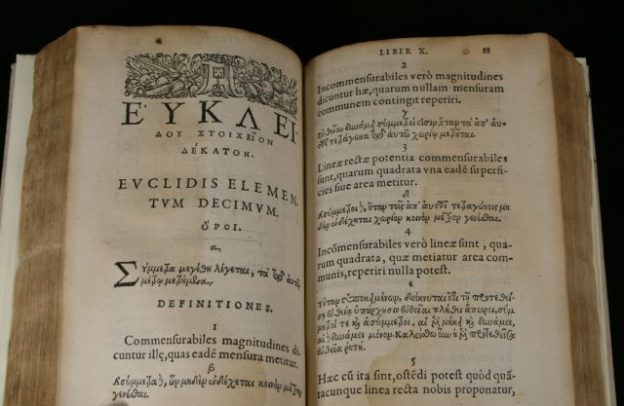
In Euclid’s Elements, Euclid follows a certain architecture for how he structures his logic. Mathematics at its core is pure logic. It is not bound to anything but itself. The logical architecture is in itself the framework of any particular theoretical mathematical reality. In math, the framework can be endlessly changed, but everything else is based upon extrapolation of that framework. Euclid provides a framework and much extrapolation upon the framework throughout the elements. Although this structure can be seen throughout the Elements, focus will be drawn to the first book. And due to space and time constraints, the structure will mainly be focused on the context, up to the twelfth proposition, in relation to the whole, from the definitions to the postulants and from the common notions to the propositions.

When Euclid begins to set up the theoretical reality of the Elements, he begins with three fundamental types of truth. The first of type of truth is definition. The definitions are truths of the factual level. This is this and that is that. It identifies basic parts of his theoretical reality in the same way a scientist tries to reduce the universe into fundamental scientific facts or laws. The first definition is a point is that which has no part. The second definition is a line is a breathless length. These two definitions are fundamental to Euclid’s Elements. They are not based upon each other and can be seen as foundational laws. We also see extensions to some definitions in later definitions. The definitions are the basis on which geometry is extrapolated and other fields in math are based. However, these definitions should not be seen as constant; they are free to be changed to create a new theoretical reality of mathematics.

The second of the three fundamental types of truth are the postulates. A postulate can be defined as a fundamental principle accepted as self-evident without proof. The postulates are claims to be considered true regardless. These can be thought of as a special revelation the same a religion may claim special revelation from a God. Euclid’s postulates are necessary for his theoretical reality to make sense. Some philosophers thought the foundations of reality are ultimately unknowable and only the individual can decide what foundational theory is true for them. Similarly, mathematics in general can have postulates that may seem to concur with reality or not. Since mathematics is pure logic, it is not constrained by any physical reality. Euclid provides in his Elements a definite special revelation of the foundations of his theoretical reality with these postulates. The postulates can almost be viewed as a form of religious dogma or worldview Euclid uses to explain the operations of his theoretical reality. They are Euclid’s five commands. They dictate certain things are possible and these things be considered fact. The first of these is to draw a straight line from any point to any point. This could be said differently as it is possible to create a straight line between two points. The second in the same fashion could be said differently as it is possible to create a straight line so it is straight. However, these slight rephrasing may disrupt some of Euclid’s nuances.

The third of the three fundamental types of truth are the common notions. The common notions are generally accepted logics. They are common for they are generally understood by human sentience. And they are notions because they are abstract reasoning. The common notions reflect the general revelation of man. Man understands the universe he lives in has general rules for functioning. In Euclid’s Elements, these are those rules. For example, the fifth common notion is the whole is greater than the part. It makes sense to the common understanding of sentience a whole is greater than the part, because it is not known to them an example otherwise. The common notions could be left out and more could be added. They act more as a shove toward logical extrapolation, a gentle guide toward the laws of the theoretical reality Euclid is creating in his Elements.

The fourth part of Euclid’s Elements is the propositions. Propositions are hypotheticals that can either be disproven or proven. An assertion is examined through the use of the common notions in the light of the definitions and the postulates. It takes the provided truths and logically analyzes them to see whether or not another truth can be extrapolated from them. Each proposition expands upon the foundation to create multiple and exceedingly more profound layers in the theoretical reality. This profoundness can be seen through the elegance of the each proposition alone, but they can also be overlaid to show their interactions and how they have built upon each other. Each proposition adds to the complexity of raw extrapolated logic. It is from this superposition of the layers Euclid’s theoretical reality can be seen as truly elegant. Euclid takes the layers a step at a time, first proving one thing, and all necessary corollaries and other needed propositions on the layer, before taking the next step up.  The ultimate layer of the first book is with proposition forty-seven, the Pythagorean Theorem. The Pythagorean Theorem is well known for being mindlessly memorized as a2+b2 =c2. Although the Pythagorean Theorem taught in that simple algebraic form, it is based on tons of logical extrapolation from several dozen propositions. It should be remembered there are no numbers or variables in the Elements and it is built only by extrapolation and inquisitive shape line arrangements. The Pythagorean Theorem is proven by comparing lines together in context of the previous propositions.  Euclid’s Elements are intuitive at their core.

Euclid’s logical architecture in the Elements provides insight to the complicated, because it is the process from the simple to the complicated. It is easier to climb a staircase one step at a time rather than trying to jump from the bottom of a staircase to the top. The book leaves the reader to find the theoretical universe behind the words but gives the reader freedom for his own intuition to guide him. In Euclid’s Elements, intuition is the only path to understanding. To be intuitive with logical frameworks is to find the heart of mathematics. Euclid makes it easy to grasp and to love the pursuit for that reality. On this staircase, each step is provided, but the steps have to be made not memorized. Unlike the bulky mimic taught in many math classes, mathematics is imaginative, fantastical, and intuitive.  In this elegance lies the heart of beauty itself, for mathematics is best defined as “the art of expression.”

Bibliography

Devlin, Keith, Ph.D. “What Is Mathematical Thinking?” Devlin’s Angle. Mathematical Association of America, 1 Sept. 2012. Web. 02 Feb. 2015.

—. “Will the Real Geometry of Nature Please Stand Up?” Devlin’s Angle. Mathematical Association of America, 2 Sept. 2014. Web. 02 Feb. 2015.

Lockhart, Paul, Ph.D., and Keith Devlin, Ph.D. A Mathematician’s Lament: How School Cheats Us Out of Our Most Fascinating and Imaginative Art. Jackson: Bellevue Literary, 2009. Print.

Overlooked Gems TV Edition: As Time Goes By

Christopher Rush

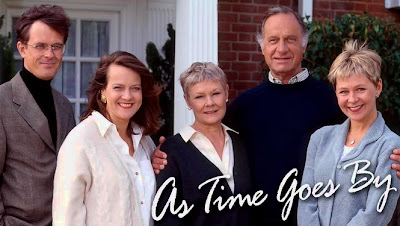
One may accuse me of being an anglophile if one wishes, but it is fair to say a good deal of the time television series from our cousins across the pond are superior in numerous ways to their American “counterparts.”  This is perhaps not always true, assuredly, since I did just say “a good deal of the time,” which is not a lengthy way of saying “always” (which, as an amalgam of “all” and “ways” seems like a strange expression to use for time and not methods).  Still, the BBC has given us a wealthspring of enjoyable series.  It is no secret I am a lifelong fan of Red Dwarf and Doctor Who (the original run, since I haven’t much experience with the relaunch).  Elsewhen I have mentioned the superiority of crime-drama shows such as Cracker and Prime Suspect.  Jeremy Brett’s Sherlock Holmes cannot be topped, and that’s just a fact.  Rumpole of the Bailey, Poirot, A Bit of Fry and Laurie, Jeeves & Wooster, Whose Line is it Anyway? — most of you likely agree with the general high quality of the BBC’s offerings, and we haven’t even mentioned the contemporaneous shows and their international popularity (mainly because I haven’t seen them yet, though you could check out some of the recommendations given earlier this issue).  To this list of delightful shows I add a show certainly not overlooked in its native England but far too long overlooked by Americans, the delightful As Time Goes By.

The premise for the series strikes one immediately as being wholly British — not in the sense of tea, crumpets, or Scotland Yard, but as a premise only the British would consider for a television series: a young couple in love, separated by war and communication breakdown, meet again 40 years later and slowly rekindle their relationship (and romance — sorry for the spoilers).  A show about two experienced people, getting along in years, both fairly set in their ways, does not seem at first glance to be a show with a lot of appeal … but somehow, the simplicity, the general aura of ease and calm create such an atypical show that draws you in and feels most of the time as a refreshing, relaxing relief from the antagonism-filled workday you have temporarily escaped.  Sure, the show has its inane moments: characters do bizarre and occasionally frustrating things here and there, but the vast majority of the time we know we are going to be in for an enjoyable time with these characters.

The two central characters are Jean Pargetter and Lionel Hardcastle, played by Judi Dench and Geoffrey Palmer (the powerhouse casting certainly helps the enjoyment of the series).  Jean is a semi-recently widowed mother of her twice-divorced daughter Judi.  Jean owns and manages a typing/secretary agency (perhaps dating the early seasons a bit … the subplot of a late episode revolves around getting a modem), and Judi works for her.  Judi’s own secretary, Sandy, becomes a major supporting character before too long in the series.  Lionel, after his time in Korea (at which he is kicked by a mule, prompting Jean to dub him Lionel Hardcastle, kbm, mimicking the British knighthood system), becomes a coffee plantation manager in Kenya, marries, divorces, and returns to England and writes a book about his experiences.  His publisher, Alistair Deacon (a truly great character who must be seen to be believed — and even after seeing him you won’t believe him), urges Lionel to get a typing secretary to help him finish his book.  This throws our main characters together, starting the rekindling process slowly but surely.  It takes some time for their friendship to resume and grow over a few seasons, but the pacing (thanks to the shorter British season-lengths) is not a problem, especially if you have the whole show on dvd or Amazon Prime™.  Soon enough, we meet family members and others who become recurring characters each season, and the focus of the show shifts from rekindling friendship and life at the agency to home life, new business opportunities, and other character-driven stories, all the while giving us good laughs, intelligent dialogue, and simple stories that give you more value and enjoyment than you think you’ll get most of the time.

My favorite character is Lionel, mostly because we’re pretty similar (overlooking the fact I’ve never been a coffee plantation owner in Korea, a soldier, divorced, or British).  Lionel gets grumpy rather easily, though I don’t think I do, not as badly as he does, but there’s enough Eeyore and Marvin the Android in there to remind you sooner rather than later his soft, nurturing side is going to override whatever momentary goofiness is interfering with his relaxation.  One gets the sense he’s the kind of parent/husband you want Mr. Bennet to be but never will.  Lionel, for all his gruff, is an intelligent, caring man — the show does revolve around his ability to re-woo the long, lost love of his life, after all.  Like Lionel, I have difficulty understanding the younger generation (as also indicated earlier this issue), I enjoy being at home more than most other places, I would totally enjoy being on the lecture/book-writing circuit, and I am skeptical of technology (we’ve already had that conversation).  Unlike Lionel, I don’t follow rugby or cricket, I don’t pop down to the pub for a quick half, I don’t walk to the neighborhood grocer for groceries, and I don’t like custard tarts.  Three of those could easily be addressed if I lived in England like Lionel is fortunate enough to do, however.

He’s certainly not a perfect man; his flaws come out with fair regularity (it is a situation comedy, after all), and he does let us down at times when his bluster and self-centered drive for things to be more comfortable and easy than they usually are override good sense and common courtesy.  But, then again, that would be another area in which we are similar, and that well-rounded humanness of Lionel’s character makes those many bright spots when he comes through and saves the day and says just the right thing all the more enjoyable.  He’s probably the most lovable wet blanket you’ll ever meet on the screen.  The plus side is seeing those flaws encourages one (me) to improve those flaws within oneself (myself).

I don’t want to ramble on about too much else, since the point of this was to introduce you to an overlooked series, not tell you everything you should know so you don’t have to watch it (like I did with Centennial way back when).  Jean, Judi, Sandy, and Alistair (especially Alistair) all are good characters with their ups and downs, and the second tier of supporting characters that flesh out the series starting in season two make the show even better.  It is the television equivalent of putting on your favorite jim-jams, eating your favorite goodnight snack, and spending time with people you really care about, all the while being believable, realistic, and worthwhile.  It is sentimentality at its finest.  Do yourself a tremendous boon and get and delight in As Time Goes By.

Desensitization

Matthew Nalls

“The amount of educational programming on television today is simply desensitizing.  The only reason left to go to school is to see gun violence,” (Humphreys 1) states Martin Chizelwit Humphreys in his book, Some Inspiration for the Overenthusiastic.  In this day and age, Martin Humphreys is not the only one who shares this view reflected by his quotation on desensitization.  Many others take up the call on the subject of desensitization with the same outlook.  In their minds, desensitization is a horrible, vile cancer upon society; one which must be avoided at all costs.  An example of one who shares the thoughts of Humphreys on this matter is Genice Phillips.  On the Web site “Beliefnet,” Phillips is the author of a particularly interesting article on desensitization entitled, “Is Desensitization the Norm in America?” in which she states

When violence, of any kind, splashes across our TV screens during the news, what is our reaction?  For a moment we’re concerned.  If it hits close to home, we’re afraid, overwhelmed by the thought that tomorrow it may be our daughter, our son; it may be us.  But those feelings last for a short period of time, and then, the news moves on.  And so do we…  Our emotions have numbed towards violent occurrences across the country (par. 2).

Phillips’s outlook on desensitization in a corrupted society is nearly exactly homogenous to Humphrey’s thoughts on the matter.  Both authors share the previously stated idea desensitization is comparable to a form of crippling cancer.  Hence, the question is raised, “If more than one person seems to firmly hold this belief desensitization is present and detrimental, what evidence exists upon which they stand?”

Evidence of desensitization runs almost as rampant as desensitization itself.  The majority of officials, authors, scholars, or others who take up arms against the spread of desensitization usually cite the growing “mature”-rated gaming industry as evidence of its spread.  On July 24th, 2006, Iowa State University officials published a report involving studies completed on the link between violent video games and exponential desensitization.  In the findings, the report makes numerous claims based on studied observations, stating:

Research led by a pair of Iowa State University psychologists has proven for the first time that exposure to violent video games can desensitize individuals to real-life violence….  Their paper reports that past research — including their own studies — documents that exposure to violent video games increases aggressive thoughts, angry feelings, physiological arousal and aggressive behaviors, and decreases helpful behaviors.  Previous studies also found that more than 85 percent of video games contain some violence, and approximately half of video games include serious violent actions (sec. 4).

As if the evidence found in this report supporting the link between violent video games and desensitization was simply not enough, the pair of researchers went on to make their own conclusions on the experiment at the end of the report, stating

They conclude that the existing video game rating system, the content of much entertainment media, and the marketing of those media combine to produce “a powerful desensitization intervention on a global level.”… “In short, the modern entertainment media landscape could accurately be described as an effective systematic violence desensitization tool,” he [researcher Craig Anderson] said (sec. 4).

Only one undeniable and obvious fact can be drawn from the findings of the pair of Iowa State University researchers: desensitization is prevalent and highly corruptive upon society by being exuded from violent media.  Based upon the firm conclusion drawn by the researchers, violent media is a tool that would spread desensitization globally.  Something to note, however, is the fact this study was carried out, completed, and published all in 2006; nearly 9 years ago.  The only way to prove the validity of the seemingly-outdated study is to compare it to studies completed in the past three or four years, studies more recent and therefore more “valid” than Iowa State University’s report.

A report published August 12th, 2013 by the University of Texas at San Antonio reviewed evidence again supporting desensitization linked to violent media, seven years after the Iowa State University initial report.  In the report, UTSA scholars describe their findings:

Today, a growing number of children, teens and adults purchase and play video games, supporting an industry that is valued at nearly $80 billion worldwide.  Scholars estimate that more than 85 percent of video games contain some form of violent imagery, and half include what they coin “serious violent actions.”  They also warn that violent video games such as Call of Duty: Black Ops have desensitizing effects on the body’s physiology….  “It is generally accepted within the scientific community that violent video games lead to desensitization, negatively impact psychological functioning and contribute to aggressive behavior” said [UTSA scholar] Cordova (par. 2-4).

As clearly and concisely laid out by the UTSA report, desensitization is still prevalent nine years after ISU’s original report.  Not only does that prove the still-extant validity and relevance of ISU’s findings, but also it proves the point made by ISU researchers when the report stated, “They conclude that the existing … media combine to produce ‘a powerful desensitization intervention on a global level.’”  Desensitization has latched onto the gaming industry like a parasite, as it has abridged continents and grown across the world.  Based upon the findings of both reports, anyone who attests to the valid fact the gaming industry is partly responsible for the spread of desensitization is neither inaccurate nor incorrect.

Thus, based on these findings, the fact desensitization is a crippling cancer upon society, using violent media as one of its means of locomotion, is now feasible.  Both Martin Humphreys and Genice Phillips are correct in their logic regarding the subject of rampant desensitization.  Desensitization is definitely rampant and undoubtedly dangerous.  Now that the question of desensitization’s existence is proven, many turn to face questions begged by the whole of societies across the globe yet, thus far, have unfortunately gone unanswered on a wide scale.  Arundhati Roy, writer and winner of the Booker Prize in 1997, summarizes the questions many ponder on the subject the best, as she states, “Have we raised the threshold of horror so high that nothing short of a nuclear strike qualifies as a ‘real’ war?  Are we to spend the rest of our lives in this state of high alert with guns pointed at each other’s heads and fingers trembling on the trigger?”  While many recognize desensitization as a major threat, only time will tell if and how the world will react to it on a unified scale.

Works Cited

Carnagey, Nicholas. “ISU Psychologists Provide First Study on Violence Desensitization.” Iowa State University News Service. 24 July 2006. Web. 26 Feb. 2015.

Fish, Christi. “UTSA Scholars to Study Desensitization…” UTSA TODAY. 13 Aug. 2013. Web. 26 Feb. 2015.

Health Day. “Violent Video Games May Numb Players to Brutality, Study Says.” U.S. News and World Report. 9 May. 2013. Web. 26 Feb. 2015.

Humphreys, Martin Chizelwit. Some Inspiration for the Overenthusiastic. 2 Nov. 2011. Web. 26 Feb. 2015.

Phillips, Genice. “Is Desensitization the Norm in American Society?” Beliefnet. N.d. Web. 26 Feb. 2015.

Roy, Arundhati. “Quotes on Desensitization.” Goodreads. N.d. Web. 26 Feb. 2015.

Anne Boleyn and Her Unfortunate Encounter with Sony Pictures

Elizabeth Knudsen

The media have a way of taking history and rewriting it to create a tale more easily sold to the public.  Most recently, this has been done with the Bible, like in Noah, A.D., and many others.  But even more often a historical figure is misrepresented entirely — like Pocahontas in Disney’s classic, who was supposed to be around 10 or 11 years old and had no romantic connection to John Smith whatsoever.  However, this paper isn’t another bout with Disney.  Instead, the decline of fiction is shown through the portrayal of another historical figure: Anne Boleyn, the second wife of King Henry VIII.

Anne was born in Norfolk and appears to have been the dutiful daughter expected of 16th-century England.  In other terms, she, along with her father and brother, worked vigorously for the family’s interest in the court of King Henry VIII.  They were known to be early acceptors of the “New Religion” — or Protestant interpretation of the New Testament from Germany — and Anne in particular shared these views with precise, deep, and learned zeal.  She had been educated in France since she was six years old, and thus not only became fluent in French but also was gifted with exposure to Renaissance classicism and fashion.  The fervor she held for the Reformation was most likely first introduced to her through Marguerite of Angoulême, who later became known as the Queen of Navarre; Gillaume de Briçonnet, her Reformist bishop; and Jacques Lefèvre d’Étaples, the humanist Bible translator and influential polymath.  Indeed, “Lutheran” ideas came to France through these three individuals.  Anne’s delight in the French language — it being the third principal language of the movement — became her primary source of the Reformation.

Her relationship with Henry Tudor began with the English king’s impatience for a male heir.  Despite the fact the physical descriptions of Anne are not particularly flattering, her vivacity and personal confidence caught Henry’s eye.  Around 1526, Henry began courting her.  The story of Henry VIII’s break with the church over the annulment of his previous marriage is a well-known one, and it ultimately ended with his marriage to Anne in 1533.  Three years later, Anne was executed on grounds of treason, having failed to produce a male heir because of multiple miscarriages.  She remained steadfast in denying the charges against her and was equally resilient in holding to her faith.

Enter Natalie Dorman, starring as Anne Boleyn in Sony’s The Tudors television series.  It would admittedly be unfair to pin the blame on the actress.  For many actors, a job is a job, and they need it.  The writers and the production company, however, have no way to escape criticism.  The Tudors depicts Anne as a hot-tempered, French-taught seductress and schemer.  It follows the basics of her life — her children, her marriage to King Henry, and her death — but in between the glimmers of truth are deep shadows of eroticism.  Additionally, and perhaps most importantly, it downplays Anne’s faith and magnifies her sexuality.  One of the most poignant examples of this is possibly in how Anne’s refusal of Henry’s sexual advances is portrayed.  In the TV series, it is presented as one more way she seduces Henry.  She encourages him and then refuses him, all the time making him all the more infatuated with her (which was her aim in the first place).  However, it is recorded Anne really did refuse to be Henry’s mistress saying she would only be his wife.  And if she was, as is believed, a Christian, wouldn’t this refusal be a no-brainer?

So once again, the media are seen portraying a female as a character “more befitting” to the screen.  Why is it a singing self-actualizer or a fiery-tempered temptress are better than a noble heroine or a leading figure in the English Reformation?  The world’s values have shifted drastically, and not for the better.  These shifted values are most prominently shown through the decline of fiction.

Bibliography

BBC History. BBC, n.d. Web. 3 Mar. 2015. <http://www.bbc.co.uk/history/people/anne_boleyn/&gt;.

Zahl, Paul F. Five Women of the English Reformation. Grand Rapids, MI: Eerdmans Publishing Company, 2001. 10-26. Print.

Extrasensory Perception

Jared Emry

Already, at the title, the mere claim the topic of extrasensory perception may seem irrational and even pointless to discuss. If one were to do a Web search on the subject, it is likely one would find hundreds of sites without good credentials of any kind willing to impart their secret knowledge, often for a slight fee. These sites may be taken as representative of the subject matter, but they’re not. These sites tend to be fraudulent in nature, and one’s opinion of the subject matter should not be based on such things as these sites are filled to the brim with exaggerated claims and bogus studies in order to make money (Stein). Even without such a negative, yet extremely popular, influence, the claims of extrasensory perception may seem bizarre and baffling to the point they should be rejected offhand. However, as Einstein once said in a letter to Jan Ehrenwald, “It seems to me, at any rate, that we have no right, from a physical standpoint, to deny a priori the possibility of telepathy. For that sort of denial the foundations of our science are too unsure and too incomplete” (Frazier 63-64). This concept is known is otherwise known as Clarke’s Law. When a distinguished but elderly scientist says something is possible, he is almost certainly right. When he states something is impossible, he is almost certainly wrong. It would seem rather than denying extrasensory perception a place for discussion under the enlightenment of science it would be far more rational to explore the topic to see if it is researchable or to see if a phenomenon actually does exist. As our level of technology increases, perhaps phenomena currently difficult to study may be the next frontier of science. After all, the black hole was only recently considered to be mere science fiction and any scientist caught taking such things seriously would be politely ridiculed. Rationally, who could expect objects of infinite density, mass, and gravity could exist? The entire Earth would have to be collapsed into the size of a golf ball. Yet science has since proven these astronomical monsters do exist. If people weren’t scanning the heavens for them, they would still be a laughing matter. But what exactly is extrasensory perception? To know that, it is best to start with the history of extrasensory perception and its terminology. The potential benefits for scientific analysis should be examined so as to know whether or not the field is worth any extra attention.

Parapsychology really began in the British Isles during the middle of the 19th century. Some of the people who were involved in the field at that time included such names as Sir Arthur Conan Doyle, William James, Lord Rayleigh, Henry Sidgewick, and C.D. Broad. They studied such things as mediumship, telepathy, the Riechenbach Phenomena, and apparitions. While many scientists would subscribe to the belief in the validity of the field, it also became widely criticized by many scientists, splitting the scientific community more than ever before. Above all else, the field became incredibly popular in the masses. Harry Houdini even took it upon himself to try to prove parapsychology was false, although many people thought he could legitimately cast magic with strange occult powers. This era developed little to no substantive proof for anything in the field of parapsychology (Kurtz).

In 1930, Duke University opened up its parapsychology unit. Duke wasn’t the first university, but it spawned a new era in parapsychological research known as the Rhine Era. For the parapsychology laboratory, Duke University employed psychologists William McDougall, Karl Zener, Louisa E. Rhine, and J.B. Rhine. The era would be named after J.B. Rhine, who would become the most well-known parapsychologist ever. His name would become as well known as Einstein’s for a decade (Berger). J.B. Rhine would be one of the first to attempt to rigorously study parapsychology and quickly realized the study of Extrasensory Perception was at the time the only part of parapsychology that had a possibility for study in a laboratory setting. Initially the results of the Duke experiments were quite successful, but soon they discovered methodological errors in their studies. The studies would be fixed of those methodological errors and repeated only to have more methodological errors. The Rhine Era was a continuous cycle of refining methodologies for laboratory studies, and with each cycle the results diminished (Laycock 28-31). After the Rhine Era, the studies broadened to include more topics. The research publically known continued to show no significant results; however, other studies were done in secret.

In the late 1940s, with the defeat of the Nazis, the United States government began to secretly and systematically bring Nazi scientists back to the United States and even sometimes away from the Nuremburg Trials. Many scientists were given amnesty in return for sharing the Nazis’ technological secrets (National Archives). This program was known as Operation Paperclip. The goal was to keep Nazi scientists away from the Soviet Union. NASA was a product of Operation Paperclip, as the Nazis were the first to develop rocket technology, so much of NASA’s original group of scientists were former Nazi scientists. However, Operation Paperclip had a darker side to it. In addition to Nazi rocket scientists, they also brought over and employed Nazis who were involved in Nazi mind control experiments. These brainwashing specialists were employed by the CIA in a collection of programs often collectively referred to as Operation MKUltra (Lasby). MKUltra was declassified in 1975 by the U.S. Congress shortly after CIA Director Richard Helms managed to destroy all but 20,000 documents in 1973 (CIA). MKUltra and its many subprojects were experiments into human behavioral engineering; many of these experiments were highly illegal and unethical. The CIA would collect unwitting American and Canadian citizens for human experimentation that often resulted in severe neurological and psychological damage. The subjects of the human experimentation would be subject to many varieties of altered mental states brought on through various means including, but not limited to, hypnosis, hallucinogenic drugs, insulin induced comas, LSD, sensory deprivation, isolation, verbal abuse, and even sexual abuse. “The frequent screams of the patients that echoed through the hospital did not deter Cameron or most of his associates in their attempts to depattern their subjects completely” (Mark ch. 8). In subproject 119, scientists implanted electrical devices into people in order to try to take control of motor function and human behavior. In subproject 68, lead by Dr. Ewen Cameron, patients were placed into comas, sensory deprived, and forced to listen to repeating tapes for months on end. Dr. Cameron’s experiments included the sexual abuse of children. His subproject and other subprojects would manage to obtain film of high-ranking American government officials committing sexual acts on children and blackmail those officials in order to maintain funding (Goliszek 170-171). He would become president of the American, Canadian, and World Psychiatric Association.

How do these atrocities relate to extrasensory perception? Firstly, any significant research into extrasensory perception during altered states would have been researched in this program. Secondly, the work done (and probably still being continued under another codename) by Operation MKUltra prompted the U.S. Army to start Project Stargate. MKUltra lead to many strange and bizarre projects concerning parapsychology and extrasensory perception, but Project Stargate has more easily available information concerning it. Project Stargate was a remote viewing project that lasted until 1995. Remote viewing is a type of extrasensory perception that involved subjective locating abilities. The Stargate Project involved soldiers and some civilians being isolated from news reports and current events and asking them in to find out about enemy movements while in a trance. The final public report of the Stargate Project proclaimed that,

Even though a statistically significant effect has been observed in the laboratory, it remains unclear whether the existence of a paranormal phenomenon, remote viewing, has been demonstrated. The laboratory studies do not provide evidence regarding the origins or nature of the phenomenon, assuming it exists… even if it could be demonstrated unequivocally that a paranormal phenomenon occurs under the conditions present in the laboratory paradigm, these conditions have limited applicability and utility for intelligence gathering operations (Mumford).

While the specifics pertaining to results of these tests are widely unknown, they are still a significant portion of the history of extrasensory perception.

Modern-era parapsychology has become rare in the United States. The only two universities in America that continue to study parapsychology are the University of Virginia and the University of Arizona. The University of Virginia is studying near-death experiences and the possibility of survival after death. The University of Arizona is studying mediumship. Mediumship includes a little extrasensory perception. There are also a variety of private institutions in America that study parapsychology, and they do tend to have occasional studies into extrasensory perception. In Europe, parapsychology has had substantial increases in research funding. The University of Edinburgh has become somewhat famous for the Koestler Parapsychology Unit and is currently offering degrees in parapsychology for anyone who has two masters degrees in two other fields of psychology and completes all of their parapsychology courses. Parapsychology has also started to be augmented by other fields of psychology in recent years to try to provide theoretical framework (Zusne). Overall, there is no known research that substantiates the claim of extrasensory perception. To claim the government managed to succeed with their secret tests would be a conspiracy theory that would require far more substantiation. For more than a century research has been poured into this subject without any fruitful results.

As previously mentioned, there are several kinds of extrasensory perception, and they can be categorized into types. These types are telepathy, clairvoyance, and trans-temporal cognition (Encyclopedia Britannica). Telepathy is the transmission of thoughts between at least two people. Clairvoyance is a general term for several subtypes of the ability to know or be aware of objects or events that shouldn’t be known because the senses haven’t been exposed to them in what would generally be considered the natural way. Trans-temporal cognition is a broader term for precognition and retrocognition. Precognition is the ability to see into the future. Retrocognition is the ability to see into the past (Parapsychological Association).

Telepathy is essentially thought reading. There are several forms of telepathy. One of these forms is emotive telepathy, which is the ability to influence others with emotions. However, latent telepathy is typically considered to be the most frequent form. Both of these along with classic telepathy are the only pure forms of telepathy. Telepathy is often studied with Gansfeld effects, or other uses of sensory deprivation in order to try to increase the ability of extrasensory perceptions. Earlier experiments made use of Zener cards. Experiments tend to have two subjects, one of whom is given a picture in one room and the other is in another room and is supposed to try to know what the other is thinking subconsciously. Testing is done by marking the time by when the photos appear and what the sensory deprived subject says to be seeing or feeling (Parapsychological Association).

Clairvoyance is the sixth sense. It has many subtypes as follows: clairalience, clairaudience, claircognizance, clairgustance, clairsentience. True clairvoyance is the ability to actually see the objects or events that should be out of sight. True clairvoyance includes remote viewing. The subtypes each relate to the other senses, with the exception of claircognizance. For example, clairalience refers to the sense of smell, and clairgustance refers to the sense of taste. They all generally operate in the same way, but each to its own sense.  Claircognizance, on the other hand, is more of a general feeling. A good example of claircognizance would be the feeling one is being watched, which is a common phenomena currently being researched. While claircognizance is an intrinsic knowledge, it defers from trans-temporal cognition in that claircognizance only gives knowledge about the present. It may be likely claircognizance is more similar to trans-temporal cognition than the other forms of clairvoyance (Parapsychological Association).

Trans-temporal cognition is both retrocognition and precognition. It is the ability to know the past and the future. All evidence for this must be anecdotal in nature. Currently, there is no proof it is anything other than a confirmation bias and self-fulfilling prophecy. Recently, thanks to new technologies, social media, and mass data storage, it may be possible to start new experiments by observing old data collected in order to objectify the anecdotes (Alcock).

Extrasensory perception is part of the field known as Parapsychology. Parapsychology encompasses telepathy, precognition, clairvoyance, psychokinesis, near-death experiences, reincarnation, apparitional experiences, and similar claims. Contrary to popular belief, Parapsychology is not concerned with UFOs, Bigfoot, paganism, or witchcraft. Like many forms of psychology, parapsychology is a pseudoscience (pseudo is a prefix meaning false). A pseudoscience is anything that takes the form of science but isn’t. In other words, a pseudoscience can be empirical and based on statistics (Panskepp).

One of the key parts of what demarcates science from pseudoscience is the idea of falsifiability. For example, if one were to examine an instance where a man saved a child from drowning that was being drowned by another man from both Freud’s and Adler’s differing theories, we would get different results of which both are equally valid. Freud would claim the second man is suffering from psychological repression stemming from the Oedipus Complex and the first had attained sublimation. Adler, on the other hand, would claim both men simply had feelings of inferiority, which drove one man to save another and also drove the other man to kill. The observation in this case confirms the theory, both opposing theories. This is pseudoscientific as there is nothing that could prove either theory to be false (Popper). For something to be truly scientific, it must be falsifiable, refutable, and testable. In science a prediction must be made, like Einstein’s prediction light can bent by gravity. That is testable during a solar eclipse by observing the light of stars behind and nearby the sun during an eclipse. If the effect isn’t observed, then Einstein’s theory is refuted, thus it is refutable. Since Einstein is either correct or incorrect, it is falsifiable. Therefore, Einstein’s theory of relativity is true science. Psychology fails to meet the standards of science (Kuhn). Technically, however, psychology is an accepted science but is considered a soft science, which is merely a way to separate the stigma of the field being called a pseudoscience (Popper). The reason for this is just because it is pseudoscience doesn’t necessitate it being not true or helpful. Certainly psychology is thought to be helpful for many people, but it isn’t scientific. It uses many aspects of science to attain a level of empirical thought, but it relies on a confirmation basis, and the theories are mostly inherently improvable. It would be hubris to throw out psychology on the basis it isn’t always scientific. Additionally, psychology does have a few parts to it that are scientific (although, admittedly, quite a bit of the earlier scientific portions of psychology were unethical). Psychology’s credibility only came about by advances in other fields of science, particularly neurology and biology. Similarly, parapsychology currently fails at not being falsifiable or refutable.

If there hasn’t been any known substantiated research and if extrasensory perception is a pseudoscience that will defy any attempts at true scientific analysis, then why continue devoting funding and time to studying extrasensory perception? This is a good question. Parapsychologists always start from the assumption the phenomenon of extrasensory perception and other phenomena are real. There is an inherent confirmation bias in parapsychology that prevents answers from being found. Whereas in the past, some pseudosciences were able to achieve the rank of soft science, or even hard science in the case of chemistry, by managing to create a substantial theoretical framework and laboratory data, parapsychology will never be able to achieve that level of credibility. By always looking for the confirmation and not considering the null data, parapsychology has crippled itself. Yet, this doesn’t necessitate the subject matter of extrasensory perception shouldn’t be studied. It would be a fallacy to assume because the field extrasensory perception is relegated to is corrupt and unscientific extrasensory perception shouldn’t be studied scientifically at all. Unfortunately, until recently, the critics and skeptics of parapsychology have done very little in the way of running tests themselves in order to refute the phenomena the parapsychologists claim exist. There is a new field of psychology that has recently been established known as anomalistic psychology that attempts to study these purported phenomena from a purely scientific view (French). Anomalistic psychologists don’t rely on a confirmation bias and therefore are free to explore all possibilities, and they have made great strides in doing so. Wiseman and associates did a study on apparitions and alleged haunting that showed environmental factors caused people to more likely see apparitions. These environmental factors included levels of lighting, local electromagnetic fields, and other similar factors. In one case, they found a fault line in the earth was emanating certain ions underneath a house and causing hallucinations to anyone in proximity to the house and the effect of the ions increased with exposure. Hauntings and apparitions aren’t normally considered to be part of extrasensory perception, but this was brought up to make an example of the successes of anomalistic psychology. Unfortunately, there have not yet been anomalistic psychological studies into extrasensory perception. It is here encouragement for study into extrasensory perception is warranted and needed (Wiseman).

Extrasensory perception has eluded researches for more than a century because of a confirmation bias that has existed since research has begun. Only recently have researchers taken the study beyond the pseudoscience, and it is now time for research to truly begin into the paranormal. This line of research is of the utmost importance as the results would either change all we scientifically know about the nature of the universe, or it will do nothing more than cast away doubt. Either way, the research is necessary.

Bibliography

Alcock, James E. Parapsychology, Science or Magic?: A Psychological Perspective. Oxford: Pergamon, 1981. Print.

Berger, Arthur S., and Joyce Berger. The Encyclopedia of Parapsychology and Psychical Research. New York: Paragon House, 1991.

“Extrasensory Perception (ESP) (psychology).” Encyclopedia Britannica Online. Encyclopedia Britannica, n.d. Web. 8 Nov. 2014.

Frazier, Kendrick. Paranormal Borderlands of Science. Buffalo, NY: Prometheus, 1981. Print.

French, Chris. “Nature.com.” Soapbox Science. Nature.com, 19 Dec. 2011. Web. 25 Nov. 2014.

“An Interview with Richard Helms.” Central Intelligence Agency. Central Intelligence Agency, 08 May 2007. Web. 24 Nov. 2014.

Goliszek, Andrew, Ph.D. In the Name of Science: A History of Secret Programs, Medical Research, and Human Experimentation. New York: St. Martins, 2003. Print.

“Historical Terms Glossary.” Glossary of Psi (Parapsychological) Terms. Parapsychological Association, 2006. Web. 1 Nov. 2014.

“Koestler Parapsychology Unit.” Koestler Parapsychology Unit. University of Edinburgh, n.d. Web. 5 Nov. 2014.

Kuhn, Thomas S. The Structure of Scientific Revolutions. Chicago: U of Chicago, 2012. Print.

Kurtz, Paul. A Skeptic’s Handbook of Parapsychology. Buffalo, NY: Prometheus, 1985. Print.

Lasby, Clarence G. Project Paperclip German Scientists and the Cold War. New York: Atheneum, 1975. Print.

Laycock, Donald, David Vernon, Colin Groves, and Simon Brown. Skeptical: A Handbook of Pseudoscience and the Paranormal. Ed. David Vernon. Canberra: Canberra Skeptics, 1989. Print.

Marks, John. The Search for the “Manchurian Candidate”: The CIA and Mind Control. New York: Times, 1979. Print.

Mumford, Michael D., Andrew H. Rose, and David A. Goshin. An Evaluation of Remote Viewing: Research and Applications. Palo Alto, CA: American Institutes for Research, 1995. Print.

Panksepp, Jaak. Affective Neuroscience: The Foundations of Human and Animal Emotions. New York: Oxford UP, 1998. Print.

Popper, Karl R. Conjectures and Refutations; the Growth of Scientific Knowledge. New York: Basic, 1962. Print.

“Records of the Secretary of Defense (RG 330).” National Archives and Records Administration. National Archives and Records Administration, n.d. Web. 19 Nov. 2014.

Stein, James D., Ph.D. The Paranormal Equation: A New Scientific Perspective on Remote Viewing, Clairvoyance, and Other Inexplicable Phenomena. Pompton Plains, NJ: New Page, 2013. Print.

“The VERITAS Research Program.” Laboratory for Advances in Consciousness and Health. University of Arizona, n.d. Web. 5 Nov. 2014.

Wiseman, Richard, and Caroline Watt. Parapsychology. Aldershot: Ashgate, 2005. Print.

Zusne, Leonard, and Warren H. Jones. Anomalistic Psychology: A Study of Magical Thinking. Hillsdale, NJ: L. Erlbaum, 1989. Print.


As The Kids Say

The Voice of the People

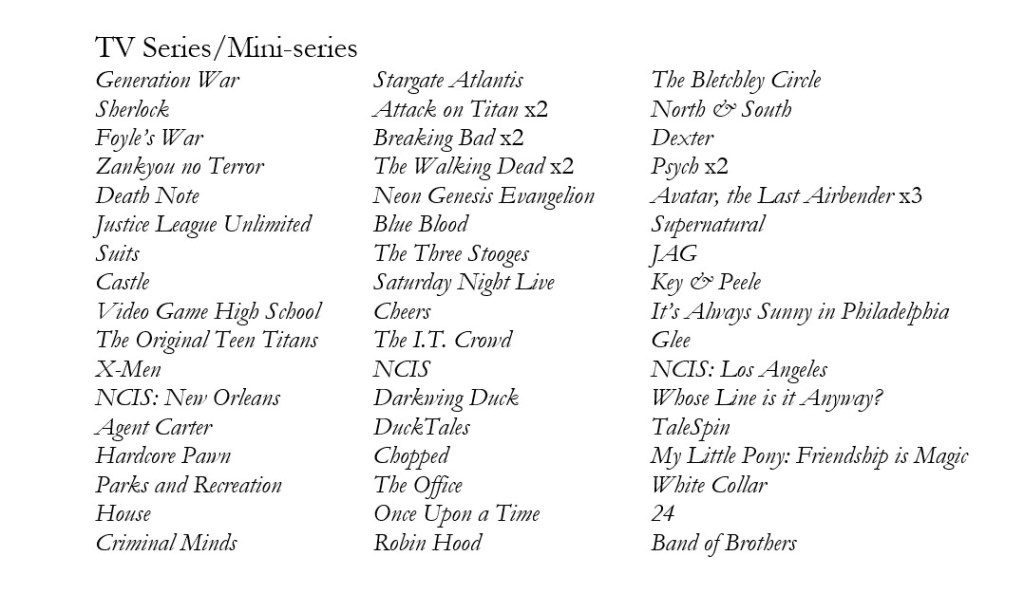
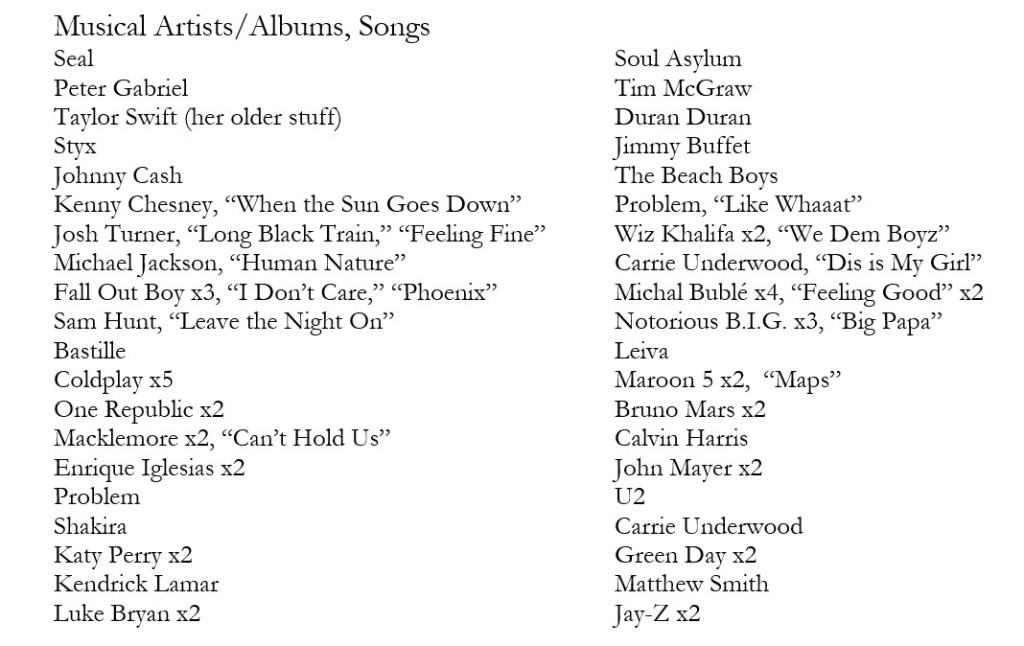
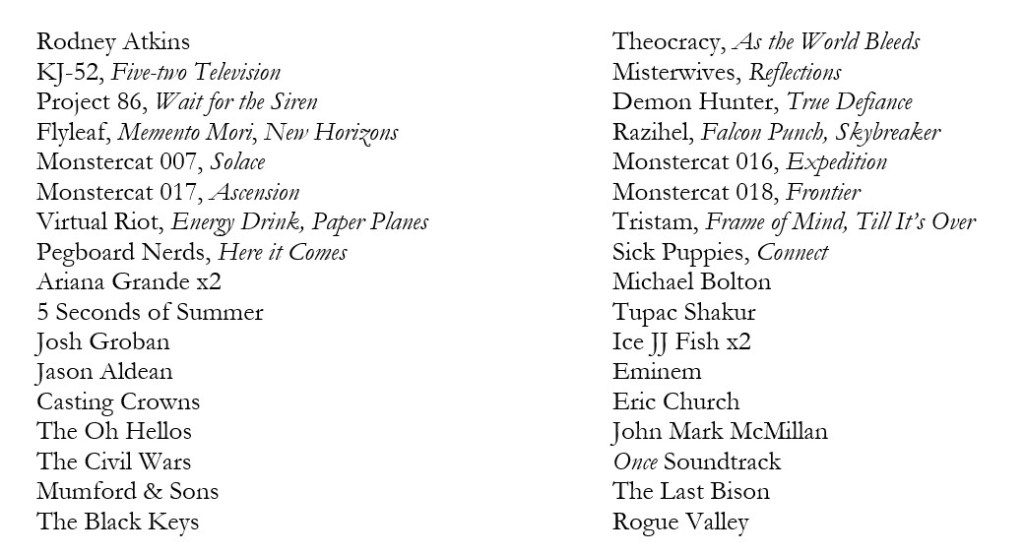
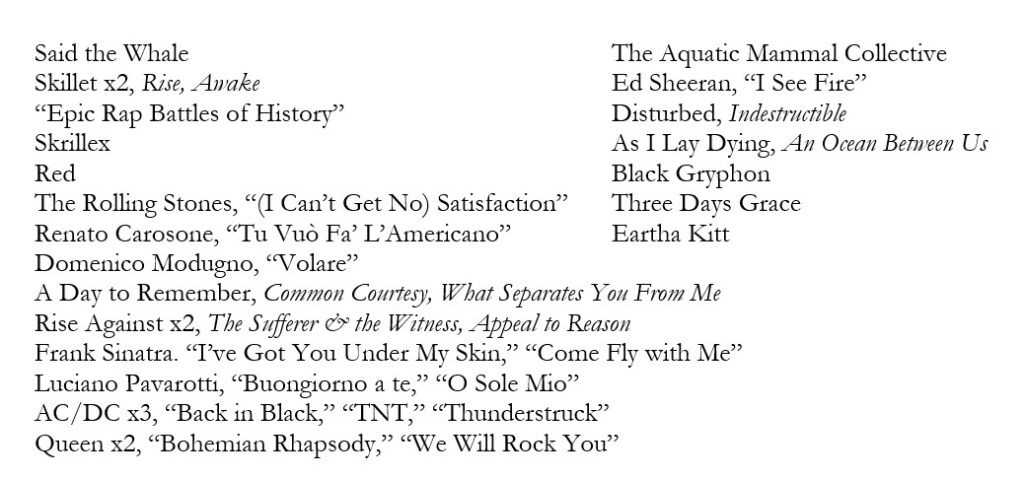
I hope you aren’t disappointed by this article or you find it misleading.  Like Colin Mochrie, I try to stay pretty current with the latest vernacular of the younger generation, especially since we at Redeeming Pandora like to keep it fresh.  My students are certainly aware of my intuitive grasp of the latest lingo, but despite what you may have thought from the title of this article, it’s not really about diction.  Instead, having recommended a number of quality movies, books, albums, and games over the issues, I thought it would be good to hear from some of the youth today.  What movies, series, and artists/albums do they find worthwhile?  What classics resonant within this generation?  What contemporary aesthetic delights should I and my elders experience?  We have kept the responders anonymous, in part to avoid the excessive adulation and further requests for recommendations that no doubt will follow (and in part so you don’t get mad at anyone specifically if you think any of these are inappropriate — I assume they mean the clean versions of whatever selection you find distasteful).  Any multiple-responder recommendations are noted with an “x#.”  As always, no grown-ups are to blame for what happens next.

Well, there you have it.  The people have spoken.  Rousseau is happy.  Before you start clamoring for a “Here’s What Good Culture Is, You Philistine Youth!” elective (which, actually, isn’t such a bad idea), remember even Bach was “pop culture” long ago.  Perhaps these may not have Bach’s staying power, but who better to keep us informed on what’s current than the youth?  So go check out some of the new good stuff, as the kids say.  Or keep enjoying the good old stuff, whichever.  Either way, delight in something beautiful and share it with others.