This is a good book. Full disclosure: it was written by my father-in-law. Still, it is a fine book worth reading, especially if you are a fan of a) autobiographies, b) spiritual journeys, c) books about Vietnam experiences, d) fine real-life stories, or e) books edited by me. Mostly my editing work consisted of adding the letter “s” to the word “corps” and adding commas between independent clauses joined by coordinating conjunctions. This is not a shattering tell-all about ’70s government or military intrigue, though you will get an honest, authentic first-person account of a young man struggling to understand life, religion, war, politics, and how he fit into all of it as a man of love and peace in what seemed to be the least appropriate place for him: the battlefields of Vietnam. You will enjoy the honesty, the style, and the action, and you will feel the frustration, the sorrow, and the loss right along with him. Get this book and read it. Then get 10 more for each of your friends. You’ll be glad you did.
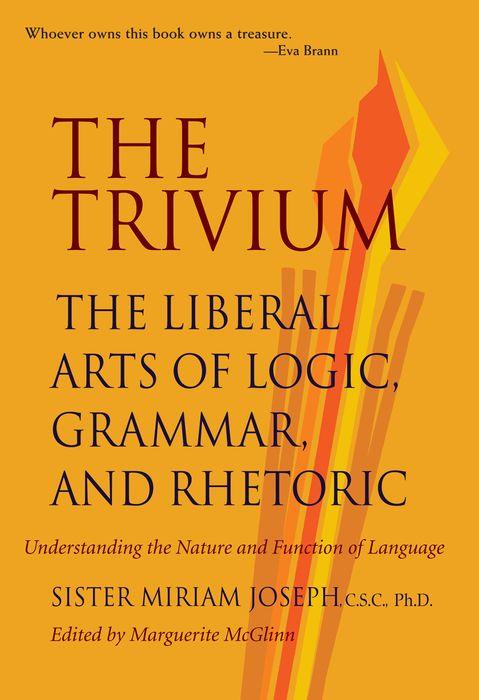
Readers may at first suspect of the three titles this book contains, it has almost nothing to do with the first (The Trivium), a scant bit to do with the second (The Liberal Arts of Logic, Grammar, and Rhetoric), and spends almost all of its time on the third (Understanding the Nature and Function of Language). If such is the case, we are directed toward two possible conclusions: 1) Sister Joseph didn’t really know much about the Trivium after all; or 2) we didn’t really know much about the Trivium after all. I shall lean toward option #2. The Trivium really is about language — its nature, function, and connection to thought, worship, and reality. Strangely enough, I’ve never read that in any other book purporting to be about the Trivium — have any of the modern reshapers of “classical education” read this book? Many will no doubt find this book tedious because of its lengthy treatment of language. Many will wonder “what about the subjects of the Trivium? where is her talk on what science classes we should have, what Bible curriculum, what novels to read, whether we should incorporate tablets into our education?” and thus prove they have wholly missed the point of the Trivium. It is related to the Humanities, indeed, but it is not the Humanities. The “Liberal Arts” of the Trivium are related to the other Liberal Arts, indeed, but they are not identical.
Who should read this book? Anyone claiming to be involved in “classical education” or anyone who wants an education. If you find it boring, guess what that tells us about you (your vocabulary, and your comprehension of reality). Remember: “slow, difficult, yet important” books are not tantamount to “boring.”
I give this four out of five stars not for Sister Joseph’s work (though her diction is at times cumbersome, even for the time when she wrote it, and her insistence the first premise of a syllogism is the “minor premise” is perplexing) but for the editorial work and oftentimes tendentious footnotes by the editorial team involved in revamping this work. If ever a work needed a glossary, this is it — but, sadly, no glossary is contained within. It has an index, though that isn’t quite as helpful as it was likely intended to be. Thus the presentation of the material sometimes detracts, yet the reader should persevere and read this wholly necessary work again and again — especially if one is paid to be involved with “classical education.” (If such a one reads this work attentively, such a one will find out the “tools of learning” are, in fact, reading, writing, thinking, and speaking … who knew? … certainly not anyone whose sole knowledge of “classical education” comes from reading books by, well, no need to mention names at this point — but you know who they are.)
I understand this comes at a very strange time in Marvel history, when the X-Men are moribund and not the powerhouse of today, and while the focus on Hank McCoy in his own title is wholly deserved, the creative team does no justice to his character or his story. I grew up with Hank McCoy already in his furry form, so I was originally surprised when I learned he wasn’t always like that. Now that I have finally read through the issues up to this point, I was disappointed in the actual transformation. I know the Marvel Universe has a number of similarly-transformed characters (The Thing, especially), who no longer look the way they used to, and though the premise of McCoy transforming himself into a furry beast because of his research and whatnot is plausible, it just felt off. Conway does a fine job with the transformation issue, and the pain of McCoy’s new life is depicted quite well throughout the issue with the off-putting atmosphere from the beginning until the end, so perhaps it is mostly the sadness for Hank that irritates. Plus, if he is as smart as he supposedly is, surely he would have developed a counteragent before trying some magically-timed Cinderella-like potion on himself.
Steve Englehart truly does the greatest disservice to Hank through this series. It’s bad enough the storyline is cancelled without any meaningful resolution (likely not Englehart’s fault, admittedly), but the characterization is rather wretched. At first, we are willing to follow Englehart’s revision of Hank’s character, as his vocabulary and demeanor embrace the bestial identity of the new Hank McCoy … but a few issues later Hank has resumed his humanity and diction. This is certainly a positive mark, in one sense, but the immediate abandonment of the character direction replaced with the early ’60s flippancy and dialogue in the dark days of the X-Men are grating, at best. One gets the suspicion Englehart was itching to revisit the pirate ship episode if the series lasted any longer. At least he doesn’t end every sentence with an exclamation mark, though he does feel the need to bring back old characters/villains just long enough to have them commit suicide by the end of each issue. The other issues featuring Iceman, Polaris, and Havok are equally steps in the wrong direction, though on the whole we are willing to forgive the egregious disrespect the creative staffs display for their subjects, since we are just glad to spend some time with these characters again.
This collection definitely gets worse at it goes along, which is probably why the series was cancelled so soon, but it does have many fine moments and is rife with great possibilities … which never seemed to materialize, sadly. What happens next to Hank and Linda and the Brand Corporation? I wish I knew. This collection does not tell us. It’s worth reading, certainly, especially to fill in the missing gaps between the first demise of the X-Men and Giant-size X-Men #1, but it will not answer all your questions.
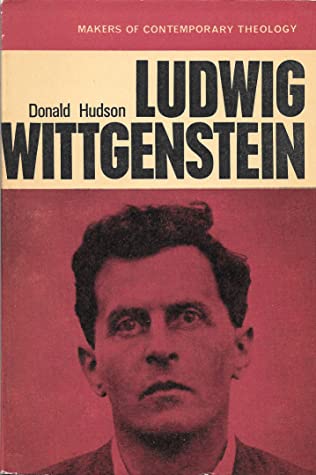
As intriguing and potentially helpful as this booklet it, I’m not sure it really fulfills the promise of the subtitle. Wittgenstein has no intention of connecting his philosophical output to religious thinking, though he seems fairly accepting of people who have it (which is awfully decent of him). Wittgenstein is certainly a tricky fellow to grasp, especially since he spent the latter half of his output refuting the first half of his output. Hudson provides a fairly helpful overview of major ideas, but a good deal of the end is spent somewhat hastily attempting to establish Wittgenstein as a “maker of modern theology,” since that is the series in which this booklet appears. Hudson does present some ideas worth pondering, but their connection to Wittgenstein’s philosophy appear tenuous to me — though I am rather a tyro in the realm of Wittgenstein. Hudson’s book could potentially serve the same function as a prose summary before a canto in the Inferno or book of Paradise Lost: read it first, get a grasp of the basic idea, read the chapter, then go back and read the summary to cement within yourself what it is you just read. Similarly, Hudson could be read before one ventures into Wittgenstein’s work, then read the Tractatus and Philosophical Investigations, then read Hudson again. Perhaps other introductions to Wittgenstein may be more helpful, but Hudson’s commitment to framing Wittgenstein within a religious/theological realm (even if it is against W’s wishes) is intriguing enough to engage in as a reader. Track this installment (and the rest of the series) down and give it a try.
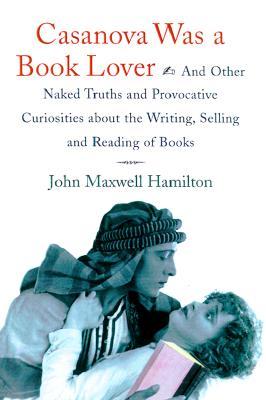
“N-a-k-e-d” is a strange way of spelling “boring.” This book is really not interesting or provocative. Hamilton spends a bizarre amount of time praising the Marquis de Sade as some sort of exemplar of humanity-literary behavior, followed by a preponderance of vitriol against religion and American presidents. The attentive reader will also need a new hypocrisy meter after reading this, since it will overload and break somewhere around chapter 3. Hamilton lambastes authors who use assisting teams, ghostwriters, and amanueses … all the while telling us how his graduate assistants (the goofy way college professors have of spelling “indentured servants”) gathered much (if not most) of the information retold within these pages while he was busy doing not his own research. Hamilton lambastes boring and meaningless dedications in books … apparently forgetting the fact he has one in his own book. In chapter seven, Hamilton feigns he is going to finally reveal the “most stolen books,” then backpedals with an excuse to the effect of “librarians don’t like to talk about it,” and finally pretends to give us a list of the most stolen books — but really are just representatives of types of books that probably get stolen a lot. This book promises so much, yet despite an intriguing story-filled opening chapter, delivers mostly sub-interesting minutiae, vitriolic caterwauling, and a fecundity of dullness that even Thomas Shadwell might find lame. Hamilton spends a chapter decrying the absence of negative reviews of books: here you go, sir.
This is a great book, though its beneficial audience is limited to educators, students, people who haven’t been educated, people who are being educated, people who should be educated, and people who need to be educated. Thus, the audience is, well, everyone. It’s one of those indispensable books, whose declarations about the sorry state of education and the ideal ways to ameliorate most problems are made even more frightening and sorrow-filling when the reader notices the book was written in 1943. Education at the Crossroads is even more necessary than it was 70 years ago — something that can’t be said about too many education books. It is dated only in fleeting moments, which adds to the tragedy of the intervening years: why didn’t anyone listen to him?
I wish I read this book 10 years ago, but there’s also the possibility I might not have been “ready” for it then, so better late than never, I suppose. Maritain is correct about many things: the purpose of education, what schooling/education are not, the importance of understanding God and humanity for any education to work, and a slew of other things too numerous and adroitly explained by him that any brief treatment here will only perform injustice on the work and the author. Not everyone will approve of his suggested curriculum and proposed age/school year alignment — in fact, most contemporary educationalists (the ones who get paid to make decisions and, like the characters in Peter Jackson’s version of The Two Towers, make only wrong decisions) will decry and rail and lament and ridicule (if they are willing to read a book that isn’t in e-format and doesn’t appear on any Common Core tests). That’s one sure-fire way of knowing this is a book to read and incorporate into one’s soul. It is not perfect, but it will help you understand reality better.
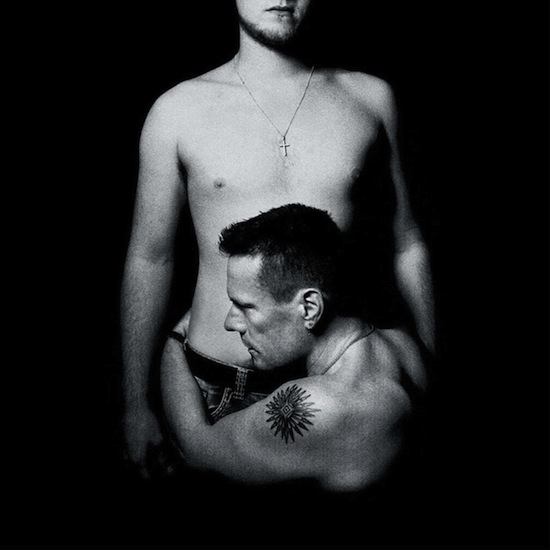
Having listened to this album a number of times in the last few months, I can assure you it is a much better album than you probably think it is. In its way, it is superior to even The Joshua Tree and possibly Achtung Baby, keeping in mind “its way” is its ultra-personal nature. It is a wholly introspective, open window into the making of these men and their musical influences, possibly the most revealing album a band has ever put out, which makes the “self-gratifying and grandiose” palaver spewed out at the album’s unusual release all the more embarrassing to those who served the vitriol. I am not, however, qualified to comment on the historical influences that generated not only this album but the band we have loved for decades, so I do not pretend to comment on them too much. You, the faithful reader, can track them down in various places (I hope, too, my old buddy Steve Stockman will write another book about these recent albums as well). Instead, I will comment on what I think of when I hear these songs (especially in context of other U2 songs and albums) and what (if not the same thing) makes them so good. Without further ado, let us semi-briefly explore these songs.
“The Miracle (Of Joey Ramone)”
Unlike the slow-building openers “Where the Streets Have No Name” or “Zooropa,” “The Miracle” just starts — even more abruptly, really, than “Vertigo” or “Zoo Station” (or any of the others). We feel like we have walked in two seconds after it started, and while that is initially jarring, it fits well with the point of the album. This isn’t The Wall — it doesn’t have to begin with birth and build slowly up to a life story. Boom. Here is the start. Here is the point where the rising action is about to begin. This isn’t season one, episode one; this is season one, episode eighteen, and things are about to change for the better (in some cases).
Much of this album gives us the impression we are re-covering old ground, doing what Frost said is practically impossible, but we are doing it with fresh eyes and fresher ears. The almost pep-rally nature of “The Miracle” is unusual for U2 and brings a lot more energy than we are probably expecting, considering the band isn’t getting any younger and a retracing of one’s roots often has the laconic feeling of Wordsworth not the immediacy of Keats (I should probably say Byron or Shelley, but as we all know Keats is far superior). Even so, this is an energetic song. Retracing their roots has brought that energy the band needed — not merely to remain “relevant” — and this is an energetic album.
The lyrical freshness of the album matches the reinvigorated musical energy. “I was chasing down the days of fear” and “I wanted to be the melody / Above the noise, above the hurt” is as lyrically excellent as “So Cruel,” and you know how much that says. I love that last line of the bridge “And we were pilgrims on our way.” We should have been listening to the albums of U2 as a pilgrimage, shouldn’t we?
I’m not Ramones-knowledgeable enough to know what makes them so beautiful, but I’ve had similar experiences in my intellectual, spiritual, aesthetic pilgrimage to know what is being described so enthusiastically, and I hope you have, too. I also know what it is like to take myself too seriously, and it is especially refreshing this album finds a very good balance in presenting their (sometimes painful) youth and influences seriously while simultaneously commenting on their naïveté with the knowing raised eyebrow of old age (I suspect more of this will come in the companion album Songs of Experience). The self-effacing humor of the pre-bridge is one such knowing raise.
One great element of this album is that self-awareness, manifesting in this instance by the different choruses. After the verses communicate the feeling, the memory, the experience the song is capturing, the choruses often metamorphose from “here’s what we were like” to “here’s what we appreciate better and what you can learn now” ideas. The final chorus of this song is truly great: I, too, “get so many things I don’t deserve.” The thought “All the stolen voices will someday be returned” is as uplifting and enthusiastic eternity-anticipating line as you will ever hear. It usually brings me to tears. It does anticipate “The most beautiful sound I’d ever heard.” It will indeed be beautiful to hear again the voices of those who have been stolen (by death, surely, not by God). That will be a miracle, indeed.
“Every Breaking Wave”
Here is one of the all-time greats. Musically, this is great. Lyrically, great. It’s great. You probably think that’s circular reasoning, and perhaps it is (okay, it is), but this song added to “The Miracle” make for as impressive a 1-2 start to an album as The Joshua Tree. Here is a song concerned with our infatuation with fear, our unwillingness to slough off our uncertainties as if they are comfy blankets, our trepidancy to risk. We are so reticent to acknowledge what we can see, what we know: the waves will keep coming, we don’t have to chase them. Chasing them, trying to control the world and the waves is not the way to succeed at life. It’s that hubris that siphons from us our courage. It’s time to stop futilely chasing after the waves and let them take us. That’s the only way to get where we want to go. The spiritual implications are glaringly obvious.
Lyrically, the inverted word orders at time may be for the rhythm of the phrases, but they add to the weight of maturity undergirding an album that could easily have devolved to self-pastiche. (I hope that doesn’t sound as pretentious as it sounds.) My favorite part is the “I thought I heard the captain’s voice / It’s hard to listen while you preach” section. True, having just read The Tempest twice with two different groups of sophomores, this section about shipwrecks and waves and shores resonates a little more loudly than it might during the summer, but the reminder we can’t hear The Captain when we are trying to give the orders is always a timely reminder. It’s impossible not to love this song.
“California (There Is No End to Love)”
The trademark Bono “oh” gets new life in this album, as remarkable as anything else here. Despite the backlash against their exploration of American music during the Rattle & Hum era, U2 goes where it needs to go, learns what and where it needs to learn, and unashamedly (and less unabashedly than in their less-temperate youth, shall we say) lets us know about it. They aren’t the Beach Boys, but then again the Beach Boys weren’t always the Beach Boys, and California is big enough to influence just about anyone. Just because my brief personal experience of California wasn’t all that great doesn’t mean U2 isn’t allowed to enjoy Zuma or Santa Barbara (or not enjoy it, as may possibly be the case here).
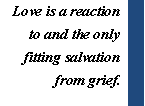
Instead of knowing beauty and truth are (almost) the same thing, it’s likely more significant and efficacious for us to know there is no end to love. Most of the song may give the impression of a light, frothy sort of “love is forever” sort of palliative, despite the revelations of the rather painful experiences couched in the first two verses … until we get to the end of the second verse. It’s one thing to write about and sing about painful experiences — we’ve heard that before (though not as often in U2, not their own painful experiences but certainly Ireland’s pain) — but suddenly the typical “cry in the mirror a lot” notion morphs into a more honest admission “I’ve seen for myself / There’s no end to grief” — and that acknowledgment of man’s prison of grief, eternal if left to himself and his fallen nature, reveals itself as the true basis for why “there is no end to love.” It’s not the simple “I’ve had fun times on the beach, so life is good.” It’s not “we’ve found each other, so love is forever.” Love is a reaction to and the only fitting salvation from grief. Since grief does not end (in this lifetime) love will not end (ever). I don’t know of a more comforting thought, really.
I haven’t quite sussed out the last two lines about stolen days, though I suspect the use of “stolen” is different from the “stolen” in “The Miracle,” since it seems to me we are the ones doing the stealing in “California,” stealing days of happiness and moments of love and joy away from the grief. We certainly don’t want to give those back, and perhaps they are enough, in the end. That makes sense, I suppose.
“Song for Someone”
This is one of those songs if you just listen to it casually once or twice without paying attention to the words you get a very faulty misapprehension of how good it is. That could be said about the entire album, of course. From the first line, whatever “write good lyrics” pills Paul Hewson has been taking in the last five years pays off again. I mentioned “So Cruel” earlier; perhaps this is a companion or sequel, as it is about healing and restoration. We have a great lyrical irony, in that this song purports to be universal (if my assumption about the “someone” being fit for anyone doesn’t take us all to Pleasure Island), though it frequently references private conversations and personal experiences. Again we have the modified chorus trope: the third line in the three choruses is different each time. (I can imagine the uproar if the second version was “with or without” instead of “within or without.”)
The best and worst parts of this song come at the end. The final chorus begins with a wonderful pair of lines: “And I’m a long, long way from your Hill of Cavalry / And I’m a long way from where I was and where I need to be.” I’m not under the impression the “Someone” this whole time has been Jesus … though, come to think of it, that would be totally awesome (and change the meaning of this song drastically). Hold that thought. The second of that pair is a wonderfully honest line about how far Bono has come in his spiritual journey and how far he still has to go — not since October have we heard anything this direct (except “Yahweh,” perhaps).
Now, if the “Someone” is actually Jesus throughout the song, and thus most of the “you”s are also Jesus, that would indeed elevate this song exponentially in both my appreciation for it and, more importantly, its quality. The first two lines of the song don’t seem to fit with that interpretation, though, especially as it would be unthinkable to say to Jesus “my scars are worse than yours, you know.” But then, Jesus does have eyes that can see right through us. He does “let [us] in to a conversation / A conversation only we could make.” He does “break and enter [our] imagination / Whatever’s in there it’s [His] to take” — that fits, too. The last line of verse two, “You were slow to heal but this could be the night,” also doesn’t seem to fit either, however. Also, I don’t know why Jesus would let the light go out, but perhaps the choruses are directed toward us, the audience: the listener is the “you” of the chorus. We can’t always see the light though we should have faith it is always there; we can’t always be the world we want to be; we have the responsibility not to let the light go out. If most of the “you”s are Jesus, the line “If there is a kiss I stole from your mouth” would take us immediately back to “Until the End of the World” and “When Love Comes to Town.” I’m not sure about the whole song, but there’s no denying whose “your Hill of Cavalry” it is. Maybe Jesus is the “someone” the song is for, and we are the “someone” the song is to? Regardless, this is another superb song.
The worst part of the song I alluded to above is only that after this great last version of the chorus (or bridge, maybe), we very much desire one final round of “And this is a song, song for someone,” but we don’t get it. Maybe the live shows.
“Iris (Hold Me Close)”
This song feels like it escaped from The Unforgettable Fire, and since that is one of my favorite U2 albums, that’s clearly not a slight. It’s a lyrically diverse song, even if one is tempted to dismiss it because of the musical sound. Initially I was a bit disappointed by this one, musically, but it does grow on me, especially as I understand the words better. “Iris” plays a few roles in this song, emphasizing the “seeing” theme of the song and possibly being an actual woman named Iris. Of course, once we find out Iris Hewson was Paul’s mom and this is another overtly personal song about Paul’s young life, that part comes into sharper focus. The Freud fans will likely latch on to this notion and interpret the ending refrain as “one needs to free oneself from one’s parents in order to fully become the person one is to be,” but I think it’s more Robert Burns than Freud. As Burns says, if we could see ourselves the way others see us, we would be much more free to be who we should be. And truly, as Christians, we know there is no better (or no other way at all) to be truly free to be ourselves than to be ourselves in Christ. All in all, it’s a very moving song by a man who lost his mom when he was very young, a man letting his mother know she is always with him and possibly wants her to be proud of him. I don’t think there is doubt about that.
“Volcano”
“Volcano” makes you wonder if this album has been locked in some Island vault since the mid-’90s and has suddenly escaped. It’s hard not to find this song somewhat goofy, though its message is important like the rest of the album. This album impresses you the more you learn about it and the influences that have shaped it (again, resources elsewhere can help far better than I can) and the keener one hearkens to the thematic/lyrical motifs strewn throughout multiple numbers. Waves and seas, eyesight and insight, identity, faith and doubt … sure some of those are fairly typical U2 fare, but the intentional lyrical development of certain phrases and ideas in multiple numbers creates an impressive unity to this album easily unnoticed by the casual listener/hearer.
Even with the dangerously goofy dance-techno-like beat of the chorus, which comes dangerously close to undermining the seriousness of the lyrics, the variety within the song works to a good effect, taken as a whole. The “You were alone / … You are rock n roll / You and I are rock n roll” breakdown toward the end gives the song a helpful push to the conclusion the chorus alone wouldn’t have given it, since its (the chorus’s) sound may have been too repetitive to make for a strong enough finish. The basic message seems to be a warning for easily-hotheaded people about the dangers of that, which, while not anywhere close to unique for a message, does not appear all that frequently as a peppy remix-like number. I need to appreciate this song more than I currently do.
“Raised By Wolves”
U2 has been singing songs about Ireland’s war on terror for about 40 years now, but it has never been so personal as this song. It’s a straightforward song for the most part, though it does have some lyrically impressive lines (“My body’s not a canvas” … “Boy sees a father crushed under the weight / Of a cross in a passion where the passion is hate”). The bridge, “I don’t believe anymore / I don’t believe anymore,” is for me the most inscrutable section of this song. If it is about young Paul Hewson rejecting the faith that has brought about (supposedly) these sorts of things, that’s understandable, though that doesn’t seem to mesh with the history of U2’s music (especially with “I Will Follow” and October coming closer to this life experience than War, and War, we must remember, ends with “40”). If it is older Paul Hewson not believing in something, that is even less credible. I just don’t get it yet, but that’s not a bad thing.
The chorus is likewise thought provoking, partly because I don’t have a good grasp of it, either. Musically, it’s an edgy song, certainly the edgiest political song since “Love and Peace or Else,” and that edginess makes the song. The way Bono sings the chorus is also a highlight of the song. I suspect the line “Raised by wolves” is a negative thing, if it is a comment on how his generation was led/affected/burdened by the terrorism and conflict (certainly he is not referring to his own parents or any of the band’s parents, since they have always been open about the tremendous support their families always showed them). But the next line “Stronger than fear” presents itself as a positive thing, as far as I can tell. Then the final two lines, “If I open my eyes, / You disappear” return to a negative idea. It’s another song that would improve with understanding its origins, but it is also translucent enough to assure us of its quality, even if its full meaning is immediately opaque.
“Cedarwood Road”
Another overt homage to friends and experiences of their youth, though this time the overall impression almost dares us to consider it positive, despite being replete with echoes of bombings and loss and pain from the previous song (again, the continuity and overlapping and motif spreading throughout the album snowballs our appreciation for this album the more we grasp it). Guggi is one of Bono’s lifelong friends, a fellow survivor of those dark times, though he didn’t survive quite so successfully.
The music of this song is perhaps its most noteworthy component, so to speak. Say what you will about The Edge, and I’m sure you will, he can still come up with some catchy, integral licks (“The Miracle” has some catchy riffs, too). They only seem familiar because he makes them fit so well.
This is an album of great song endings (even if I think “Song for Someone” ends one section too soon). “A heart that is broken / Is a heart that is open” is a fantastic line, though our enthusiasm for it is likely tempered when we remember (to what limited degree we can appreciate it) the great volume of pain that generated its profundity.
“Sleep Like a Baby Tonight”
I don’t have much to say about this song. It has my least favorite line on the album, “Tomorrow dawns like someone else’s suicide.” It has that “Babyface” feel to it, and we jump, not cynically I trust, to a conclusion there is more here than our initial impressions give us, since U2 and lullabies don’t mix. As I’ve said, I haven’t done a whole lot of research, since I wanted this exploration to be mostly my own experiences and reaction, but what little I saw (mostly accidentally) about this song indicated this is about a priest (the kind of priest Alan Moore writes about in V for Vendetta … yeah, that kind of priest).
Does that make this a bad song? Certainly not. Unpleasant? Perhaps. Is it a social problem we should know about, do something about, bring to an end? Certainly. Musically, it’s another impressive stretch for a band most people likely thought had run out of ideas, even if it reminds us of an earlier song. Bono’s falsetto gets a healthy workout once again, another facet of U2 most people likely thought had faded into the mist.
“This Is Where You Can Reach Me Now”
I’m sure you already knew Joe Strummer, to whom this song is dedicated, was The Clash’s front man, telling us this song reflects the influences The Clash had on young U2 back in the day. I’m not as familiar with The Clash (or any in the punk scene, apparently) as I probably should be, but what little I do know makes the sound of this song (and its military theme) wholly believable. It’s a very straightforward song, as far as I can tell, though it’s also highly probably I’m missing out on a great deal of meaningful subtext. It’s also quite likely I’m misinterpreting much of this album, but that has never stopped me before.
“The Troubles”
Another very personal song (yes, we’ve said that eleven times now, I understand), this one is about the pain of abusive relationships and the freedom that comes from escaping it and reaffirming one’s self worth and value. Musically, it’s another impressive stretch for the band. Lyrically, it’s another remarkably courageous display. If the last half of the album is not as “enjoyable” as the first half, it’s only because the honesty and openness make us uncomfortable, not because it’s an inferior half. I’m not a big fan of rehashing my painful memories (though someone should tell that to my subconscious, since it’s a big fan of running that tape about 12x a week) — I doubt I’d have the courage to write almost a dozen songs about some of my positive life-shaping experiences, let alone the negative experiences. Thank you, men. The people who find you “no longer relevant” must have thought the same thing about Don Quixote … and look how well that ended for them.
So there you have it. I like this album a great deal, and I think you should, too. It will definitely go down in U2 history as one of their best. I don’t know how many more albums these four have in them — hopefully we will not have to wait so long for Songs of Experience (considering their recently-announced tour, “The iNNOCENCE & eXPERIENCE Tour,” is purportedly going to focus on Innocence songs one night and Experience songs the following night in pairs, that gives great gusto to our hope). If they release Experience in a year or two, then, a few years later, top it all off with Man, I’d be quite satisfied (though if they can release several albums in the coming decades, that’s fine with me, too).
It holds up to the scrutiny. It is an incredible gift, not just because it was free. I did get the 2-disc deluxe edition for Christmas from my wife, which was a very pleasant surprise. The bonus disc songs, including alternate takes of “The Troubles” and “Sleep Like a Baby Tonight,” while perhaps less “canonical” improve our appreciation of these songs even more (though I haven’t listened to them enough yet to say more). The 30-minute acoustic set is definitely worthwhile, and the otherwise unreleased songs are obviously a must-have for U2 fans (those who don’t get the special Japanese releases, of course).
You probably have this album, whether you wanted it or not. Let’s not rehash that again. Instead, now that you know about it more, give yourself a tremendous boon and listen to it carefully. Soak it in. Embrace the honesty, the openness. Even if you don’t fully interpret everything correctly, as I most assuredly have not done myself, appreciate it for what it is: a superlative album from one of the great bands of all time.
It’s an album about many things, but it is fundamentally an album about love. Don’t chase love like every breaking wave. Let it take you. Love, as we know, conquers all. Let us, too, surrender to love. You’ll be glad you did.
The poem written by Percy Shelley, “Ode to the West Wind,” personifies the winds in the west. It is seen as a powerful force that destroys but also preserves. It kills the decaying and weak to make a path for the new. It destroys the old and provides a new environment for the new.
In the first stanza, Shelley says the West Wind is “wild.” It blows away the leaves that have died and started to rot. It makes way for the springtime after the rough winter. The wind takes the seeds off the trees and bushes and buries them in the soil so they can spring up into new life a few months later. The seeds bloom into new life during the spring. It destroys the old and starts a new fresh beginning in the spring. This is why the west wind is described as both a destroyer then a creator, or a preserver.
In the next stanza, Shelley talks about the sky. He talks about the effect of the winds on the clouds. The winds break the clouds apart almost like the decaying leaves of a tree. The clouds become rainclouds and look ominous over the earth. The clouds are compared to the outspread hair covering the sky from the horizon to its zenith. The craziness of the sky is compared to Maenad, worshipper of the Greek god of wine. Shelley uses this comparison because Maenad worships the god in a sort of wild and crazy way, lifting her hair like tangled clouds. These indicate an approaching storm.
The West Wind then becomes a funeral song. It is being sung because the year is dying. The dark night sky becomes a grave or a tomb where the clouds mold the tomb. They will soon pour down rain.
In the third stanza, the West Wind blows across the Mediterranean Sea. He describes it as a vast sleepy snake, which dreams of old civilizations rich in flowers and vegetation. In the sea’s sleep, it sees “old palaces and towers,” which quiver when the wind blows. The West Wind also affects the Atlantic Ocean. The plants under the surface tremble at the sounds of the strong breezes. They fear the power of the West Wind.
In stanza four, the West Wind becomes a more personal force. Shelley said if he were one of the leaves, or the clouds or waves, he would be able to feel the power of the West Wind. He said during his childhood he had the power and speed of the West Wind. Shelley said he no longer has the strength and speed like he did in his childhood. The burdens of life have dragged them down. He is facing problems in his life, which have drained his strength. He now looks to the West Wind for help.
In the last stanza, Shelley offers himself to the West Wind in the same way as the leaves, clouds, and waves do. He wants the wind to be a musician, and he should be used as a lyre for this purpose. The music could be gloomy but a sweet sound. Then he compares himself to a burning fire with sparks and ashes. He requests the West Wind blows his sparks and ashes among mankind.
Shelley ends his poem with the hope the West Wind will take his words across the world. Winter is a symbol of death and decay, but spring brings new life and hope. He portrays this poem as saying if there is despair and pain now, then hope and optimism are just around the corner. If winter is here, spring isn’t far behind.
“Ode on a Grecian Urn” Analysis
Michaela Seaton
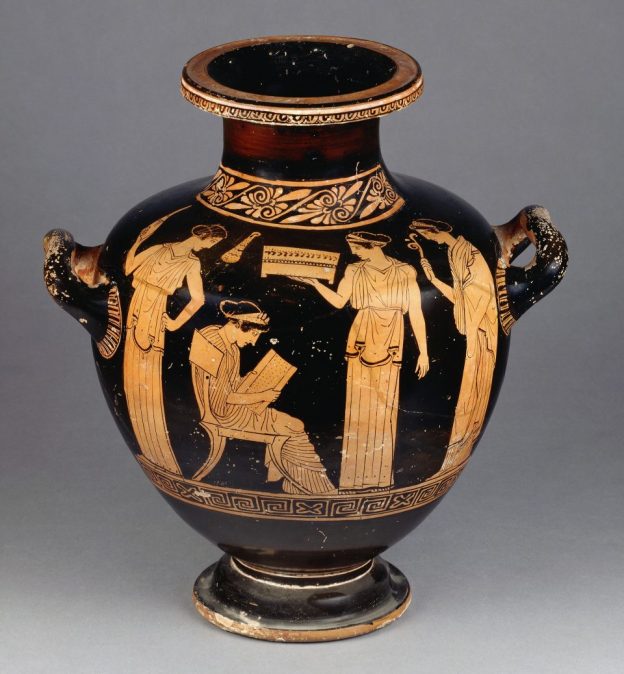
“Ode on a Grecian Urn” is a great example of Romantic poems. It is a highly emotional poem addressing things not present. Written by John Keats, “Ode on a Grecian Urn” utilizes moving language, sensations, and images to get its point across. The main theme is constancy or eternity, the innocence that comes with not changing.
In the first line of the first stanza, he says “Thou still unravish’d bride of quietness” which literally means pure bride of quietness. It isn’t actually talking about the marital vows of an urn, it is talking about how the urn is silent; she’s not an “adulterer” to quietness, literally meaning the urn was adopted by silence and slow time. She keeps all her secrets, while still showing the story upon her. The second line is similar in its message: “Thou foster child of silence and slow time.” Once again, Keats uses imagery to show how he sees the urn, as a perfect representation of stagnant time.
The next two lines, “Sylvan historian, who canst thus express/A flowery tale more sweetly than our rhyme:,” talk about the urn’s job as a historian. Keats compares her job to his job as a poet. She uses pictures to tell her tale, while he uses words and rhymes. In his opinion, her way of telling the story is superior.
The next three lines are the first close look at the urn: “What leaf-fring’d legend haunts about thy shape / Of deities or mortals, or of both,? In Tempe or the dales of Arcady?” This is talking about the actual artistic qualities of the urn. Apparently, it is ringed with leaves, perhaps contains shapes of gods and men frolicking about in different areas of nature and life.
“What men or gods are these? What maidens loth? / What mad pursuit? What struggle to escape? / What pipes and timbrels? What wild ecstasy?” These next three lines pose questions about the urn, asking what it is revealing about history, what stories is it telling. Keats is telling the readers what is coming up.
Then comes the next stanza. In the first two lines Keats says “Heard melodies are sweet, but those unheard / Are sweeter; therefore, ye soft pipes, play on;” In this stanza, it appears he has turned the urn so one of the scenes is showing, a scene with flutes. When he says the unheard melodies are sweeter than the heard, he is probably talking about how with the scene pictured on the urn, the music and fun you imagine is happening is perfect, while in real life often expectations are not reality. Those people on the urn are actually living, in his mind, but simply frozen in time.
Lines 3-4 say “Not to the sensual ear, but, more endear’d / Pipe to the spirit ditties of no tone.” In these lines, Keats is ordering the pipes to play to his imagination, which ties in with the previous lines. In his imagination, any scenario he creates will be perfect in his mind. The melodies have no tunes in the real world, but in the imaginary world they are the perfect notes.
The next two lines say “Fair youth, beneath the trees, thou canst not leave / Thy song, nor ever can those trees be bare;” In this, the youth is in an eternal spring beneath a tree that will never lose its leaves. He is stuck in the same position, playing the same song but never being able to change. For Keats, however, this is preferable. The youth never has to experience the pain of passing time.
The next four lines say “Bold lover, never, never canst thou kiss / Though winning near the goal yet, do not grieve / She cannot fade, though thou hast not thy bliss / For ever wilt thou love, and she be fair!” This scene seems to be referencing a young man chasing a maiden. This is probably what Keats was talking about earlier, with “mad pursuit.” In this scene, the man is ever chasing the maiden, but Keats tells him not to despair. Keats knows because they are frozen in time on the urn, he will never stop chasing the girl, and the girl will never lose her beauty. It’s much different in the world where time marches on.
The third stanza begins with “Ah, happy, happy boughs! That cannot shed / Your leaves, nor ever bid the spring adieu.” Again, there is an almost Norman Rockwell feeling to the urn; it’s like what an ancient Greek version would look like. The tree is stuck in perpetual spring. Never will it lose its leaves. Keats obviously thinks this is a good state to be in, never will the tree have to suffer through a winter.
“And, happy melodist, unwearied / For ever piping songs for ever new / More happy love! More happy, happy Love!” are the next three lines. Once again, Keats is showing how happy he considers the scenes on the urn to be. This melodist is playing a song that will never go out of style, with a pipe that will never break. He is, and always will be, happy. Keats envies him, and he calls for more happy love songs; he wants to feel what he imagines it would be like, a perfect happiness that never ends because time cannot touch it.
The next two lines state “For ever warm and still to be enjoy’d / For ever panting, and for ever young”. This line seems to be talking about the birds and the bees. Joy that man and woman can experience on the urn for ever and ever and never tires. The next three lines also talk about this passion, but in the real world. They say “All breathing human passion far above / That leaves a heart high sorrowful and cloy’d / A burning forehead, and a parching tongue.” In this one, Keats seems to be saying the people in the world “above,” those who are looking down on this urn, they, too, experience passion, but it ends. Once the deed is done, it is over, and on comes the regret. A fever, a dry mouth, a muddled brain are left behind, a stark contrast to the moment of happiness. To Keats, the people on the urn, the men or gods chasing the maidens, are still in the moment of happiness. They aren’t regretting any decisions right now, and they never will because for them time does not exist.
This is where stanza four begins with the line “Who are these coming to the sacrifice?” Keats has turned his attention off the scene of the lovers and onto one where a sacrifice is about to take place. He wonders who is coming to watch it happen. Lines 2-4 give a better picture of what is happening. “To what green altar, O mysterious priest / Lead’st thou that heifer lowing at the skies / And all her silken flanks with garlands drest?” He asks the priest where he is taking the bellowing cow, but the priest will never reach the green altar because they are all frozen in time. The heifer is outfitted with flowers, so she is probably destined for the gods as a holy sacrifice.
The next three lines say “What little town by the river or sea shore / Or mountain built with peaceful citadel / Is emptied of this folk, this pious morn?” The priest and cow have a following, a crowd coming with them to the altar. Keats imagines what their little village would look like, desolate with all its people gone to worship their gods. However, the town could be by a river, or a sea shore, or on a mountain; so the town is not pictured on the urn since we do not know what it looks like.
The last three lines state “And, little town, thy streets for evermore / Will silent be; and not a soul to tell / Why thou art desolate, can e’er return.” In these, he address the sad state the town is left in for eternity. It will be forever empty, its people will never return. Although most of his words have been happy, yearning for a stop in time, these seem sad. He feels sorry for the village, whose people are gone and never coming back.
In the fifth stanza, he begins with “O Attic shape! Fair attitude! with brede / Of marble men and maidens overwrought / With forest branches and the trodden weed.” In these, he both praises and dismisses it. At first, he marvels at its shape and fairness. But then he seems to think it too ornate, too fancy. There are too many branches, the details are too well done, like it looks alive. It almost sounds as if Keats is jealous of it, because the pictures it displays show what he cannot have: eternal happiness.
“Thou, silent form, dost tease us out of thought / As doth eternity: Cold Pastoral!” say the next two lines. He seems to be accusing the urn of teasing him into thoughts about eternity, like one would tease a knot out of a ball of string. Keats does not like what he is thinking about eternity. The eternity shown on the urn is not the eternity that we live in. There, there is constant happiness and joy, while we must suffer here.
The next three lines state “When old age shall this generation waste / Thou shalt remain, in midst of other woe / Than ours, a friend to man, to whom thou say’st”. Keats imagines even after everyone in his generation has died, this urn will still be around. The problems of the current generation will be no more, but the new generation will have different ones. Even still, the urn will stay the same. In fact, it gives the same advice to every generation.
The advice is in the last two lines of the poem, which say “Beauty is truth, truth beauty, — that is all / Ye know on earth, and all ye need to know.” He is not saying simple truth and beauty are the same. He is saying beauty, what is the meaning to our lives, is the same as truth, which is the meaning for our being here. These thoughts can be had while looking at the urn, thoughts of life, regrets, and eternity. No matter what generation looks upon it, they are all going to see that, feel what Keats felt. To him, you don’t need to know the truth of the history books, or the celebrities, or the medical magazines, you simply don’t need the truths that are passed down from generation to generation.
I enjoyed “Ode on a Grecian Urn.” Although I certainly did not agree with its suggestion that we throw out the truths of the past, I do understand his longing to live in a moment in time that is always happy. Those happy people on the urn represent what I’ll never have until Heaven: eternal bliss. But at least I am assured in my eternity; Keats is not so lucky.
“Ode on a Grecian Urn” addresses much deeper issues than can be seen on first glance. Questioning truth, examining eternity, and wondering about beauty are often not seen in poets of today. Keats throws out what had been taught in previous generations and focuses on the one thing he believes to be constant: beauty.
Charles Dickens was an influential writer whose work was heavily influenced by the poverty he experienced and witnessed. Great Expectations emphasizes this theme of poverty. In many ways, the main character mirrors Dickens himself and his own struggle with poverty.
An orphan, the main character Pip lives with his abusive sister and her husband, the village blacksmith. Over the course of the book Pip runs across escaped convicts, jilted old ladies, and cold-hearted beautiful women. He goes from his marshy village of Kent to bustling London. He goes from one of the poorest of the poor to rich and must acclimate to that society.
Dickens is similar to Pip in many ways. Although he lived with his mother and father during his childhood, he spent part of his childhood in Kent, just like Pip. They also lived in during the same time period, when the Industrial Revolution was taking place and there was great social upheaval. He also moved to London, just like Pip, although he moved there earlier than Pip does in Great Expectations. Likely he met many different type of folks in London that gave rise to characters like Joe and Estella.
Dickens, unlike many other famous people, found relative success during his lifetime, and he had to adjust to society as a person with money. Pip also had to adjust to gentleman society, and there were strict rules to follow. Climbing the social ladder required learning a whole new set of skills and expectations as Pip soon realizes as he studies to be a gentleman. Dickens also would have experienced the disparity between the desperately poor and those who were well off, or at least moderately so.
Pip studies to be a blacksmith under Joe, but he feels himself too good for this after getting a taste of the genteel life with Estella and Miss Havisham. Dickens also worked a job he did not feel put all his skills to use, at a blacking warehouse when his father was in debtor’s prison. Eventually he is able to gain more education and raise his status and wealth, just like Pip does.
The entirety of the book is centered on social status and wealth, or lack of it. Pip’s purpose in life is to gain recognition and marry a woman of higher status. He doesn’t just care about money, he cares about where the money came from. When he finds out his fortune is due to a convict he helped once, he is disgusted.
Dickens’s status also rose, and he was able to chronicle the trials and problems he experienced in the character of Pip. Even though he became famous, Dickens’s poverty had a tremendous impact on his life, and this can be seen in Great Expectations. Pip desires social improvement, but when he finally attains it, he finds himself still feeling empty; there are still the basic immorals and depravity he saw as a blacksmith’s apprentice. Dickens is trying to say no matter how much money you have, it is moral improvement that makes a difference, not money.
The Civil War was not a good time to be an American. This conflict that lasted for a few, bloody years pitted brother against brother, father against son, and family against family. Most conflicts America has been involved in have not affected us in such a manner. This is to say the Civil War was a crucial time in our nation’s history. It helped form racial equality and freedom never thought imaginable. But this outcome would have been drastically different had the Confederacy won. Such a victorious Confederate army might have existed if it were not for the thwarting battle known as Gettysburg. From July 1-3 of 1863, Union and Confederate troops were gridlocked in one of the bloodiest Civil War conflicts. It was not looking good for the Confederacy by day three, when the Union controlled most of the high ground and hills and began shooting artillery down onto Confederate positions. It was at this moment when Robert E. Lee made the risky, and debatably ludicrous, decision to attack the strongest Union position. When this attack failed, the Confederates retreated with great losses. One might think a Confederate account of Gettysburg would be pessimistic, but the journal entry of Randolph McKim proves this to be quite the contrary.
The journal account gives off a feel the Confederate state of mind was in a sort of “better luck next time” mode. This was a huge offensive into the north. He starts off his account with giving the reader details about positioning. He states things like “…there was a double line of entrenchments….” These types of statements run throughout the account, probably in an attempt to keep the reader up to date in the events. This account only covers the third day, as well. Taking a quick read through you can see any attacks the Confederates made were either repelled or forced retreats due to losses. The account does not describe any land gains made by the south but rather quite the opposite. The only reference to any successful advance comes in the last paragraph, in which he says: “We were beaten back to the line from which we had advanced with terrible loss and in great confusion.” So we see even in the one reference he makes to any successful advance he mentions it was with terrible loss and with not much leadership. Perhaps the South could have won the battle if they just kept their casualty count to a minimum! Pickett’s failed charge put the nail in the South’s coffin for the battle that day. With the North holding the high ground and relentlessly bombarding the South, and the casualty count increasing exponentially, the South had no choice but to retreat back to Confederate-controlled areas.
There are a few conclusions we can draw from this. One is even though the South was losing, badly at times, they kept trying. They attacked the Northern positions multiple times, each time with more vigor. Secondly, the South believed in their cause. It’s one thing to secede from the Union, but these men and boys were willing to lay down their lives to protect their way of life. Such a sacrifice can still be seen today in the modern armed forces. Thirdly, the South was not going to retreat out of Gettysburg until it was absolutely tactically necessary. If the South didn’t think that, then they would have left Gettysburg by day 2 after suffering plenty of casualties. The last conclusion we can make is Gettysburg may not have been as huge of a morale loss as we might think. If that were the case, then the overall tone of the account would be much more negative and criticizing of superior officers. Instead we see a blow by blow account of the last day of battle from the eyes of a soldier describing how groups of soldiers moved and how the enemy reacted. Perhaps this soldier should have been a reporter instead.




 Redeeming Pandora