Monthly Archives: April 2022

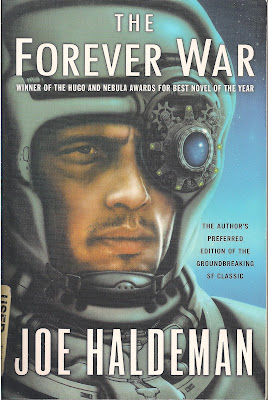
Review: The Forever War, Joe Haldeman ⭐⭐⭐

Christopher Rush

I was going to give this only a couple of stars, but the ending alone (primarily the epilogue and what is implied) deserves another star itself.  I know this is a beloved classic, and far be it from me to disparage a classic, but I didn’t really like this all that much, at least most of it.  After a smidgeon of pseudo-research, I learn I have read the abridged early version, not as definitive or swell as the finalized authoritative version, so I have no qualms giving this copy away.  Perhaps some day I will return to this universe and read the proper version and its sequels.

Being me, the language for the first half of the work was off-putting, enough to make this a 3-star book instead of a 4-star book.  I get what it’s about, especially after my smidgeon of pseudo-research, but still.  So it’s a Vietnam story not a space story after all.  I suppose that could somewhat assuage the Del Ray-like limited science fiction vision of the future, but the absence of futuristic vision was disappointing, especially after Haldeman did such an intense job cramming real science down our throats for much of the work.  That was another source of my reaction.  I’m all for science (sort of), but what I thought was supposed to be a novel seems more like Haldeman trying to show off his science chops — I like Moby-Dick more than most people, but I didn’t want to read Moby-Dick in Space when I picked up The Forever War.  Knowing as much science and its progress as Haldeman did, especially knowing Star Trek like he did, he should have at least created computers and data processing in the 22nd century to be less clunky than what is here.

Small points, perhaps, but then one never knows about these things.  The sections I did enjoy were the brief moments of happiness between Mandella and Marygay and, as noted above, the epilogue.  I suspect those are the bits many fans enjoy as well, but what do I know.  The second half is generally much better than the first half, even with the heartbreaking separation in the middle — perhaps it’s Mandella’s resignation and almost accidental maturity (or just resignation) that makes it more enjoyable (like Jack Shepherd’s attitude, finally, in season 6 of Lost).  The war itself and its explanation was a bit obvious, especially Haldeman’s message, and that combined with his treatment of what Earth becomes in the meanwhile seemed forced, but knowing as I now do that he has more to say in the unabridged version is a small comfort.  It’s a good book.  It didn’t blow me away, and it did frustrate me at times, but that tells you more about me than the book.  You’ll probably really like it.
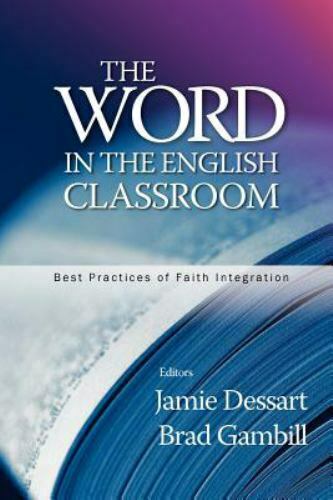
Review: The Word in the English Classroom: Best Practices of Faith Integration, eds. Jamie Dessart and Brad Gambill ⭐

Christopher Rush

Caveat: I have nothing positive to say about this book.  Who is the audience for this work?  I truly suspect the intended audience was the CVs of the contributors, especially the supposed editors.  This is certainly one of the worst books I have ever read.  I thought about giving it 0 stars, but I didn’t want to give John Piper and David Platt comfort one book exists that is worse than theirs.  The only good anyone can get from this (other than “look, prospective employee, I published an essay in a book!  It’s on my CV!”) is to write down the names of the contributors and warn any loved ones not to take their classes ever.  That may sound harsh, but consider it just saving the registrars the trouble of having to drop them after they want to drop their classes anyway.  I truly don’t mean to sound libelous, but I read every single word of these essays and they did not provide what they promised.  If these are the “best practices of faith integration,” we are all in serious, grave, deep trouble.

The first few essays treat “faith integration” more like “be sure to make room in your lukewarm Christianity for secular writings, because they are good stuff and you have no right not to appreciate them.”  One of the early essays goes so far as to decry being dogmatic about one’s faith, especially in the classroom!  Several essays throughout the collection warn the prospective teacher against being authoritative, as if all contributions are points of view are valid.  In other words, all faiths are equal, effectively, and if your version of Christianity is not flexible enough to applaud Dickinson, Faulkner, Darwin, Marx (multiple authors casually mention their use of feminist and Marxist criticism as if they are truly the ways to read works!), then your “Christianity” needs to be integrated with more faith — faith in the “don’t judge ever” interpretation of Matthew 7, apparently.

This is indeed one of the most disappointing books I have ever read.  One contributor at the end even goes so far as to admit she never really integrated her faith overtly into her classroom experience!  How does that help us?  Several contributors say effectively “since we are Christian college professors at Christian schools, we integrate our faith in the English classroom by reading Lewis and O’Connor.”  Wow.  “Brilliant strategy — thanks, Napoleon!”

The essay about using R-rated movies in courses likewise embarrasses throughout: since we are all basically inured to “adult content,” it’s okay to get the audience thinking, just never correct any of their statements — conversation is more important than truth.  Now, the essay doesn’t say that (none of them outrightly say that), but that is the impression the attentive reader draws from these exercises in puerility.  I thought of many more scathing remarks to make about these while I was reading them, but, fortunately, my mind has forgotten them.  If you are looking for a book on how to integrate Christian faith into the English classroom, a more useful book than this might be the Advanced Dungeons and Dragons 2nd Edition Player’s Handbook.  The alternatives for “integrating one’s faith” presented in this present book are 1) “read Lewis and O’Connor” or 2) “water down your faith so you can delight in Whitman, Faulkner, and everyone who disagrees with Christianity — don’t be dogmatic or stodgy! Get with the times!”  No thanks.

I was truly embarrassed by this book.  It made me sad to read this is what is passing for “best integration practices” at many colleges today.

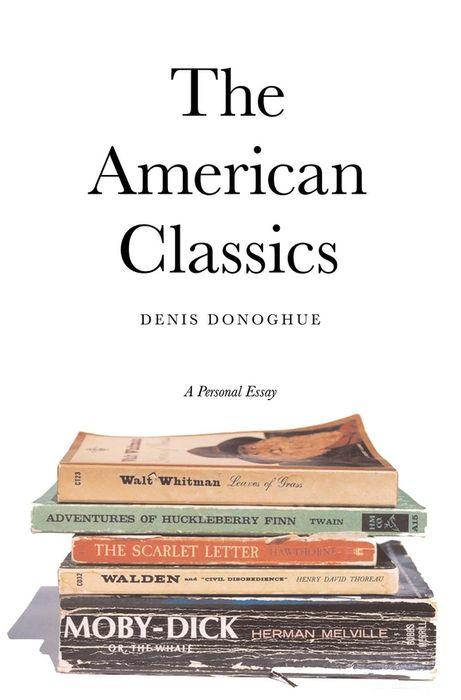
Review: The American Classics: A Personal Essay, Denis Donoghue ⭐

Christopher Rush

I’d be willing to give this 1.5 stars, out of the wealthspring of mine own munificence, but my level of irritation is forcing me to round it down.  With possibly not all due respect to Mr. Donoghue, I can’t perceive this book as one worth writing.  True, most of them aren’t, but this one proves it from the beginning.  What purports to be a personal essay about Mr. Donoghue’s personal experience with the five American classics pictured on the cover (Huck Finn, Moby-Dick, Walden, Scarlet Letter, Leaves of Grass) is, in actuality, a mildly deconstructionist survey of the critics and thinkers that have “informed” (oh, that word) Mr. Donoghue throughout his many decades as an expatriate Irish smartypants (perhaps he’s not an expatriate, and perhaps “smartypants” is inaccurate).  And while I am on record as preferring by far authorial voices with authority (“this is how it is!” instead of “I’m only trying to start a conversation”), Mr. Donoghue’s smugness overrides his authority — which is likely a wholly misrepresentative thing to say, as Mr. Donoghue’s smugness only appears rarely.  Yet when it appears, it appears in full throttle, often in the form of wholly irrelevant attacks against President Bush (43).

Another reason my irritation prevents me from giving Mr. Donoghue the whole 1.5 stars is his not-so-covert hypocrisy in the chapter purportedly about Moby-Dick.  After excoriating the 1940s critics who apparently read Moby-Dick incorrectly, blinded as they were by their culture and world circumstances, Mr. Donoghue follows up with asking us “how are we to read Moby-Dick today in light of the post-9/11 world?” (or words to that effect, which also include a vitriolic epithet toward President Bush not-so-subtly associating him with despots).  If the “right” way to read Moby-Dick is not to be limited by one’s time, why would being in a “post-9/11 world” matter?

Donoghue, like Socrates, rarely gives us the “right” way to read things (too high praise for him, even in derogation).  He is willing to drop names that should have delighted me (Trilling, Eliot), yet he does so in a way of dismissal that borders on “I just read about them on the Internets, so I know all about them.”  Mr. Donoghue does casually mention toward the end of the book he met T.S. Eliot, but he gives no indication it was a positive memory.  Further, Donoghue demonstrates an inability to stick to the point.  The thread of Emerson runs throughout the work, and while that is not necessarily a problem, he states the chapters are about different works.  The Moby-Dick chapter is sometimes about Moby-Dick, sometimes about other things by Melville, sometimes about Emerson.  The Scarlet Letter chapter is mostly about other things Hawthorne wrote, rarely about Scarlet Letter, and never in a way that makes us feel like Donoghue “gets it.”  Even the Moby-Dick chapter makes us feel like Donoghue, and potentially the coterie of critics Donoghue often cites (usually with favor but occasionally to correct them), didn’t even understand what Moby-Dick was about.  The Walden chapter is more often about other Thoreau works, and while it is more pertinent to speak of Emerson here, Emerson tends to occlude the purpose of the chapter.  And so on.

What was, then, the purpose?  To explicate these classics?  Nope.  To deconstruct them as not worthy of being classics?  Perhaps.  If so, Donoghue’s discursiveness prevents us from knowing.  To highlight the “crimes” of President Bush?  At times.  (One wonders what Mr. Donoghue has to say about the present incumbent.)  To point to the critics whose opinions we should share?  I can’t honestly tell.  Then, having waded through it all, we learn the sinister secret we suspected all along: many of these chapters previously appeared in discrete magazines over the years.  Yes, Mr. Donoghue is recycling old work to make money.  And while that is certainly his right and perhaps something I might try to do myself some day, it only gives us one more reason to ignore pretty much everything he has said.  What’s the 1 star for, then?  Because he does give some insights worth pondering (mainly from the quotations of other critics), and reading such a deconstructionist load of piffle encourages me to read these classics again (or for the first time, in the cases of Walden and Leaves of Grass; I haven’t read them in their entirety yet).  Oh, well.  It would have been great if this were a good book.

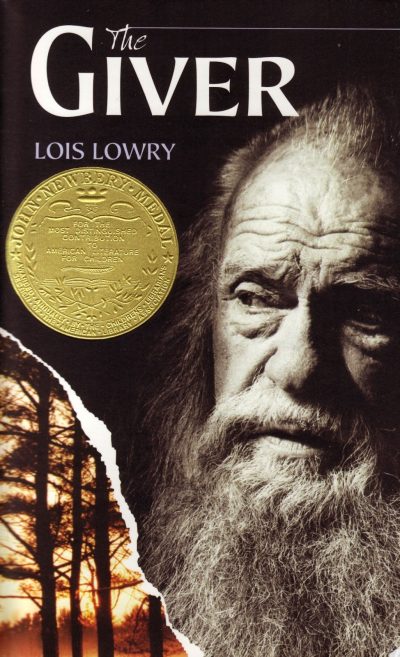
Review: The Giver, Lois Lowry ⭐⭐

Christopher Rush

Umm … nah.  To be fair, though, I suspect if I read it for the first time as an early teenager, without much reading experience (not that I have stellar experience now), and I only had, say, Bridge to Terebithia to compare to this, I would possibly have thought this a mighty fine story.  Now, though, it reads like a slipshod, hastily slap-dashed ramshackle of a half-story.  Lowry presents us with partially developed ideas — and many of them are worth engaging, definitely, but she doesn’t engage them, either through our “hero” or in commentary form.  Where is the confrontation between Jonas and his father after seeing the “release” video?  Where is the payoff for Jonas no longer taking his morning pills?  And are we completely sure the “best” plan is “run away”?  Have they truly thought out all the potential ways in which they can improve the society? especially since Jonas only has some of the memories and the Giver clearly still has a great deal of them.  The entire “giver/receiver” process is rather suspect as well.  Allowing for the otherwise-incredible notion the Giver is the repository of all human knowledge and memory of all time before the instatement of this society apparently the world over, which is a rather big allowance, that one Giver could majickally transfer a memory or portion of a memory to another and then wholly forget the memory (except in “wisps”) is rather a strain of credulity, even for this tale.  Now the ending. If we could, as Dave Lister has suggested elsewhen, turn the dial to Reality FM for a moment?  The ending is pure laziness on the part of Ms. Lowry.  Ambiguity is one thing.  Modernist Uncertainty/Subjectivity is another.  The ending of The Giver, though, is sheer laziness.  Nothing more needs be said.

This book has some fine ideas.  While it begins to present them well, it feels like it gives up rather quickly (and honors the characters who have given up and run away, which seems like a poor trait to encourage in a teenage audience).  I suspect the youth who enjoyed it “back in the day” might find on reading it again now it just does not hold up well, even to its most stalwart defender (likely based solely on 20-some-year-old nostalgia).  On the other hand, if one wants to read a classic “children’s” book that definitely holds up well, re-read The Westing Game. That certainly stands the test of time (unlike The Giver).

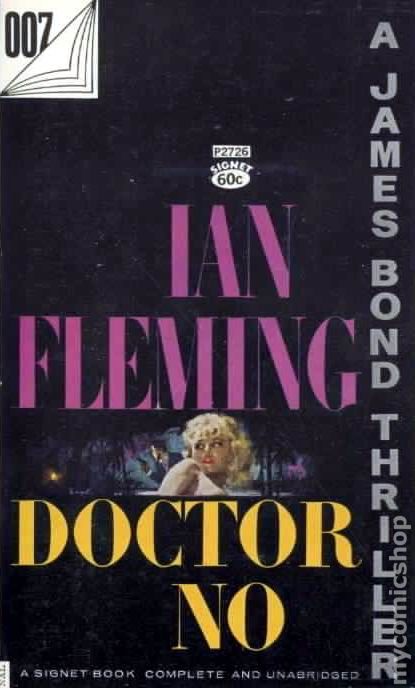
Review: Doctor No, Ian Fleming ⭐⭐⭐

Christopher Rush

I really don’t understand the backlash against this book.  Is Bond racist in this book?  No, he isn’t.  Bond doesn’t shoot badguys because they are “Chinese negroes” (as Fleming has other characters say), he shoots them because they are trying to kill him and he wants to stay alive.  He never says “because these people are of this race, I don’t like them.”  Similarly, he is not misogynistic toward “Honey” Ryder.  Yes, he is a little patronizing to her at the beginning, but his initial impressions of her are accurate: she is a young girl (of 20) with no experience of “civilization” beyond being assaulted by a drunken guy once, who has spent most of her life on her own adapting to Nature.  His comments about her broken nose are a tad overboard at first, but they go away soon, especially once she proves her strength toward the end.  Let’s remember, too, it’s Honey who is in charge and aggressive at the end, not Bond.  He never forces himself on her.  He tries to protect her.  He tries to protect Quarrel — he cares about him.  Bond is perhaps at his most human in this book, feeling the anger at the losses he encounters more than in the other books so far.  If the antagonistic readers should be mad at anyone, they should be mad at Ian Fleming for Honey’s real name and the attitudes of the other characters toward the other races, certainly not at Bond.  Bond even admits his failings and feels like apologizing to M a couple of times.  Yes, Fleming does get a bit heavy-handed with the prose at times, but some of the dramatic scenes (okay, there are two) are rather intense and engaging.  And there’s actually a real epilogue, not just a stoppage of action.  So what’s the deal, people?  Why the antagonism?

Two from Neil Gaiman

Christopher Rush

Murder Mysteries ⭐⭐

Not Mr. Gaiman’s best work, that’s for sure, but Murder Mysteries does have some interesting points.  His imagining (though this may also be more the brilliance of P. Craig Russell) of the angels’ home was a high point, so to speak, and the mysterious nature/history of the narrator of the story-within-the-story was mildly intriguing.  Other than that, though, these stories fell somewhat flat.  “Mystery” is not “ambiguity.”  Some stories/authors can generate ambiguity that adds to the overall effect of the work, and we all know Gaiman is capable of that, but the ambiguity here is more akin to disinterest.  We are left with a narrator as unattached as possible to the story he has heard, the terrible events he may or may not be connected to, and even his own fate — and we don’t really care, either.  On top of that, Gaiman wants us to feel sorry for Lucifer, consider God a sadistic jerk who does unfair things on purpose to make Lucifer fall, and believe Love somehow magically creates Jealousy just because, and this story and its characters don’t achieve those aims.  I suspect Mr. Gaiman used up all his brilliance for 2002 on American Gods, which is certainly a tough act to follow anyway.  If this is a low point in Mr. Gaiman’s oeuvre, that’s not such a bad thing (especially if you can overlook the heresy with only a disconsolate grimace).

Creatures of the Night ⭐⭐⭐

I’m not usually a fan of dark and mysterious and spooky (if “not usually” means “never”), but this was a surprisingly fine read.  Tepid praise, perhaps, but I prefer to consider it more effusive than tepid, considering my aforementioned distaste for dark and mysterious.  Despite this, as contradictory as it may be, I usually make exceptions for Neil Gaiman, who rarely disappoints (only a smidge of what I’ve read of Sandman was disappointing, and Murder Mysteries fell a bit flat), and while I can’t nudge this into Poe-like literature, it is macabre to be sure yet moralistic enough to escape mere supernatural fetishism.  That’s a good sentence.  You have my permission to start bandying it about ’round the water cooler.

Gaiman is all kinds of genius, and more importantly he has respect for Art.  That protects most things he does from failing (not everything, but he’s okay with that, and we should be, too), and it protects this pair of weird tales.  The first story achieves the kind of successful ambiguity lacking in Murder Mysteries: we don’t know what’s going to happen, but we are actually interested and hopeful (though the story does not give us much room for optimism).  The second is not quite as scary as the first, and it is a bit more typical than uniquely-Gaiman (since he’s his own subculture of creativity), but one gets the impression it’s the story he wanted to write along these lines, and he’s glad he’s done it and we can be, too.  As I said, a surprisingly fine read (not that we should ever be surprised by Mr. Gaiman).

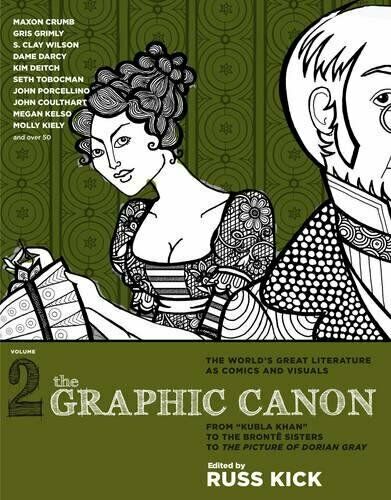
Review: The Graphic Canon, Vol. 2: From “Kubla Khan” to the Brontë Sisters to The Picture of Dorian Gray, ed. Russ Kick ⭐⭐

Christopher Rush

This volume was better than volume 1, but one has to say that with the same tone as one says “having a temperature of 104 is better than having a temperature of 106.”  Some of the artwork is great — this is a fine showcase of a number of up-and-coming artists who may make it big for all the right reasons.  Some of the “artwork,” though, is just sloppy mediocre pseudo-art pretentiously demanding we call it “art” just because it says so (even though Mrs. Wilson’s 3rd-grade class could draw better than this).  In what purports to be a collection of the “World’s” best work during the 18th-19th centuries, we are led to believe “the world” is mostly the UK and the USA, with only a dozen or so selections from other countries, including one that is essentially pornography (Venus in Furs), but Kick assumes we are enlightened enough to consider masochism is actually fine literature.  Some artists do treat the source material with great respect.  Others, like Hunt Emerson, don’t.  If I said Kick gives too much space to Nietzsche, Darwin, Ludlow, Carroll, and Blake, would that betray my biases? or his?  Nat Turner, who killed people solely because of their race, we are told is a hero — killing people on the basis of their race is a quality of a hero? in the 21st century? or ever?  I dunno.

Kick, as usually, exerts himself to the point of apoplexy trying to get us to believe each selection is astounding and each artist is a genius: if the work doesn’t speak for itself, no amount of cheerleading (i.e., grandstanding) is going to make it canonical.  At other times, Kick makes us wonder if he even read the work in question: Huck Finn respects Jim as a human being early in the novel?  Not really, no.  Perhaps Kick’s penchant for postmodern criticism has hindered his understanding of the actual works.  Some inclusions just make us scratch our heads in bemusement, wondering why entire short tales are in here simply to show off one panel of artwork from Kick’s heroes — especially since Kick includes other works about selections without the relevant prose (such as the lengthy litany of Alice in Wonderland adaptations).  If the purpose of this is to encourage readers to go out and read the real thing, I fear it fails.  If the purpose is to show off the contemporary panoply of artists, it may succeed both to tell us whom to admire and whom to avoid.  Reading this is mostly a chore — it has some bright spots, but they are few and far between.

Review: The Trial of Socrates, I.F. Stone ⭐⭐

Christopher Rush

This book was a gnat’s wing away from being a good book, but Stone spoiled it for me with his pseudo-academical language and absence of an ending.  I applaud I.F. Stone’s ability and desire to learn Greek in his late 70s: that gives me great hope for my own linguistic aspirations … though I suspect Stone was able to do so because he spent the first 70-some years of his life working hard, making money, and making friends, all of which (mostly the first) allowed him to spend his twilight years learning Greek and writing this book.  Notice, however, this is not Irving Stone.  This is a different Stone — a journalist who wanted to learn Greek and know more about the trial of Socrates.  As admirable as that sounds, Stone comes off rather highhanded throughout, and from the beginning the ubiquity of words such as “Xenophontic” dispels any enthusiasm the reader had for the material.  Structurally, it is rather confusing, since several chapters do not really discuss what the title of the chapter is about until after that chapter is over and the reader has begun the next chapter.  Much of part 1 gives the reader the impression you are reading the same basic idea simply in different guises — but that could also be the frequency of “Platonic” and “Xenophontic.”  Stone has all the suavity and facility of a sophomore Classics major who, having read at least three semi-definitive works on Ancient Greece feels confident to name-drop the authorities and translators, as if his personal (admittedly limited) experiences give him permission to define and represent the entire field.  Stone says in the prefatory material of the book Socrates’ death was unjustified, but then Stone spends over a dozen chapters on why Socrates was an undemocratic, elitist snob who only ridiculed people and never defined the terms he supposedly wanted to define, yet the Athenians did the wrong thing (mainly because “he’s Socrates”).

By the last few chapters (including the discursive epilogue), the reader gathers the impression Stone would rather tell us things he has read about in the classical world than give any meaningful summation of his investigation into Socrates’ trial — again with all the authority of someone who, having last night watched Enter the Dragon for the first time, is suddenly an expert on Bruce Lee.  This book could have been so much better.  The reader will certainly learn a few things about the subject, but Stone’s language and style will not make the journey all that enjoyable.  You will be better off reading the works (even in translation) for yourself.

Review: When You Reach Me, Rebecca Stead ⭐⭐⭐

Christopher Rush

A 2.5-star book rounded up.  It’s not that great of a book, if I may speak openly, primarily in the tone and style and (for me) feel of the reading experience.  Admittedly, “feel” is highly subjective, but as I read the book I have the experience to discuss it.  I don’t doubt Author Stead grew up in the ’70s, nor do I doubt she grew up loving the works of Madeleine L’Engle.  Yet, this work feels like someone writing in the 2010s as if it were the 1970s — and it doesn’t work, no more so than any movie in the 2000s that tried to recreate an ’80s feel of a movie.  Similarly, the 1st-person narratorship falls flat and irritates; this does not sound like it is narrated by a teenage girl (or however old Miranda is as a supposed 6th grader), just like one of the main failings of the supposedly-great-but-really-overrated Catcher in the Rye.  I don’t doubt 6th graders 35 years ago were more intelligent, and I’m pretty sure I was more intelligent as a 6th grader than most 6th graders today, but the work comes off like it is trying too hard and instead drizzles with all the authenticity of Pat Boone covering AC/DC.  Or each and every single reboot of ’70s and ’80s pop culture done today (though Stead’s work is better than these horrible movie deconstructions, since Stead maintains a love for L’Engle not an outright rejection of her).

If, as Stead claims, A Wrinkle in Time is not supposed to dominate the story, that, too, is a failure.  The book is dominantly a love letter from Rebecca Stead to Madeleine L’Engle … and it would be fine if that was the intention: we certainly need more outright homages to important/quality works and authors of the past … but pretending it isn’t rings hollow and adds to the disappointing tenor of the work.  I admit freely I haven’t read A Wrinkle in Time, nor do I apologize or feel like I somehow missed out on something important in my childhood.  I was reading other important authors and having other important experiences, literary and otherwise.  Would having read A Wrinkle in Time make reading When You Reach Me a more enjoyable experience?  Perhaps, but it may also have made it more irritating.  I suppose if I read a book written today about how The Westing Game dominated someone’s life and thought and was about some mystery with undertones of Westing Game-likeness, I could potentially be enthused, but I suspect I would more likely be disappointed, with reactions such as “it’s not like that!” or “that wasn’t the most important part!” dominating my experience.  It’s a dangerous endeavor to share one’s childhood happinesses with others, especially later in life.  I suppose I should applaud Stead’s willingness to do it, but since so many clearly already do and have (especially the Newberry people, who bizarrely claimed this is “wholly original,” despite it being so dominated by A Wrinkle in Time — though I suppose it is too much to ask that today’s Newberry committee have ever read L’Engle either), I will just let the accolades come from others.

It does have some mildly clever things about it, yes.  The basic ideas are done well, and clearly Stead worked hard at making it a unified work with the foreshadowings and consistencies and little details here and there that probably wowed the people that really like this book.  Does anyone else feel sorry for Annemarie?  She really seems to get left out, both in the present and the distant dome-future.  The treatment of the supporting characters is a major factor in my disappointment with the book.  They come and go only to serve whatever temporary purposes Stead has in driving the main ideas in the book, though beyond time travel and I Love L’Engle, we aren’t really sure what the main ideas are, other than we applaud the commitment of that certain character to dedicate his life to right that wrong at such a high price (is that vague enough not to spoil anything for those who haven’t read it?).  That realization Miranda has is probably what pleases most audience members, and that was certainly a high mark of the book, but for me the casual dismissal of the supporting characters and supporting stories frustrates and disappoints — that and the pretentious (perhaps too harsh a term) chapter titles and teeny chapter lengths.

I would like to give this a higher mark, and perhaps if I read it again I could appreciate it more, and perhaps if I read more (any) L’Engle I would love it more. I’m willing to do that … just not right now.  Maybe some day.

Review: God and Man at Yale, William F. Buckley, Jr. ⭐⭐⭐⭐

Christopher Rush

Even more frightening (and pertinent) that it is now more close to the 65th anniversary of this work, unsurprisingly Buckley’s book is necessary, enlightening, and apropos.  Buckley’s introduction to the 25th anniversary reveals his growth as a critic, thinker, and writer (the writing is much better than the book itself, which should not be surprising, considering he doubled his life experience and honed his writing output in the meantime).  It is more enjoyable to read than the book, but the book itself should be read, if for nothing more than the reminder, especially to collegians today, the only thing colleges want from their alumni is their money.  What will perhaps come as an “I should have seen that coming” notice to us all is the litany of colleges, especially akin to the league of ivy-covered universities, during the ’50s that eschewed private enterprise and the free market in favor of government intervention and control (often called “socialism”) in economics courses.  Thus, all the decision makers in government who went to college since the 1950s have been weaned on Keynesian economics — no wonder we are in the state we are in today: all of them think they are doing the right thing.

Buckley’s discussion on the inefficacy of religion on Yale’s campus is thoroughly disheartening, especially considering the Decision Makers’ decision to prevent Buckley from giving his cautionary speech to the alumni under the abused, hypocritical claim of “academic freedom.”  Buckley’s trenchant discussion of both the passive (and sometimes overt) destruction of religion on campus, and the mythical trope “academic freedom” are likewise necessary reading, especially since the atmosphere at more colleges are even worse than they were when he first wrote this book.  We certainly are in a bizarre academic world when ideas like Intelligent Design are blackballed from the very public schools that claim to espouse “academic freedom.”

I especially enjoyed Buckley’s refutation of the notion Yale (and thus all, especially private, educational enterprises) must present all ideas in an unbiased way to the students and thus allow the students to weigh and decide for themselves what is true (or worthwhile or pragmatic or whatever) — as if the classroom is suppose to be an intellectual buffet.  Indeed, this is not the case: classrooms and teachers/professors, especially at private institutions, wholly have the obligation to stand for something — to proclaim what is true and encourage the students to believe what is true.  Certainly this does not mean they should avoid the thinkers and ideas contrary to what they believe, nor must they only discuss them superficially or derogatorily, but such inferior ideas should be refuted in the classroom.  Anything less is not an education.  That Buckley and his friends are not popular today should be enough reason for you to read this book.