
Alex Touchet
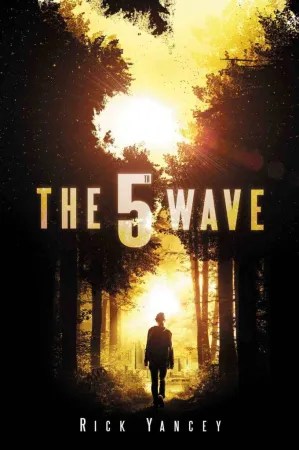
An ominous alien craft appears over earth. It assaults Earth with a series of four waves of destruction. The first is in the form of an electromagnetic pulse that shuts down every electronic device on the planet. This initial attack results in the deaths of around half a million people. As technology becomes obsolete, the aliens drop a large metal rod onto a geographic fault line, creating a gargantuan tsunami that wipes out coastal cities on every continent. This wave’s death count is over three billion. The third assault is a plague called the “blood plague” or the “fourth horseman.” Its mortality rate is nearly one hundred percent, and it decimates around ninety-seven percent of the remaining human population. The fourth wave is the activation of an alien consciousness inside select human beings that were “infected” in the mental invasion of 1995. These humans, called “silencers,” proceed to hunt down remaining survivors with cold precision.
The story follows two survivors: Cassie is a girl searching for her lost brother, and Ben is a survivor training in what is said to be a resistance-oriented military. Their story is closely entwined with Evan, a silencer who narrowly spares Cassie’s life for sentimental reasons he himself does not entirely grasp. This disparity between characters is one sign of Rick Yancey’s literary mastery. He doesn’t fall victim to the trope of the “strong young female surviving a post-apocalyptic world,” such as Suzanne Collins (The Hunger Games) or Veronica Roth (Divergent). Yancey gives multiple differing perspectives that have an individual voice and personality. Ben often uses militaristic language while narrating, while Cassie exhibits a more feminine personality unique to her character. This dual-perspective approach is a tactic many authors avoid. One of the only other stories where I have seen it flawlessly executed is Worm (a completed Web serial) written by Wildbow.
Rick Yancey succeeds so well with this novel because he openly approaches a genre often marred with a painful multitude of stereotypes and clichés and circumvents them. He foresees how the story might become predictable and tosses in a plot twist. He writes his characters not as mirror images of the over-used stereotypes of dystopian fiction, but as real (and blatantly flawed) people. Cassie had romantic feelings for Ben before the Waves decimated the planet, and so when her brother pops up in Ben’s squad of trainees, the reader expects a clichéd romance to occur. While this setup inherently seems a little too unrealistic to make sense, Yancey does not take the expected route of playing matchmaker with two broken survivors connected by preexisting relationships. He sets up a controversial connection between Cassie and Evan the alien-boy before Cassie ever even reunites with Ben and her brother. This sort of “always one step ahead” approach destroys the sense of familiarity readers often feel toward predictable stories and demands their attention.
One of the most complicated characters in the story is Evan. He is a walking contradiction. Silencers are the epitome of efficient destruction, so it makes little initial sense when Evan falls for a member of the race he was programmed to kill. Even though he has the brain of a hostile alien, there is something about Cassie (and humans in general) that forces him to rethink his priorities. He has fallen in love, which may not be too unique as a plot point by itself, but is not an event created merely to inspire emotional connections around a love-interest. Instead, it is a doorway that opens up new possibilities and questions concerning the silencers and their role in humanity’s extinction. It also demands the question: “Why does Cassie fall for him as well?” Normally, in stories where a character’s world and family has been destroyed by a hostile invader, the protagonist feels imperatively obligated to seek some form of vengeance. Forgiveness is often rejected for the sake of “justice,” or more appropriately, revenge. Jean Valjean is possibly one of the only protagonists I have ever observed to willingly forgive an antagonist, regardless of their wrongs and choices.
Yancey, once again, crosses out another typical cliché and instead gives Cassie the ability to look past Evan’s nature. When she first discovers the real Evan, she is torn between her love for him and mistrust for his kind. However, she finally decides he is worth the risk. She is not blinded by his mere connection to the aliens; she sees him for who he really is and how he treats her. She understands the weight his betrayal of his own race holds and reciprocates when she falls in love with him. This mutual romance demonstrates what is at the core of Yancey’s novel. In a broken world where the enemy’s final attempt at annihilating humanity is to tear apart their ability to trust each other, two individuals reach across the divide and hold onto one another. This is the most powerful element of the novel, because it exemplifies one of the characteristic traits of humanity: its search for community and its thirst for connection.
Yancey plays a long and deliberate game with his characters while making sure they don’t conform to typical cliché guidelines. Every little detail of the plot has been designed to fit into a larger, much more complicated plan. Ben and Cassie’s little brother have been trained along with the rest of their barracks by soldiers to “kill aliens.” They have become cold-blooded and efficient. Mr. Yancey allows readers to begin to discover early on the military camp is not as it seems. It becomes increasingly obvious the soldiers may not be true human soldiers, but the characters themselves are unaware and continue to make decisions that force them into worse situations. This forces the reader to arrive at conclusions before the characters themselves, adding a new element of conscious discovery not present in most novels. When the soldiers are revealed to be alien agents training children to hunt down and kill their own species, readers are practically screaming at the until-then oblivious protagonists.
While The 5th Wave is definitely not a reinvention of the genre, Yancey succeeds in multiple aspects of the story usually overlooked by most other authors. He changes the protagonists often enough to provide more variety than a book such as The Hunger Games could ever accomplish. He takes obvious (and expected) clichés, and then turns them on their head. His mastery of his individual characters is evident with how well he handles their separate, broken identities. He even approaches the primary question that plagues almost every alien invasion story ever: “Why do they want us dead if they don’t need anything we have?” This is probably the main reason I liked the book so much. It approaches elements of science fiction other authors seem to take for granted. This novel is not the best teen science-fiction ever written, but it is definitely a favorite worth picking up.
 Redeeming Pandora