
Christopher Rush
Murder Mysteries ⭐⭐

Not Mr. Gaiman’s best work, that’s for sure, but Murder Mysteries does have some interesting points. His imagining (though this may also be more the brilliance of P. Craig Russell) of the angels’ home was a high point, so to speak, and the mysterious nature/history of the narrator of the story-within-the-story was mildly intriguing. Other than that, though, these stories fell somewhat flat. “Mystery” is not “ambiguity.” Some stories/authors can generate ambiguity that adds to the overall effect of the work, and we all know Gaiman is capable of that, but the ambiguity here is more akin to disinterest. We are left with a narrator as unattached as possible to the story he has heard, the terrible events he may or may not be connected to, and even his own fate — and we don’t really care, either. On top of that, Gaiman wants us to feel sorry for Lucifer, consider God a sadistic jerk who does unfair things on purpose to make Lucifer fall, and believe Love somehow magically creates Jealousy just because, and this story and its characters don’t achieve those aims. I suspect Mr. Gaiman used up all his brilliance for 2002 on American Gods, which is certainly a tough act to follow anyway. If this is a low point in Mr. Gaiman’s oeuvre, that’s not such a bad thing (especially if you can overlook the heresy with only a disconsolate grimace).
Creatures of the Night ⭐⭐⭐
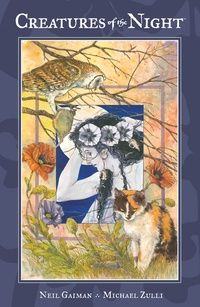
I’m not usually a fan of dark and mysterious and spooky (if “not usually” means “never”), but this was a surprisingly fine read. Tepid praise, perhaps, but I prefer to consider it more effusive than tepid, considering my aforementioned distaste for dark and mysterious. Despite this, as contradictory as it may be, I usually make exceptions for Neil Gaiman, who rarely disappoints (only a smidge of what I’ve read of Sandman was disappointing, and Murder Mysteries fell a bit flat), and while I can’t nudge this into Poe-like literature, it is macabre to be sure yet moralistic enough to escape mere supernatural fetishism. That’s a good sentence. You have my permission to start bandying it about ’round the water cooler.
Gaiman is all kinds of genius, and more importantly he has respect for Art. That protects most things he does from failing (not everything, but he’s okay with that, and we should be, too), and it protects this pair of weird tales. The first story achieves the kind of successful ambiguity lacking in Murder Mysteries: we don’t know what’s going to happen, but we are actually interested and hopeful (though the story does not give us much room for optimism). The second is not quite as scary as the first, and it is a bit more typical than uniquely-Gaiman (since he’s his own subculture of creativity), but one gets the impression it’s the story he wanted to write along these lines, and he’s glad he’s done it and we can be, too. As I said, a surprisingly fine read (not that we should ever be surprised by Mr. Gaiman).
 Redeeming Pandora