
Christopher Rush
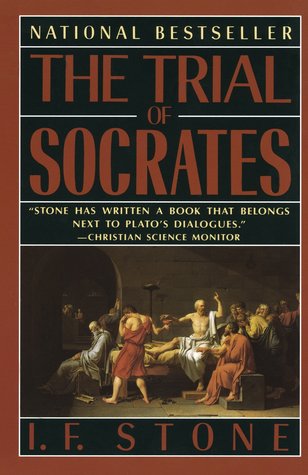
This book was a gnat’s wing away from being a good book, but Stone spoiled it for me with his pseudo-academical language and absence of an ending. I applaud I.F. Stone’s ability and desire to learn Greek in his late 70s: that gives me great hope for my own linguistic aspirations … though I suspect Stone was able to do so because he spent the first 70-some years of his life working hard, making money, and making friends, all of which (mostly the first) allowed him to spend his twilight years learning Greek and writing this book. Notice, however, this is not Irving Stone. This is a different Stone — a journalist who wanted to learn Greek and know more about the trial of Socrates. As admirable as that sounds, Stone comes off rather highhanded throughout, and from the beginning the ubiquity of words such as “Xenophontic” dispels any enthusiasm the reader had for the material. Structurally, it is rather confusing, since several chapters do not really discuss what the title of the chapter is about until after that chapter is over and the reader has begun the next chapter. Much of part 1 gives the reader the impression you are reading the same basic idea simply in different guises — but that could also be the frequency of “Platonic” and “Xenophontic.” Stone has all the suavity and facility of a sophomore Classics major who, having read at least three semi-definitive works on Ancient Greece feels confident to name-drop the authorities and translators, as if his personal (admittedly limited) experiences give him permission to define and represent the entire field. Stone says in the prefatory material of the book Socrates’ death was unjustified, but then Stone spends over a dozen chapters on why Socrates was an undemocratic, elitist snob who only ridiculed people and never defined the terms he supposedly wanted to define, yet the Athenians did the wrong thing (mainly because “he’s Socrates”).
By the last few chapters (including the discursive epilogue), the reader gathers the impression Stone would rather tell us things he has read about in the classical world than give any meaningful summation of his investigation into Socrates’ trial — again with all the authority of someone who, having last night watched Enter the Dragon for the first time, is suddenly an expert on Bruce Lee. This book could have been so much better. The reader will certainly learn a few things about the subject, but Stone’s language and style will not make the journey all that enjoyable. You will be better off reading the works (even in translation) for yourself.
 Redeeming Pandora