Christopher Rush
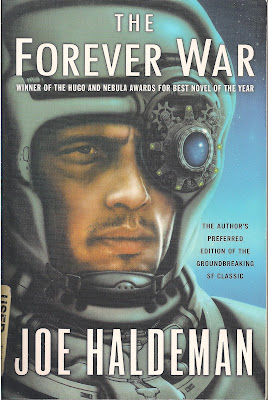
I was going to give this only a couple of stars, but the ending alone (primarily the epilogue and what is implied) deserves another star itself. I know this is a beloved classic, and far be it from me to disparage a classic, but I didn’t really like this all that much, at least most of it. After a smidgeon of pseudo-research, I learn I have read the abridged early version, not as definitive or swell as the finalized authoritative version, so I have no qualms giving this copy away. Perhaps some day I will return to this universe and read the proper version and its sequels.
Being me, the language for the first half of the work was off-putting, enough to make this a 3-star book instead of a 4-star book. I get what it’s about, especially after my smidgeon of pseudo-research, but still. So it’s a Vietnam story not a space story after all. I suppose that could somewhat assuage the Del Ray-like limited science fiction vision of the future, but the absence of futuristic vision was disappointing, especially after Haldeman did such an intense job cramming real science down our throats for much of the work. That was another source of my reaction. I’m all for science (sort of), but what I thought was supposed to be a novel seems more like Haldeman trying to show off his science chops — I like Moby-Dick more than most people, but I didn’t want to read Moby-Dick in Space when I picked up The Forever War. Knowing as much science and its progress as Haldeman did, especially knowing Star Trek like he did, he should have at least created computers and data processing in the 22nd century to be less clunky than what is here.
Small points, perhaps, but then one never knows about these things. The sections I did enjoy were the brief moments of happiness between Mandella and Marygay and, as noted above, the epilogue. I suspect those are the bits many fans enjoy as well, but what do I know. The second half is generally much better than the first half, even with the heartbreaking separation in the middle — perhaps it’s Mandella’s resignation and almost accidental maturity (or just resignation) that makes it more enjoyable (like Jack Shepherd’s attitude, finally, in season 6 of Lost). The war itself and its explanation was a bit obvious, especially Haldeman’s message, and that combined with his treatment of what Earth becomes in the meanwhile seemed forced, but knowing as I now do that he has more to say in the unabridged version is a small comfort. It’s a good book. It didn’t blow me away, and it did frustrate me at times, but that tells you more about me than the book. You’ll probably really like it.
 Redeeming Pandora