
Christopher Rush
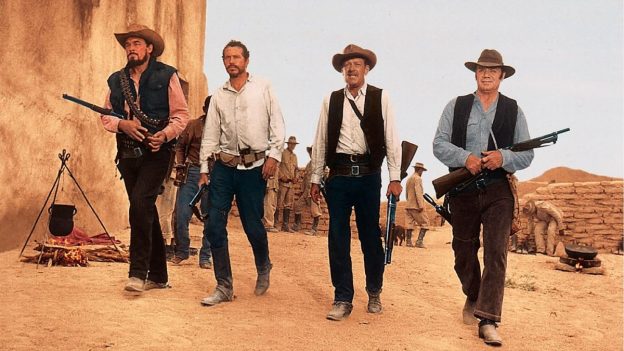
This is a violent movie. It also has some moments of explicit adult content, in both language and visual imagery. Most of the characters are coarse, greedy men struggling to live up to a moral code of their own devising. But still. This is a good if not great movie. Now, please don’t get the impression we are tired of recommending family-friendly classics here at Redeeming Pandora. We aren’t going to extol the merits of Pulp Fiction or A Clockwork Orange in my lifetime (only one of which I’ve seen). I was planning on writing a little something about Wild Bunch even before Daniel Blanton submitted his treatment of Fight Club last time, and since I advertised it I wanted to follow through. I wouldn’t want to be disloyal.
Speaking of which …
Loyalty is a dominant theme of this movie, and it’s certainly the ideas discussed and explored by this film that makes it so impressive. Loyalty is connected to humanity: the less loyal you are, to your friends, your mission, your values, the less human you are, the closer you are to animals. The whole climactic finale of the movie is driven by the bunch’s inability to obviate their failure to uphold this value. Many who dislike the movie I would imagine liken the characters to animals anyway, since they are fairly rough and course for much of it. They do steal, kill, and cavort their way through what passes for life. And yet. William Holden’s character, especially, tormented by the moments of disloyalty in his life (those he’s suffered and those he’s dispensed) drive him to cling to one vestige of his long-moribund humanity, loyalty to those with whom he travels.
The movie’s other theme, the death of the “ol’ West,” a popular subject for director and co-writer Sam Peckinpah, is a fitting companion to a story of men trying to cling to something — yet it is impressively ironic as well, since the Wild Bunch aren’t trying to cling to the way things used to be. They are tired of living this sort of life, and with a new world of automobiles, international finance, and the disappearance of open ranges, they are attempting to adapt to the new ways of life. They only embark on the major plot thread of the movie because their supposed “last big score” turns against them at the beginning of the film. After all, one needs money if one is to retire and embrace a new way of life in the “modern world.” Of course, with all the odds against them, the chances of this old group of ragtag gunmen, whose moral code is as elusive as their financial solvency, achieving a successful adaptation into a new world is unlikely. The only thing they know is how to be themselves. And that tension makes for a great movie. (I guess I do think it’s great after all.)
The stellar cast (William Holden, Ernest Borgnine, Robert Ryan, and more) definitely helps the film excel as well, especially with some actors in roles that don’t surprise us and some that do. Is this movie for you? As I said, it’s got a good deal of asperity: coarse language, brief nudity, and violence that may make Quentin Tarantino blush. For the kids out there, put it on the back burner until you’re a little older and wiser. For the adults out there, I’d say give it a try. You can be bothered by the rough stuff (I certainly am — I don’t excuse it at all), but what’s underneath all that is as intriguing a complex of ideas and characters and values worth fighting (and dying) for that make for a great movie. As they say in the film, in one of the best “realization moments” of any film I’ve seen, “why not.”
 Redeeming Pandora