
Christopher Rush
Two of the greatest literary detectives are assuredly Rex Stout’s Nero Wolfe and Bob Kane’s Batman (or, Bruce Wayne, when hosting in his stately manor). Both have very little in common beyond their basic commitment to right wrongs and bring perpetrators to justice, considering Wolfe will usually only bring justice when he is paid for it and rarely leaves his home and Batman prefers anonymity and patrolling the streets practically constantly. Both do have a certain moral malleability, even with Batman’s commitment never to kill (something we are occasionally led to believe Wolfe has done in his youth, if for a certain kind of justice), but we are never far from the firm conviction these great detectives are valuable assets to the fight against crime — certainly never for very long, at least. One significant thing they do have in common, as with most great literary detectives and epic heroes of other ilks, is their catabasis and anabasis, requisitely occurring because of their nemeses. Of course, Batman has more arch-nemeses than the shore has sand, but no one has taken him to his nadir as one behemoth of a villain: Bane. Nero Wolfe, having managed to offend and upset everyone from Serbian diplomats to the head of the Central Intelligence Agency, likewise, has no dearth of enemies—but no one has so altered and affected his life like the scourge of the underworld: Arnold Zeck. Within recent memory, I have read the three collections of Batman’s epic encounter with Bane and its aftermath and the three novels detailing Wolfe’s brief but cataclysmic history with Zeck. In an effort not to spoil too much of the mystery, action, adventure, plot, and (most important of all) great character moments, I include hear my brief reviews after I read them. I refrained from spoiling too much in hopes you will pick them up and read them for yourself, if for nothing else than to have some great reading experiences. We begin with the three Nero Wolfe adventures written by Rex Stout and conclude with the three recent-ish TPB collections of Batman’s fall and rise in the mighty Knightfall Saga, mostly written by Chuck Dixon.
And Be a Villain ⭐⭐⭐
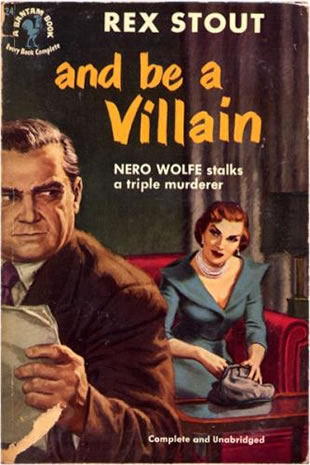
If I call this “another satisfactory addition” to the Nero Wolfe canon, you should realize that is no slight against this book. It would be impractical to require each Wolfe novel to be an innovative, life-altering humdinger. This is another enjoyable Wolfe story, which dallies with tedium at times but refrains from indulging too much (even more successfully than Too Many Women) and provides nice moments both of tension and humor. We are treated to a surprising rare scene in this story: Wolfe gives Cramer all he knows before the murder is solved and asks him to effectively take over. While this is a genuine offer, Wolfe returns to form by the end, effectively blackmailing the police to get what he wants (though, nicely, not at Cramer’s personal expense). The mystery itself is a nicely complex puzzle: not only is it a “whodunnit,” but also it develops into a “was that the right victim?” investigation. Most Wolfe fans probably remember it for the first Arnold Zeck story, who will apparently become Wolfe’s arch-nemesis, but I don’t know much about that at this point. It does add a sense of tension to the story that feels a little off, like Psych’s Yin-Yang series (despite being a series about murder/mayhem, it’s usually much lighter than having an “arch-nemesis”) — but still, it adds some spice and freshness, even if it’s not something fans really clamored for. And Be a Villain isn’t a knockout, but it has some engaging twists and turns and those moments we enjoy.
The Second Confession ⭐⭐⭐⭐

Though all Wolfe stories are different to some degree, this was clearly the most distinct in the canon thus far: Wolfe not only leaves his house (which he has done in other stories, to be sure), but his house is attacked by the mysterious person quickly becoming an arch-nemesis to Wolfe. The pacing is much more rapid than most Wolfe books: we have a sense of urgency from the beginning that drives through the first half of the novel. Even when the pace slows down around the ¾ mark, we still feel along with Wolfe and Archie things are not as “back to normal” as they may superficially appear. Thus, for once, the slowing down section just before the rapid tortuous conclusion is a welcome relief. Another unusual stylistic flavor in this entry is the almost episodic feel to the early chapters. It is almost as if the chapters were serial entries in a magazine, or the classic serialized shorts from Columbia Pictures, each ending with a shocking, unexpected twist. It almost “feels” like it is not Stout writing these chapters, but we are confident and assured this plot is in the hands of the master. There is not as much humor in this one as many of the others lately have had, but there is a far more convincing romance between Archie and the female “lead” than in, say, “Before I Die.” The lack of humor is not a problem, though, since the fast pace, the political undercurrent (which does not stay “under” for long), and the palpable tension distract us enough to make this atypical Wolfe adventure one of the best yet.
In the Best Families ⭐⭐⭐

I strongly suspect this is a unique book in the Wolfe series for many reasons, many of which will not be mentioned to avoid too much plot spoiling. As one of those “wholly different” episodes, like the brownies episode of Barney Miller or “Dreams” in M*A*S*H, the feel is totally different and thus “off” for most of the book. It starts off fairly typically, but it’s not long before the drastic changes happen quickly and in full force: Wolfe disappears, the orchids go to Hewitt, Fritz goes to Rusterman’s, and Archie gets his own office. I certainly do not begrudge Rex Stout for doing something different — it is good to break out of a routine once in a while, no matter how salubrious the routine. I’m glad he did it; I’m glad Wolfe had an arch-enemy after a fashion (most of their “relationship” being phone conversations); I’m glad it ended after three stories — too many more stories would have felt dragged on. Still, the differences make this work, even in its necessity, less enjoyable than the “usual” stories. Many no doubt love this even more because of its distinctions, and they are welcome to that affection.
For me, the irritation of this book is Archie’s true feelings about his housemates: once it seems like that 10-year-some phase of his life is over, Archie has mostly negative things to say about Fritz, Theodore, and Wolfe. Being a romantic, sweet person, I naturally assume Archie and Fritz are friends: apparently they aren’t, even though Fritz cares for him. It’s almost reminiscent of Huck and Jim’s relationship, with Fritz as the caretaker role more than friend. Archie comes off as a pretty big jerk in this one, and one almost wants Cramer to actually beat him up when the situation arises. Stout does a good job of getting us to feel the long passage of time without slowing the story down too much (far better than in Too Many Women), and though the story does drag a bit, it picks up with good alacrity toward the smashing conclusion. It ends nicely, fittingly, and the suspense is well done. It likely won’t make you think less of Archie, but be prepared for some harsh honesty from the characters in this one, understandably brought about by the harsh edginess of the situation.
Knightfall, vol. 1 ⭐⭐⭐⭐
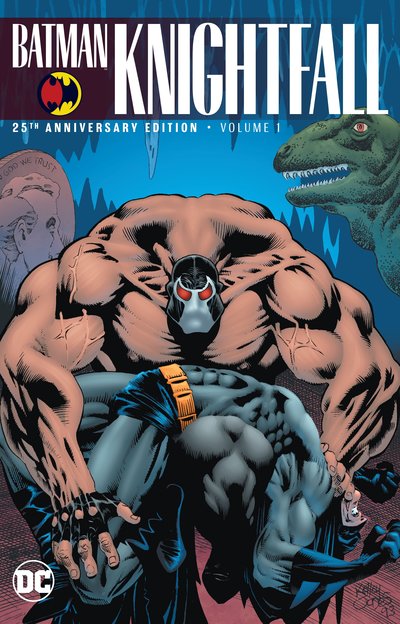
Finally, after all this time, it’s come out in a nice TPB, and I have read it. Without all the preliminary prologue stuff, non-Batman readers might be a bit lost for a time, such as who Jean-Paul is, why Bruce is already beleaguered, when Bane fought Killer Croc, for examples, but it shouldn’t bother people too much. Bane’s origin is dark, but he doesn’t do much except wait throughout the TPB, other than the entire Arkham thing and breaking Bruce Wayne’s back. It’s not nearly as boring as that sounds, since he is a fairly intelligent villain, though the addiction to Venom diminishes him somewhat, since it’s not just about his personal strength and intellect. Anyway, the inevitable backbreaking isn’t the climax of the story, which is more impressive than I thought it might be — the real story is the destruction of Batman, the idea, the symbol. As Bane says toward the end, J-P as the new Dark Knight (emphasis on the Dark, not the Knight) does more to destroy Batman than he did, since he just broke Bruce Wayne: turning Batman into no better than the evil he conquers, Jean-Paul becomes perhaps a worse nemesis for Bruce Wayne than even Bane is, but we’ll see what happens in part two. The pacing is an odd thing for a 19+ part series, depending on whether you add the non-numbered parts of the story: sometimes issues take place immediately after each other, sometimes days pass, but all of it is fairly rapid in the beginning, following Batman and Robin’s attempts to recapture the inmates from Arkham, though Batman doesn’t treat Robin all that well whether he is Bruce or Jean-Paul. Even so, one doesn’t need to pay too much attention to the time factors, since the breakdown of Bruce Wayne is the central idea of volume one, and the creative teams do a fairly fine job with it. The clash of ideas (the nature of good, for example) are highlighted at times, though they take a backseat to the action more often than not, but it’s still a good read that holds up after all these years.
Knightfall, vol. 2: KnightQuest ⭐⭐⭐
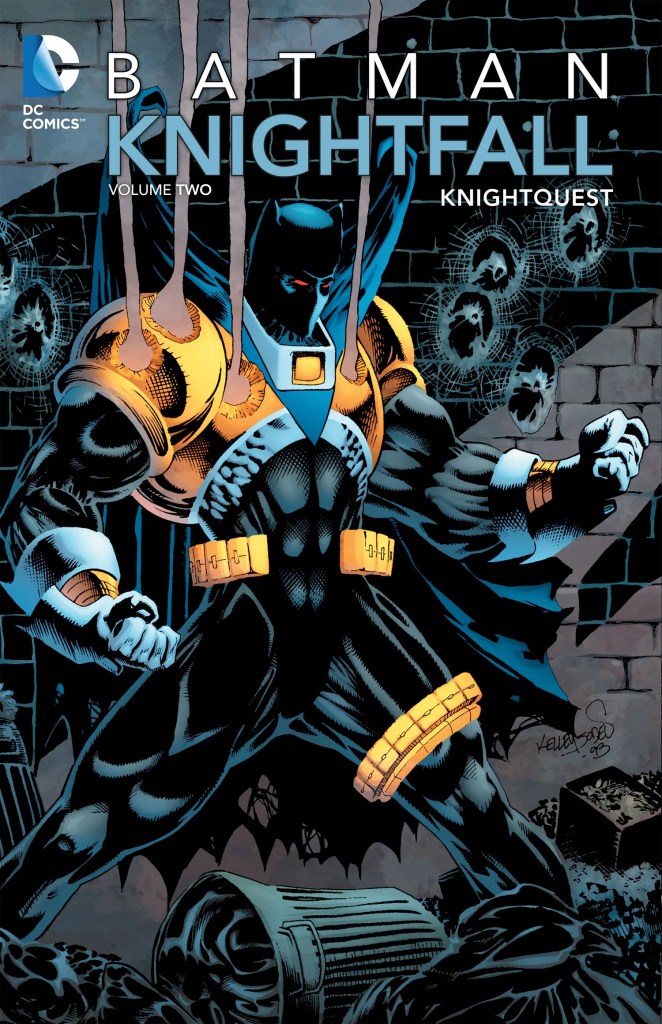
This middle volume is a little bit of a letdown, though that isn’t too surprising, considering where it falls in the spectrum of the whole major arc. The good news of this volume is it collects for the first time a lot of the issues involved in this period. Fans of The Search may be disappointed, since it does not have any of those issues (and probably should), but by this point no one should be surprised this collection is missing them, and those who are interested in this storyline will find enough to be interested anyway. Fans of the real Batman may not need this collection, though Azrael/Jean-Paul Valley fans will certainly be glad this collection exists, even if the stories aren’t all that meaningful for most of the collection. It does have some highlights here and there, but it does take a fairly long time to build up any steam or interest, especially to the casual Batfan. The only really interesting thing going on for most of the collection is J-P’s internal conflict: is he an Angel of Death, a heartless assassin like his father wanted him to be; or is he an Shadow Instrument of Good, a noble defender of the poor who has to take the grime of corruption upon himself? This culminates in one of the darker issues of the collection — some may say “especially for 1993!” but dark is dark, regardless of what year it is published. The other “highlight” of the collection is Gordon’s increasing despair with the new Batman. It’s not enjoyable to see him realize he is now all alone, but his character moments are great in its way. The culminating panel of Gordon destroying the Bat signal should have received a bigger space for such a drastic event. Completists will most likely want to pursue the diasporic issues (lists of which are available elsewhere), if they don’t already have them, but those who are only interested in the major Knightfall Saga will be more than satisfied by this 20-year reunion collection. It’s not as good as the first, but it was good to finally read what the KnightQuest was all about.
Knightfall Vol. 3: KnightsEnd ⭐⭐⭐⭐
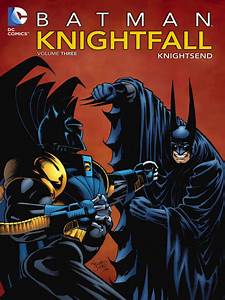
Finally, I have completed this journey started almost 20 years ago. I know the trades don’t include every single tie-in, and perhaps some day I’ll try to track those down, but I am quite satisfied (for the most part) with the way this story concludes. The first half of the collection, KnightsEnd (or Knight’s End, perhaps) resolves the issue of Bruce Wayne vs. Jean-Paul Valley in an unexpected yet predictable way, as the basic story does what Keats says true art does: being both surprising and familiar at once, giving us the impression “but of course, it couldn’t have happened any other way,” which is about as close to calling this “literature” as anyone will likely get. Some may be disappointed the climactic confrontation between Jean-Paul and Bruce does not end in the knock-down, drag-out fight we are expecting, but as Batman has always been about more than just fighting, a detective who thinks things through, performing the impossible with relative ease, the highly-symbolic conclusion is truly moving and fitting. The only real problem with the end (as with the epilogue Prodigal storyline’s conclusion) is its abruptness. We could have used another page or two (no need for more), at least of J-P walking away into the fading darkness as Bruce returns back to the dawn.
Similarly with Prodigal, the main point of contention between grown-up Dick Grayson and Bruce Wayne is they never talked it over, never discussed their rift and differences, never discussed Dick’s hurt over being apparently rejected in favor of Jean-Paul as the replacement Batman: here the authors recognize a key aspect of these characters, and instead of giving us a wonderful un-sappy heart-to-heart between these two veterans, we get a few panels of sort-of-obvious semi-platitudes, a different scene, and then a final resolution of implied “well, it’s all okay now.” Had they given us a genuine dialogue of authentic resolution, this would definitely have been a 5-star review, missing tie-ins and all. Do these stories have some goofy moments? some confusing references to pieces not missing? Sure it does. Most TPBs do. Is the final page of the TPB an odd way to end a 1,900-some-page odyssey of identity, especially with Batman in shadow? Indeed. Could we benefit from learning what Bruce did while he was away, allowing Dick to don the cape and cowl for a time? Sure. But that’s not really what this is about. In one sense, it’s about trust and the “idea” of “Batman.”
The pacing of KnightsEnd is quite impressive, even if the sensations it evokes are compressed as each issue is rapidly accessible in the TPB form instead of waiting a couple of weeks for the next installment. Bruce Wayne, on his quest to recapture his mantle, goes to the world’s deadliest killer to re-hone his martial skills, getting metaphorically to the edge of killing while he literally gets to the edge of Gotham’s highest point, still unwilling to let go of his failures and fly free again. The inevitable climax of Robin and Nightwing seeing Bruce “kill” someone (and the proper reveal of the truth) brings Bruce’s personal rehabilitation to a fitting conclusion, enabling his appropriate symbolic conclusion with Jean-Paul later.
Prodigal is a similar kind of story, with a surprising number of “light” moments between Dick and Tim running a mansion without Alfred. That they are both youngish and enjoy (to an extent) going out and fighting crime brings for a few brief issues a vitality the usually-dark Batman-as-man-on-a-mission feel doesn’t give. This doesn’t last, of course, as Dick starts to evaluate his life of (from his perspective) mostly failures, culminating in Bruce’s giving the mantle to Jean-Paul instead of him. As stated above, the absence of a lengthy conversation between the two of them at the end was a real failure on the creative staff, but such is life. Perhaps the saddest thing of the storyline is just as Dick starts to get the hang of things, just as he starts to find his place, poetically having defeated Two-Face alone, Bruce returns yet again to resume the cowl. In the missing conversation, we are to assume Dick is mollified by Bruce considering him a son enough to resume his role as Nightwing and truly be content being his own man with his own superhero identity. Fair enough.
Lastly, a word should be said for poor Commissioner Gordon. What is he, the whipping boy of the DC Universe? Can nothing go well for this defender of justice? Here was another missed opportunity for a great conversation between secret-keeping heroes. Dick knows Gordon knows he’s a different Batman; he could quite easily have said “I used to be Robin. You can trust me.” It’s all about trust, after all — why not bolster Gordon’s trust in him? Ah, well.
All in all, it’s a satisfying conclusion to a full, good story. If one is tempted to consider this corny and lacking in enjoyable violence, one should be tempted to step back and reflect about life, morality, and what is important. The benefits of this experience outweigh the detriments, especially for the cost and convenience of these TPBs.
There you have it. You can destroy their possessions, you can break them physically, but you cannot keep good detectives down. It’s comforting to know some heroes will always be there to right wrongs and promote justice (even if doing it for money or while dressed as a bat). If I haven’t made these stories sound all that appealing, please remember these reviews are intentionally light on the good stuff so as not to spoil your enjoyment of them when you get the chance to read these treasures. Go out and get a copy of the fall and rise of these great detectives — you’ll be glad you did, especially if it entices you to read even more Nero Wolfe or Batman adventures.
 Redeeming Pandora