
Christopher Rush
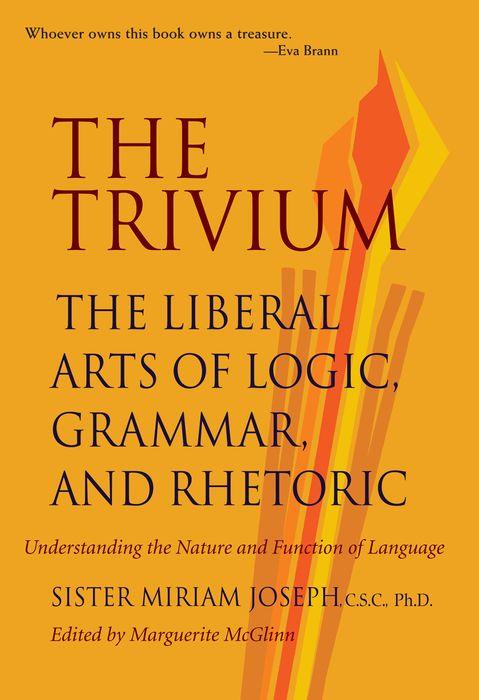
Readers may at first suspect of the three titles this book contains, it has almost nothing to do with the first (The Trivium), a scant bit to do with the second (The Liberal Arts of Logic, Grammar, and Rhetoric), and spends almost all of its time on the third (Understanding the Nature and Function of Language). If such is the case, we are directed toward two possible conclusions: 1) Sister Joseph didn’t really know much about the Trivium after all; or 2) we didn’t really know much about the Trivium after all. I shall lean toward option #2. The Trivium really is about language — its nature, function, and connection to thought, worship, and reality. Strangely enough, I’ve never read that in any other book purporting to be about the Trivium — have any of the modern reshapers of “classical education” read this book? Many will no doubt find this book tedious because of its lengthy treatment of language. Many will wonder “what about the subjects of the Trivium? where is her talk on what science classes we should have, what Bible curriculum, what novels to read, whether we should incorporate tablets into our education?” and thus prove they have wholly missed the point of the Trivium. It is related to the Humanities, indeed, but it is not the Humanities. The “Liberal Arts” of the Trivium are related to the other Liberal Arts, indeed, but they are not identical.
Who should read this book? Anyone claiming to be involved in “classical education” or anyone who wants an education. If you find it boring, guess what that tells us about you (your vocabulary, and your comprehension of reality). Remember: “slow, difficult, yet important” books are not tantamount to “boring.”
I give this four out of five stars not for Sister Joseph’s work (though her diction is at times cumbersome, even for the time when she wrote it, and her insistence the first premise of a syllogism is the “minor premise” is perplexing) but for the editorial work and oftentimes tendentious footnotes by the editorial team involved in revamping this work. If ever a work needed a glossary, this is it — but, sadly, no glossary is contained within. It has an index, though that isn’t quite as helpful as it was likely intended to be. Thus the presentation of the material sometimes detracts, yet the reader should persevere and read this wholly necessary work again and again — especially if one is paid to be involved with “classical education.” (If such a one reads this work attentively, such a one will find out the “tools of learning” are, in fact, reading, writing, thinking, and speaking … who knew? … certainly not anyone whose sole knowledge of “classical education” comes from reading books by, well, no need to mention names at this point — but you know who they are.)
 Redeeming Pandora