
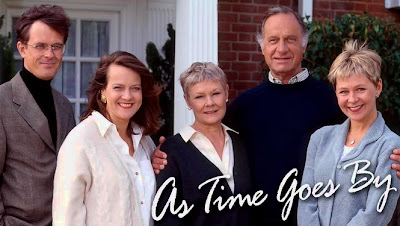
Christopher Rush
One may accuse me of being an anglophile if one wishes, but it is fair to say a good deal of the time television series from our cousins across the pond are superior in numerous ways to their American “counterparts.” This is perhaps not always true, assuredly, since I did just say “a good deal of the time,” which is not a lengthy way of saying “always” (which, as an amalgam of “all” and “ways” seems like a strange expression to use for time and not methods). Still, the BBC has given us a wealthspring of enjoyable series. It is no secret I am a lifelong fan of Red Dwarf and Doctor Who (the original run, since I haven’t much experience with the relaunch). Elsewhen I have mentioned the superiority of crime-drama shows such as Cracker and Prime Suspect. Jeremy Brett’s Sherlock Holmes cannot be topped, and that’s just a fact. Rumpole of the Bailey, Poirot, A Bit of Fry and Laurie, Jeeves & Wooster, Whose Line is it Anyway? — most of you likely agree with the general high quality of the BBC’s offerings, and we haven’t even mentioned the contemporaneous shows and their international popularity (mainly because I haven’t seen them yet, though you could check out some of the recommendations given earlier this issue). To this list of delightful shows I add a show certainly not overlooked in its native England but far too long overlooked by Americans, the delightful As Time Goes By.
The premise for the series strikes one immediately as being wholly British — not in the sense of tea, crumpets, or Scotland Yard, but as a premise only the British would consider for a television series: a young couple in love, separated by war and communication breakdown, meet again 40 years later and slowly rekindle their relationship (and romance — sorry for the spoilers). A show about two experienced people, getting along in years, both fairly set in their ways, does not seem at first glance to be a show with a lot of appeal … but somehow, the simplicity, the general aura of ease and calm create such an atypical show that draws you in and feels most of the time as a refreshing, relaxing relief from the antagonism-filled workday you have temporarily escaped. Sure, the show has its inane moments: characters do bizarre and occasionally frustrating things here and there, but the vast majority of the time we know we are going to be in for an enjoyable time with these characters.
The two central characters are Jean Pargetter and Lionel Hardcastle, played by Judi Dench and Geoffrey Palmer (the powerhouse casting certainly helps the enjoyment of the series). Jean is a semi-recently widowed mother of her twice-divorced daughter Judi. Jean owns and manages a typing/secretary agency (perhaps dating the early seasons a bit … the subplot of a late episode revolves around getting a modem), and Judi works for her. Judi’s own secretary, Sandy, becomes a major supporting character before too long in the series. Lionel, after his time in Korea (at which he is kicked by a mule, prompting Jean to dub him Lionel Hardcastle, kbm, mimicking the British knighthood system), becomes a coffee plantation manager in Kenya, marries, divorces, and returns to England and writes a book about his experiences. His publisher, Alistair Deacon (a truly great character who must be seen to be believed — and even after seeing him you won’t believe him), urges Lionel to get a typing secretary to help him finish his book. This throws our main characters together, starting the rekindling process slowly but surely. It takes some time for their friendship to resume and grow over a few seasons, but the pacing (thanks to the shorter British season-lengths) is not a problem, especially if you have the whole show on dvd or Amazon Prime™. Soon enough, we meet family members and others who become recurring characters each season, and the focus of the show shifts from rekindling friendship and life at the agency to home life, new business opportunities, and other character-driven stories, all the while giving us good laughs, intelligent dialogue, and simple stories that give you more value and enjoyment than you think you’ll get most of the time.
My favorite character is Lionel, mostly because we’re pretty similar (overlooking the fact I’ve never been a coffee plantation owner in Korea, a soldier, divorced, or British). Lionel gets grumpy rather easily, though I don’t think I do, not as badly as he does, but there’s enough Eeyore and Marvin the Android in there to remind you sooner rather than later his soft, nurturing side is going to override whatever momentary goofiness is interfering with his relaxation. One gets the sense he’s the kind of parent/husband you want Mr. Bennet to be but never will. Lionel, for all his gruff, is an intelligent, caring man — the show does revolve around his ability to re-woo the long, lost love of his life, after all. Like Lionel, I have difficulty understanding the younger generation (as also indicated earlier this issue), I enjoy being at home more than most other places, I would totally enjoy being on the lecture/book-writing circuit, and I am skeptical of technology (we’ve already had that conversation). Unlike Lionel, I don’t follow rugby or cricket, I don’t pop down to the pub for a quick half, I don’t walk to the neighborhood grocer for groceries, and I don’t like custard tarts. Three of those could easily be addressed if I lived in England like Lionel is fortunate enough to do, however.
He’s certainly not a perfect man; his flaws come out with fair regularity (it is a situation comedy, after all), and he does let us down at times when his bluster and self-centered drive for things to be more comfortable and easy than they usually are override good sense and common courtesy. But, then again, that would be another area in which we are similar, and that well-rounded humanness of Lionel’s character makes those many bright spots when he comes through and saves the day and says just the right thing all the more enjoyable. He’s probably the most lovable wet blanket you’ll ever meet on the screen. The plus side is seeing those flaws encourages one (me) to improve those flaws within oneself (myself).
I don’t want to ramble on about too much else, since the point of this was to introduce you to an overlooked series, not tell you everything you should know so you don’t have to watch it (like I did with Centennial way back when). Jean, Judi, Sandy, and Alistair (especially Alistair) all are good characters with their ups and downs, and the second tier of supporting characters that flesh out the series starting in season two make the show even better. It is the television equivalent of putting on your favorite jim-jams, eating your favorite goodnight snack, and spending time with people you really care about, all the while being believable, realistic, and worthwhile. It is sentimentality at its finest. Do yourself a tremendous boon and get and delight in As Time Goes By.
 Redeeming Pandora