
Christopher Rush
Hello, friends. As you know by now, I tend to lean in favor of Marvel over DC, though I have certainly spent a fair amount of time in the DC Universe (not that there is such a thing as “the” DC Universe, of course) and began in the DC Universe (for a short time, at best) and don’t feel any need to declare one comic universe is somehow superior to another. Though I’m not a “die-hard” DC fan, having never subscribed to a series for example, I would consider myself a decent DC fan of some long standing. I own a number of DC issues and TPBs, I grew up watching (and recently owning) Super Friends, and Batman Returns was the first movie I saw twice in the theater. I regularly read the Death of Superman 3-TPB storyline and have for a couple of decades. I am thrilled beyond repair the Adam West and Burt Ward Batman series is finally available on DVD, and I hope with intense passion I will be receiving it for Christmas (though I’ll be fine if that doesn’t happen). So I believe I may say with some DCU authority “The New 52” is a total humongous pile of nonsense.
Supporting that declaration I have actually read a fair amount of it — certainly not all 52 series, and not every single issue of even the major “flagship” series, but thanks to my semi-local library I have read a respectable amount of this palaver in the past year or so, and almost all of it has been a tremendous disappointment. Yes, the Batman “Court of Owls” story had some fine points, and while I am willing to allow many of the series I haven’t experienced could be quite spectacular, what I have read of it so far has demonstrated The New 52 is a disorganized, purposeless shambles.
The “purpose” behind it, purportedly, is to give a new generation of readers the chance to jump aboard with a brand-wide re-launch (apparently the term “reboot” is verboten) without feeling burdened by ignorance of the last 70-some years of character development, plotlines, conflicts, and other interfering story elements. One suspects the memo to the faithful readers of the last several decades went something along the lines of “Get Bent.” If I had been a loyal fan over the decades, having weathered Crisis after Crisis after Crisis, origin rewrite after origin rewrite after retcon, I would probably feel a little betrayed. Then again, it’s possible I might have thought, “Yeah, figures.”
Below I have included the reviews I wrote for my Goodreads.com account for each of the New 52 TPBs I read in the past year, in the order in which I read them. In order to avoid plot spoilage, you won’t get too much of the stories, but I think they will be helpful enough to see the imbricating failures and even the infrequent successes. The main theme that develops by the end of my to-date experience with The New 52 is, as you shall see, the apparent absence of a unified goal or creative guideline beyond “make it young and sassy.” Despite the advertised “you don’t have to worry about the last 70 years of issues, supporting characters, and anything at all,” most of these series expect the reader to know a great deal about the DC Universe, its history, its supporting characters, and an almost ludicrous amount of arcane knowledge in direct violation of the stated goals of the re-launch. Either that, or it’s all a lavish tribute to the Easter Egg, making the audience more irritated with a nagging feeling of “I’m missing something, aren’t I” more than “yeah, this is new and fresh! Whoopee!” (or whatever the kids are saying these days). I hope these don’t come off as cynical — especially as I am trying to extirpate that in my life quite intently — though I admit now many of them are filled with disappointment. Anyhow, here’s my experience with The New 52.
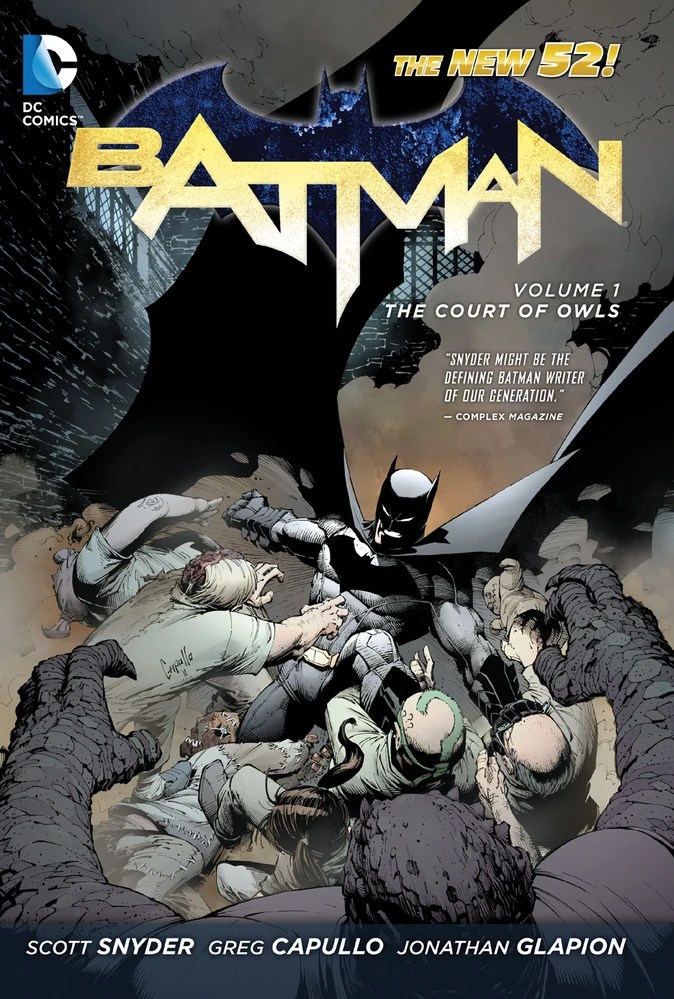
Batman, Vol. 1: The Court of Owls, Scott Snyder and Greg Capullo ⭐⭐⭐⭐ (read in late 2013, several months before I got to any other New 52 TPB, so enjoy the optimism while it lasts)
I thought I wouldn’t get a chance to read this until I found it on the shelf at a local library. Unfortunately, this library doesn’t like to get volumes after 1, so this may be my only experience with the New(est) 52 Batman. Snyder impressed me fairly well with The Black Mirror, so I suspected going in this would be fairly good, but I’m glad I read this second, since I would have gone into TBM without as much enthusiasm. Not that this was bad, it just leaves you wanting more, since it’s not the complete story and little is resolved even in 7 issues. Positively, Snyder treats us to a reminder he knows of the Batman history and isn’t completely rewriting it with this relaunch (at least at first), and he even gives us some nice humorous moments (a refreshing change for me, since Black Mirror had about 0 lighthearted moments). Soon, though, Snyder starts making Batman his own, thanks to the freedoms of relaunching the character and his corner of the DCU. He doesn’t do it heavy-handedly (in these issues, at least), but he does it earnestly — so fans will have to experience that and react to it for themselves. He does create a sensible and fitting new nemesis for Batman, which is rather an impressive feat, considering the myriad nemeses Batman has accrued over the decades. The danger, though, as is so often the case, is the villain seems almost too powerful: how can Batman (and Snyder) overcome a cabal older than his great-grandfather, who own the city far more authoritatively than he does? I sense a Locutus “sleep” sort of resolution, but I may never know (I’m sure you all do by now, though). It probably has something to do with newly-coined too-good-to-be-true? Gotham shining knight Lincoln March. The artwork is impressive and increasingly gritty, especially as the story progresses from the safe, shiny, futuristic world Bruce Wayne wants Gotham to be to the dirt, ancient, downtrodden world Gotham really is. I was a little confused at the beginning since Bruce, Dick, Tim, Damian, and Lincoln all look exactly alike (minus height differences), but I got over it and allowed Snyder to tell his story (the first half of it, anyway). I’d like to know how it ends, but I don’t need anyone to tell me here. For those who like shiny, computer-generated comics and don’t mind the casual violence of contemporary comics, this is not too shabby a place to start. It’s not the Batman you may remember from the days of old, but that’s not necessarily a bad thing. If you like those days, as I do, you can probably go back to them without too much hassle. If you want something newish, check this out.
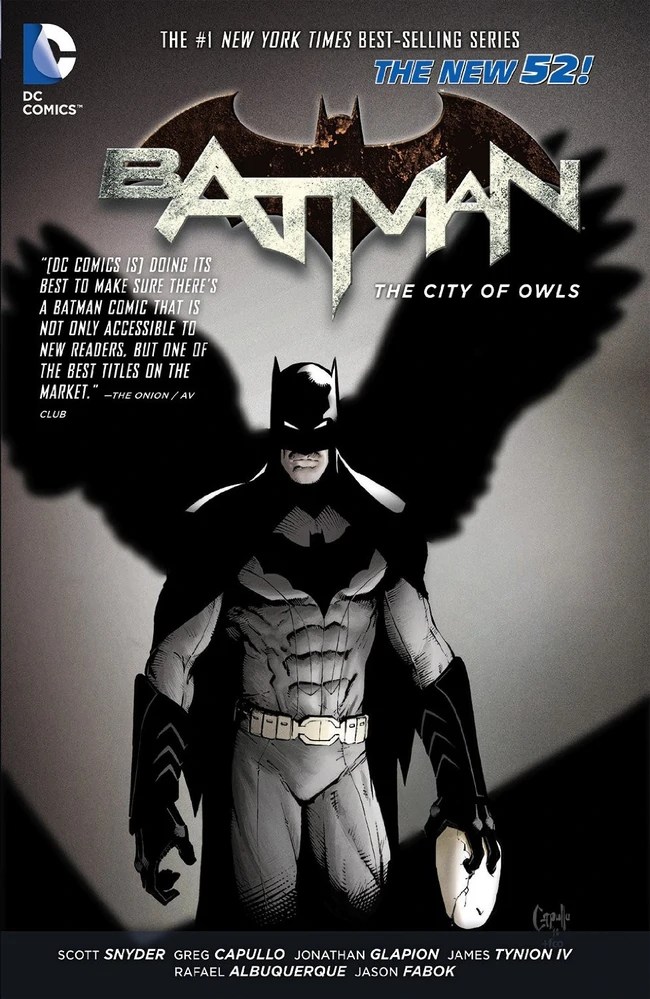
Batman, Vol. 2: The City of Owls, Scott Snyder and Greg Capullo ⭐⭐⭐ (read about 10 months after volume 1, admittedly, but the rest were read in short order after this)
Well, that was easy. Taking a lesson from “Best of Both Worlds, pt. 2,” Scott Snyder decides the best way to conquer a centuries’-old unstoppable secret force is to have it self-destruct, giving our hero nothing to do but wonder (and doubt), really. I suppose there wasn’t any other way to stop this threat, given the head-scratching notion of Batman being able to discover, rout, and extirpate a 200-year-old secret cabal in 36 hours, but be prepared to be a bit disappointed. That’s the trouble with stopping unstoppable foes. Supplementing the explosion-filled semi-conclusion to the Owls saga, we have some reprinted stories from Night of the Owls, the best being the Mr. Freeze story, wholly unrelated to the rest of the collection. We also have a “slice of Gotham life from the commoner’s view” story, which isn’t quite as bad as it could be, but we are also left wondering why our hero isn’t as nice as he could be to some of the downtrodden he supposedly loves. After all, one of the major themes of the Owls story and its epilogue (driven home by the end of the of Death of the Family storyline coming up in volume 3) is Bruce Wayne loves Gotham City — not just the idea of it or the sentimentality of saving something because it makes him feel powerful and accomplished, but he truly cares for the city, its people, and he wants to make it a better place. So why does he treat the people he is apparently doing all this for with such semi-disdain? We may never know. Or, we’ll find out two issues before DC launches the Newer 52 in a couple of years. Stay tuned.
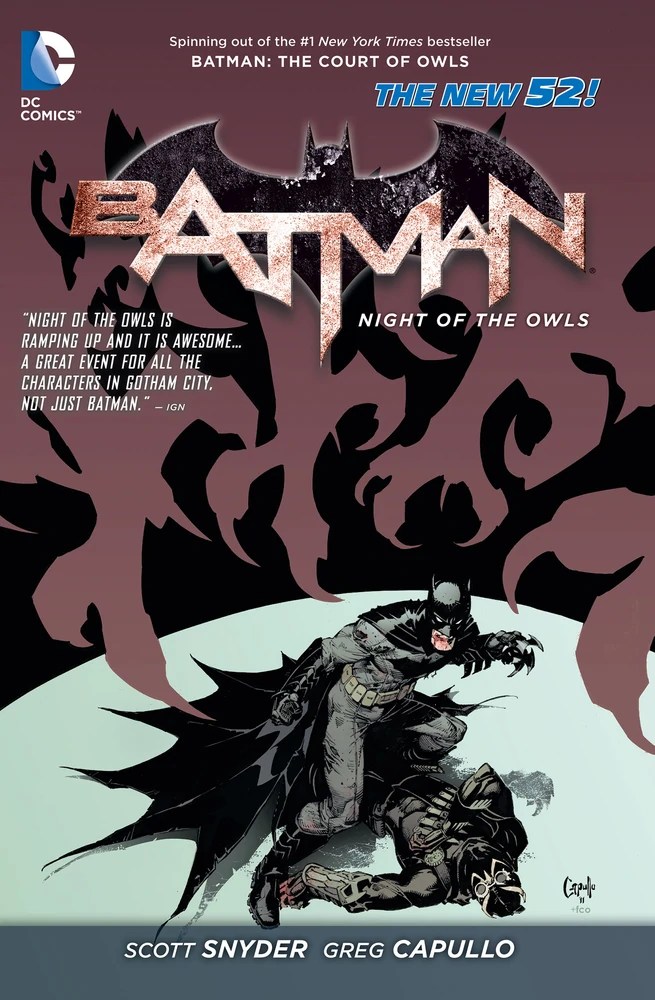
Batman: The Night of the Owls, Scott Snyder, et. al. ⭐⭐⭐
As the whole “Owls ruling Gotham” thing starts to wear thin, we are presented with one slam-bang night of bloody action as the almighty Owls let loose their centuries’-old Talons against all the powerful people of Gotham … only to fall to the inevitable, more or less. Apparently, the Owls want to secretly rule a city populated mostly by the world’s craziest psychopaths, corrupt politicians, and police officers, and eliminating all the decent, hardworking policy and decision makers who bring order and stability to the city will somehow make that a more enjoyable experience. On the surface, this is a touch confusing. Adding to the confusion, some of the early entries in this collection give us “flashbacks” into the history of Gotham and the Owls, though most of them go nowhere and don’t relate in any significant way to the present story. Additionally, as with many crossover collections, unless you are familiar with the characters/supporting stories going on in the other series, some of the issues will be confusing. This is exacerbated at times by this collection’s refusal to let you know what issue you are currently reading: some of the early stories tell us we are reading Nightwing or Birds of Prey, but most of them just start, giving us no cover artwork or series title/number (as if knowing what we are reading would somehow detract from the momentum or enjoyment of the story). Another detraction here is some of the failed emotional moments: if the girl is going to leave Hiroshima in a few months, why are we supposed to be emotionally moved by the bombing several years after she leaves? especially since the A-bomb bombed a city that made devastating bombs that bombed the USA. Instead of a pointed and poignant attack on America’s political decisions, we are given even more reasons to cheer on President Truman’s decision. Anywho.
Apparently the most effective way to defeat the almighty Talons is to get them to talk about their past, and as fast as you can say “Bob’s your uncle,” they will give up their quest to destroy you. The first issue with Jonah Hex is confusing and almost wholly unrelated to what is going on, but apparently the mention of the word “Owl” is enough to include it here. Some issues are out of order, which one supposes could have been better planned out by the development team, but sometimes “making sense” is a luxury comic makers just can’t afford. Still, this series does have some interesting moments, especially the Mr. Freeze story and the story about Alfred’s father. The “Gray-son” idea is also an intriguing notion, but we get no payoff with it here, since that thread is perhaps taken up in a different series. It’s worth reading if you are really into the New 52 or the Court of Owls thing, but be prepared for some confusing rabbit trails and a lot of tension that gets resolved rather quickly.
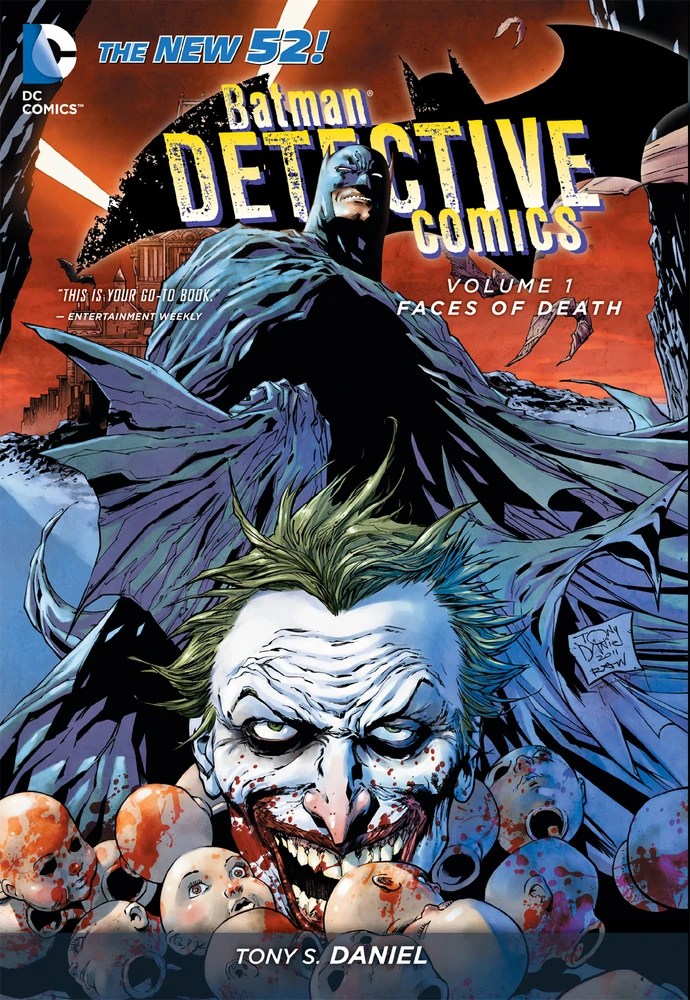
Detective Comics, Vol. 1: Faces of Death, Tony S. Daniel ⭐⭐
Somewhere along the way, “Batman” became an excuse for “excessive violence” and über-violence, perhaps because DC was jealous of Punisher MAX or something. I do not deny Batman (as an idea/world) has a dark side — as much as I enjoy the Adam West Batman, the “Dark Knight” aspect to the character is just as true. But that does not mean we need this much blood: removed faces, blown-out brains (Night of the Owls), etc. As Daniel even proves himself by the end of this collection, he can tell decent Batman stories without grotesque indulgences appealing only to the base visceral impulses of man. I’m sure many of you will disagree with me and my weak tummy — that’s fine. Part of my frustration with the violence in the Dollmaker story was the sheer absence of any meaningful payoff: it goes nowhere, delivers predictable moments of “detection” and suspense, and stops. The second group of stories is a little better, but it also either expects too much of us, or just assumes we know what is going on, or uses too much flashback with Batman knowing too much to be very believable — or possibly a combination of all of them. I know Daniel didn’t stay long on the series, but he did show a little bit of promise — it just doesn’t go anywhere meaningful here.
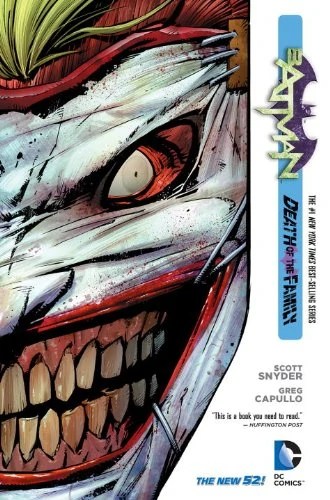
Batman, Vol. 3: Death of the Family, Scott Snyder and Greg Capullo ⭐⭐⭐⭐
I am willing to give this 4 stars for a graphic novel, though I don’t agree with Goodreads’s “4 stars means ‘really liked it.’” I would probably give Joyce’s Ulysses 4 stars, but I don’t really like that. I would probably give Joan Miro 4 stars without liking what he does, either. It’s a goofy thing, art. Perhaps it’s being overly generous to call this “art,” especially with its preponderance toward unnecessary graphic violence at the beginning of the work (too much red-shirting at the beginning), but the challenge of creating a meaningful, fresh interaction between Joker and Batman certainly demands a high degree of difficulty after 70-some years of their “relationship,” but Mr. Snyder does a fine job, especially toward the end of the collection here, telling an edgy Joker/Batman story with genuine menace and an allegiance to Batman’s high ideals (his version of them, at least). The pacing is a bit off, mainly because of the misplacement of some of the supporting stories (the commitment to reprinting the issues in their published order is sweet, but for a collection such as this I’d be happier getting the bits and pieces in the proper overall story order, something the Night of Owls collection failed at quite impressively), but the ending of the story is quite well achieved. The Joker’s appraisal of many of his “colleagues,” especially the scene between him and Two-Face, is a welcome group of “character moments” (I don’t mean that in the patronizing way it always sounds when people say “good character moments”).
The final confrontation is not unexpected (I was expecting Joker to shout “MacGyveeerrr!” as he fell), but the actions of the supporting Family during that scene is a nice testament to their moral centers (despite DC’s frequent attempts — and Marvel’s — to make all “heroes” gray, morally ambiguous anti-heroes). I was a tad disappointed by the epilogue, everyone’s desire to be alone, though I suppose if they all re-gathered to talk it out it would have come across more like a Star Trek: The Next Generation wrap-up (or early ’90s Avengers or X-Men finale). That’s fine, provided they don’t believe the Joker. They don’t, do they? Bruce doesn’t, does he? Let’s hope not. If he does, what would he really be fighting for all this time? As Snyder tried to teach us with the Owls thing, Bruce Wayne truly does care for Gotham City. He wants it to be a good place to live. Similarly, Bruce Wayne must truly care about his family, dysfunctional and manufactured though they may be. They better believe that, too. If you don’t, I hazard to suspect you may be reading/enjoying Batman for the wrong reasons. Thank you, Mr. Snyder, for encouraging us to care about Batman for the right reasons.
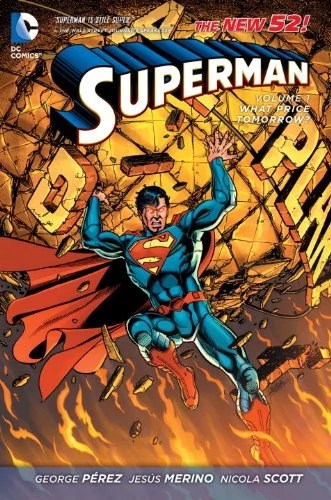
Superman, Vol. 1: What Price Tomorrow?, George Pérez and Jesús Merino ⭐⭐
Fun — excitement — interesting — fresh — engaging — and other words that don’t apply to this volume. No offense intended to the great George Pérez and his lifetime of fine work, but this was just dull. We’ve seen this in most every science fiction show already, and if it was dull on Babylon 5, it was dull in the “New” 52. I guess the point of this relaunch was to shake it all up, make it all different, and by that they meant break up all the good relationships that took 60-some years to develop and frustrate all the loyal readers (because OLD = BAD and NEW = GOOD, and loyal readers = useless detritus and new readers = the best thing ever). The Daily Planet is gone, Perry and Lois and Clark are all separated, the Kents are dead, and no one likes Clark, really. In order to make the Superman world “fresh and relevant,” the Daily Planet has been sold to arch-villain Morgan Edge. Doing things the old-fashioned way (with honesty and integrity) are as buried as Jonathan and Martha, but only Perry seems to care (maybe Clark, too, but he spends so much time dazed and confused we don’t get to know this version of him much, other than he cares about the poor and displaced and his old apartment building doesn’t exist anymore). Also, for no explicable reason, Pérez has Superman narrate all his thoughts, but his thoughts are more like stage direction and ultra-obvious commentary, nothing truly insightful or worthwhile. Pérez seems stuck in the old days of having characters narrating all their motions. Oh well.
Like Alex Ross’s Justice, this volume has the potential gem of “what if Metropolis lost its faith in Superman?,” but like Justice it gets sidetracked with all its other things (though the other things here are far more confusing and old hat than Justice) and sort of abandons that idea by the end in very rapid and unbelievable “oh, sorry, Supes, we love you and always did” epilogue panels. This story just doesn’t know where it wants to go and takes a long, dull journey to prove it to everyone.
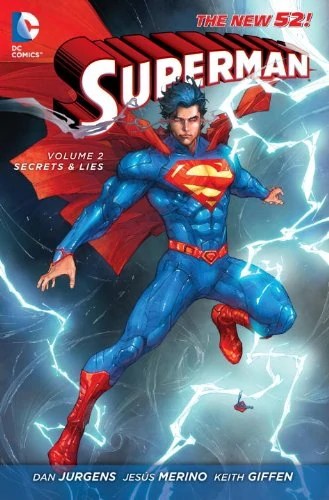
Superman, Vol. 2: Secrets and Lies, Dan Jurgens and Keith Giffen ⭐⭐
I like the Death of Superman story (not that Superman died, just the whole story, all three parts). I read it fairly regularly. I even like the Hunter/Prey followup. Zero Hour … meh. See, this is what I’m not quite getting about this New 52 thing. Why are we bringing back guys from 20-some years ago to contribute to something supposedly new and fresh for this present generation that thinks conversation is done with thumbs? I’m not saying Pérez and Jurgens don’t have it anymore, but if they do, they didn’t share it with Superman New 52. Part of the failure with this series is Jurgens continues Pérez’s “what if Metropolis thought of Superman the way Gotham thinks of Batman, like he is the problem?” But Superman is not Batman. Don’t try to transplant that sentiment over here — it doesn’t work. Maybe this is why Mr. Morrison’s All-Star Superman gets so much love, because it doesn’t try too hard to be a fresh Superman story. Secrets and Lies, here, is just dull.
Jurgens also feels the need to have Superman narrate his actions and obvious commentary. I don’t need that. Granted, I must admit, I rarely pay much attention to the artwork. No offense to the great pencillers and artists and colorists and the whole gang, I just usually read for the story and character development/moments/lah-de-dah. But even I notice what the characters are doing — I don’t need stage direction telling me “I must break free from these chains and now I will punch this villain!” I can see it. The whole Daemonite thing is also a letdown: stop giving us acerbic, witty villains who take nothing seriously. I can’t take Superman’s turmoil seriously if he is trying to escape from Stalag 13.
The “revelation of Superman’s secret identity” thing could have made for an interesting, drawn-out storyline, but it occurs as a backdrop to a nowhere-going combat between Superman and some girl who wants a locket and can’t be touched (but she can hold a locket) and gets wrapped up quickly and obviously. Then there’s another unstoppable alien who is wiping out people left and right and suddenly we’re on a lesser-quality episode of Step By Step and we find out his problems and feel sorry for him and say goodbye. Blah.
At the end of this volume I suppose we have switched to the annual (since the editorial team can’t be bothered to let us know what issue we are actually reading at the time), which is a total embarrassment, not only for the way Superman looks but also for the way women are drawn (literally — why are we still doing this, people?), and the whole Daemonite nonsense twaddle bushwa. It can’t really be this difficult to write Superman stories. It can’t. It’s been happening for 80 years. Why is The New 52 Superman so dreadful? Someone please help me understand this.
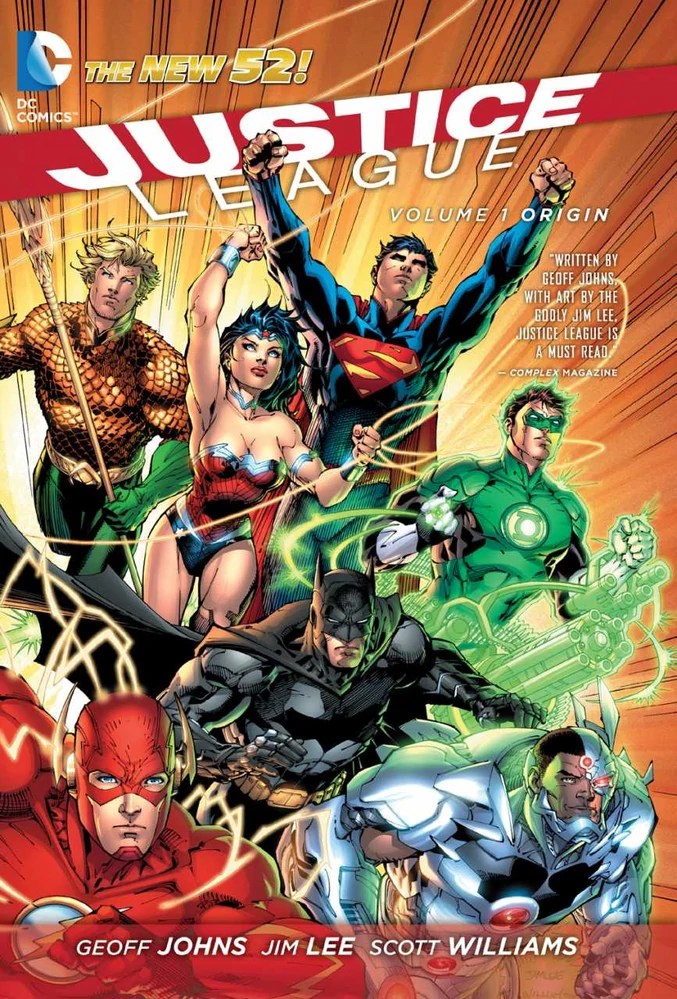
Justice League, Vol. 1: Origins, Geoff Johns and Jim Lee ⭐⭐
If the creative team got paid by amount of work done, Jim Lee earned about 18x more than Geoff Johns did. Apparently DC’s motto for New 52 was something to the effect of “Since Old People are Worthless!” Making all the superheroes young and brash may have sounded good on scratch paper, but it doesn’t read well on glossy paper. Fortunately, Johns gives us almost no dialogue to read, though most of what he gives is petulant ranting, petulant whining, and self-evident observations of actions and whatnot. Virtually none of these beings are heroes: they are almost all self-indulgent jerks, with the exception of the Flash and Batman. I suppose Cyborg isn’t much of a jerk, but I have no idea why he is popular enough to warrant being a first stringer instead of Green Arrow. The basic premise of this volume called “origin” is … hold on, I’ve got it … wait … no, I just had it. What was it? Oh, that’s right: look at giant, mostly meaningless and overly-complicated splash pages by Jim Lee. Perhaps it’s the “origin” of Jim Lee’s diminutive pencil collection. Saving the day, as I said, are Flash’s decency and Batman’s maturity. Almost wholly out of character with the rest of this mess is Batman sounding like the more mature Batman, not the “this is supposedly five years ago Batman.” But, we’ll take it.
Since all the old people (and authority figures in general) are presented as worthless idiots (in contrast to all the valuable idiots we all know and love), it’s odd the young “heroes” are doing their best to prove they aren’t worth knowing — most of the time they (including Superman) are trying to prove the people’s fear and mistrust of them are warranted. Except Batman. Ironic, especially since he does want their fear. It’s just mostly a mess. It moves fast, says very little, and gets the job done more or less, but it takes six issues. X-Men #1 does it in one. As usual, though, we are left wondering “what is the point of the New 52?” All this does is make the heroes young and jerky, all the while tossing things from the supposedly rejected canon at us like grapeshot (too much?). Is this “new” or just an admission “we aren’t nearly as creative as the old teams, so we are just going to do their stuff our way”? and for a new generation that values worthless “heroes”?
This could have been so much better.
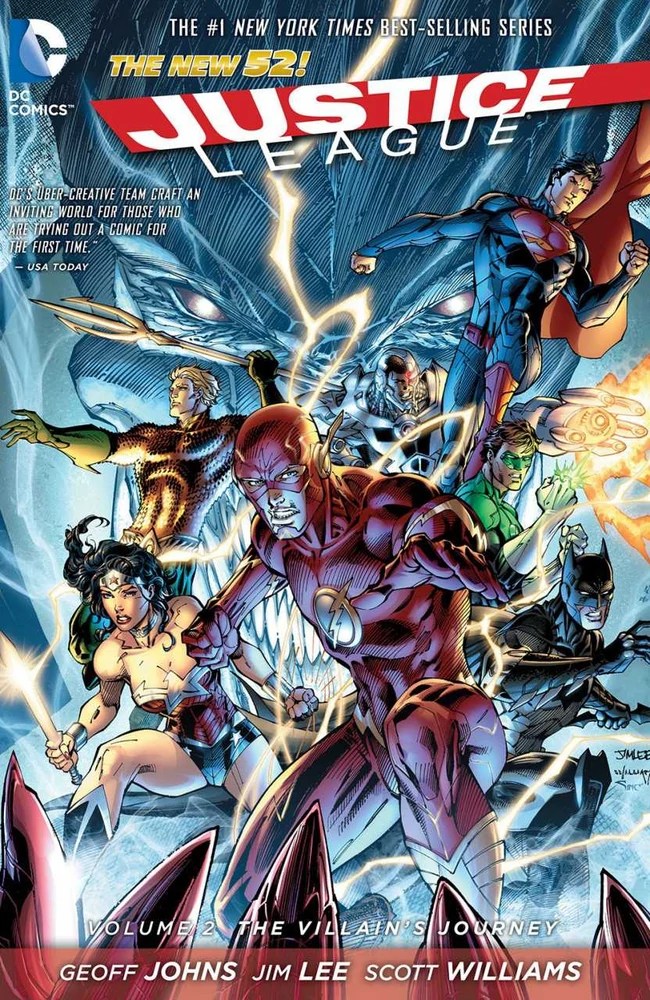
Justice League, Vol. 2: The Villain’s Journey, Geoff Johns and Jim Lee, et. al. ⭐⭐
2.5 stars, how’s that? We finally have the beginnings of a story, and Mr. Johns finally beginning to attempt to earn his paycheck. Yet, the main premise for this villain and his motivation is rather disgraceful: having given us a reason to care about these heroes from the regular guy perspective, instead of developing that line or character it is immediately shattered with a puff (or sniff, rather) of magic smoke. Johns attempts to prove he knows as much mythology as Joseph Campbell, but he certainly falls short, even shorter than JMS (who certainly knows his fair share of myths), and the failure makes the story that much thinner. Once again the series seems to be mainly a vehicle for Jim Lee splash pages. The dialogue is less insipid, which is surprising considering there’s more of it, but a few mildly enjoyable comments and asides do not make up for belabored plot resolution and pedantry. We are timeshifted back to the “present,” five years after the so-called origin series, and we haven’t missed anything except Steve and Diana breaking up (and our “villain,” who is treated more like a poor, misguided, product of his environment, not a responsible being who acted out of malicious volition, starting on his eponymous “journey”).
Finally Green Arrow shows up, but he is treated horribly by most of the JL — no doubt because they are jealous of him getting younger and slimmer (like the rest of them, since old, stocky people can’t be heroes in the New 52) — though Aquaman hints at something we are supposed to know about, as if they had an altercation in the past. But I thought the point of the New 52 was we aren’t supposed to care about the past or even be bothered by it: not only is the New 52 disregarding the Old 52’s past, it can’t even be bothered to cement a believable New 52’s past. Oh well.
In an continuing effort to make humanity seem wholly incompetent, the politicians in the New 52 universe are wholly embarrassing specimens (well, perhaps that part is realistic) and, even worse, military families are presented as over-reactionary crybabies. I seriously doubt Steve’s sister would blame WW for him disappearing, especially since he has been a top-line military soldier for years, even before the JL appeared. The military families I know would certainly not react that way. Fairly offensive characterization, really. There’s no way a 38-second clip of the JL fighting amongst themselves (plus a nonsensical talk-show interview) would suddenly turn worldwide opinion of the JL 180°. Everything is done too chaotically and suddenly (like Cyborg’s instantaneous acceptance of everything from last volume). Oh well.
Plot Convenience Playhouse will return in Volume 3 — a new Justice League, new villains, and certainly no resolution to the “why are we supposed to care about these mysterious beings and their inscrutable soliloquies into thin air?” epilogues. Green Lantern is gone (in a wholly unbelievable change of heart), Green Arrow is still who knows where, Martian Manhunter is a badguy (nonsense), and, well, I just really feel sorry for the people who not only had to wait 6 whole months to read these issues but also had to pay, what, $24-some dollars for the privilege of being let down? What a world.
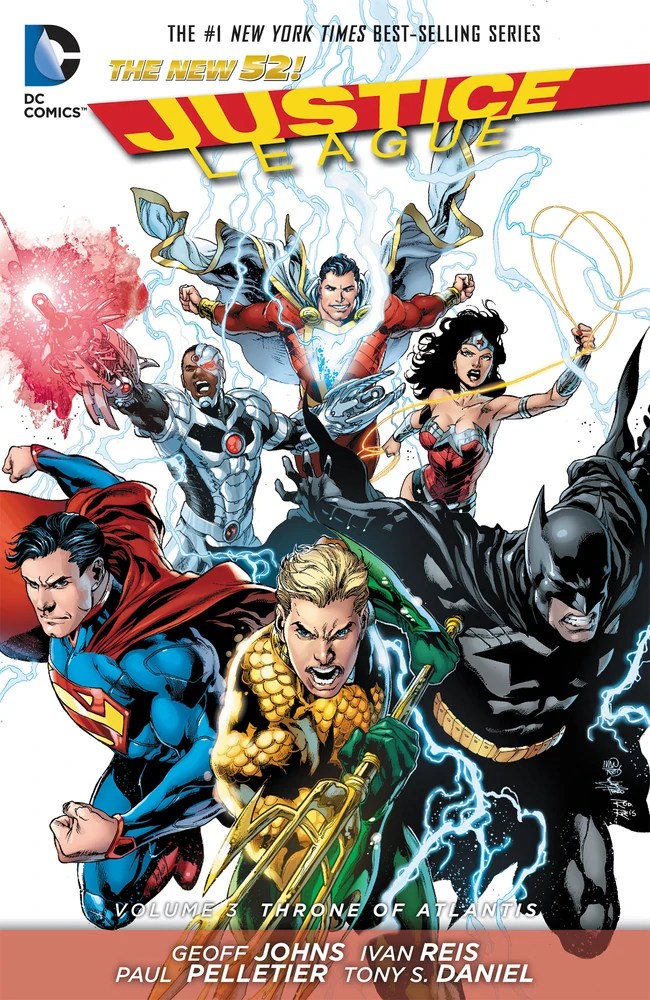
Justice League, Vol. 3: Throne of Atlantis, Geoff Johns and Ivan Reis ⭐⭐
Just when you think a cohesive story is about to occur, we are given a crossover without all the pieces, a villain that’s 12 years younger than he looks with his villain mask on, a surprise twist that gets ruined by the rest of the story, and further mistreatment of poor Steve Trevor. Once again we are expected to have read every other single New 52 issue along with this so we can understand the missing pieces and the rest of the new characters and who the mysterious villain behind other things is. It’s hard to sustain interest in this series, especially with the puerile writing of Mr. Johns. He continues to have characters narrate what we can see, as well as spell out things we have already figured out. There is one great moment toward the end, but Aquaman’s treatment of Vulko feels out of character. His entire resolution of the conflict is likewise nonsensical. Most of how the Justice League behaves during this is confusing: if Wonder Woman’s family were really attacking she’d side with Earth instead of finding a solution to save everyone? Doubtful. It’s another example of the confusion everyone is under with the New 52: do we ignore everything before this? do we assume everyone knows all the supporting characters and events? do we ignore the need for characterization because of the mysterious 5-year jump? Apparently the answer to all of them is “yes,” even though these questions contradict each other.
The two-part Cheetah story is a nice respite between forever-earth-changing four-to-six-parters, but it doesn’t quite work as a Justice League story, since it’s mostly a Wonder Woman story. The Cheetah’s ability to stop the Justice League singlehandedly is no testament to the strength and power of this disunited League. And it all ends with further mistreatment of poor Steve, who has done nothing except give and give and give. Perhaps Steve represents the audience: DC has taken everything away from you, acted like the first 75 years of character growth and storylines never happened, and is now charging you high prices for the pleasure of giving you poor work. DC Fans: you should expect better. That the best sources of praise the makers of the TPB can find are made-up Web Log sites that didn’t exist two years ago and won’t exist in two years should give you enough warning — this is not good enough.
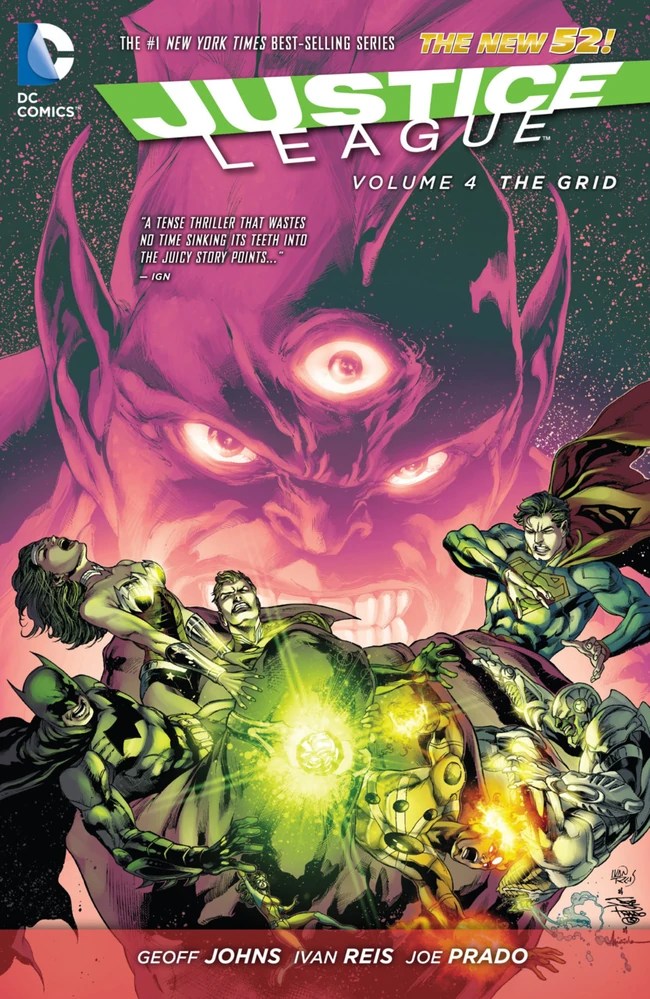
Justice League, Vol. 4: The Grid, Geoff Johns and Ivan Reis ⭐⭐
Now we know what “DC” stands for.
Should we give the audience a complete story? DC.
Should we include all the issues so they get their money’s worth? DC.
Should we tell people what they are missing from the skipped-over issues? DC.
Should we introduce the “bonus” material so the audience knows why it’s there? DC.
Should we explain the differences between the old and New 52 versions of the characters, especially the ones who are different genders? DC.
Should we charge less for this trade since it has fewer issues? DC.
Should we be consistent in what we sell in the TPBs within the same series? DC.
Should it matter to us if we tell stories that make sense and/or are any good? DC.
Should we be respectful to or honor readers who have been with us for decades? DC.
Should we try to give meaningful payoffs to the nonsensical super-secret characters we have been polluting all our issues with? DC.
Should we come up with a name that is impressive or should we go with “Crime Syndicate”? DC.
I guess Johnny from Time of the Apes grew up to take over the creative direction of DC. “Crime Syndicate” is really the best name we could come up with for the all-powerful, super-menacing döppelgangers the entire New 52 has been heading toward, huh? Why haven’t I heard about The Great DC New 52 Reader Revolt? Are you people just passively accepting this? Storylines rehashed, even from recent memory? Characterizations that make no sense? Plotlines that have more holes than a whiffle ball? Conflicts that exist for no reason other than to make large splash pages? Stop settling for sub-mediocre work, DC fans. Maybe they “don’t care,” but you should care.
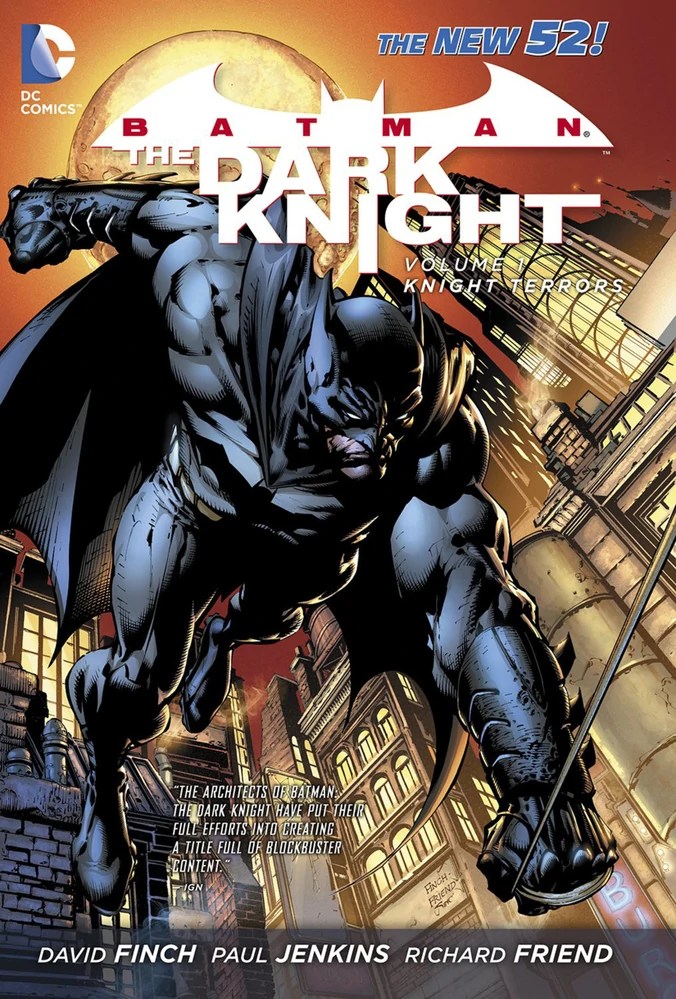
Batman: The Dark Knight, Vol. 1: Knight Terrors, David Finch and Paul Jenkins ⭐⭐⭐
This really should be 2.5 stars, but I’ve rounded up just because it was better (sort of) than most of those not-that-great Justice League collections. The artwork is both impressive and nauseous together: the impressive parts remind us of Neal Adams’s way of revitalizing series with real movement, fine detail, and believable action. The nauseous parts are the over-abundance of blood and gore. That truly is not impressive. The depiction of the female characters is also insulting to every human being, but I guess you can’t take the Image out of the artist.
The writing is likewise a confusing combination of rambling internal monologue and decent storytelling. Nothing is a surprise, but at least some of the character moments are good. But then again, just when one thinks things are going to run intelligently, along comes another “I’m going to take down Batman and Gordon!” I.A. guy … I mean, honestly. Don’t these two have enough to worry about? Is writing for Batman truly that difficult we have to rehash this nonsense? Finch teases us with potentially enjoyable moments only to snatch them cruelly away, such as the potential enjoyment of seeing Batman and Flash together only to sidetrack the Flash immediately and send him away. This could have been better without the blood and violence — I know this is the “Dark” Knight, but subtlety and implied violence would work far better than showing it, especially so frequently. If offstage violence worked for Aeschylus and Sophocles, surely it could work for crafters of Batman tales. I acknowledge this review does not apparently mesh with 3 stars, but as it was on the whole better than most JL tales of the New 52, and the potential of storylines such as Gordon at the psychiatrist office and The White Rabbit (despite her embarrassing visual appearance), I’ll say “decent effort.” Faint praise all around, on me!
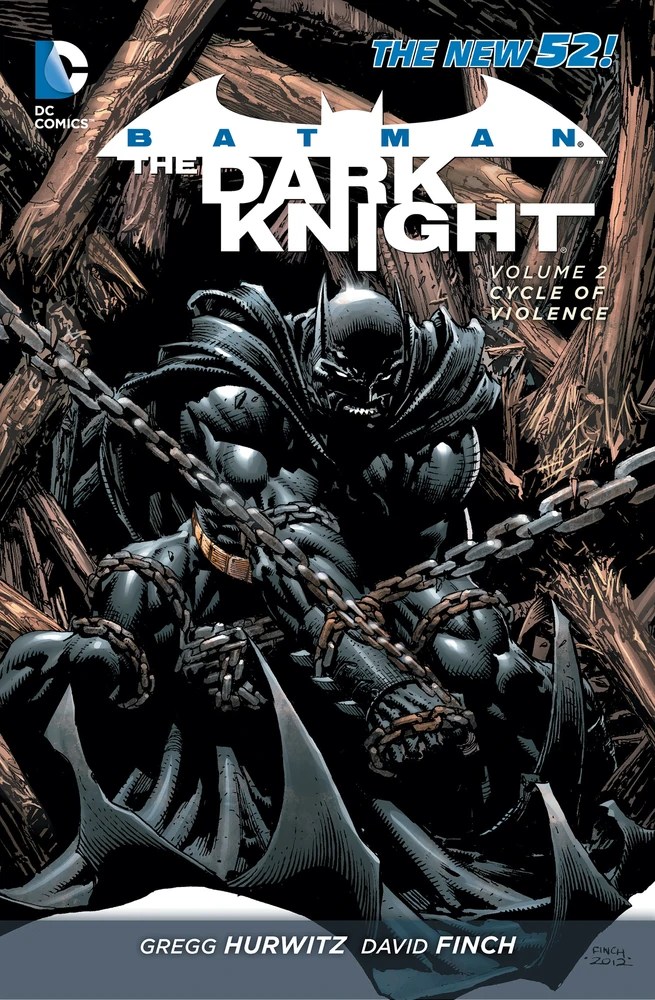
Batman: The Dark Knight, Vol. 2: Cycle of Violence, Gregg Hurwitz and David Finch ⭐⭐
Most of these 2 stars (which I feel even now is too many) are for moments of what is I suppose issue #0. In DC’s TPB commitment to hiding from you what issue you are actually reading at the time, I can only guess the final origin-like story at the close of this volume is issue #0. While that issue doesn’t tell us much we don’t know, as the continuing uncertainty over reason for The New 52’s existence provides an “origin” for Bruce Wayne — not Batman — we already knew. It’s nice to see the origin of Bruce Wayne on paper, I suppose, as well as the confrontation with Joe Chill (strangely reminiscent of Minority Report).
The majority of this collection is the overly-long Scarecrow story. Having just seen Scarecrow in the last TPB, his return is bizarre. I understand a new writer has taken over, though David Finch is still around to draw unnecessarily bloody fight scenes and other grotesqueries — but still, this is a wholly different Scarecrow from whom we just saw. Even in the dark world of the “Dark Knight,” this story is probably too dark. For some inexplicable reason, the library has labelled this “YA” — I’ll probably show them this is not in any way the case. The world is already dark enough, why must we keep adding to it with stories like this? Batman can be effective without this. I’m not saying we have to return to Adam West’s Batman, but even Neil Gaiman was regretful for the “24 Hours” issue of Sandman. While there are interesting moments in this story, such as Scarecrow’s reactions to the brave girl who stands up to him, the Light vs. Dark scene, and Bruce’s gratitude for Damian’s rescue, it’s overall just a barbaric appeal to the base and the visceral. We are given too few redeeming moments in this to make it worth owning or reading again (or for many even reading the first time).
It’s like the first TPB didn’t even happen — none of the storylines there are picked up here, none of those new characters return, and new ones are introduced here as if we should already be familiar with them! I can see the idea Hurwitz + Finch wanted to present, but it fails — as evidenced by the anticlimactic wrap-up to the story. It may not be my place to say, but I don’t consider this a respectful treatment of Batman and his world (as dark as it is and may “need” to be).
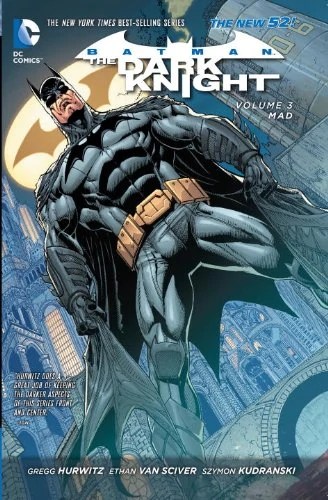
Batman: The Dark Knight, Vol. 3: Mad, Gregg Hurwitz and Ethan Van Sciver ⭐⭐
As with the previous TPB, most of these 2 stars are for the atypical issue, the annual. At least, I assume it is the annual at the close of the volume, since we are still not allowed to know what issue is which throughout the TPB, given instead an exciting repetition of cover issues two pages in a row (sadly, it’s not nearly as thrilling as I’ve just made it out to be). Hurwitz’s relaunching of the relaunch continues, with the second new version of the Mad Hatter in this storyline. Again Hurwitz tries to make Batman seem more of a “bad guy” than the supervillains are, since the new backstory of the Mad Hatter places all of his evil on experimental medication and societal rejection — he was a sweet, wonderful guy, really, so none of his badness is his fault. Bruce Wayne, however, chose to go to the darkness when his parents were killed. Pretty shoddy writing, overall.
Making it even more infuriating, Hurwitz takes the low road for pathos. Now we know why Hurwitz ignored the new characters from the previous writer — well, actually, no, we still have no idea why Hurwitz wants us to pretend none of those things happened (other than perhaps he realizes how fatuous most of them were) — but at least we know why he invented a new girlfriend for Bruce. Cheap. (Hurwitz’s writing, not the girl.)
The Mad Hatter story has plenty of holes (Gordon and Batman had identified the criminal organization before they instigated their plan — surely they would have announced that before the terror began). Hurwitz even rips off himself: the story opens with more kidnappings, just like the Scarecrow story did. And even though we have new artists, the violence and gore are far more graphic and “onstage” than they should be: less is more, people — implied violence is stronger than going through four red markers each issue (or whatever they are using to paint the blood on every panel these days). Three easily forgettable TPBs so far.
The only interesting story, as mentioned above, is the annual story: seeing three villains outsmart themselves with a clever and humorous payoff. This is much closer to a good Batman story. It really shouldn’t be this difficult to write well for Batman.

Batman and Robin, Vol. 1: Born to Kill, Peter J. Tomasi, Patrick Gleason ⭐⭐⭐
As with most of the New 52, this volume has a lot wrong with it, but it is better than most of the other Batman titles I’ve been reading lately, so by sheer novelty (or its rehashed version of novelty, at least) it deserves a slightly higher rating. Unlike the dialogue-sparse Geoff Johns volumes, the absence of dialogue in parts of this collection is aided by quality artwork and better dialogue when it occurs. True, some of it is stilted and obvious, but by the end it gets better.
Even with the violence, it is not as over-the-top as The Dark Knight, even with a killer in the title, and the tensions between Bruce and his son drive the issue more than violence. Nothing in the story is groundbreaking. We get a “secret” look at some of Bruce Wayne’s missing years, which to no one’s surprise comes back to break him. But this is another volume in which the success of the ending makes up for a fair amount of lackluster and obvious moments, and the better painting-like artwork and better writing make this a better Batman series than many of the others.
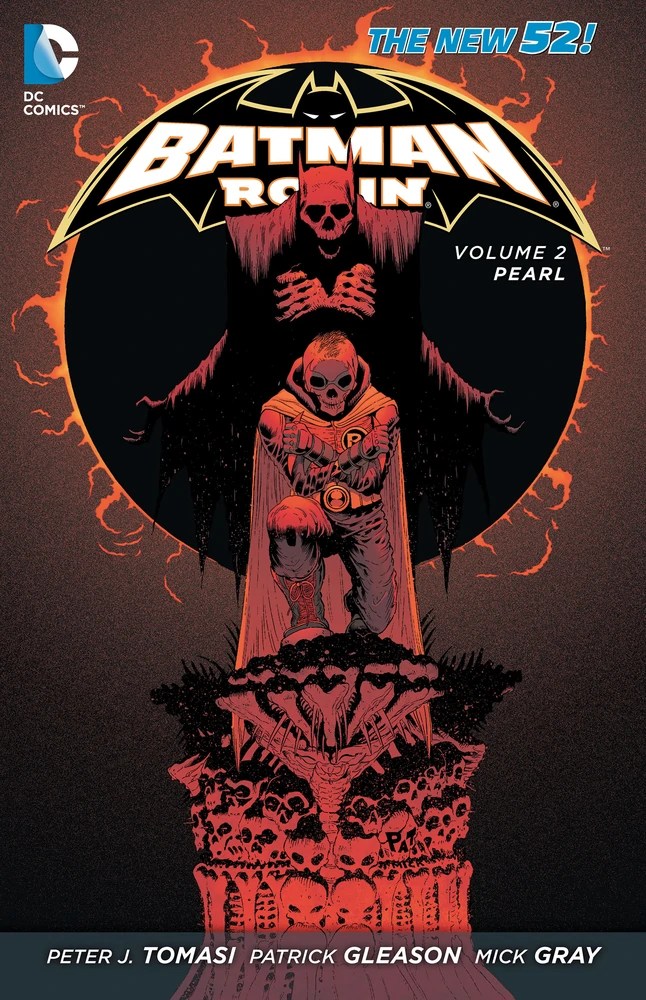
Batman and Robin, Vol. 2: Pearl, Peter J. Tomasi, Patrick Gleason, ⭐⭐
A bit of a letdown after the decent first volume — seems almost like the basic idea was fully played out in the first series and now they were getting a bit desperate. Zombies? That’s the best we could come up, zombies? Did I miss the “teenage vampires in love” crossover? As potentially great as the final moment of this collection could be, it comes out of nowhere and seems forced and majickally convenient. Also, the story just stops. Batman and Robin go home and we are left wondering, “wait, what about all that stuff you said you had to go do? Is this halftime?”
The first story in the collection has some very fine moments, especially with all the Robins together, but the basic premise for it is irritatingly tiresome: another “Batman is the real menace and we are all victims of him!” story, with a main nemesis whose origin is unclear, motivation is murky, and grief with Batman is unexplained. Feel free to tell me how he was back in issue #3XX of Detective Comics waaay back when — I picked up “The New 52” because I was promised I wouldn’t need to know all that stuff.
Stop trying to get us to feel sorry for the villains, Bat-writers. Stop giving us “will Batman lose his cool and finally kill?” stories. Do better at your overly-paid positions. And stop giving us cover art that has nothing to do with the content of the stories. This series promised more than it delivered here.
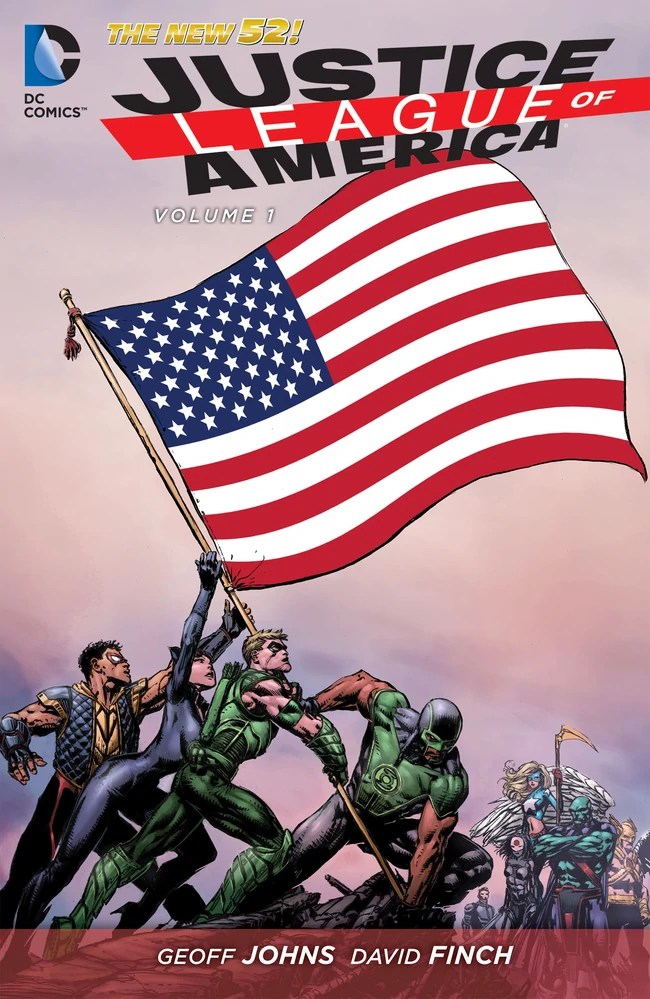
Justice League of America, Vol. 1: World’s Most Dangerous, Geoff Johns ⭐⭐
Someday, the intelligent among you must explain Geoff Johns’s popularity. In the New 52’s concerted effort to play foully with our affections and intellect, this ball of confusion exists. True, it would be nice if we knew what issues we were reading, where they occur in connection to other series, who these characters are, and other mundane trivia, but that would make too much sense. Why be helpful when you can be inscrutable? This started out with such promise, but it doesn’t take too long to devolve to the usual depths of sub-interesting New 52 shenanigans. On the off-chance the unstoppable superheroes go rogue (despite being okay for everyone for 5 mysterious years), the B-squad is gathered led by poor Steve Trevor and some stereotypical tough-as-nails-no-nonsense-I’ve-earned-it-of-no-substance-female-character. Somehow these unskilled, untrained ragtags will be able to take out the A-squad. If necessary.
Shockingly, “necessary” shows up almost immediately. But first, some “getting to know you” story with as many surprise twists as a candy cane. It could have been good, but as it’s all part of the Master Plan for The Trinity War, well, it doesn’t make much sense, especially to new readers who don’t know who these characters are (which seems counter to the basic premise of the “New” 52). Then we get a few pieces of the Trinity War, which won’t make a lot of sense if you are reading these series in the TPBs the way they are published. Finishing up seems to be a separate issue about Martian Manhunter, but apparently it was a B-story series in the first few issues (which you can’t learn simply by reading the collection as it is printed). This could have been better. But it’s not.
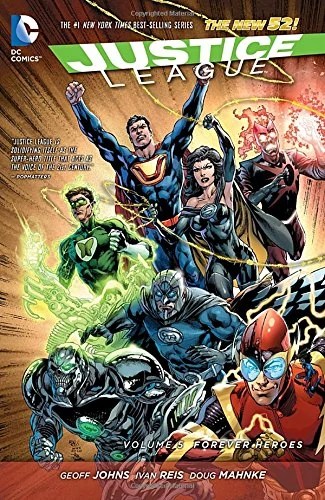
Justice League, Vol. 5: Forever Heroes, Geoff Johns ⭐⭐
I give this 2 stars because of the Metal Men. Without them toward the end of this collection, I’d probably give this 0 or negative 1 stars. This is quite possibly the worst Geoff Johns writing I’ve read yet, which is rather an impressive, if stomach churning, achievement for him. This is really abysmal. We totally get from panel 1 that these alternate-universe versions (or parallel-dimension versions, if you prefer) of the Justice League are villains — cold-hearted, ruthless villains. We completely understand that. However, to drive the point home, Johns gives us four mind-numbing and utterly extraneous issues to underscore this point. Nothing new is revealed in these “when they were young” issues we couldn’t have already filled in with our own imaginations. Oh my, the bad Superman (Ultraman) killed his parents! … So what? Oh my, the bad Batman (Owlman) killed his family including Bruce Wayne! … Why should we care? Even the “Creative Teams” got tired of giving backstories to these new villains, since Wonder Woman (or is it the other Lois Lane? they say both, which is probably just shoddy editing) and Firestorm don’t even get stories. I’m thankful for that, of course, but it’s just another exemplar of the sheer lack of meaningful direction in this New 52 universe. Oh, I’m sure they have their multi-year storylines all figured out and storyboarded and what not, but that doesn’t mean they are being executed with any amount of finesse or skill.
So you want to “shake up” the New 52 Universe, eh DC Masterminds, after an eternity of 24 issues? Howabout you hire writers who can write quality stories! with engaging dialogue! that are not insulting piles of rubbish such as this mess! Yes, the Metal Men are in it toward the end in what appears to be their own spin-off issue, and that was enjoyable because it was the Metal Men, but after that the insensible palaver returns.
Finally, Cyborg confronts Grid, his rogue, sentient computer self! And Cyborg has an EMP but does not use it! Surely the only reason rebuilt Cyborg even has a built-in EMP is to stop rogue, sentient computers! How ridiculous. Instead, Cyborg just tricks the Grid into feeling sorry for himself … and we know the feeling.
Consider, in final reflection, the masterful work given to us 20 years ago: The Age of Apocalypse. In that brilliant, effectively 4-month-contained storyline event, we have a compact, well-structured “alternate universe” look at the X-Universe totally believable and understandable even when given to us in its final moments. Yes, it had a couple issues of prequel stories, but they were additional things not main title issues. This masterpiece is 20 years old, and the supposedly “even better generation of creative writers” in the “young, hip New 52 Universe” can only give us this attempt at an interesting alternate universe cross-over. Forever Heroes? Forever Boring.

Detective Comics, Vol. 2: Scare Tactics, Tony S. Daniel and Ed Benes ⭐⭐
Not much to this rambling collection of sub-quality issues, really. The extra star is again for what I assume to be issue #0, since as with all New 52 TPBs, we are not allowed to know what issue we are reading at the time (too much information might clue us in to an awareness nothing important is happening). I’m not sure why this is called “Scare Tactics” — yes, the first issue is called that, but the collection contains longer storylines, though as I said none of them are really impressive. The longest story concerns a nonsensical excuse for drawing yucky melted bodies under the guise of time-travel and villainy, but while there is all the appearance of scientific credibility sprinkled throughout, most of the scientific application is “Batman pushes a button and majickal things happen.” It’s just a boring mess that ends abruptly without any closure.
Following this is a potentially interesting conflict between Black Mask and Mad Hatter, which likewise ends with the “majick plot-stopping button” being pressed and the story just ending. I suppose we should be grateful for that. The #0 issue flashback is the most interesting in the collection, despite its rather obvious ending. The epilogue between Bruce and Alfred is certainly the highlight, even if it is yet another version of the Batman mythos (the point of the New 52, I know).
The ending of this collection is a worthless series of Two-Face vignettes that are so poorly lit you’d think they were sponsored by the color “invisible.” It tries to make us interested by dangling a few lines of “the secrets of Two-Face’s moral struggles” out there, but nothing comes of it and instead we are given grotesque violence, banal dialogue, and no reason to care about any of it after all. Another disappointing collection of half-baked Batman and Co. ideas.
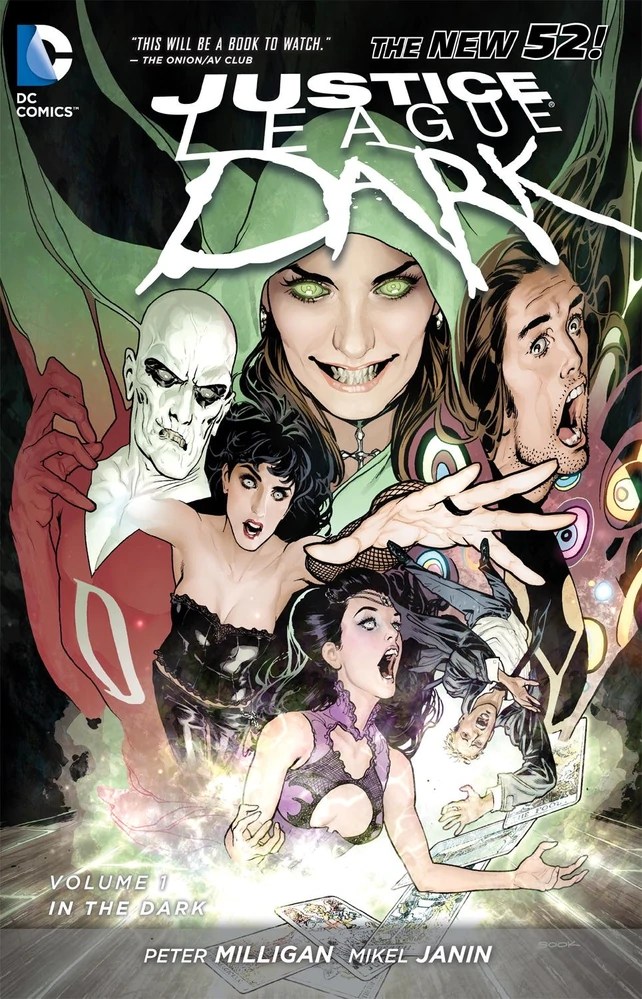
Justice League Dark, Vol. 1: In the Dark, Peter Milligan, Mikel Janin, ⭐
I solemnly promise I am not reading these hoping they will be bad. I’m not looking for a frustrating time. Nor can you really say I’m not giving these a fair shake: reading over a dozen New 52 volumes is quite generous, considering how unimpressive they are. Take this pail of hogwash, for example. Admittedly, beginning with a nominalization is poor writing, but there is no story here. Truly no story. Instead, we have a jumbled mess of pseudo-introduction stories masquerading as a typical “gathering of heroes for a new team” story — but get this! It’s “dark”! Apparently that makes it new and fresh, or at least it did in the minds of the people who gave this project the proverbial green light (no doubt a dark green light). Perhaps “dark” is New 52 talk for “draw lots of grotesque things and the people won’t know nothing meaningful is happening.” Even X-Files had generally good narrative reasons for its grotesqueries. This palaver has nothing substantial to tie its nonsense together. Panels happen in whirly-gig order, as if we are supposed to have some intuitive guide to discerning how this is supposed to be read. Oh, and apparently we are already supposed to know who these characters are, since we are never told who they are, even the ones who are possibly new, except Deadman. We are told his origin every issue.
This jumbled mess has some potentially interesting ideas, but none of them come to fruition and we are not given any reason to hope they will mature in future issues. Characters all basically look alike (which is not impressive), and most of the poses and outfits of the ladies are apparently designed to evoke ungentlemanly responses within the male readership. Characters show up, leave, wide gaping holes of what poses as a story rip through and no one bothers to explain why (not that we need moment-by-moment spoonfeeding, but an absence of meaningful continuity is not tantamount to “quality storytelling”).
Horrible things happen throughout these pages (children murdering one another, towns caving into madness), but none of these “heroes” care. Then we are to believe it was all a test to get this ragtag group of jerkweeds together. It’s impossible to empathize with any of these characters until John Constantine says he wants no part of this.
If this is the best this series has to offer, it’s hard to disagree.
If it makes you feel better, I have read very high-quality DC trades recently (especially the Knightfall trilogy). One of my key goals for 2015 is to read fewer books but books I just know are going to be good. I’ve read too much tripe lately, and I know it has all been volitional, but still I need to improve my literary diet. In my vast munificence, I will likely give The New 52 more chances to disappoint me, but that does not necessarily mean you won’t enjoy them. It’s likely it’s not as bad as I have made it sound. Somebody out there must think these are worth making again and again, and since several of them are available for free from the library (perhaps the best part of that is you don’t have to feel obligated to keep them — you can’t actually give them back!), this is as good a time as any to try The New 52 (I don’t want that to sound like a threat, of course). If not, fair enough. In either event, I wish you and yours good reading.
 Redeeming Pandora