
Elizabeth Knudsen
Before any court case is filed, there is a valid reason as to why the recent Disney blockbuster Frozen is in fact a film that could be classified as “bad.” Although many fans are unaware of this, the beloved film is based off of a lesser-known folktale, following the style of most preceding Disney classics. The title of this folktale is “The Snow Queen,” and it was written by Hans Christian Andersen. At first one might think there’s no problem, but unfortunately, when the individual story and movie, respectively, are examined and compared, the inconsistencies are startling. Three basic categories can be used to contrast the two. These three categories are plot, characters, and morals or themes.
The original Frozen, Hans Christian Andersen’s folktale “The Snow Queen,” was actually written as a seven-part story. These seven parts relate the adventures of a girl named Gerda, who goes on a journey to save her friend Kai, a boy. The story begins with a brief backstory concerning a wicked hobgoblin — sometimes referred to as the Devil himself — who creates a mirror that shrinks everything beautiful in a thing and magnifies everything ugly. The hobgoblin and his minions plot to take the mirror up to Heaven to make fools of God and the angels, but on the way up it slips from their grasps and shatters into billions of pieces. These pieces, some no larger than a grain of sand, are blown all around the world; they make people’s hearts as frozen as blocks of ice and settle in their eyes, distorting their vision as the full mirror would.
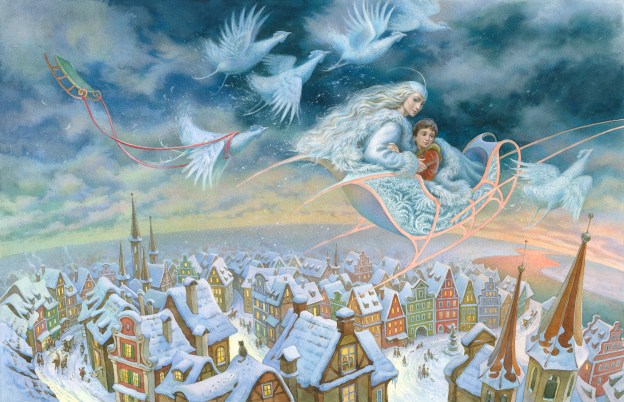
Years after this event took place, the two main characters enter; Gerda and Kai. The two are neighbors who share window boxes filled with roses and are as dear to one another as brother and sister. Kai’s grandmother tells the two children stories of the Snow Queen and her “snow bees” (the snow flakes).
One winter, Kai sees the Snow Queen from his window, beckoning for him to come to her. He backs away in fear. Kai’s grandmother teaches the two children a hymn, two lines of which are repeated throughout the story. The summer after Kai glimpses the Snow Queen, shards of the terrible mirror get into his eyes and heart. As he and Gerda are at their window boxes, he becomes cruel and loves Gerda no more. He destroys their window-box garden and instead gains an aptitude for math and physics and becomes fascinated by the only things that seem beautiful and perfect to him anymore: snowflakes.
One day after that, the Snow Queen comes to him in a disguise while he is playing in the town square. She kisses him twice — first to numb the cold, second to make him forget all about his family and Gerda — but no more, because three kisses would kill him. She takes Kai to her palace, near the North Pole. While Kai is gone, the townspeople get the idea he drowned in a nearby river. Gerda is heartbroken and refuses to believe it, so she goes to look for him. The river tells her it did not drown her friend by refusing to take her new red shoes, and a rosebush tells her Kai is not among the dead, as it could see under the earth. A sorceress who lives near the rosebush tries to keep Gerda with her, but Gerda flees. A crow tells her Kai is at the princess’s palace, but the prince only looks like Kai. The princess and the prince provide her with warm clothes and a beautiful coach to aid her on her journey.
On her way, however, Gerda is beset by robbers and taken prisoner. She quickly befriends a little robber girl, whose pet doves tell her they saw the Snow Queen take Kai toward Lapland. A reindeer captured from Lapland named Bae is freed by the little robber girl along with Gerda and the two ride to Lapland, making two stops. One stop is at a Lapp woman’s house, the other at a Finn woman’s house, the latter tells Gerda she can save Kai because she is remarkably pure.
Once she reaches the Snow Queen’s castle, snowflakes try to stop her, but they are stopped by the angel shape her breath takes as she says the Lord’s Prayer. Kai is alone inside the palace, trying to solve the Snow Queen’s puzzle to earn his freedom and a pair of skates. He must spell the word “eternity” using ice shards she gave him. Gerda runs to him and saves him with a kiss and her tears, which melt the shard or mirror in his heart and cause him to remember her, which causes Kai himself to burst into tears, removing the shards in his eyes. The two are so overjoyed they dance together, and in their dance the ice shards are jostled to form the word “eternity,” gaining Kai his freedom. The two then leave the Snow Queen’s kingdom with the help of Gerda’s friends, and they return home to find they have grown up, and it is summertime.
Although there are several characters in this story, the hero is clearly Gerda, and the villain is clearly the Snow Queen. Kai could also be considered a main character, although he isn’t actually in the story that much. Prominent themes are female strength — displayed in both the Snow Queen and Gerda — as well as a true, realistic ending. It is suggested true happiness is found through purity of heart and strength, which appear through childhood.
Turning to the movie Frozen, one has an entirely different storyline. Elsa and Anna, two sisters, are princesses of a fictional realm called Arendelle. Elsa has the ability to produce snow and ice and general winter at will but is not able to control it. On the night of her coronation, the young queen loses control in front of her kingdom after being a shut-in for many years and flees to a distant mountain, after accidentally setting off an eternal winter across her kingdom. Her younger sister Anna blames herself — she got mad because her sister did not sanction her marrying a Prince Hans of the Southern Isles — and goes after her, recruiting troubled Kristoff and his reindeer Sven along the way to help her.
On their way, they meet a living snowman named Olaf (who loves warm hugs), who leads them to the secret passageway to Elsa’s ice castle. Elsa, while her kingdom is freezing and her sister is almost getting eaten by wolves, has transformed herself into an ice-wearing self-actualizer, when in fact she is still very much afraid of herself and of others. Anna tries to tell her she will help Elsa work through anything, but Elsa loses control again after hearing she froze Arendelle, and her powers strike Anna in the heart; an act which is known to be nearly fatal.
With only the hope of an act of true love from Hans to save her, Kristoff, Sven, and Olaf rush Anna back to the castle. However, Hans has been planning to take over Arendelle all along and leaves Anna to die while going to capture Elsa, claiming Anna had died already. However, while Hans is off capturing Elsa, Olaf rescues Anna from freezing to death. Anna realizes Kristoff is the one who truly loves her, and she loves him back, so she runs across the frozen river toward him, but as she is turning to ice she sees her escaped sister, kneeling broken-hearted on the ice after hearing Hans’s lie about Anna’s death. Anna turns from her path to Kristoff and leaps in front of Hans’s sword just as he tries to kill Elsa, and she turns to ice. Elsa is shocked and even more devastated and throws herself onto the ice statue that was once her sister and sobs as Kristoff draws near.
But then, a breath is seen, and the girls’ sisterly love is strong enough to bring Anna back. Then Elsa realizes the key to controlling her powers and bringing back summer is love. The movie ends with a hint Kristoff and Anna end up together, while Elsa hosts kingdom-wide ice skating parties in the palace courtyard whenever she feels like it.
As one can see, the main characters are quite different. The “Snow Queen” is not the villain after all, instead she is a misunderstood sociopath. Her sister Anna is the hero and is supported by Kristoff, Sven, and Olaf along the way. Themes in the movie include sisterly love, female strength, and the importance of staying true to oneself.
It is pretty obvious the words “based on” meant something a lot looser than one might at first think. The plots of the tales are completely different. One story makes the Snow Queen a villain, the other doesn’t. It would be a completely different ballgame if Disney had done something like the Broadway musical Wicked, where the story is told from the Wicked Witch of the West’s perspective, and thus one is given a different outlook on L. Frank Baum’s The Wizard of Oz. But instead, Disney decided to take an idea — the idea of a queen who could control snow — and make it into something nothing like the original story. And not only that, but they didn’t even try to present any fresh values in the movie. All of them have been done before; sisterly love in Lilo and Stitch; feminine strength or “girls can fight, too” or “girls don’t need a man to save her” in Mulan and Brave; the importance of staying true to oneself in every single Disney classic except for The Little Mermaid.
What is most ironic, however, is the fact in the original folktale there was an even better storyline to suggest a girl doesn’t need a man to save her: Gerda saves Kai. And over all, it would have be more beneficial in today’s culture for girls to hear strength and purity of character are what really count, not self-actualization and “letting it go.” Girls are surrounded by the pressure to be yourself (while ending up being like everyone else) enough every day. They didn’t need a Disney movie to confirm it.
In the end, Frozen still made millions in the box office, because it fed girls across the world what they wanted to hear, disguised in a catchy tune. But that doesn’t make it a good movie. In fact, it makes it a bad movie. It doesn’t make people think; it entertains them for two and a half hours and then encourages them to be singing “Let it Go” for the rest of the day, because that’s the message Frozen represents. No one should have to change (despite the fact change is a part of life), and people should just deal with others’ emotional and mental problems without trying to help them with it. Love — whatever that means — is the answer to all of life’s problems. Frozen versus “The Snow Queen” is just one example of the decline of book-to-movie adaptions.
Works Referenced
Andersen, Hans C. The Snow Queen. 2nd ed. Vol. 1. Denmark: n.p., 1844. N. pag. New Fairy Tales. Print.
Buck, Chris and Jennifer Lee, dir. Frozen. Writ. Chris Buck, Jennifer Lee, and Shane Morris. Walt Disney Studio Motion Pictures, 2013. DVD-ROM.
 Redeeming Pandora