
Kaitlyn Thornton Abbott
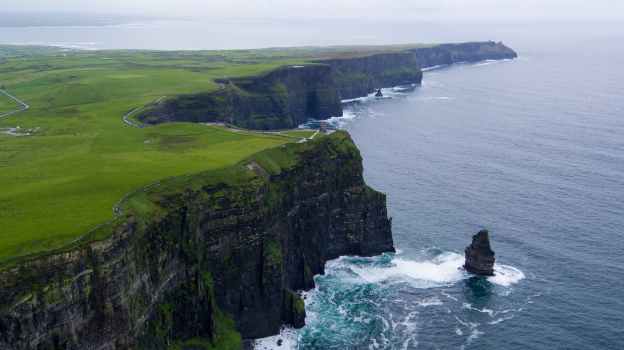
Far superior to most European countries, this little island sometimes goes unmentioned when talking about the wonders of the continent. When talking about Europe, most people will quickly be able to list off their favorite countries (most of which they haven’t been to, but that’s another can of worms). When talking about Europe, what countries or scenery jump to mind — probably the Eiffel Tower, or London, or Barcelona; all of which are great cities. But when I think of Europe, my mind is taken on a wonderful adventure into the hills of Ireland, with the water crashing into the cliffs.
When Ireland is discussed, many don’t realize what they’re talking about; see, Ireland is actually two different countries. There is the Republic of Ireland, and then there is Northern Ireland, which is actually a part of the United Kingdom. The Republic of Ireland contains four provinces: Ulster (northeast), Leinster (south-eastern), Munster (south-west), and Connaught (northwest). There are thirty-two counties, twenty-six of which actually belong to the Republic of Ireland.
Ireland has a rich culture and an even richer history. The first known settlements of Ireland were around 6,000 B.C. when Mesolithic hunter-gatherers migrated over from Britain. They settled on the eastern coast, since they were hunters and fishers by trade. There’s little archeological evidence surrounding this history, but their descendants and Neolithic arrivals were responsible for the founding of historical sites such as Newgrange. The Gaels, a Celtic-speaking people group from Western Europe, settled between 600 B.C. and 150 A.D. By the time of Christ, the island had been organized into five “kingdoms,” which are known today as the “Five Fifths of Ireland.” By 400 A.D., two more “kingdoms” had evolved. Many of these kings raided their neighbors, which included the continent of Europe and Britain. On one of these raids, a young boy was captured and sold into slavery. Eventually he escaped but returned to Ireland to bring the gospel. This man was none other than St. Patrick. Patrick brought Christianity to the Celtic region, and by the year 600 A.D., it had completely engulfed the nation.
From 837 A.D. on, Viking invasions wreaked havoc on the poor, working Irish families. Their war ships came up the mouth of the River Liffey. Five years later, Dublin was taken by force; they attacked the monastic culture and the cities. They plundered the villages and stole the women in the midst of the night. But the Irish proved their strength and fought back vigorously, causing the Vikings to flee. Seventeen years later, however, the Vikings returned under the command of Olaf the White, and they made a permanent settlement in Dublin. Once English mercenaries set their sights on Ireland, there was no going back. Mercenaries came under the direct orders of Richard de Clare, 2nd Earl of Pembroke, in 1169. This original invasion of Ireland opened the door for the next 700 years of direct British involvement and control of Ireland and its people. In 1177, Prince John Lackland was dubbed Lord of Ireland by his father King Henry II of England.
From the latter half of the twelfth century to about 1400 A.D., many of the Normans moved to Ireland from England and settled on the eastern part of the island, particularly around Dublin. The Irish strongly resented these colonists, but in 1367, English Parliament enacted a law to keep the two populations separate. England essentially left Ireland to its own devices, operating as it always had until King Henry VIII. When he removed papal authority, he asserted complete dominance over the island. The English Reformation was an idea Henry VIII tried to force in Ireland but subsequently failed due to the Irish having no loyalty to the crown. King Henry continued to question the loyalty of the Irish, and between the years 1534 and 1691, there was a series of Irish military campaigns. Because of the influx of militaristic movement in Ireland, Scottish and English settlers were sent to live there. The rise of the Scottish and English presence in Ireland led to a rise of Catholicism, as well. Eventually, this led to a militaristic and political defeat of Gaelic Ireland.
During the reign of King James I of England, Catholicism experienced a lot of suppression and persecution. All Catholic organizations such as schools were shut down, and instead the children were taught in the Protestant faith. Any segregation that had been drawn up due to racial prejudices now shifted to religious lines instead. The sides were clear: Protestant and Catholic, although a majority of the island leaned toward the Catholic side. When Cromwell took control of England, he also continued the English hold over Ireland and tried to force Protestantism by taking over all of the Catholic institutions. Once he died, the Irish struck back at England and, in 1690, regained control of their historic land. They signed a treaty with London that granted the Irish rights, but, alas, it was rejected by a Protestant-controlled Irish Parliament. This religious war continued on. In 1727, no self-proclaimed Catholic was allowed to run for office, nor were they allowed to vote.
The latter half of the nineteenth century did not bode well for the Irish. Already having suffered an incredible amount of hardship due to restrictions of the British, they then had to face what is known today as the Great Famine. Essentially, it was caused by a potato blight that attacked all of the crops between 1845-1849. Over a million Irish men, women, and children died from starvation, and even more fell prey to sicknesses such as typhus. Over two million immigrated to other countries, such as the United States, the United Kingdom, Canada, and Australia. Over the course of the famine, a total of six million Irish fled the land. Because of the diaspora of the Irish, scholars think around eighty million Irish descendants are worldwide (within three or four generations).
Following the famine, however, Catholics in Ireland were slowly gaining in prosperity. A demand of a national self-government arose, and as the Catholics grew in parliamentary power, they used this as leverage to gain a home government, and in 1914, a home rule bill was enacted, but due to World War I could not be put into effect. However, throughout the course of the twentieth century, the situation in Ireland remained essentially unsettled. “The Government of Ireland Act” in 1920 set up separate parliaments for Northern and Southern Ireland, but only the southern parliament ever got anything accomplished or even remotely functioned. When 1921 rolled around, Britain and Ireland signed a treaty establishing Ireland as a free state, which meant while Ireland had the power to be a self-governing state, it was still considered under British rule. As a result of the treaty, a civil war broke out between pro- and anti-treaty supporters. In 1937, the parliament of southern Ireland drafted a new constitution, through which the new state of Eire was born. This state was a republic in every sense of the word, the only catch was the technicality of the name — they were still under British rule. This state lasted only eleven years, and the ties between northern and southern Ireland were completely severed; because of these severed ties the Republic of Ireland was born. In 1972, Northern Ireland was completely dissolved and put under direct British rule. That same year, Ireland joined the European Economic Community (EEC) along with its neighbors the UK and Denmark.
Ireland’s history isn’t an easy one: it’s struggled and overcome many difficulties, and its culture has had an impact on American society and history as well. A slight side note, the common phrase you hear “tying the knot” comes from Irish descent. It was a common practice in Ireland for the pastor, or whoever was doing the ceremony, to have the bride and groom cross arms and a ribbon tied around their right hands; thus, tying the knot.
Ireland’s culture and landscape are painted with its history. From the waves that crash into the Cliffs of Moher to the rolling hills; from the farmer, to the owner of the local pub; from the songs of the people to the patriotism in their hearts — Ireland is a country like no other; it’s a story waiting to be discovered.
 Redeeming Pandora