
Nicole Moore Sanborn
Over the past few months my mom and I have indulged in watching a set of superhero movies. As I watched, I could not help but notice a key thematic element. The theme of man’s overwhelming need for a savior seemed to be a reoccurring aspect of the movies we watched. This theme presents itself primarily in princess and superhero movies, where someone or something tends to need saving. With the exception of very few, each movie in these archetypes clearly presents man’s helplessness and despair without a savior. The archetype also appears in other movies to be discussed in this article.
Every girl loves a good princess movie, right? Wrong. Many girls do not like the fact in nearly every princess movie, the girl requires the aid of a prince to either break a spell or save them from whatever predicament they are in. Many girls do not like this theme and archetype, because it subordinates the girl to require a man’s assistance. Either way, the realization of man’s need for a savior has sprinkled itself into these princess movies. I am basing this article off of the Disney princess movies, not on the original fairy tales.
In Cinderella, Cinderella is trapped living under the dictatorship of her stepmother and two step-sisters. If the Fairy Godmother had not arranged a feasible way for her to attend the royal ball, Cinderella’s life would have remained static. Had Cinderella not gone to the ball, left her shoe, and proved to the prince they danced at the ball, she would not have gotten married. Cinderella needed saving from her condition. The Fairy Godmother, and later the prince, stepped in and saved her. The Fairy Godmother saved her night (through creating the means for Cinderella to attend the ball), and the prince fell in love with her, ultimately saving her and removing her from her predicament into a life of royalty and comfort. While the Bible does not guarantee us a life of comfort, God brings us where He wants us and sends us certain places to do His work. This is similar to the Fairy Godmother sending Cinderella to the ball where she met the prince.
In Sleeping Beauty, Aurora can only be awakened by the prince’s kiss. If the prince had not defeated the evil queen in dragon form and eliminated the monstrous cage of brambles engulfing the castle, Aurora would have remained asleep. The only way she could be awakened and the spell broken was if Prince Charming kissed her. Aurora needed outside assistance to bring her out of her predicament and change her life. She needed a savior: Prince Charming. Christ brings us out of our previous predicament of being slaves to sin and apart from God by giving us new life, making us slaves to righteousness and justifying us with God, as Paul says in Romans. In doing so, Christ brings us out of our previous predicament and changes our lives forever.
Beauty and the Beast presents a different type of princess movie: Belle provides outside assistance to her father and the Beast as opposed to needing outside assistance for herself. Belle travels to the castle to save her father but becomes imprisoned by the Beast. The only way the Beast will release her father is if she breaks the curse and falls in love with him. In doing this, Belle not only saves her father, but she also breaks the curse the Beast was under and saves him. Belle also restores beauty and order to the palace. Belle’s father and the Beast both require outside assistance from Belle to be removed from their predicaments. God restores beauty in our chaotic and sinful world as Belle helped restore beauty in the castle. Christ breaks our curse of being slaves to sin and releases us from the prison of sin we were once in before He saved us, similar to how Belle saves the Beast and her father in Beauty and the Beast.
Mulan is another classic Disney princess movie. Mulan sacrifices herself, paying no heed to the rule against women joining the army. She sacrifices herself for her feeble father, the only male in the family, because she did not want him killed in battle. The army discovered Mulan was a woman and banished her (instead of killing her, the traditional Chinese custom). If this had not occurred, she would not have gained the intelligence necessary to save China. Through Mulan’s actions, the Chinese army defeated the Huns and her father was saved from going to war. Similar to Christ saving humanity, Mulan saves China as well as her father.
Superhero movies completely embody the idea and theme of man’s need for a savior. First, let’s take a look at the word “superhero.” Merriam-Webster’s New World Dictionary defines “super” as “to a degree greater than normal; higher in rank or position than, superior to; and, greater in quality, amount, or degree than, surpassing.” The same dictionary defines “hero” as “any man admired for his courage, nobility, or exploits, especially in war; and, as any man admired for his qualities or achievements and regarded as an ideal model.” Combining these definitions, “superhero” can be defined as “a man greater in quality, amount, or degree than and surpassing other men, who is admired for his courage and nobility.”
In Marvel’s Avengers, only the band of heroes, specifically The Incredible Hulk, Iron Man, Black Widow, Hawkeye (after he is released from Loki’s spell), Captain America, and Thor, with their combined abilities, can defeat Loki’s army and recover the powerful Tesseract. Without this band of heroes, Loki would have taken over the world and used the Tesseract for sinister purposes, ultimately conquering earth. Although this parallel seems extreme, please bear with me. Just as only this particular band of heroes can save earth from the villain, only Christ has the power to defeat Satan and win us over, providing us a way back to God.
The Incredible Hulk is a slightly different example of man’s need for a savior as reflected in movies. After the experiment on Bruce Banner goes wrong, the people in charge attempt to capture and kill him. The authorities fear his condition and want to avoid the slaughtering of innocent civilians. However, in their efforts, the fatal error of genetically altering one of their men is made, and he, in the end, becomes a greater threat than the Hulk (Bruce Banner). Only the Hulk has the strength and ability to defeat the monster due to the genetic altering (as a result of Gamma radiation) that took place in both of them. The men in charge require outside assistance to save humanity from the new monster they created, and Bruce was the only one capable of finishing the job. Christ is the only one who can bring us back to God through his death on the cross. He is the only one who can finish the job to restore us. Without Christ, we would be lost, just as the people would have been lost without Bruce.
In Captain America: The First Avenger, Steve Rogers, a weakling, is not cleared for service in World War II. By choice, driven by his desire to fight, he is genetically altered into a “supersoldier.” The serum is lost after Rogers is transformed, foiling the plan to create an army of genetically-altered supersoldiers designed to win the war. Captain America becomes the only one strong enough to defeat the Red Skull, the all-powerful leader of HYDRA (the bad guys). Without Rogers’s alteration, multiple soldiers would have been lost. Rogers led a rescue mission to save a group of soldiers, including Bucky, his best friend. Without him, the rescue mission would not have been successful, nor would the Red Skull have been defeated, as he was the only one capable of doing the job. Once again, Christ is the only one capable of restoring us. Only the son of God can bring us back to God; Christ sacrificed everything for us.
In Thor, Thor is sent to earth to learn humility. However, Loki remains and betrays their father. It is only after Thor learns humility that he can return to save his people. Without Thor sacrificing the Rainbow Bridge, his only way to return to Earth and see the girl he loves again, his people would be lost. Thor, after being sent to learn humility, sacrifices his desires for the good of his people. The Biblical parallel is not quite the same in this example. Christ did not have to learn humility, as He is perfect. However, He did humble himself to live as a human and die on the cross for our sins. Christ sacrificed all after humbling himself. Christ sacrificed His life, while Thor simply sacrificed not seeing the girl he loved again, making the parallel more difficult to draw. Both sacrificed out of love: Christ’s love for us; Thor’s love for his father and people. Thor’s people required his assistance to break the Rainbow Bridge and restore order; humanity required (and requires) Christ’s assistance to redeem us.
A couple of other movies that employ man’s need for a savior include The Chronicles of Narnia: The Lion, the Witch, and the Wardrobe as well as The Lord of the Rings trilogy. Once again, these examples are based on the movie adaptations of the original books.
The Chronicles of Narnia: The Lion, the Witch, and the Wardrobe parallels easily with man’s need for a savior, as C.S. Lewis was a Christian when he wrote the book (the basis for the movie). It is a parallel of the Bible. The White Witch represents Satan and Aslan represents God. Edmund betrays Aslan, just as we betray God through our sin (the origin of our sin nature being the fall of mankind in Genesis chapter three). Aslan dies on the stone table to buy Edmund back from the White Witch. Edmund is saved, and Aslan is resurrected. This clearly parallels our betrayal of God and Christ redeeming us (or buying us back) from our sin nature through His crucifixion. Aslan’s death on the Stone Table and his resurrection represent Christ’s death on the cross and His resurrection. Thus, man’s need for a savior is purposefully embodied in this example.
In The Lord of the Rings trilogy, only Frodo can take the ring and get rid of it once and for all. The lust for the ring’s power is so strong only Frodo can resist it (while he does succumb to the lust for power, he is not wholly defeated). The journey to save everyone and burn the ring can only be accomplished by, well, himself. In the same way, Christ is the only one who can save us. Without His death and resurrection, we would still be separated from God due to our sin.
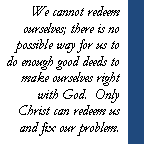
In each of the above examples, the characters cannot fix their problem by themselves. They need an external aid to redeem them of their problem and fix the situation. Similar to the above examples, we cannot fix our sin. We cannot redeem ourselves; there is no possible way for us to do enough good deeds to make ourselves right with God. Only Christ can redeem us and fix our problem. These movies reflect man’s helplessness as well as the fact man is void without God. These characters reflect man’s need for someone (an external source) to reach out and save them. This theme is something I stumbled upon through my enjoyment of these films, and drawing parallels between these movies and my faith was enjoyable. I hope you, the reader, thought it enjoyable as well. Man knows he is incomplete, but many choose to turn away from the fact we are helpless without Christ, an external source, aiding us and saving us. Movies reflect the idea man needs an external aid, and I hope this look aided the way you view movies in the future.
Sources
Merriam Webster’s New World Dictionary
Personal experience
 Redeeming Pandora