
Christopher Rush
TV’s Franks
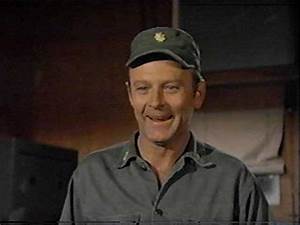

As we continue to wend our way down the long and winding road to completion of this journey, it’s about time we paid tribute to some of my favorite loveable TV villains: TV’s Frank from Mystery Science Theater 3000 and Frank Burns from M*A*S*H. Admittedly, these two rapscallions aren’t always “nice,” in that one is trying to help his boss take over the world by unleashing the worst movie ever made upon an unsuspecting populace and the other is a somewhat hypocritical hypochondriac whose parsimony is surpassed only by his pedantry. Despite this, these two have given us some unforgettable and highly enjoyable moments from two of TV’s best shows of all time, and it’s time we be nice to them for all they’ve given us.
Push the Button, Frank
TV’s Frank is that remarkable mixture of loveable sidekick and cuddly antagonist few shows ever get right (though many try). It’s hard at times to remember Dr. Clayton Forrester and TV’s Frank are the villains of the show, considering the more time we spend with them the more we enjoy having them around. I’ve always thought the better episodes are the ones that have a lot of Dr. Forrester and Frank in them, even if they are being unusually cruel (“Deep hurting!” from experiment #410 Hercules Against the Moon Men) or plotting to get rid of Mike (#512 Mitchell). Though he’s definitely a sidekick or lackey (dressed as he usually is in a chauffeur outfit) and not a mad scientist (what can one expect from a former Arby’s employee with the nickname “Zeppo”?), Frank holds his own with Dr. F, despite being killed several times (always to be resurrected no later than the next episode) and comes to befriend Joel, Mike, and the ’bots before being assumed to Second-Banana Heaven (though he soon leaves for new adventures).
As a primarily supportive character, even as an antagonist, Frank doesn’t always get a lot of lines, but nearly every episode has Frank give us something memorable (at least something worth the while of watching it) during his tenure in seasons 2 through 6. Whether he is apathetic toward Dr. F (such as during Clay’s supervillain conference at the end of #504 Secret Agent Super Dragon) or a willing supporter of his schemes (such as cheering on “Proposition: Deep 13” in #621, The Beast of Yucca Flats), Frank provides the gooey, nougatey center the show didn’t have before he arrived.
Is Frank my favorite MST3K character? It’s hard to say. Just as I can’t really choose which Collective Soul song is my favorite (which is rather akin to trying to choose which was my favorite slice of pizza I’ve had in my lifetime or which was my favorite DQP with cheese), I can’t really choose which MST3K character is my favorite. It possibly depends on which episode I am watching at the time. Some people can choose definitively between Crow and Tom — I’m not one of those people. I certainly lean more toward Joel than Mike, but that’s more about the movies themselves, not Mike as a character/person. I prefer Frank to Larry and the Sci-Fi channel episodes, but that isn’t saying all that much. Every character is necessary, at least in seasons 2-7. Even Magic Voice. Similarly, you can’t separate Clayton and Frank — they are a unit. Frank’s indispensableness is clear even to Dr. Forrester, as evidenced by his song of farewell to Frank after Frank is taken away at the end of season 6. Things aren’t the same anymore for anyone, and the show itself is transformed in drastic ways for season 7 and even more so for the Sci-Fi channel seasons 8-10.
Though a litany of some of my favorite Frank moments wouldn’t mean much to you if you haven’t seen the show, chances are you probably aren’t reading this even you aren’t either familiar with it or interested in reading whatever I say anyway, so here are some of my favorite Frank moments. As noted above, since Frank is a supporting character early on, it takes a while for him to be featured more regularly. The later seasons, when the show spends more time with the Mads, are sometimes more enjoyable to watch because of the developed nature of the characters by that point. For Frank, his greatness often comes in his delivery: the way he says his lines are often central to his magic. His line “he’s got to want to change!” is perhaps the best example of this. His emphasis on “want” is pure gold. I have already mentioned another of my favorite Frank moments: at the end of Secret Agent Super Dragon, Clay hosts a “how to be a supervillain” conference, presumably for Joel and the ’bots, which doesn’t make much sense considering he is trying to control them, not give them insider tips on how he does what he does. The gem, though, is Frank’s total lack of interest in the conferences, sleeping through it, then reading his already-prepared questions in as apathetic a voice as possible, including the stage direction. He is supposed to read his question eagerly, but he says the word “eagerly” along with everything else without any zeal or eagerness at all. Though this description does not do the moment justice, it is a beautiful moment after one of the more enjoyable episodes in the series.
The times Clay and Frank have to do what Joel and ’bots do are also great moments. When Clay and Frank try to show them it’s not hard to make jokes through bad movies by sampling a few moments of #323, The Castle of Fu Manchu, Frank comes to the realization it would be a lot easier to do it if the movies weren’t so bad, which totally dispels Clay’s victory over Joel and the ’bots, giving them new energy to continue their lives out in space. The other similar occurrence, when the magnetic storm sends them into a “Mirror, Mirror”-like parallel world in #611, The Last of the Wild Horses, allows us to see Dr. Forrester and TV’s Frank in the movie theater riffing on the movie for an entire segment, as well as doing some call-backs to memorable earlier episodes’ moments. I wish the entire episode was like that, but it’s only the first twenty minutes or so.
Frank gets to sing some of the better songs during the series, but certainly his best is “Nummy Muffin Coocol Butter” from #605, Colossus and the Headhunters. Nummy Muffin Coocol Butter is an engineered puppy created by the Mads to overpower the world through cuteness, but Frank refuses to give him up and laments his loss exceedingly throughout the episode, culminating in this great song. At the end of the episode, the Mads are thwarted by their plans once again, since Mike returns Nummy to them and they can do nothing but be enamored of the cutest pet in the world. It’s hard not to love TV’s Frank.
Thank you, TV’s Frank, for teaching us how to laugh about love. Again.
You Tell ’em, Ferret Face
Whereas TV’s Frank had the opportunity to grow and do diverse things (such as both support Dr. Forrester and be antagonist in different episodes), Frank Burns on M*A*S*H was for the most part a monolithic antagonist to the “good guys” on the show, Hawkeye, Trapper, and B.J, and yet he, too, solidified the show for most of his tenure. Though often the receiving end of jabs, jokes, and not-always-good-natured ribbing, Frank Burns regularly gives us priceless lines delivered in as brilliant a way as possible. Larry Linville took that character to the mountain; it’s no wonder he was highly regarded by his castmates.
As with many of the characters in the first couple of seasons, it took some time for Frank (and the writers) to find his best niche. The many episodes of Frank in command reveal a mixed bag of personality traits, best summed up himself by his desire not “to be derelict in [his] officiousness” (“Henry in Love”). Season one is its own entity throughout, considering the revisions made later (Hawkeye from Maine instead of Vermont, the number and ages of Henry’s children, Radar’s personality), and so Frank’s perniciousness in “Henry, Please Come Home” feels out of character even for Frank in retrospect (especially the use of an armed sergeant to confiscate the ’still). This also accounts for the contradiction of Frank “never knocking a team [he’s] on” and betting against the 4077th in “Requiem for a Lightweight.” Frank does truly have a mean streak in him: he is unnecessarily cruel to Ginger in “Major Fred C. Dobbs,” and he gets downright scary in “The Bus.” A complex and contradictory man, Frank Burns is at his best both when he knows he is right and when he is at his most vulnerable.
His contradictory nature is apparent from the beginning, since he claims to be standing for morality and American decency, yet at the same time engages in an extra-marital affair with Margaret. His bedside manner, likewise, leaves a great deal to be desired for a follower of the Hippocratic Oath (“Deal Me Out,” “It Happened One Night”). One of his more intriguing complications is his ambivalent relationship with Klinger: Frank usually seems to want Klinger out of the army, but he is never willing to sign the section 8 release form. He gets close on one of his birthdays, but he never follows through with evicting Klinger from the army, even going as far as threatening to promote him if he continued dressing as a woman (“Welcome to Korea”).
Another enjoyable aspect of his contradictory nature is his infatuation with all the branches of the military. His several naval and Air Force comments are so ubiquitous even Radar notices (“Are you sure you’re in the right branch of the service?” he asks in “Henry, Please Come Home”). They are too numerous to list here, but one of my favorites is his plan to put the camp on pontoons and head for the high seas (“A Smattering of Intelligence” — his arm motion makes it perfect, even though Hawkeye and Trapper mock it).
Perhaps his most bizarre contradiction is the often-forgotten fact Frank is primarily responsible for the 4077th getting their Officers Club. He arranged it with General Mitchell. Frank, the alcohol-banning, “strength through obedience,” “‘m’ stands for ‘mobile,’” “this was a great war ’til you guys showed up” hypochondriac arranged for an Officers Club. He is an enigma, that one.
When Frank knows he is right, he gives us some of his best lines: “There’s a war on, and we’ve no time for violence!” (“Deal Me Out”); “My morale’s fine; I love it here” (“Dear Peggy”); “Unless we all conform, unless we obey orders, unless we follow our leaders blindly, there is no possible way we can remain free” (“The Novocaine Mutiny”; this episode gives us many of my favorite Frank lines: “It was one of those days that, more than most, reminds us that war, no matter how much we may enjoy it, is no strawberry festival”); and, of course, “Individuality’s fine, as long as we all do it together” (“George”). I could go on and on. “It’s nice to be nice to the nice” is a classic. Another gem is “I want fox holes: there, there, there, and there — each smartly dug” (“There is Nothing Like a Nurse”). The words by themselves aren’t anything, but Larry Linville’s intonation turns it into pure gold.
One of the best self-assured Frank moments is at the beginning of “The Incubator,” when he refuses to scold Hawk and Trap: “Whatever happened to those two bright-eyed and bushy-tailed young surgeons I used to know?” Some of his better lines come when he’s angry (or bizarrely responding to Hawk or Trap or BJ’s cordial greetings: “that’s for me to know and you to find out,” “go peddle your fish,” “oh go practice your putts,” “that strikes me funny, not” — and, let’s not forget “nertz to you” and “phooey to youey”), but when Frank knows he is right, we all win (except for Klinger when he makes him cry).
Vulnerable Frank is another impressive aspect to his character. We see it with some regularity, and when we do, Frank is nearly admirable. Frank’s attempt at sangfroid in “The Army-Navy Game,” just before he faints, is an early such moment, showing us Frank is not quite the leadership material he wants us to think he is. Though he cowers throughout “The Sniper,” Frank shows us some willingness to be “a real man” and face the danger with his gun, though he doesn’t get very far — it’s still a good scene for him. Frank dealing with his hernia in “As You Were” and resigning not to write the report against George in “George” are other great facets to Frank’s personality. “The Novocaine Mutiny” is a great Frank episode filled with great lines and emotional scenes, both for and against him, but the ending always leaves me feeling sorry for Frank. Despite trying to get Hawkeye court martialed, Frank’s utter look of isolation and being totally unwelcome at their poker game as he shrinks back out of the room gets me every time.
When he gets sick, naturally we see a very confused and vulnerable Frank: “Carry On, Hawkeye,” “As You Were,” and the greatness of “Soldier of the Month”: not only do I flinch every time Frank’s head hits the furniture when he faints, but also I have to recite with him “my friend, my comrade, my li-i-i-ittle soldier.”
Vulnerable Frank is prolonged throughout season 5, which warrants its own essay, no doubt. The combination of Colonel Potter being openly hostile to Frank by the end of season 4 and the loss of Margaret’s intimacy starting in “Margaret’s Engagement” at the beginning of season 5 propels Frank down a spiral culminating with his final breakdown, promotion, and transfer (off screen in “Fade Out, Fade In,” the opener of season 6). Frank experiences his initial breakdown in “Margaret’s Engagement,” culminating in detaining the Korean family and holding Potter, Hawkeye, and BJ at gunpoint. When Radar rescues them with the phone call to Frank’s mom, we get to see what I think is the real Frank Burns: the genuinely vulnerable guy who grew up basically alone and has no friends. His brother gave him the nickname “Ferret Face.” Even his dad pretended to like him. We get glimpses of this side of Frank earlier, true, especially in his great conversation with Trapper in season 3’s “O.R.,” but the loss of Margaret (and command back in season 4) sent him over the edge. He recovers somewhat, as evidenced by his great jab at Margaret at the end of the episode, but as Margaret says later in the season in “38 Across,” his marbles are already shaken loose, beyond repair.
As evidenced by his final scenes in “Margaret’s Marriage,” I truly think Frank really cared for Margaret — not as “Hot Lips” or a mere physical plaything during a time of war, but as a genuine companion. She truly was his “snug harbor.” His litany of things they do together in “Bombed” is Frank’s genuine plea for their camaraderie, coupled by their calm spring day together in “Springtime.” Certainly this is a point of tension for Margaret, as evidenced by her remarks in “Hot Lips and Empty Arms” and her understandably irate reaction to his phone call to his wife in “Mail Call … Again.” But as she realizes somewhat too late (“Fade Out, Fade In”), Frank wasn’t all that bad.
Despite this impressive humanity in Frank, he is mostly the villain in a show never running out of antagonists: the army with a big “A,” the enemy, disease, bombs, bullets, the weather, boredom, and more. Frank embodies, unfortunately, unthinking conservative right-wing politics (with a dollop of hypocritical Christianity). It is clear from the beginning of the series his monolithic flag-waving is in stark contrast to the protagonist views of Hawkeye and Trapper: life and health are more important than national boundaries and patriotism. I don’t wholly disagree with them, but the older I get the more I agree with Frank on multiple things (not everything, of course).
Sometimes Frank is right, even when everything in the episode disagrees with him. That deep into the Korean War, it is too late for pacifism. Why not fight to win? Certainly peace is preferable to war in philosophical, general human culture terms: clearly I’m not joining the army anytime soon — but Frank is right about either committing to war or exiting altogether. Why should they really laugh at an enemy bomber attacking them every day? This is war — blast Charlie out of the sky; don’t gamble on him. (Strangely enough, this makes Frank quite similar to the Ancient Mariner of Coleridge’s poem, the 4077 gang represents the other sailors, and Charlie is the albatross.) Halfhearted commitment to war certainly didn’t help the wounded any. “Better dead than Red?” Well … quite possibly, yes.
This is part of the great irony of his character: he is clearly supposed to portray improper thinking, but a good deal of the time he is philosophically accurate; he is just often wrong in his implementation of his ideas (not that I’m condoning his anti-foreigners mentality or infidelity). “Strength through obedience” is philosophically correct. Certainly as Christians, we know our identity, purpose, and meaning are found in proper relationship to Christ the King, by whom we were created and to whom we submit. Additionally, whereas Hawkeye is frequently referring to Sigmund Freud as some sort of doyen of human behavior, Frank doesn’t “put any stock in the Freud stuff” — and he shouldn’t, and neither should we, really.
Unlike Henry (as much as I love him), Frank realizes more the importance and pressures of command — he just falters (almost completely) in application and usage of power. But Frank did try to keep the camp in shape, with calisthenics and regular mobility exercises: when Col. Potter laments the softness of the camp in “The M*A*S*H Olympics,” it certainly wasn’t Frank’s fault. Perhaps his address to the troops at the beginning of “Henry in Love” best captures the schism between Frank’s intentions and applications:
As you all know, tonight Colonel Blake will resume his command after a week in Tokyo. Unless I made a few remarks about my recent stint as your temporary supreme commander, I would be derelict in my officiousness. I think you’ll all agree that by trying to introduce more discipline, more order, I have hopefully made this a more enjoyable war for all of us. Leadership is a lonely business. Your Napoleons, your Kaisers, your Attilas the Hun, we’re all alone there in the front office as I have been this week. I have thought of you. I know you have thought of me. But some of the notes in the suggestion box were really below the belt. I mean, why drag my mother into this?
Hawkeye and Trapper naturally represent less discipline and less order (outside of the O.R.), so naturally they can’t get along with Frank most of the time, especially when he is in one of his power swings. But leadership is a lonely business, indeed, and Frank is willing to make the hard decisions — but like Barney Fife before him and Saul Tigh after him, he may not be cut out for command material. Perhaps if Frank were a better surgeon, Hawkeye and Trapper and BJ would get along with him more. As evidenced in “Dr. Pierce and Mr. Hyde,” Frank values democracy, freedom, and justice. He just gets sidetracked by appearances and political squabbles. If Frank could truly balance a leadership mixture of Napoleon, Kaiser, and Attila with a genuine Bible-believing morality (in contrast to his “thou shalt not admit adultery” version … perhaps Frank himself “rewrote the commandments”?), he may have made a great leader. Unfortunately, he is too concerned with “looking right.”
But sometimes he is right. And these are generally my favorite episodes of his. Sadly for Frank, they usually occur when Margaret is not in the episode. For the sake of time, we’ll focus on what I think is Frank’s best episode, season two’s “The Chosen People.” Frank is the only one to get anything done in this episode. He solves both plot points, essentially single-handedly (as far as the 4077 gang is concerned). Despite the fact the episode begins with Hawkeye railing against Frank’s unwillingness to learn Korean and his insistence he is an American who doesn’t need to, Frank solves everyone’s problems in this episode. True, he does get off to a rough start with the Korean family, and Sam Pak has to step in with his knowledge of the Korean language (being Korean himself), but Sam doesn’t provide any solutions to either the 4077th’s problems or the Korean family’s problems. He just communicates in words what everyone already knew: they were there to set up house.
Later, while everyone is standing around wringing their hands over Radar’s supposed fatherhood, Frank comes in and suggests a solution: take a blood test of those involved. The other doctors sarcastically applaud, but Frank’s right — and that’s exactly what they do. They were just sitting around doing nothing, but Frank, the man of action, got the solution in motion. Returning to the Korean family, Henry makes an ineffective phone call to Civilian Affairs, again offering no solution to anyone’s problems. It is not until Frank calls and gets CA to send someone to help move them somewhere else does anything productive get done (despite the misunderstanding Frank gets himself in over the phone). Trapper and Hawkeye don’t like the idea of moving the family, but would it really be good for the family to stay on a hospital site? Certainly not. And their adoption of the young mother and the baby (who isn’t Radar’s) brings something positive to both parties. Frank gets them all transferred to a better place, and the family is even relieved and glad to go. Frank solves all the problems. Hawkeye ends by comforting Radar with the apparently solacing news he will someday lose his virginity. How is that good advice? How does that genuinely help Radar? Frank’s somewhat bellicose upbraiding for Radar’s inappropriate dalliance is far better advice: don’t do that. Frank has kids, yes, but he’s married, so it’s okay he has children (not okay that he is unfaithful, certainly). Despite the hostile attitudes and words toward him throughout the episode, Frank saves the day all around.
Additionally, there’s Indecisive Frank in “Bombed,” Pecuniary Frank in “Bulletin Board,” Envious Frank in “The Gun,” and Disappointed Frank in “Change of Command.” Economical Frank in “Some 38th Parallels” does exactly what Colonel Potter’s beloved Army wants him to do: sell trashy substances. Lastly, we should mention Regular Guy Frank. Despite usually being the antagonist (even when representing better ideas if not better actions), once in a great while Frank stops being snotty and pals around. Unfortunately, more often that is a result of some manipulation by Hawkeye and Trapper, as seen in “Germ Warfare” and “5 o’clock Charlie.” Frank genuinely enjoys working with Hawkeye and Trapper, only to find out the only reason they are talking to him is so he can’t get to his gun and shoot Charlie down. Fortunately, though, thanks to the restoration of the entire episode on the dvd releases, we finally get to see the actual ending of the episode with Frank admitting he can’t stay mad at them, despite all their needling.
At the end of season two, in “Mail Call,” Hawkeye brings some of these feelings back and considers Frank is potentially worth humanizing, despite doing it in a slightly mean-spirited way through the Pioneer Aviation trick. At least Hawkeye recognizes some humanity in Frank, and some nice lines throughout the next few seasons (rare though they may be) reflect that. Perhaps this culminates in “Der Tag,” when Frank finally gets to play poker with the gang and unwind and have some fun. Hawkeye and BJ ruin it somewhat at the end, though, which perhaps is another factor in sending Frank over the edge soon (coupled with “The Novocaine Mutiny” later), but it is nice to see Frank happy even for only a few minutes.
Henry, you are a bit mistaken: Frank, you aren’t always wrong, but even by being wrong sometimes, that is what’s so right about you. He does willingly give Ho-John his mother’s precious silver frame. That should count for something. He’s not all bad, after all. He’s not a great doctor, he’s not a doctor for the right reasons, he’s unfaithful to his wife (but it’s not like Trapper or Henry hold the high ground there), but he can give as good as he gets (“Showtime”), and he cares about America and freedom. He loves his mother, tapioca, and chocolate pudding.
So long, Ferret Face. I hope you find your tortoise-shelled scrub brush.
You Were Enjoyed
Such ends our tribute to two of the greatest Franks in TV history. If you are not familiar with them, I exhort you to go out and start watching Mystery Science Theater 3000 and M*A*S*H. There’s always time for what matters.
I’d like to close this article with the lyrics to “The Greatest Frank of All,” and though it was originally sung to TV’s Frank, I think it applies just as equally to Frank Burns, MD (manic depressive).
Frank, the sun never shone upon our love before,
Until there was Frank.
Up for you from me to you
Sweet floppy Frank
We’ve had a lifetime of Frank.
Endless Frank will always flow
For all we know.
For all we know.
Right from the first day
I knew your name
I never knew love was the same.
Never knew love was the same.
Hopin’ to find
Sweet Frank on the line,
Nothin’ but sweet lovin’ Frank.
Cause it’s Frank
Cause it’s knowin’ that love
Could be Frank if only
The sun and the moon
Would collide to be Frank.
Let me be frank about Frank,
Let me be frank about Frank.
Let me be frank about Frank,
’Cause Frank is the best Frank
That’s ever happened to me.
Goodnight, Franks. You were enjoyed.
 Redeeming Pandora