
The Last of the Great Crossovers
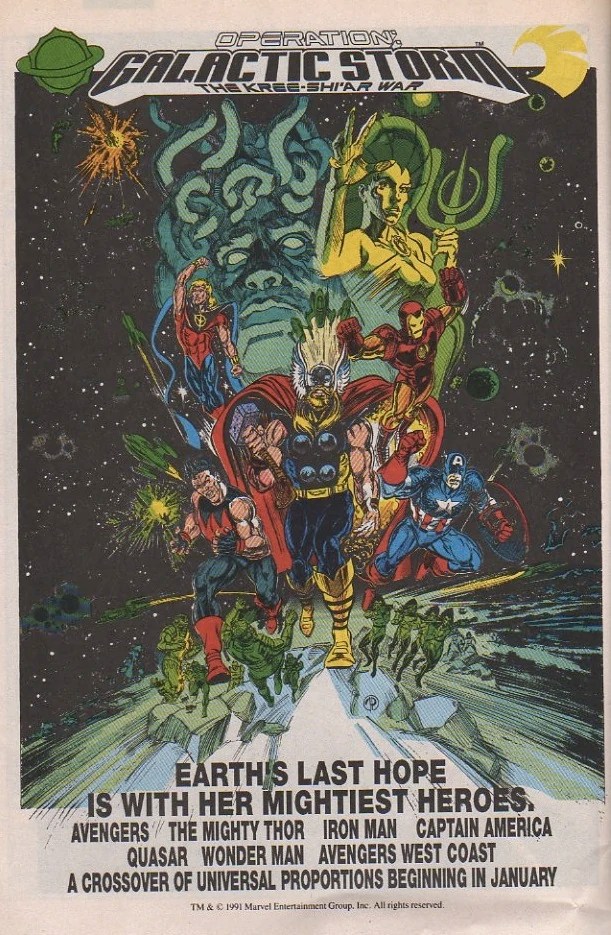
Twenty years now … where’d they go? Twenty years … I don’t know. I sit and I wonder sometimes where they’ve gone. Regardless, twenty years ago, the House of Ideas gave us one of the last truly great crossovers in the Avengers universe: Operation: Galactic Storm. A 19-part maxi-series (not counting the prologue and epilogue issues), Operation: Galactic Storm is an interstellar masterpiece of storytelling precision, daring yet consistent characterization, and climax and dénouement rarely surpassed in what the denizens of Highbrow Street call “literature.” Best of all, perhaps: it’s a great story. I don’t know how 20 years have passed since I first delighted and dismayed through its greatness, but I could tell even then it was truly something rare and wonderful. Even though it is longer than X-Cutioner’s Song, the X-Men crossover we reflected upon last season, it is better paced, has no filler parts, has a larger cast, and tells perhaps a better story on an even larger scale. Let us travel back now to a simpler time and delight ourselves once again (or for most of you, for the first time — a journey you won’t regret, especially if you go out and get the two volume TPB collection to read for yourself) in the magnificence that was, is, and always will be Operation: Galactic Storm.
By “Interlude” we mean “Prologue”
The unofficial prologue to Operation: Galactic Storm begins (for me, if no one else since it’s not in the first TPB) in Avengers 344, “Echoes of the Past.” The majority of the issue is the continuation of a confrontation between the Avengers (which had recently had a roster change as it so often has during its 50-some year existence…where has that time gone?) and an old teammate thought dead now returned (not as uncommon in the Marvel Universe as one might suppose).
Perhaps the most intriguing aspect of this issue is its position in Avengers history and future, augmented by its own self-awareness of its position in that spectrum. The old Swordsman is back, apparently, though he is unstable and antagonistic to his former team, just as old friends are back (also unstable but not quite as antagonistic): Crystal the Immortal has joined recently, Sersi the Eternal is back, and Thor has recently been born anew in Eric Masterson, soon to be called Thunderstrike, bridging past and future. As Dane Whitman, the current Black Knight, is confronted with part of his past, so too Sersi suffers from an identity crisis. Even in the Avengers’ kitchen, past and present collide as Jarvis’s cooking and authority is questioned for the first time by Marilla in an amusing (if not familiar) comic relief break during the danger and uncertainty the other Avengers are experiencing elsewhere at that moment. The issue presages the storyline of Proctor and the Gatherers, though we aren’t sure of their connection to Sersi until several issues later — a conflict that affects the Avengers for some time, making it a fitting beginning for such a transforming crossover.
The self-awareness of the issue is most overtly seen in the three interludes (though one of the interludes is at the end of the issue, and should probably be an “epilogue” or “postlude”) sprinkled throughout, hinting at terrible and catastrophic things closer than we think: aboard intergalactic solar observatory Starcore, Dr. Peter Corbeau — Marvel’s go-to interstellar genius, roommate to Bruce Banner, friend to Charles Xavier — discovers the sun is close to going nova. You know you are in trouble when Uatu shows up all worried. What worries him, we now know, is the arrival of one of the greatest crossovers of all time: Operation: Galactic Storm. These three “interludes” are the only connection in the issue to the crossover, so it is understandable most people don’t consider this issue essential to the story. Though the intergalactic winds of the storm are not fully swirling, they are starting to gather on the horizon.
Part One — Captain America 398, “It Came from Outer Space”

The storm begins with a disastrous premonition: the Kree Empire is going to explode and only Captain America is going to survive … but it’s not Captain America — it’s the deposed leader of the Kree, the Supreme Intelligence. It’s all a dream, of course, but it’s a startlingly disconcerting way for the crossover to begin. Rick Jones, former friend and ally of Steve Rogers, is the sufferer of this portent, hundreds of miles away from Captain America in Arizona (and hundreds of light years away from the Kree Empire). The crossover element begins already, since Rick is back with his original pal Bruce Banner (the Hulk), guesting among the secret Pantheon of near-immortals. In an effort to understand his dream, Rick is counseled to speak directly to Cap about it, despite the fact they still aren’t close friends having never fully recovered from their fallout almost 300 issues ago (which was only a few years, Marvel reckoning, according to Rick). The narrative focus shifts to Captain America once Rick contacts him, and he is only too eager to meet him and discuss the issue, since Cap is that kind of guy (at least he was, back in the ’90s).
Cap is also having his own problems at the time, including his girlfriend having just gone missing and his personal pilot John Jameson getting snippy and mildly insubordinate. These problems (which become the main thrust of the rest of the year in Cap’s series after the crossover ends) soon are forgotten as Cap joins Rick for a spot of breakfast. As is so often the case in the Marvel Universe, our heroes’ breakfast is interrupted by the arrival of an alien: this time, Warstar of the Shi’ar Imperial Guard arrives to kidnap Rick Jones for some inexplicable reason. Despite his lingering antagonism, Rick is somewhat grateful Cap is there to fight off Warstar and help him get away, though his escape is short-lived, since the rest of the Imperial Guard soon arrive to finish what Warstar started. Considering how much time Rick Jones spends getting caught up in the squabbles of intergalactic empires, his growing antagonism toward most superheroes is understandable.
The main story ends with more questions than answers, which is where the first part of a 19-part giant crossover should end: Cap is stranded in Arizona wondering what is going on and why the Shi’ar came after Rick (and what happened to his girlfriend and his pilot); Rick is prisoner of the Shi’ar, who somewhat hardheartedly consider abandoning Warstar after his failure to secure Rick; and suddenly the issue comes full circle, as the Kree Supreme Intelligence awakens after a long dormancy his android receptacle for a portion of his mighty intellect, Supremor, ready to create something called the Starforce. Perhaps the being in Rick’s dream at the beginning was Supremor and not the Supreme Intelligence … only time (and the next issues) will tell. The winds of intergalactic war are starting to swirl indeed. (The issue concludes with a continuing sub-plot of some of Captain America’s other foes, as many issues do. We shall try to limit our focus solely on the main crossover-related aspects of these issues.)
Part Two — Avengers West Coast 80, “Turn of the Sentry”

Picking up directly after part one, AWC 80 is an incredibly packed issue a decade before 24 made the time-conscious narrative popular (but over a decade after the M*A*S*H episode “Life Time”). Rick Jones’s assumption the Kree are kidnapping him is understandable, considering they are inquiring after the Kree Captain Mar-Vell, and he just had the dream about the Kree homeworld. The rapid backstory review might be confusing to readers who weren’t around to read comics in the late ’60s and ’70s like I wasn’t, but the mind of a youth reading it accepts it as a nice rapid summary of a story without even realizing it refers to earlier comics. The letters page at the close of the issue explains whence the stories came, which wasn’t too helpful back in the day, but now with the benefits of various websites and classic TPB reprints, they are much more easily attainable. After the backstory, we return to the Avengers West Coast, training and recovering from their recent run-in with the Night Shift (though no sweet sounds came down other than the sweet sound of silent victory). Their temperamental differences contrasted with the East Coast Avengers is displayed rather well, with the high tensions between exes Hawkeye and Mockingbird, Living Lightning’s hesitation and acclimation, and Iron Man’s perpetual antagonism with Captain America. The writing, especially in subtle ways (such as the “yes” connections between both narrative foci) is quite good, even for an issue still preliminary to the main conflict featuring a second extended fight scene. Avengers West Coast always strikes me as a much better series than its recognition status, which is ironically appropriate considering it chronicled a team who felt the same way (since never were the New York-based Avengers called “East Coast,” as Spider-Woman points out in this very issue).
We still do not know why the Shi’ar are interested in Kree technology and information, especially since Oracle has such a hostile reaction to being called a Kree, but that only further piques our interest in what is really going on in this crossover. X-Men fans are quite familiar with the Shi’ar and may be surprised at the Avengers’ ignorance, but it is an impressive point in favor of the realistic quality of the Marvel Universe (if such a consideration may be allowed) that not everyone has heard of everyone else, just because they all have the same publishing imprint. Cap’s concern for rescuing Rick is rewarded with a brief but good panel, which is impressively balanced with the AWC’s general discontent Cap is around giving them orders as if everyone is always automatically under his authority (as Living Lightning is quick to point out) — though he is, since he’s the Avengers CEO. The mêlée ends with mixed results: the Kree sentry and outpost are destroyed, but the Shi’ar get away with the Psyche-Magnetron (a matter-reshaping device), no one knows what their plan is, and Rick Jones’s fate is unclear (though we soon find he has been rescued). To prevent their escape, Cap contacts Quasar in outer space and the narrative shifts to him at the close of the issue, demonstrating how well-plotted this crossover is. Quasar fails to capture the Shi’ar because a black solar flare interferes, tying in nicely to one of the “prologue interludes” from Avengers 344. The final panels bring the issue full-circle, as we return to the tomb of Captain Mar-Vell and the ominous revelation someone else is there, too. “Are we in for a Kree/Shi’ar War this time?” Cap asks, not wanting to know the answer. Hold on, Cap — you ain’t seen nothing, yet. This storm is just getting started.
Part Three — Quasar 32, “The Tomb of Mar-Vell”

Continuing the impressive narrative concision of this crossover, Quasar quickly shifts from failing to stop the Shi’ar from departing to connecting with the Starcore crew, learning from them what the readers found out back in Avengers 344: the sun is suffering egregious deleterious effects from the warping of space, an example of which Quasar has just seen for himself. It is mildly bemusing Dr. Corbeau is not in this issue, but the information is transferred in any event.
Quasar travels to Mar-Vell’s tomb (having been sent there by the Avengers after learning of the disturbance at the tomb hinted at the end of AWC 80). There, he rendezvous with another interstellar Marvel denizen, Starfox the Eternal, resident of Titan. Someone is breaking into Mar-vell’s tomb. The “someone” is actually two people: Captain Atlas and Dr. Minerva, the Kree’s go-to scientists and troublemakers (and love interests). Captain Atlas admits to Quasar and Starfox the Kree are indeed at war with the Shi’ar, and they are there to retrieve Mar-vell’s Nega-Bands, essentially to keep them out of Shi’ar hands (somehow they already know the Shi’ar have the Psyche-Magnetron).
During all this, Quasar and Starfox engage in another massive battle, the third in as many issues, each bigger than its predecessor — yet, somehow, each battle is well-scripted, well-paced, and well-received. Never does one get the feeling of “oh yes, another ‘epic’ battle — must be a crossover.” Each battle features different combatants, though all have been against the Shi’ar Imperial Guard, which makes the trio even more impressive. The surprise twist to this battle (I shan’t spoil it for you) is especially clever, abetted by its discovery not by our hero but by Dr. Minerva, an antagonist. The battle also showcases the first of this crossover’s many two-page “splashes” (as they are called in the business), each one an extraordinary display of artistry and emotional impact.
Meanwhile, in the Kree Galaxy, another seemingly-unconnected event occurs. A brilliant scientist, more aware of the decay and decadence growing in the Empire (in part because of the recent accession to power by the current rulers of the Kree, whom the scientist considers usurpers of the former ruler, the Supreme Intelligence we’ve heard so much about lately), unofficially exiled to a backwater planet, has not stood idly by but has instead continued his pursuit of cyber-genetic engineering. He tries out his work on himself, transforming into Korath the Pursuer, a mighty power intent on shaking the Kree Empire “to its foundations!” The plots and sub-plots start to ravel.
The narrative concision and precision of this series, as we have and shall continue to iterate, continues unobtrusively, as demonstrated during the major mid-issue battle scene: the action breaks to return our attention back to the Avengers West Coast at their Compound, where Captain America and the AWC discuss with Rick Jones (somewhat one-sidedly) what to do with him (ending the confusion of his whereabouts somewhat glossed over in AWC 80). Unwilling to return Rick to the Hulk just yet, Cap entrusts him to the 24-hour care of Simon Williams, a.k.a. Wonder Man. Meanwhile, as Quasar and Starfox bring the mighty battle to a conclusion (aided indirectly by Dr. Minerva, who virtually finishes the fight single-handedly), Captain Atlas recovers Mar-Vell’s Nega-Bands and makes Wonder Man’s job a whole lot more difficult: with a simple clang, Captain Atlas escapes Quasar and Rick Jones appears in his place — about to suffocate and explode in the vacuum of space! (Talk about your intense endings!) It’s a great issue, with humor (Quasar: “So where are the tomb-raiders?” Starfox: “In the tomb, I’d imagine.”), philosophy (Captain Atlas: “It is the mind that matters, not its house of flesh.”), a great fight scene, vulnerable heroes, dangerous villains, intriguing movement in all plot strands while adding more, an impressive two-page splash, and an intense ending demanding the reader dive into the next part of the series.
Part Four — Wonder Man 7, “Shared Space”

Picking up immediately where Quasar 32 left off, fortunately for Rick Jones, Captain Atlas begins his barrage against Simon Williams, demanding to know where he is. Wonder Man responds in kind, demanding to know where Rick Jones is. Neither is happy with the answers: Atlas is disgusted with being on “this backwater planet,” and Simon is disgusted with his immediate failure in his bodyguard role (as well as disgusted by the stupid Kree names).
Again the smooth flowing nature of the crossover is demonstrated well here in the language connections of the narrative shift oscillations: Wonder Man asks about “Nega-Bands” in one panel and the next shows Quasar, still at Mar-Vell’s tomb, responding to Rick with “What do you mean, ‘Nega-Bands’?” For a time, Rick is the only person who knows what is going on and explains to Quasar how the Nega-Bands allow the wearer to trade places with him (see AWC 80).
The title of the issue, “Shared Space,” is rather intelligent, considering all the layers of narrative to which it applies: immediately, Captain Atlas and Rick Jones “share space” thanks to the powers of the Nega-Bands; likewise, the primary reason the series occurs (other than a kairotic metaphoric treatment of the first Iraq War) is because the “shared space” of the Terran solar system between the Kree Empire and Shi’ar Imperium is in danger thanks to their stargate usage. In smaller, subtler ways, the title also relates to the continuing Wanda/Vision/Wonder Man conflict, as the personality/identity of Simon Williams is still a matter of “shared space” between the Vision and Wonder Man, and Wanda herself is a kind of “shared space” (in no demeaning way). Similarly, both the East and West Coast Avengers conflict over the “shared space” of Avenger name and identity. Simon’s inability to “share space” with his girlfriend adds to the genuine pathos of the conclusion of the issue, as Simon can’t ever find a way to live a “normal” life. This is an impressive, tightly constructed issue from title to conclusion.
The majority of the issue is another battle scene, yet once again the creative forces behind the series have come up with another interesting variation. Here, it is an extended duel between Wonder Man and Captain Atlas, which may seem dull in a prose summary, until one knows the particular twist on what could have been a conventional comic book trope in lesser creative hands: once Atlas figures out the transposition side-effects of the Nega-Bands, he utilizes them in an unusual hit-and-run strategy until Wonder Man figures out a successful countermeasure. It takes Simon some time, considering every time he winds up to smash Atlas in the face, before his hand connects Rick appears where Atlas just stood. Simon’s countermeasure, essentially aligning his windup with Atlas’s timing, results in the second great two-page splash of the series: one of the biggest, most memorable knockout punches in the history of comicdom. It’s mighty impressive.
In the lengthy conclusion to the issue, Wonder Man 7 continues the integration of multiple plot strands: Rick is finally returned to the Hulk (after a nice resolution to his conflict with Wonder Man, if not entirely sincere), Simon spends some time with his personal life, Scarlet Witch’s continual friction with Simon is given a few nice lines of dialogue, and Cap sets up the next issue by arranging for all Avengers (even reservists) to join him in New York. Additionally, the next in the series of Kree warriors is called by the Supreme Intelligence: this time it is Ultimus, the Demon Druid who has been hanging around in the misty back alleys of the Marvel Universe since 1973. Playing on familiar elements of the series, the issue does so in different and engaging ways. Even the time spent with Wonder Man’s supporting characters is fresh, in that we see Simon experience some of the psychological trials of being a superhero, wondering if he will ever return from the latest intergalactic mission, wondering if he will ever have the chance to enjoy a “normal” life, as mentioned above — an enjoyably refreshing close to the issue, considering Simon spends so much of the time hiding behind a façade of bravura, especially among his fellow superheroes. This pathos is made especially poignant when the narrative focus shifts to Simon’s landlady, who supposes he is flying off to some incredible adventure giving her a vicarious thrill she would be only too glad to know a posteriori. That she doesn’t understand his own hesitancy and despondency only adds to our own empathy with Simon: how could a superhero be embarking upon anything other than a grand adventure?
With the Avengers finally making some positive progress (capturing Captain Atlas and Dr. Minerva, gaining some intel on what is going on), the pieces are in place for the next major developments of the story … and suddenly the scene oscillates again to Starcore, where Dr. Corbeau is leading an emergency evacuation of the entire crew — a solar flare is about to destroy Starcore! The storm winds are turning into a mighty gale.
Part Five — Avengers 345, “Storm Gatherings”

Some time passes: Rick Jones’s time on stage is complete (much to his relief), and Captain America returns him (behind the scenes) to the Hulk, presumably on his way back to Avengers Headquarters in New York (ahead of the West Coast Avengers who are still preparing to rally later). Additionally, enough time has passed for the Avengers to rendezvous with Quasar (leaving Starfox and the captive Kree tomb-raiding twosome at HQ) and send an away team to respond to the emergency broadcast from Starcore. This brief reconnaissance trip produces an important secondary effect: Eric Masterson, the newly-made Thor, gets to test his powers and succeed at something — though he still needs more practice both in wielding his powers and coalescing with the Avengers (an already testy bunch at this point, considering everything going on lately). The moment the Avengers ascertain the Starcore crew is safe, the Shi’ar create another space rift, this time with an entire armada of warships on their way to the Kree Empire. The main Shi’ar vessel identifies the Avengers and, after some intriguing philosophical and ethical debate, opens fire. Quasar sends the Starcore crew to safety, and we never hear from them (or this armada, strangely enough) again.
Meanwhile, the impending conjunction of both coasts of Avengers fills everyone with discomfort. Crystal is uncertain which worries her more: intergalactic war or “being reunited with [her] estranged husband’s sister,” to which the Black Knight responds for us all: “It’s nice to know you can keep things in perspective. Then again, choosing between an angry Scarlet Witch and a space battle with little green men, I think I’d vote for the battle.” Understated mistrust and dissension runs through the team before they even leave home. Cap, too, is unsettled at the thought of so many Avengers together, lamenting the long-gone days of a small team and simpler problems.
The latest battle is again unique: this time, the four Avengers in outer space combat a Shi’ar warship, an unusual pairing for a fight. The commander of the warship, who advocated attacking the Avengers, turns out to be the shape-shifting Hobgoblin of the Shi’ar Imperial Guard, complicating the issue even further. Soon, Dane’s remark about Wanda is frighteningly applicable to Sersi: she has every intention of moving in “for the kill,” disturbing Quasar with her sheer brutality.
As can be expected, Captain America’s response learning of Sersi’s threat is not one of delight. Before the war commences, Avenger is pitted against Avenger, morality pitted against pragmatism. “It’s a slippery, muddy road once you being making death threats and incarcerating people … and I don’t want to see the Avengers … despite the best of intentions … get caught in the muck,” he says. Hank Pym has shrunk Dr. Minerva, Captain Atlas, and the crew of the Shi’ar warship (after the praetor surrendered) down to portable size. (Presumably, the crew of Starcore has also been rescued by now. The armada, apparently, went to wait out the war, not directly assault the Kree.)
Once the tempers cool, the Avengers get down to business: getting the Shi’ar and the Kree to stop their war. Mockingbird raises the good point: what right do the Avengers have to tell those races how to live (the parallel to the first Iraq War becomes clear, though it wasn’t clear to me reading it for the first time when I was 11). The Avengers, though, have an impeccable reason for urging the cessation of the conflict: the sun will go nova if the war continues. Instead of just acting like the police officers of the galaxy, the Avengers are compelled by pragmatism more than a personalized version of morality (this makes it easier for the creative team to prevent philosophical or religious backlash, though it would have been interesting had they sent the Avengers to do it simply “because it was the right thing to do”).
After much behind-the-scenes deliberation (most likely while the space quartet brought the Shi’ar warship back to Avengers headquarters), Cap separates the Avengers into three teams: one envoy to the Kree, one to the Shi’ar, and a reserve team to guard the home front. After an odd side scene of part humor and part antagonism, Hawkeye finds a way, thanks to Hank Pym, to switch from the home guard to the Kree team, much to the chagrin of U.S. Agent, who now has to stay behind, adding to the dissention in the ranks. Quasar stays behind to send the two teams to their destinations and resume his main rôle as Protector of the Universe (keeping an eye on the stargates).
Continuing the pattern of ending with a shocking epilogue, we oscillate for the first time to the Shi’ar homeworld. Fans of the X-Men are certainly familiar with Lilandra, Empress-Majestrix of the Shi’ar Imperium, and the burden of rule she constantly bears. Though she, too, expresses dissatisfaction with having to go to war, she, as most rulers seem to do, can find no alternative. We still don’t know what particular issue is driving this conflict, considering the Kree and Shi’ar more often travel different orbits in the Marvel Universe, or to what act of vengeance Lilandra refers, but the weight of the no-longer-impending conflict is about to reach its tipping point. The shocking epilogue this time is the arrival of Deathbird, Lilandra’s older sister, hinting at mysterious failsafe devices Lilandra not-so-covertly has up her long, metallic sleeves and offering a more palatable conclusion to the conflict in ways only the conscience-unencumbered Deathbird can provide. The winds of war just got quite a bit chillier. It’s a pragmatic sort of issue, featuring arguments about pragmatism and fulfilling the function of an intermediary issue, drawing the exposition to a close, setting the stage for the main conflicts ahead. Considering all the tensions among all the combatants, we know it is going to be a powerful ride.
Part Six — Iron Man 278, “Decisions in a Vacuum”

With the extended exposition complete and the instigating event of the teams splitting up for the Kree and Shi’ar galaxies recently occurring, the rising action begins. As Len Kaminski (writer of this issue) declares: “Now’s when things really get interesting.” With three main groups of characters to balance in mind, the planners of the series intelligently split up the teams to match the series in which the story occurs: in Iron Man 278, here, we focus on the Kree Empire away team of Iron Man, Captain America, Sersi, Hawkeye (as Goliath), Black Knight, Hercules, and Crystal. The team arrives in the Kree Empire and encounters a giant space station (it’s no moon). The lack of like-mindedness evident in Avengers 345 continues to rile the team from the beginning, as not everyone agrees they should land and investigate. Even as they work their way into the station, the Avengers can’t stop verbally sniping at each other, despite the gravity of the situation. Since it is Iron Man’s issue, much of the focus is on him; we even see from his computerized perspective in his spacesuit-version of his armor. Despite Captain America being the leader of the team, Iron Man takes the initiative to tear his way into the Kree communications network, using his computer technology to reconnoiter their situation and investigate the best way to get where they need to go next.
Meanwhile, the Supreme Intelligence, aware the Avengers have entered Kree space, orders the completion of the last member of his hand-picked Starforce: Shatterax, the Borg-like combination of Kree person and computer exoskeleton weapon. Everything is falling into place, says the Supreme Intelligence — which can’t be good for the Avengers.
While Iron Man spends precious time hacking his way through the Kree protocol network (keeping in mind this story was written in 1991, only months after the inauguration of the World Wide Web and four years before the commercialization of the Internet), the Avengers lollop about until suddenly attacked, surprisingly, by Shi’ar Commandos. What is even more confusing is the Shi’ar disintegrate when defeated, adding much mystery to the situation. While the Avengers hold off their improbable foes, Iron Man works through the Kree network to discover Shatterax is on his way to either arrest or execute them. Instead of explaining this to the Avengers, Iron Man takes off to intercept him on his own, irritating Cap to no end (not for the first time, and certainly not for the last — Cap’s frustration is one of the few humorous moments of the issue, as we totally empathize with Cap when he says “I hate it when he does that!” as Iron Man flies away). The interesting thing is, even though Iron Man may be violating protocol and ignoring his leader, he is doing the right thing for the needs of the situation. He truly does not have time to explain it to Captain America.
Shatterax arrives and joins Iron Man in combat, the latest battle with a twist. It’s a duel, like Wonder Man versus Captain Atlas, but this time it is a fully airborne assault, with long-range computerized weaponry. Despite his bravado, Iron Man can’t do very much in combat in his spacesuit. Despite his trickery and tactics, Iron Man is no match for Shatterax, a living weapon. It’s an intense battle, despite its brevity, made more thrilling by the perspective of seeing out of Tony Stark’s eyes inside his armor: we assess his status and the situation with him during the battle.
As Iron Man assesses his options, we learn why the issue is called “Decisions in a Vacuum,” though there really is only one decision to be made. In a clever narrative oscillation, we return to the rest of the Avengers who have defeated their foe and await whatever is next. We share their surprise as the next thing they see is Iron Man a manacled captive of Shatterax. Iron Man has surrendered the Avengers to the Kree Empire. The bickering between Cap and Iron Man heats up again under their breaths, but despite Cap’s irritation, Iron Man is right again: if he hadn’t done what he did, they may not have survived. At least now they have that slim chance….
It’s a fast-paced issue with little narrative depth, but it gets the job done well of moving the characters to where they want to be, sprinkling enough brief character moments and tensions to keep the multiple conflicts alive and enjoyable. Things are not going well for the Avengers, but they are going extremely well for the reader of this magnum opus.
Part Seven — The Mighty Thor 445, “The War and the Warrior”
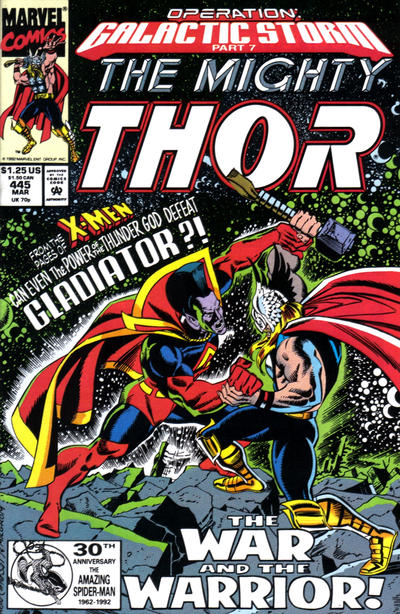
Concurrent with Iron Man 278, Thor 445 shows us the Shi’ar away team: Thor (Eric Masterson), Wonder Man, Vision, Scarlet Witch, Captain Marvel (Monica Rambeau), Starfox, and the Living Lightning, young recent recruit of AWC — certainly an odd group for such an important mission, but as all recent issues have shown, the Avengers are currently experiencing as much stress and instability as the sun is. After a brief comical moment of the Scarlet Witch landing on Thor’s arm, the issue gets serious. The Avengers stumble on a Shi’ar world under attack by a Kree starfighter. Before its destruction, the world sends a distress signal to the homeworld, intercepted by Gladiator, the nearly invulnerable leader of the Imperial Guard, who assumes the Avengers are guilty and starts to attack them. Before he arrives, Captain Marvel and Living Lightning investigate the remains of the Kree starfighter, only to find a Skrull — hated enemy of the Kree — onboard. The mysteries increase. The pair of flyers evacuates the ship just before the Skrull destructs it.
In contrast to the big splashes of previous installments, this issue does some of its finest work in small 3”x3” panels. One of the best is on page 6, as Starfox and Scarlet Witch simply turn to Thor in response to his query “Who’d be dumb enough to try such a crazy stunt [like intercept Gladiator]?” The minimalist approach works brilliantly. Wonder Man volunteers for the job, brusquely dismissing the young replacement Thor who is “obviously out of his depth,” though he soon regrets being so harsh to the guy. Despite his attempts at diplomacy, Wonder Man has already done his duel in the series, and Gladiator quickly disposes of him while Thor broods over his own cowardice and insufficiencies. In another series of minimal yet rich panels, Thor stops Vision from taking his place a second time. Letterer Michael Heisler does a tremendous job sizing Tom DeFalco’s great writing, matching the intensity of Thor’s resolve with the quietness of his utterance. With a powerful kamikaze dive and ¾-page splash into Gladiator’s back, Thor joins the fray and regains the central narrative focus of his own issue.
The third quarter of the issue is dominated by the duel between Thor and Gladiator. In contrast to the short-lived outer space battle between Shatterax and Iron Man which approached Iron Man’s deficiencies in an almost ascetic, computerized manner, this present duel is a philosophical treatise on the morality of war and the role of the warrior (hence the title of the issue). Thor is powerful yet inexperienced; Gladiator is powerful and thoroughly experienced. Thor jokes and attempts to distract with sarcasms; Gladiator waxes on the horrors of war and the duty of warriors (in contrast to the poets who glorify war without having experienced it). Both are defending their homeworlds; neither is motivated to care for the other’s. Thor is driven by a need to prove himself; Gladiator is driven by his responsibility to his people and his duty to his Empress. It’s an impressive conflict, again forcing the reader to think through the ideas being contested, as we start to realize Gladiator is right, but his unwillingness to care for Earth as well as his own people taints his moral superiority. The inexperienced Thor has no chance against Gladiator, until he sees Living Lightning escaping from the Kree starship. Using the Asgardian power of Mjolnir, Thor summons Living Lightning to crash into Gladiator, stunning them both. With one mighty full-page splash, Thor drives his Uru hammer into Gladiator, knocking him out.
Unfortunately for young Eric Masterson, in order to beat “the monster,” he starts to become “the monster.” Borrowing Gladiator’s own language, he starts railing on about his own duty to his own people, including his own loved ones, and how they are more important than Gladiator’s Shi’ar people, and how he will come after every single terrorizing bully who claims to be superior or endanger others with war — all the while pummeling the unconscious Gladiator with his hammer.
Fortunately for young Eric Masterson, Wonder Man recovers and prevents him, with Vision’s help, from killing Gladiator. While Captain Marvel learns how to reach the Shi’ar homeworld, Living Lightning forces Thor to ponder the morality of using his teammate without respect, even for what appears to be “a good reason.” If they have to resort to the tactics and moral stance of their enemy, are they truly any better? Thor isn’t quite ready to listen, though, and impulsively sends Gladiator through the Shi’ar stargate, using Mjolnir to seal it closed forever, imploding their only path home, yet enabling them perhaps to complete their mission.
While using the information Captain Marvel gathered to get to the Shi’ar homeworld, the Avengers debate briefly the morality of choices made in “total war,” and whether “no sacrifice is too great.” Captain Marvel is not for it, holding to the stance the Avengers are “supposed to be the good guys,” and thus should be above the “all’s fair in love and war” mentality. Living Lightning, one of the new recruits in the new generation, is starting to come around to Thor’s side, though. The chasm between Avengers is ever widening. The debate is curtailed suddenly as their starship is suddenly surrounded by an entire Shi’ar fleet. Things are just not going well for them in any galaxy. It’s a thought-provoking issue, despite the assumptions the reader immediately makes about it being a simple “muscle-bound blockheads engaging in senseless battle” story from the cover. Serving to progress the story along and move the characters where they need to be, the issue asks more questions than it answers, while forcing us to examine the Avengers and their motivations and morality not just for this mission but for their very existence.
Part Eight — Captain America 399, “Twenty Million Light Years from Earth”
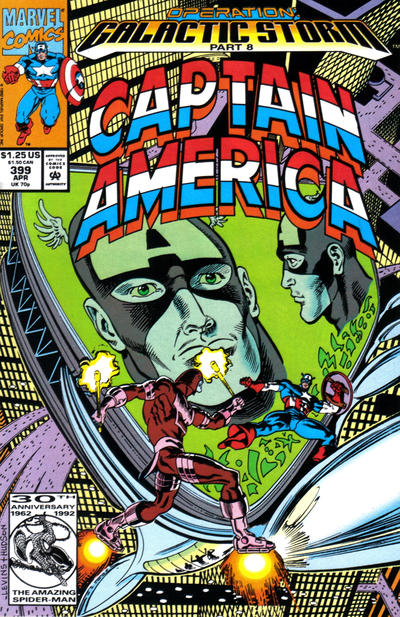
The Kree Avengers team arrives at Hala, the Kree homeworld — prisoners. The bickering between Cap and Iron Man hasn’t stopped, and Cap won’t concede Iron Man got them to their destination in one piece, since it wasn’t the way he wanted. Since it’s his issue, Cap’s internal monologue drives most of the narration. Almost immediately, Shatterax is forced to hand the Avengers over to Ronan the Accuser, equivalent to the chief of police for the entire empire, once Ronan is finished dressing him down in front of everyone. The Avengers take the opportunity in the embarrassing confusion to make a break for it, propelled by Sersi’s matter-transformation magic, disguising them in Accuser uniforms. Shortly into their getaway, Iron Man pulls rank on Cap again (being a founding member of the Avengers, regardless of whoever is field leader) and splits away again to fly reconnaissance. Hawkeye joins him, and the team is effectively split up again. Nothing seems to be going right for them during this critical mission.
Meanwhile, the Supreme Intelligence’s diverse team of warriors finally gathers in another corner of Hala for the first time. Like the Avengers, this team is disunified, though with much better reason, having been mysterious called individually by a disembodied voice, not a long-term team of superheroes willingly banded together to fight injustice. Supremor, the host for the Supreme Intelligence, joins the disparate band (Ultimus, Shatterax, and Korath) and provides them with purpose: help the Supreme Intelligence regain the throne — exactly what the Avengers didn’t need.
The rest of the Avengers wander through the main city of the Kree homeworld, observing the squalid conditions of the oppressed underclasses. Iron Man checks in to direct them where they need to go next, and the Avengers naturally hijack their own flying wanted billboard/zeppelin to do it. The only thing standing in their way now is Korath, who finally gets some action. The duel in this issue is brief and reminiscent of the fight between Shatterax and Iron Man, but it is distinct in that Captain America is not a naturally airborne combatant. Instead, he uses his acrobatic skills to defeat him in midair through quick energy and using Korath’s weapons against him. With a little assistance from Dane Whitman, Cap shakes Korath off (for now), and the Avengers head to their rendezvous with Iron Man. It’s a short, mostly fast-paced issue, since the final five pages of the issue are given to a supporting story. The fast pace helps keep it interesting, along with the progress of the Starforce finally gathering together. The continuing antagonism between Cap and Iron Man is potentially leading to something disastrous, which even Hercules can sense. At least they have managed to escape captivity, so something is going right.
Part Nine — Avengers West Coast 81, “They Also Serve…”
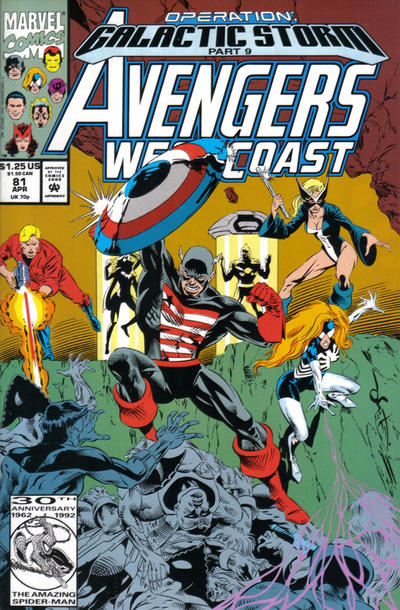
Back at the ranch (the “ranch” being Project Pegasus in New York and not either Avengers Headquarters), U.S. Agent is still irate Hawkeye usurped his place and is taking it out on, of all people, She-Hulk. That tells you everything you need to know about John Walker, U.S. Agent (and why he’s not Steve Rogers, Captain America). Most of the home guard aren’t happy about being left behind (especially the active Avengers East and West) except for Gilgamesh, who is pretty relaxed most of the time. Prevented from coming to blows (barely), Agent is reminded he and Mockingbird are supposed to be guarding the miniaturized prisoners. Agent proves he really isn’t pretending to be a jerk when he tells Mockingbird the reason he wanted her on the AWC: “even if you can’t really do all that much, you’d sure improve the scenery” (emphasis in original). Yes, ladies, that’s John Walker, superhero, circa 1992. Mockingbird does the right thing and flips him over onto his backside. Before their discussion can go further, Nightside of the Shi’ar Imperial Guard shows up, stuns them, and proceeds to release the captives with the help of her miniaturized teammate Scintilla. We knew it was going to be one of those days, Miltonian allusion in the title notwithstanding.
The Shi’ar Imperial Guard rarely get the chance to demonstrate their (for lack of a better word) humanity, especially in their distinct personalities, since they are usually shown in a combative sense, but these few panels showing some of their interaction (just like in the previous AWC issue) are impressive and enjoyable character moments, making it more difficult to think of them as “the bad guys.” Before they can fully rescue their comrades, She-Hulk stumbles onto them while attempting to apologize to U.S. Agent and manages to peal the classic rallying cry “Avengers Assemble!” before getting knocked out. It’s not really a battle this time, since the Avengers overpower the Shi’ar fairly quickly. While this rapid action ensues, Dr. Minerva and Captain Atlas escape from their imprisonment and miniaturization and make good their escape. Or do they….
Once the Avengers realize the Kree have escaped, they chase them to no avail. U.S. Agent takes the opportunity to cement his impulsiveness by jumping on their getaway spaceship, under the delusion he is Indiana Jones, but the Kree shake him off quickly. Spider-Woman and She-Hulk break his fall, saving his life, to which he responds with an antagonist barb at the East Coast Avengers. That’s the spirit, John.
Onboard the escaping Kree vessel, Captain Atlas is confused why Dr. Minerva is taking them to rendezvous with a Shi’ar starcruiser. Atlas is further confused by the presence of the Imperial Guard. Confronting her, Atlas is shocked to find Dr. Minerva is actually the Shi’ar Hobgoblin, whom last we saw causing a to-do on the Shi’ar craft in Avengers 345. With Captain Atlas in their power, the Shi’ar finally get Mar-Vell’s Nega-Bands. This cannot be good.
Back in New York, Mockingbird discovers the real Dr. Minerva, who tells them what just happened. She helps the Avengers solely out of revenge against her enemies. She-Hulk contacts Quasar to intercept the Shi’ar vessel before it’s too late … and he fails a second time, though it’s not a solar flare that prevents him this time: it’s Starbolt and Neutron, who stay behind to allow the starship to get the Nega-Bands to Lilandra, propelling the action straight into Quasar 33. It’s a good “home front” issue that manages to propel the main story along as well, a rare, impressive feat.
Part Ten — Quasar 33, “Spatial Deliveries”
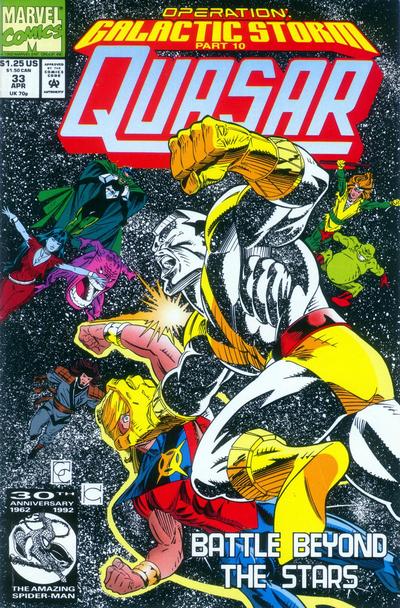
Half-way through the epic crossover, Quasar is given another transitional episode. His repeated failure at preventing anyone from using the stargates makes wonder why exactly he was left behind, since he isn’t doing much good — not that we blame him or doubt his efficacy as Protector of the Universe: one being against two interstellar fleets is a bit much to ask. With help, he effectively defeats Starbolt and Neutron, though too late, using what is becoming standard Avenger tactics: hit-and-run maneuvers combined with warping his enemy away from home. Quasar manages to track down the Shi’ar vessel, but not before they drain Atlas of information and beam the Nega-Bands back to the homeworld (hence the title “spatial deliveries”). Page 9 of the issue clarifies what appeared to be a dropped plot thread in AWC 81: the Shi’ar rescue team did escape the Avengers, most likely while they ran out to see U.S. Agent prove he’s not Indiana Jones (or even Encyclopedia Brown). It’s tough to outmaneuver alien empires with interstellar transportation capabilities.
The middle of the issue is a bit awkward, though it matches Quasar’s awkwardness in a way: barging straight into the Shi’ar vessel, Quasar demands the return of Atlas and the Nega-Bands, threatening (as he learned from Sersi in Avengers 345) to take them all on. Unfortunately for Quasar, he is dealing with the Imperial Guard this time, not a crew of mortal Shi’ar soldiers. As mentioned above, he is already too late to do anything meaningful, so he takes Atlas and heads to the heart of the Shi’ar Imperium in an attempt to regain the Nega-Bands.
The scene oscillates to Chandilar, throneworld of the Shi’ar, picking up the trail from Thor 445. Thor gratefully lets Captain Marvel do the negotiating with Prime Minister Araki, until his newfound impudence rears its head again. Continuing his descent into Gladiator-mode, Thor threatens to bring the planet down around their ears, infuriating everyone. Thor defends himself with the “it got the job done” reasoning, sliding further into pragmatism and away from the moral high ground the Avengers are quickly abandoning.
Just outside, Quasar has made his way to Chandilar with Captain Atlas in tow. Continuing the unusual nature of the issue, Binary (the former Ms. Marvel, Carol Danvers) shows up to confront Quasar; though she is a Starjammer (enemies of the Imperial Guard), she is working with the Imperial Guard in the effort to delay Quasar’s interference. The Imperial Guard captures Atlas again, though Shatterax rescues him at the close of the issue. Soon Quasar gets hoisted on his own petard, as the Imperial Guard do to him what he just did to Neutron. With Quasar out of the way (for now), Lilandra learns the secret experiment with the Nega-Bands is now a success: billions of Kree are in serious trouble. The odd, unexplained elements mar the issue somewhat, but the story moves along and increases in menace. The Avengers continue their descent into misrule and can’t manage to do anything successfully, but the readers are still treated well with a high-quality story.
Part Eleven — Wonder Man 8, “Death Adrift”

Staying in the Shi’ar Imperium, the focus returns to the Avengers. Some brief time has passed, since the Avengers have finally been allowed to meet Lilandra, who is overseeing the departure of the tool designed to end the war: the Nega-Bomb, though she is telling everyone it’s just a portal. The question of morality is raised again throughout the issue: first, Corsair refuses to be a part of it. Lilandra’s response is reminiscent of Gladiator’s: is the safety of one planet more important than an empire’s security? The rest of the Starjammers agree with Lilandra and accept the commission to tow the Nega-Portal into the Kree Empire, though they worry about losing so many crewmates (explaining the confusion in the previous episode why Binary was with the Imperial Guard and not the Starjammers). Simon Williams, Wonder Man, though, will have none of it: he knows what it truly is. Grabbing Vision, he leaps onto the departing Nega-Bomb, ignoring the pleas of the remaining Avengers. Nothing good seems to happen when the Avengers act impulsively.
The rest of the issue is a marvelous two-fold philosophical treatise on the nature of humanity and the morality of war from the soldier’s perspective. Vision, ever the unemotional rationalist, cautions him against trying to disrupt the bomb: it would be more efficient to let the Shi’ar win this way. “I won’t let people die in the name of efficiency!” is Wonder Man’s response. Compounding his frustration is his continued battle with the loss of his humanity. Vision used to be based on Simon’s personality, giving Simon a tenuous hold on his humanity (it’s complicated, but their discussion throughout the issue makes it far more lucid than a brief summary could here) which is increasingly dissipating. Dying and being reborn as an ionic entity does that to people.
The Starjammers realize they have stowaways, and the second philosophical discussion begins (after a brief brouhaha and another two-page splash). Wonder Man soon calms the Starjammers down long enough to explain the situation to them: they aren’t ferrying technology to aid the war effort; they are ferrying a bomb big enough to wipe out the entire Kree Empire, destroying billions of lives — can they live with that? will it be enough to say “I was just following orders”? Wonder Man does not tell them what to do; he does not foist his definition of war morality on them. Instead, he does what no general ever does for his troops: he gives them an accurate understanding of what they are being asked to do and then gives them a choice. The entire discussion is worth reading and debating, especially during an age of modern warfare.
The Starjammers choose not to taxi the bomb to its destination, willing to risk Lilandra’s wrath over their own seared consciences. Hastily, they sever the ties between their ship and the bomb, leaving Wonder Man and the Vision trapped in Shi’ar space adrift on the universe’s most dangerous weapon. Though lesser readers will see this as a political diatribe against war-happy/-hungry presidents (the same dull-witted folk who thought M*A*S*H was merely a mockery of the Vietnam War), better readers will recognize this as a philosophical inquiry into the connection between morality and war. If there isn’t one, there’s no hope for war (and those who love it). If there is (and this issue acknowledges there is), war must be waged morally — the best way to do that, perhaps, is to give the soldiers the same information the leaders/generals have. Deception, even in the name of “efficiency,” is unacceptable. As if that weren’t enough to make a rare, great comic, Simon’s continuing quest to understand and regain his humanity makes this truly a challenging, enjoyable read even by itself — which is not something often said about a part 11 of a 19-part series.
Part Twelve — Avengers 346, “Assassination”

Though the cover and title of this issue give away the ending rather boldly, by the time we get to it, we are still surprised and shocked by what happens. Back in the Kree Empire, the Avengers (minus Iron Man and Hawkeye) are poised to enter the capitol citadel of Kree-Lar on Hala. The narrator, again, is the Supreme Intelligence, and the reader is reminded from the beginning of the issue he is the grand designer of these events, or at least he thinks he is. He is the master weaver tightening all the threads, preparing to trim the loose frays, finishing his tapestry in which all the players are merely pawns deceiving themselves they have the freedom to act willfully. It’s an unnerving issue from beginning to end, even 20 years later.
The Avengers feel the disquiet and can’t help but comment on it: how could they have so easily gotten so far into the heart of the Kree Empire? Sersi, in her discordant way, likens their journey to storming the Bastille: an appropriately ironic allusion, since they are escaped prisoners about to storm the stronghold of government. For the first time in the series, we see the co-rulers of the Kree: Ael-Dan and Dar-Benn. Again, the Supreme Intelligence tells us (on page 3!) they will be dead before the day is over. The bluntness of the issue adds to its unnerving atmosphere.
Two-thirds into the series, the Supreme Intelligence tells us the “endgame” begins with the arrival of Deathbird on Hala. He has no respect for the Avengers (or any Earthers), and he has no respect for Deathbird as a person, but he does admit to some mild impressiveness with her abilities to bring death (her name is fitting) — yet we are chilled again when he intimates even though this is the “endgame” of one plan, it is only the prelude to the true “nightmare” to come.
One page later we finally see the culmination of the Supreme Intelligence’s gathering of disparate Kree warriors: Starforce is together! At least, version one. By the end of this issue, the roster will be modified already. Even with such a finely-paced crossover, once or twice a plot thread is moved inexplicably from one location to another (that it only happens a couple of times in a 19-part crossover is a testament to the fine crafting and skill of the creative teams involved, abilities seemingly lost — if not temporarily misplaced — by the end of the decade). Case in point: Dr. Minerva. When last we saw her in AWC 81, she was still a prisoner of the Avengers home guard. The partially inattentive reader will think this is a mistake: though we can guess she, too, was rescued by Shatterax, her real “escape” will be clarified in AWC 82. As with all the teams in this crossover, Starforce is disunified from their onset. Oddly enough, Ultimus is the one who urges unity based on remembering “what it means to be Kree,” which he hadn’t known he was until just recently. Though, as always when dealing with the Supreme Intelligence, we are dubious as to what he says and why. Immediately after Ultimus’s brief laud, the Supreme Intelligence tells Starforce the Avengers are here to assassinate Ael-Dann and Dar-Benn, which some readily believe, though Minerva is skeptical the Avengers are in league with the Shi’ar. They all tow the company line soon enough and head out for the latest battle in the crossover. Hercules is more right than he knows: the Supreme Intelligence does not overlook the passions of free men in his empire.
The battle is the most typical of the battles to date, and thus unique that way, but it does include one important scene. Recognizing they are outnumbered and outgunned (without Iron Man and Hawkeye), Dane Whitman makes the declaration: “It’s time for drastic measures.” That’s always the sign something horribly bad and morally bankrupt is about to happen. Dane says he’s switching his neural-sword setting to kill. Cap, naturally, is having none of it: “No! The day I countenance a move like that is the day I leave the Avengers! Understood?” Dane understands. This time. It’s a brief moment and thus easy to overlook — but don’t.
Somehow the battle leads into the Imperial Citadel, and Deathbird is already there watching from the rafters. The battle ends abruptly, though the Avengers don’t know why: Ael-Dan and Dar-Benn have arrived. Full of pompous recriminations, the pair castigate the Avengers and the members of Starforce, condemning them all to death for not operating the way they want. Cue: Deathbird. As is their wont, a force field springs up around the Avengers and Starforce, forestalling their interference. Deathbird swoops down, puts Ael-Dan and Dar-Benn in their places and sends them to their maker. We knew it was coming, but it is still starting in its swiftness and her brutality. Her exit speech is equally startling: she is willing to consider the Kree and Shi’ar even, but if they continue their assault, all the Kree will pay. It’s an issue bursting with irony and foreshadowing.
The Supreme Intelligence wastes no time in resuming his throne (metaphorically, considering he is a disembodied projection of eons’ worth of Kree leaders, thinkers, and scientists). Dane is right: now they are in real trouble. The Supreme Intelligence links in to the Kree network: instantly he blames the death of the leaders on the Shi’ar and the Avengers, declaring the Shi’ar will pay in total war and the Avengers will be put to death publically the next day. Ronan the Accuser takes over as the head of Starforce on a new mission to bring back the head of Lilandra; Minerva and Atlas stay behind to watch the Avengers. With all the pieces in place, and his master plan of resuming the throne successful, the Supreme Intelligence concludes the issue like he began it, ruminating on the life and death of billions. Despite the superiority and contentment he has instilled in his people, the Supreme Intelligence knows it is all a façade: the real conclusion is yet to come — the death of the Kree Empire. It’s a haunting issue, made more so by the distance the reader feels to the events. With the narration driven by the passively observant Supreme Intelligence, we feel even more distanced from the action than usual, like we are watching some horrible series of car crashes and explosions, knowing the worst is about to happen but we can’t look away. This sense of stasis is oddly set off by the rapid pace of the issue. It’s a chilling issue that’s tough to enjoy but impossible not to be astounded by. The winds of war are at full blast.
Part Thirteen — Iron Man 279, “Bad Judgment”

Picking up moments after the last installment, we find Iron Man and Hawkeye wondering what to do, oblivious to the Supreme Intelligence’s loudspeaker declarations the Avengers face imminent execution. More concerned with how Iron Man’s cloaking field makes him itchy, Hawkeye does not notice the propaganda film blaring in front of his face until halfway through the story. Once they realize what is going on, their reactions to the accusations are unsurprising: Hawkeye is irate at the notion Avengers could commit murder (“That’s not how we operate!”); Iron Man is quietly embittered (“Hardly surprising, though. I would’ve expected authentic justice to be in short supply here. We’ll just have to make some of our own.”). Oh dear. We’ve seen throughout the series the sharp differences among the Avengers, particularly in their philosophies to war, justice, and morality. Iron Man clearly represents situational morality and justice, as if that somehow will prove more just than the Kree’s situational justice. After more bickering (Hawkeye truly does complain a lot, even though he thinks he’s being funny), the final two free Avengers split up.
With Iron Man as the central focus again, we return to his computerized perspective. He’s still in bad shape after his encounter with Shatterax, and assaulting the Kree Citadel of Justice singlehandedly is not going to help matters much. Even though the panels showing Tony Stark’s mental state are scarce, we still get a good, meaningful grasp of his increasing sense of desperation. The “bad judgment” of the title again cleverly relates to multiple narrative elements: not only was the Supreme Intelligence’s vindictive judgment against the Avengers bad (as in “thoroughly unjust”), but also Tony Stark is losing his ability to make sound decisions (leading to “bad judgment”).
The narration shifts again inside the Citadel. Captain America is being taken away for individual trial, stoically claiming “[t]he innocent have nothing to fear from true justice.” Either he’s not paying attention or he’s quickly proving himself an ossified relic no longer fit for the contemporary world of situational justice. (Or perhaps the creative teams are telling us he’s the only one with a grasp on true justice, and he alone should be heeded, despite majority or pragmatic popularity.) Another brief moment of “bad judgment” comes as Hercules charges against his captors, unheeding the laser-beam bars until they zzrrap him into docility. Higher up in the Citadel, the Supreme Intelligence has his final revenge on Ael-Dan and Dar-Benn, assimilating them into himself.
Iron Man begins his one-man assault on the Kree, only to stumble immediately upon Ronan the Accuser (as the cover indicates would happen), who is himself desperate to prove his worth to his disembodied leader. It’s an interesting issue as far as location oscillation, shifting from the uppermost reaches of the Citadel where the Avengers are captive, to the street level where Iron Man and Ronan battle, and down to the sewers where Hawkeye stumbles upon Deathbird — in the manner of loudly sneaking up on her from the front using Iron Man’s tracking device, which she shoots with her laser pistol getting the drop on Hawkeye in the process. Hawkeye is certainly the comic relief, though much more respectable and likable than U.S. Agent (bolstered by his moral strength and long-lasting career with the Avengers). Ever cool under pressure (most of the time, anyway), Hawkeye turns the tables on Deathbird and convinces her to help him clear the Avengers’ names.
Iron Man’s duel with Ronan is short and intense, and though it doesn’t quite stick out in uniqueness like so many battles in the series, it is remarkable for Iron Man’s rapid acceptance of what he considers his inevitable demise. Most poignant is Tony’s acceptance of his culpability as well: he may have been right to surrender to Shatterax and thus get the Avengers arrested in the first place, but he is still responsible for where they are now, and he is in some way responsible for getting them out. His willingness to sacrifice himself (and take out Ronan in the process) strikes the right emotional chord, even if the reader is not a fan of Tony Stark and/or Iron Man.
The rapid slam-bang finish of the issue is intense, to say the least. It has a 24-like finish, a decade before 24. Hawkeye and Deathbird rescue the Avengers in time for them to save Iron Man from Ronan and self-slaughter — the appearance of the rallying cry “Avengers Assemble” in the rescue reminds us how rarely we have heard it during this crossover, when few moments of enthusiasm have been appropriate for Earth’s Mightiest Beleaguered Heroes. Deathbird stealthily disappears as is her wont, and Hawkeye (in his Goliath persona) brings down the roof to allow the Avengers to disappear much more conspicuously, motivated with the knowledge from Deathbird the Shi’ar are prepared to launch the Nega-Bomb against the Kree. With this literal ticking time bomb added to the equation, Iron Man makes the tough decision as only a leader can do: the Avengers have to abandon Captain America and go after the Nega-Bomb (more “bad judgment”). Most agree, but, bringing this and the last Iron Man issue full circle, Hawkeye dissents and rebels, heading out to rescue Cap. Even though he did the same thing last time, Iron Man will not tolerate it in another Avenger here: he stuns Hawkeye and carries him back to the Quinjet. The Avengers, stunned metaphorically, tacitly follow. As if that was not enough of a dramatic conclusion, the epilogue takes us quickly back to the Nega-Bomb still floating in space. Who should stumble across it but the mysterious race sporadically appearing at the most inexplicable times throughout this crossover — the Skrulls! “Very interesting,” says the Skrull captain. Very interesting, indeed!
Part Fourteen — The Mighty Thor 446, “Now Strikes the Starforce!”
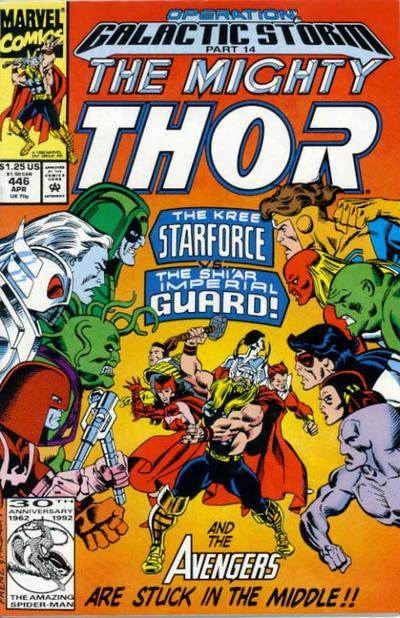
The Shi’ar Avengers have finally arrived at the Palace Regal on Chandilar, throneworld of the Shi’ar Imperium. The Imperial Guard, what remains of it, is unhappy about escorting them to Lilandra, for various reasons. Lilandra, in full regalia, is likewise irritated with them — perhaps if they were the X-Men, she would have been a bit happier to see them. The tensions are ratcheted up by Prime Minister Araki, who mimics Guardian’s argument the needs of “a single, insignificant, little backwater planet” pale in comparison to the needs of “the entire Shi’ar Empire!” He still believes they are in league with the Kree who assaulted their outpost. That Thor trounced Gladiator and closed their stargate and Wonder Man highjiacked their Nega-Portal doesn’t make their claims for peace all that palpable. Thor’s hotheadedness rears its hot head again, infuriating Lilandra (and making Captain Marvel none too happy, as well). The meeting is adjourned.
The Kree Starforce arrives at that moment, splitting up to track down Lilandra as quickly as possible. In a nice nod to the series’ continuity, the reader is privy to Korath’s thoughts they would have been their sooner had Ronan not taken the time to fight Iron Man in the previous installment. While Captain Marvel upbraids Thor and his continuing lack of impulsiveness, Araki and Lilandra discuss the progress of the war. In the solitude of her chambers, we finally see Lilandra’s softer side as she begins to lament the damage the war is doing to the Shi’ar, Earth, and even the Kree. Araki, displeased with Lilandra’s weakening, secretly prepares to assassinate her himself, saving Starforce the trouble, but he is prevented by the Imperial Guardsman Earthquake and his report. Suddenly, none of it matters as the Starforce and Imperial Guard finally join in combat throughout the palace.
This latest battle is unique mainly because the Avengers are mostly ancillary components for so much of it. The cover is quite accurate: it is a battle between the Kree Starforce and Shi’ar Imperial Guard, with the Avengers caught in the middle. Since they are there to enlist Shi’ar assistance, the Avengers soon join in with the Imperial Guard, which likewise helps heal the wounds and irritations noted earlier in the issue (though it’s not as simple and sappy as this last sentence made it out to be — fast, perhaps; neat, sure; but it works well, since the conflicts come more to an uneasy truce than genuine camaraderie). Living Lightning’s appreciation for Thor increases throughout the issue, and Thor gets some narrative focus, since it’s his series, but not as much as in the previous issue. The brief duel between Ronan with his Universal Weapon and Thor with Mjolnir is a good couple of panels, but the needs of the star-studded issue prevent it from getting enough elaboration. While this mega brouhaha rages, the scene briefly shifts to Wonder Man and Vision, who feel the effects of the Skrull’s discovery of the Nega-Bomb. Now they, too, know the Skrulls are playing some inscrutable role in this perplexing conflict between the Shi’ar and Kree.
The real highlight of the issue is Starfox’s encounter with Ultimus. Already shown to be the most conscience-affected member of Starforce, Ultimus struggles not just to overcome Starfox but also understand him, though in the end he is too limited by the biases of his recent “education” from the Supreme Intelligence to heed the higher call of mercy, since it “is not the way of the Kree” — a telling declaration in a war riven by the seeming incompatibility of morality and justice.
Though he’s there to save her, Starfox is saved by Lilandra, but she gets to the heart of the issue — Starfox’s willingness to die for her, choosing “honor above expediency” (the other key motif in the series), inspires and shames her. For the first time she calls the Nega-Portal by its proper name, the Nega-Bomb. She declares it will be recalled and the war will end by negotiations not attrition. Unfortunately for her conscience (and the lives of the Kree), we know it is essentially too late: the Skrulls are going to detonate the Nega-Bomb in Kree space. Wonder Man was right: if one waits too long for morality to rule out, stopping the war machines in time may become impossible.
Part Fifteen — Captain America 400, “Murder by Decree!”
On Hala, Captain America is about to be engulfed in a giant explosion — is it the Nega-Bomb? No, though the reader is not certain for a few pages just what is going on, an impressive tension this late into the crossover. When we last saw Cap, he was being led away from the rest of the Avengers to face individual judgment. We know the Avengers have just left him behind to try to prevent the Nega-Bomb from entering Kree space, and a brief look into the Quinjet reveals everyone is still stunned by the turn of events. Iron Man maintains his stoic leadership position on the outside, but inside he fears he will be responsible for the death of one of America’s greatest heroes — an interesting position considering their constant antagonism over the years.
Cap awakes alone in the dark, far from the rubble and human debris under which he was just smothered. In a brief flashback, Cap recounts for us what just happened: the guards led him to the Supreme Intelligence, who was about to execute him when the building exploded around him. Now he is alone in an empty room, until he is suddenly attacked from behind.
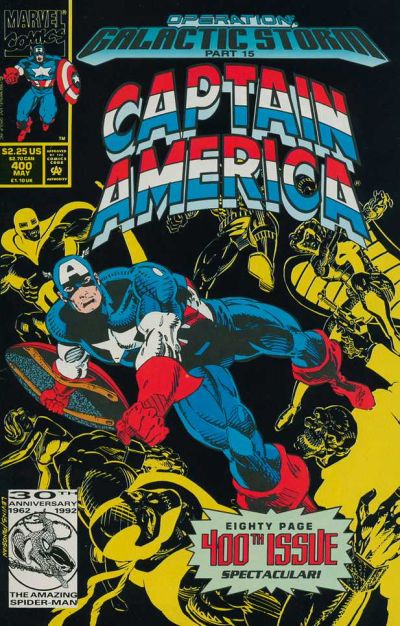
To honor 400 issues of Captain America (perhaps more than to continue the actual crossover story, which takes a little breather here), Captain America is attacked by six of his most deadly enemies: King Cobra, Batroc, Flag-Smasher, Viper, Crossbones, and the Red Skull. We aren’t certain how the Supreme Intelligence managed to transport them here just to destroy Cap, but it does provide an interesting twist in the long series of battles (a 6-on-1 handicap match). Captain America does his best to overcome the odds, and for a long time he succeeds. Eventually, though, as can be expected, they overpower him. Moments before the Red Skull finally destroys his adversary, Batroc helps Cap break free and take out the other five, preferring to be a gentleman and not let Cap be defeated in such an unfair war. Cap soon figures out they aren’t really real, just projections from his own memory. The Supreme Intelligence reappears to congratulate Cap for being so resourceful and clinging so desperately to life. Unfortunately this means he won’t have the “honor” of being integrated into the Supreme Intelligence’s collective mind. The Supreme Intelligence flings him back into the darkness telling him he only has moments to live anyway. Cap’s not sure what that means, but we are reminded in the final panel of the Skrull ship towing the Nega-Bomb slowly toward Kree space. The end is imminent.
Like most “anniversary” issues, Captain America 400 is a giant-sized issue packed with supporting stories and the obligatory “famous story reprint.” The famous reprint is Avengers 4, Cap’s resurrection in the modern world (of 1964), having spent the last two decades in suspended animation on an ice floe. The second of two new supporting stories is a continuing look at what is going on with Rachel Leighton, Cap’s villainous girlfriend, Diamondback, who is a prisoner of Crossbones. The first supporting story briefly ties in to Operation: Galactic Storm. An old friend and teammate of Cap’s, Dennis Dunphy (D-Man), thought killed several years ago in the Marvel-wide Inferno epic story (though only a year has passed in the Marvel sense of time), has reappeared alive in the Arctic. Flag-Smasher tells the Avengers to come get him (as part of a plot to lure Cap to his doom). The home front Avengers get the message, and Falcon and U.S. Agent (an unlikely pairing) head off to rescue D-Man. It’s a brief little action-adventure story, supported by amusing character moments (U.S. Agent isn’t quite as jerky as he usually is, though he wouldn’t have gotten the job done without the Falcon). The unlikely team gets the job done and return D-Man to his friends, though he isn’t in much of a condition to celebrate. Though Cap is apparently about to die in the heart of the Kree Empire, at least his friends are okay (sort of).
Part Sixteen — Avengers West Coast 82, “Shi’ar Hatred”

Though we have postulated throughout this reflection the crossover is an impressively-plotted story, we have admitted a couple of places seem not to fit. This issue clears up one such point but replaces it with another. Still, only a couple of niggling points in a 19-part crossover (with a prelude and multiple epilogues) is an impressive feat. The cover, likewise, is a smidge misleading, but it is better understood not as an indicator of what happens inside but directly after it.
The issue begins with the confusing part: when last we saw Lilandra, she was expressing her shame for attacking the Kree with little apparent provocation and clamoring for the recall of the Nega-Bomb. However, apparently her magnanimity does not apply to the Starforce: clearly she wants them dead. Likewise, despite all the mutuality of the Avengers and Imperial Guard during their recent duel with the Starforce, the amity is short-lived as tensions boil over rapidly. Again, unfortunately, it is mainly Thor’s fault: he clobbers one of the Guardsmen, again infuriating Captain Marvel, again setting the rest of the Imperial Guardsmen off — battle ensues, this time without the Starforce. As confusing as it appears to be, if one remembers the result of the recent battle was not genuine camaraderie but an uneasy truce, it’s not all that surprising, especially if Thor refuses to be mature. It does provide the next enjoyable two-page splash while we are treated to a variation on the Avengers’ battle cry: this time it’s “Avengers Attack!” — a telling difference, considering the diminishing morality involved on every side of this galactic storm. The winds of war are swirling in all directions, debilitating everyone, including allies.
The impetuousness of this new generation of Avengers finally brings one positive result: Living Lightning, fed up with Prime Minister Araki, blasts him with a bolt of lightning. Instead of knocking him out, it reveals Araki is actually a Skrull! Clearly the Skrulls have played a much more active role in this war than all have suspected. The revelation brings an immediate cessation to the conflict and helps restore Lilandra’s previous desire for peace. She awakens Ultimus from stasis (in which the Starforce have been kept) and asks him to be her messenger back to the Kree. Ultimus, shown to be more introspective and honorable than the rest of the Starforce, displays his philosophically mature side again here. Despite the positive turn things seem to be taking, Lilandra informs everyone the Nega-Bomb is missing (though we know the Skrulls have it).
Meanwhile, the narrative oscillates back to the home guard, and our confusion over Dr. Minerva is cleared up. The AWC have returned home, since the East Coast Avengers don’t have many prisoners left to watch. We are told the AWC actually let Dr. Minerva go in exchange for her brief assistance in tracking the escaping Shi’ar. It’s a small point, and many may consider it not worth belaboring, but the fact the creative teams did such a good job keeping track of all the little plot/characters strands is a major aspect to the impressiveness of this crossover.
The scene shifts again to the Nega-Bomb. Vision relates to Wonder Man their present status: the Skrulls have hijacked the bomb and are taking it through the stargate into Earth space, reminding us it was this very behavior that brought the Avengers into this dispute in the first place. Returning to the impressive issue connection style that began this crossover, the issue ends with the Shi’ar Avengers preparing to seek out the Nega-Bomb (as most likely indicated on the cover). Quasar calls to tell them he knows where it is, sending us directly to the next installment in Quasar’s own series. Despite the at-first confusing elements of the issue and the initially flimsy excuse for another battle scene, AWC 82 is a great example of characterization utilized well to tell an interesting story, balancing several plot threads and diverse character conflicts in one full issue.
Part Seventeen — Quasar 34, “The Scorched Sun”
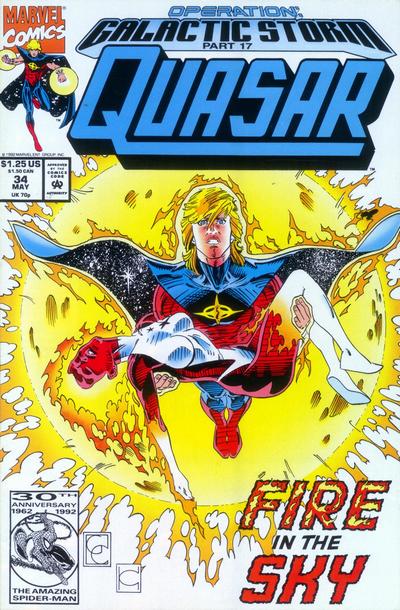
Throughout the crossover, various characters have asked whether the needs of one little planet such as Earth outweigh the needs of an entire galaxy. Quasar finally has to answer that question as the Skrull ship attempts to enter Kree space. The Super-Skrull makes a cameo appearance, but Quasar is able to dispose of him quickly. The Skrulls make it a clear choice: either let them tow the Nega-Bomb through the gate or they will blow it up next to Earth. Quasar, thinking he will be able to stop them later, lets them through the gate (essentially failing for the third time to prevent people from using the stargate — the main reason he was left behind in the first place). With this final stargate activity, the sun is in dire straits: things are not looking good for any galaxy.
The sun is about to go nova. The solution comes in an intriguing fashion: Binary — Carol Danvers, former Ms. Marvel, current Shi’ar Starjammer (and apparent moonlighter, so to speak, for the Imperial Guard). As a bridge between the aggressors and the “innocent bystander victims” from Earth, Binary is a fitting and thoroughly clever way to bring a successful conclusion to the impetus for the Avengers’ involvement in the war. Quasar, as Protector of the Universe, does his best to contain and eliminate the deleterious anti-matter sunspots, but he is not powerful enough to do it, even with his Quantum Bands (which, as their name indicates, are only good for interacting with positive matter). In some stunning panels, Binary takes the entirety of the sun’s destruction into herself, saving the solar system through as heroic a sacrifice as the entire crossover has seen. Everyone has talked about sacrifice and heroism and morality and justice — but Binary, one of the most ill-treated characters in the Marvel Universe (by her fellow characters, not the creative teams responsible), has actually done it.
Quasar finally does something successful and rescues Binary before she is completely consumed by the anti-matter. With the sun finally healed, and at least one galaxy saved, Quasar returns Binary to Avengers Headquarters, with Earth none the wiser how close to destruction it had been. At HQ Quasar learns Binary used to be the Avenger Ms. Marvel, so someone has learned something through all this, at least. Grabbing a quick bite for lunch, Quasar heads out to intercept the Nega-Bomb. With everyone racing to intercept the Nega-Bomb, we know it’s going to be an intense conclusion in the penultimate installment. The winds of war are at full blast. The issue feels a little cramped, which is odd, considering it has the fewest characters (other than Wonder Man). The cramped feeling comes, I think, from the rapid conclusion to the Super-Skrull fight and the panels with Her and Epoch seeming almost obligatory more than central to the story. Perhaps had they focused more on Binary’s internal debate it would have been more successful — but it’s still a very good installment of the series, even this late into it. The crossover has lost no momentum even with the several narrative shifts and is only picking up speed heading into the completely predicted but wholly startling conclusion.
Part Eighteen — Wonder Man 9, “Big Decisions”

With time running out, Wonder Man makes the big decision to deactivate the Nega-Bomb (somehow). Vision, however, has other plans. All the intelligent philosophical discussion in the previous issue was lost on Vision: “Logic must prevail over emotion, Wonder Man,” he says. He still is in favor of efficiency. What makes this battle unique in the long series of battles throughout the crossover is it is Avenger vs. Avenger. Vision, driven by his program to protect the Earth, can’t allow Wonder Man to endanger humans even if it means sacrificing the Kree. Wonder Man, having already escape death once, despite not quite being human anymore, will not tolerate such a xenophobic perspective. The concept of death convinces Vision he is not qualified to make this big decision after all, since he cannot die. “Death does seem to be the defining element of human existence. It might be argued that I can never understand the decisions life poses, if I do not know death.” The Homeric spirit is alive and well — maybe that’s why this is such a good crossover.
While Wonder Man and Vision fight through their discussion, the Kree Avengers (minus Captain America) finally track down the Nega-Bomb and assault the Skrull ship towing it. While Hercules and Iron Man lead the assault, the Shi’ar Avengers heave into range. While one group of Skrulls defend their ship from the Avengers, another assault team attacks Vision and Wonder Man inside the heart of the Nega-Bomb, right in front of the Negative Zone core. Their discovery of it is another impressive two-page splash. Vision, going along with Simon’s plan to defuse the bomb, must ward off the Skrull attackers first. Just when it seems as if they are about to succeed … we are treated to one of the most arresting penultimate pages of a comic ever. It is brilliant in its simplicity. (I’m not saying it’s Beethoven’s Fifth Symphony brilliant, but it’s an impressive page in a long crossover filled with impressive pages.)
The final page is likewise stunning. We knew it was coming from the first page of part one, way back in Captain America 398, but when it finally comes … no one is ready for it. No one.
Part Nineteen — Avengers 347, “Empire’s End”

Avengers 347 is an incredible issue, to be sure, but it’s hard to “like” it, if you know what I mean. It’s all about the destruction of the Kree Empire, and the deterioration of Captain America’s faith in the Avengers, himself, and everything for which he has fought his entire life. It’s a devastating issue from beginning to end, and though we have gone perhaps a little overboard on the plot synopses throughout this reflection, we won’t do that here. It’s too powerful an issue to be summarized here. It has almost everything: loss, sacrifice, heroism, vengeance, betrayal, and failure. What it doesn’t have, though, is hope. That comes in the epilogue, Captain America 401.
At the close of the issue, Empress Lilandra arrives, claiming the Kree Empire as her own. Lilandra dismisses Captain America and the Avengers, claiming the stargates by the sun will not be used again and the Shi’ar must pick up the pieces of the war alone. “Return to Earth and leave us to our destiny,” she says.
Fittingly, Captain America is given the final words of the story. It is a lengthy but appropriate response to Lilandra and the incomprehensible events of this final installment:
We wish you luck, Lilandra. You’ve assumed an awesome responsibility. Today you’ve become one of the most powerful beings in the universe. A day in which we witnessed the expression of authority so absolute that the sanctity of life meant nothing before the destiny of empires and the cause of self-righteousness. It’s a story as old and sad as time and one that must end now before there are more Nega-Bombs, more dead. You have a great opportunity to do that … to be powerful enough to cherish life … not destroy it. But you were right about one point, Majestrix…. Things will never be the same.
This penultimate panel as Cap walks away alone while uttering his final sentence is as gut-wrenching a panel you will ever find in comic history (which says a lot more than most of you think it does).
The terse finale brings a variety of responses: the Supreme Intelligence prepares to wait “the fruits of this day. My plan went perfectly … and I can afford to be patient.” It was all part of his plan. Some antagonistic to religion may see it as a vengeful perspective of God, allowing and even orchestrating catastrophic events for some inscrutably selfish master plan, but I see none of those implications here. The Supreme Intelligence is clearly in the wrong, regardless of whether his plan was “successful” or not. Captain America is right, just as Wonder Man was in his own issues earlier: mercy is not subordinate to efficiency. The needs of the many do not outweigh the needs of the few (or the one). It’s a remarkable issue from beginning to end, concluding one of the last of the great crossovers. The final dénouement issues guide us gently through our emotional and intellectual responses to this mighty experience, but Avengers 347 is a fitting conclusion all its own.
Aftermath — Quasar 35-36, “Empire of Dust” and “Soul Cage”
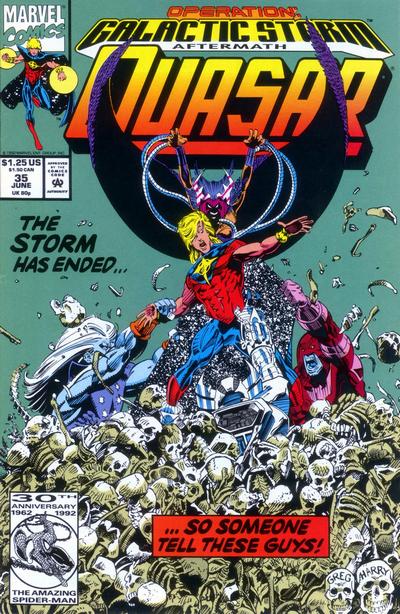
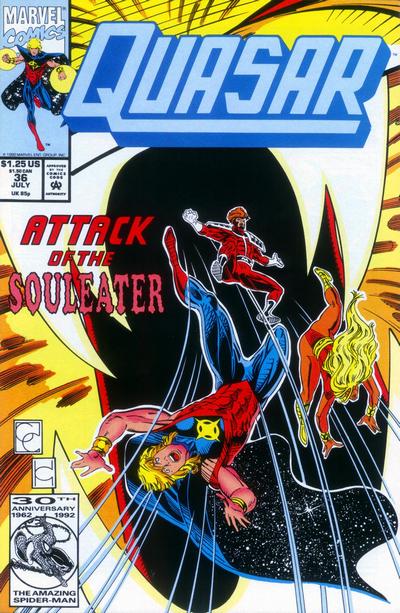
(Admittedly, I did not read these two issues until I began writing this reflection: I did not own them until just recently, thanks in part to the wonders of modern technology and delightful Web sites such as www.newkadia.com and www.comicvine.com. Though both sites have their flaws, I recommend them to anyone who enjoys living and wants to do it correctly.)
Though the first few pages of Captain America 401 take place before this issue, it is probably best to read these first. Quasar 35 picks up from Quasar’s perspective after page six of CA 401, as Quasar, having just resigned from the Avengers (doing what Cap can’t quite do), heads off to begin anew his role as Protector of the Universe. Taking on himself some responsibility for not knowing about the Shi’ar-Kree War in time to do any good, Quasar plans to perform his interstellar role much better by first returning to the Kree and seeing what good he can do for the survivors.
Again instead of a lengthy plot summary, let us say simply, while the two issues are flawed by poor pacing and occasional discordant dialogue from Quasar (who inexplicably finds difficulty dealing with the supernatural), it is an interesting wrap-up to the series. The main focus of these two issues, eventually, is the fate of the billions of Kree who were destroyed by the Nega-Bomb at the climax of the crossover. Quasar fulfills his role as Protector in a most unusual way, bringing peace not to the survivors but to the fallen, finally doing some good (through encouragement, not activity). Inexplicably, Quasar 36, part two of the two-part aftermath, isn’t in the TPB, but it is worth reading.
Epilogue — Captain America 401, “After the Storm”

Back on Earth, all the Avengers (minus the Falcon and U.S. Agent still returning from their side-mission in the previous issue) have gathered again for a somber, heavy-hearted debriefing. In a two-page splash reminiscent of Avengers 345 (when they were dividing up who was going to go where), the Avengers, worn out from both the mission and the debriefing, react with astonishment to Cap’s request for a vote to have him stand down as commander of the Avengers. No one will vote for that. They have just voted against punishing the Avengers for what they did in Avengers 347 (I can’t spoil it), and apparently everyone just wants to forget the whole thing except for Cap. Urging everyone to attend a seminar on “superhuman ethics” that night, Cap dismisses everyone. Quasar catches him on his way out to resign (leading straight into Quasar 35-36), and though Quasar tries to encourage Cap by reminding him of his greatness, Steve Rogers is in no mood for flattery.
Things continue to get worse as Cap learns not only is his girlfriend Rachel is still missing after three weeks, his pilot John Jameson now missing. Even the news his old friend D-Man might still be alive after presumably being killed a year ago can’t cheer him up. After an aside showing some movement in the Crossbones and Diamondback subplot, we see Cap still unable to function effectively in his office. His interior conflict continues to rage: is he a fit leader for the Avengers in this modern world? With heroes like Cable, Wolverine, and the Punisher fighting for good, are his 1940s tactics and values still relevant to the world today? Cap’s faith in himself continues to wane.
As the time for Cap’s seminar approaches, we see a roomful of empty chairs and only the Black Widow, Hawkeye, and the Scarlet Witch ready to listen to Steve. As soon as he walks into the empty hall, we are treated with one of the most telling 3”x1½” panels in comic history: Steve’s stunned eye and face say it all. The three Avengers try to cheer him up with reasons why the others couldn’t make it, but as is always the case, the people who need to be at the meetings are the ones who skip them. Cap walks away again in bitter disappointment, apologizing for wasting their time. Thor barges in hoping he isn’t late (he certainly is one of the group who needed to hear what Cap had to say on ethics), making it worse. The others decide Hawkeye, as one of Steve’s oldest friends, needs to take him out on the town and cheer him up for his own good.
In a humorous scene, Hawkeye convinces Cap to join him, since he won’t take no for an answer. Adding a bit of pathos to the scene, Diamondback calls to say she is fine (though we know she is not), but the Black Widow won’t let Cap be interrupted even to investigate her disappearance, since taking a break from all his worries sure would help a lot. Hawkeye takes him to the Laughing Horse Bar, which somehow happens to be inhabited by a panoply of famous characters as not-so-covert Easter eggs for the attentive reader: Popeye, Groucho, the Addams Family, the real Avengers (John Steed and Emma Peel), Dick Tracy, and quite a few others most of us would need footnotes to understand. Cap unloads his burdens onto Hawkeye, who does his best to rally his spirits using everything from reverse psychology to outright blandishments. It almost seems to be going well until who should show up (in a bar!) but Tony Stark.
Tony and Steve rehash some of their recent conflicts, going back to the Armor Wars and up through the recent decisions in Operation: Galactic Storm. Despite his gruff exterior, Tony admits his desire to regain his friendship with Steve, admitting he’s not as perfect as Steve, which Steve quickly rejects. The two finally come to an amicable end to their rivalry (though we know it will be broken several times over the years, not the least of which during the disassembly of Avengers West Coast and the Marvel Universe Civil War). After this surprisingly positive turn, Cap and Hawkeye return to Avengers headquarters to find Falcon and U.S. Agent have returned with Cap’s old friend Dennis Dunphy. He is so elated he even calls U.S. Agent his pal, much to the Agent’s surprise. Knowing his friends still care for him, despite their professional differences, and they all still respect him, his methods, and his values, Steve Rogers realizes he will get by “with a little help from his friends.” The winds of war, both interstellar and interpersonal, have (for now) come to rest.
Winds of Change
Cap was right: it’s not the same after this. Sure, there were some rather enjoyable crossovers and events (I’m much more a fan of the Infinity Trilogy than most people seem to be) after this, especially the Age of Apocalypse, but by the time we get to the Onslaught era and all the series reboots, things just aren’t what they used to be. The creative teams started to treat the old Avengers and X-Men and Fantastic Four (and the gang) like Iron Man treats Captain America here: yesterday’s news, no longer viable or interesting for a “modern” world. Unfortunately, they don’t seem to treat Steve Rogers the way Tony Stark does, realizing the need not for change but for growth; reconciliation, not rejection/rebooting. The good news is that we can still read the great works themselves, and they are still as meaningful and powerful as they were when they first came out. Read Operation: Galactic Storm. It’s one of the last of the great crossovers. Sometimes late at night, when I’m bathed in the firelight, the moon comes callin’ in a ghostly white, and I recall. I recall where the twenty years went, and, like Steve Rogers (and Ringo) says, it’s gone by just fine with a little help from my friends.
 Redeeming Pandora