
Christopher Rush
Ending is Better Than Mending
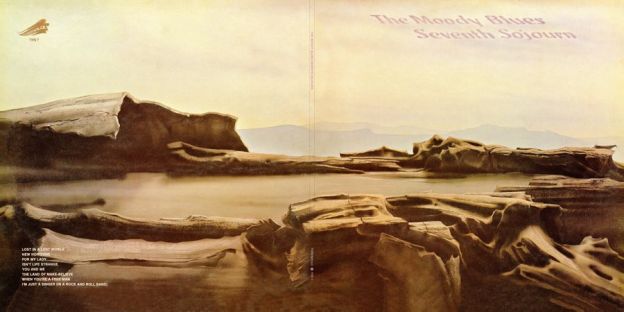
No, not really. But this does seem like a good place to finish our nearly year-long journey through some elite-level forgotten gems of the musical realm with an appropriately titled and themed album from one of the most underrated bands of the twentieth century, The Moody Blues. Adaptability is not a sign of weakness: it is a sign of strength, especially when it is not Vichy-like. The Moody Blues survived the musical fads and fashions of more than four decades, which is something only a select few bands can say with anything remotely resembling self-respect. Sure, they have had line-up changes over the years, since their main reconstruction in ’66-’67, but other than U2, who hasn’t? Their creative hiatus after this album allowed the band to grow in better ways than numerically, and we are much richer for it as listeners, with their solo and duet works as well as the great output from ’78-’03 (not to mention all their live shows and albums and compilations in the last decade), including my two favorite Moody Blues songs, “Your Wildest Dreams” and “I Know You’re Out There Somewhere” (though, since the latter is a sequel to the former, perhaps we could call them two parts to one ultra-elite magnificent song). The band clearly needed and benefitted from a break after this album, just like we all need a break after this school year and season of fantastic journaling. Even so, this album is a great album from beginning to end, with no real weak links (despite what some people say about “When You’re a Free Man”). Though tensions were high and emotions were frayed, The Moody Blues produced some of their best work here, and we should always have Seventh Sojourn handy in our music playing machines (whatever they look like in your home and/or automobile).
“Lost in a Lost World”
The album, demonstrating its over-taxed circumstances of construction, begins with a borderline pessimistic song, though it gains a great deal of optimism for most of it, and this song is more accurately disconsolate than sheer pessimistic, since this opening number at least recognizes the potential and only source of hope. “I woke up today, I was crying / Lost in a lost world” — that’s about as disconsolate as any of the songs we’ve explored this year. In a sense, though, it is how we should react a fair amount of the time as Christians: “So many people are dying / Lost in a lost world.” It’s true. The world is full of people “living an illusion,” whether it is tethered by racism, classism, or just generic atheism. Revolution is not the answer; it’s just another threat, “another form of gun” used to do wrong unto others what was wrongly done unto them. Mike Pinder, fortunately, points us to the way out of this mess: “Love will find us in the end … / We’ve got to bend / Down on our knees and say a prayer.” Genuine communion with spirituality is the only way out of this physical mess, since the mess is not physical in origin: the ultimate problem is spiritual disharmony with God, and thus with Love and Reality. The music throughout the song maintains the disconsolate tone, with its march-like syncopation. The music feels like it is a band playing the wrong kind of venue, sort of like the concert band is forced to do the parade instead of the marching band. Things are out of place, sounds are out of place (without being discordant or harmonically off). Even the hopeful bridge can’t escape the overbearing music, since the people are not yet where they need to be, even though salvation is possible and near. Sometimes songs don’t have to be happy to be worth hearing (and heeding). “Lost in a Lost World” is one such song. Mike Pinder’s lyrical and musical contributions should likewise not be forgotten in the great history of The Moody Blues.
“New Horizons”
“New Horizons” is a quintessential example of The Moody Blues’s ability to create complex songs. We knew that from the very beginning, with Days of Future Passed, but they never lost that possibly-genius ability. The lyrics are fledglingly optimistic, to neologize for a moment. Justin Hayward presents us with that painful moment of transition during the ending of one phase of life and the beginning of something new and better, yet still experiencing the lingering memories and sensations of mistakes made and regrets unforgotten, coupled with the bolstering hope of the good memories and sensations available to provide future comfort when the other sensations have been accurately accounted for, quantified, qualified, and compartmentalized. It’s the “someday” line/word that evokes the most emotion, I think. He knows (not just thinks or guesses, he knows) he will “find my own peace of mind” — there will be comfort and love and joy and contentment to be experienced. He’s “never going to lose your precious gift” (the “your” being the lady love he has to leave, most likely, or whatever situation in life on from which it is time to move). It will always be with him; he is “beginning to see” what this new life will be; he will find that peace of mind … someday. The music mirrors this borderland realm — it is always trying to move forward, it is very willing to do so, but it is not fully prepared to get there just yet. It’s a bit difficult to explain — listen to it and find out what it’s much better than can be accurately described here.
“For My Lady”
Flautist Ray Thomas has created quite the impressive sea shanty with “For My Lady.” I’m not certain he was going for a sea shanty with this thoroughly beautiful song, but he did it. Though this and “New Horizons” were written lyrically by different people, they form a good pair on this album. “For My Lady” embraces the outright gentleness and peaceful resolution to life’s changes and challenges not fully attainable in “New Horizons.” It’s certainly one of the most optimistic and encouraging songs in my admitted limited musical experience: “Oh I’d give my life so lightly / For my gentle lady / Give it freely and completely / To my lady” says the sweet chorus. Unlike the current trends of mixing lyrics with antagonistic musical accompaniment, “For My Lady” is both lyrically and musically sweet (not in a syrupy way, either — not that there would necessarily be anything wrong with that if it was). Not surprisingly, the flute dominates the melodic line and musical interlude, which fits well for the ideas of the song: “Set sail before the sun / Feel the warmth that’s just begun / Share each and every dream / They belong to everyone,” says the final verse. Admittedly the flute is associated with rather shady characters in myth and lore around the world, but the archetypal notion of the flute, the warm summer day, sailing the breeze-driven sea, dreaming the day away (for a time, not for ever), being in love — a selfless, self-sacrificial love, and thus Biblically accurate — all make for a superb song. More songs should sound and speak like this.
“Isn’t Life Strange?”
Furthering the album’s increasingly overt theme of questing for identity, understanding, and finding one’s place in the world, John Lodge’s first of two songs on the album (strangely enough, the only two single releases from the album, this and the closing “I’m Just a Singer…”) continues to ask penetrating questions: how do we know who we are? who are we supposed to be? how does the passage of time connect to our understanding of who we are? Though these are not the questions he asks verbatim, they are essentially what his lyrics imply: life is strange, love is strange, both are hard to understand yet both are essential. There is a sense of the return to despondency with this song, as the narrator seems to be lamenting lost love reminiscent of “New Horizons” in contrast to the optimistic togetherness of “For My Lady.” Even so, the chorus remains optimistic in its zeal, supported by the musical uniqueness of its accompaniment: “Wish I could be in your heart / To be one with your love / Wish I could be in your eyes / Looking back there you were / And here we are.” The force of the music makes me think there is great hope underlying these potentially melancholy lyrics. The verses add to the theme of redeeming the time: “Isn’t life strange? / A turn of the page / A book without light / Unless with love we write,” says the first half of verse three (by my count). Life is meaningless without love — as this has been one of the main themes of the entire run of Redeeming Pandora, it’s nice to realize we agree with The Moody Blues.
“You And Me”
With a flip of the record, we realize what we thought initially was a tone of despondency was in fact simply the main theme of the album: The Moody Blues are simply asking the questions we are all asking about life, its purpose, its meaning, and they have been telling us all along they have just as few answers as the rest of us have. They are no more despondent than we should be — optimistic, in fact, as we should be. Just as we saw in “Isn’t Life Strange?,” questions abound … but so, too, does love.
The Moody Blues are certainly a product of their time, even though a vast majority of their great songs have lasted in an ageless quality (with or without the synthesizer) because of their timeless content. “You and Me” is a fine example of how The Moody Blues can transcend their time while being very much dependent on the time: without any coaching, those of us who may have missed the Nixon Administration (and those flanking it) would not have been able to tell this is a protest song against the Vietnam War. The opening line, “There’s a leafless tree in Asia,” sounds innocuous enough to me, leading me to think about the general ecological concerns people have, especially since the opening stanza is replete with geological thoughts: “Under the sun there’s a homeless man / There’s a forest fire in the valley / Where the story all began.” Experts tell us, though, the opening line alludes to Vietnam. Allowing the accuracy (not to be precious) of such an interpretations, as stated before, the song has outlived its contemporaneity and transformed in the intervening years to be a still-relevant cry against general ecological and sociological mismanagement (to put it in overly-kind and apolitical terms).
The chorus of this impressively up-tempo protest song disabuses the interpretive misalignment upon which most of us operate (at least through our initial listening-through of the album): “All we are trying to say is / We are all we’ve got / You and me just cannot fail / If we never, never stop.” They aren’t trying to plunge us into despair by claiming we are all lost in a lost world; they aren’t telling us to forsake the past and seek new horizons. They are just “Singing all [their] hopes and dreams.” They are just as mystified about life as the rest of us. Of course, as Christians, we have a stronger grasp on purpose and direction, and though it is somewhat painful to disagree with The Moody Blues, we know we are not all we’ve got, which is the quintessence of why we don’t have to be disconsolate in this lost world — because we once were lost but now we’re found. The encouragement they offer (“never, never stop”) is potentially futile unless it is coupled with alignment with Ultimate Reality, with the God Who is Love. Once we have done that, and the “you” becomes “You,” this song becomes as authentically Christian as anything out there (perhaps more so).
“The Land of Make-Believe”
I like this song. Maybe I’m in the minority, but that’s quite all right with me as you know by now, if you’ve read other articles in this very issue. Since we are not here to spiritualize things, which we all know is bad hermeneutics (you are missed, Dr. Dave), it wouldn’t do any good to say “they are really singing about Heaven and the life to come.” It’s possible The Moody Blues are just imagining a utopia in which “heartaches can turn into joy,” since that doesn’t happen in this present incarnation as much as we would like. Regardless of whether they are truly singing about Heaven or just a fairy-tale land reminiscent of the underworld in Final Fantasy IV, the fundamental message of the song is true: “Love’s the only reason why” we exist, “Only love will see us through / You know what love can do to you.” This life is all about love, indeed. Perhaps the “make-believe” of the title is not as serious as it at first seems, and they are ironically reminding us “it’s only make-believe because not enough of you live this way yet.”
“When You’re a Free Man”
Like the previous song, Mike Pinder’s “When You’re a Free Man” imagines a utopian society, but the musical accompaniment this time makes us think we are in a sort of Kafkaesque utopian society (if we can use such a word without being cliché … which isn’t an adjective, anyway, people). The song is about the quick passage of time, but the music is slightly slower than if you paused the album (but I kid The Moody Blues — as I said earlier, I like this song, even if most think it is the weak link on the album). We shouldn’t be too surprised this song is another tribute to Timothy Leary, though why The Moody Blues are so keen on referencing him is somewhat beyond me. Fortunately they seemed to have outgrown him by the time they regrouped after their hiatus following the album under present examination. Again, we don’t want to spiritualize the album, and we would be straining that notion if we tried to “rescue” this song too much from its original intention, but again, if something is true, it’s true, regardless of who originally said it or why. When The Moody Blues enjoin us with “Let’s be God’s children and live in perfect peace,” it’s still a pretty excellent idea (if you’ll allow the expression), even if they meant it not as well as we would have liked. I’m rather skeptical we will see Timothy Leary again when we are all free from the sin which so easily entangles us … but I wouldn’t be surprised if we are still singing The Moody Blues songs then.
“I’m Just a Singer (In a Rock and Roll Band)”
One last time (before a five-year hiatus), The Moody Blues remind us they are no experts on life — they are just a rock and roll band. Don’t look to them for answers — go out and live your own life. Fortunately for us, we know where the answers for life are located. Fortunately as well, we can enjoy great music like Seventh Sojourn from The Moody Blues, especially when we have the answers to the questions they ask. They ask the questions better than most bands do, and by this time in their diverse recording career, they were polished, poised, and, well, petered out. This song musically mirrors the band precisely this way: full of energy, being themselves (not what people expect them to be), asking intelligent questions all the way … eventually they run out of steam and it all comes crashing to a halt. Fortunately again, they picked it all up again soon enough (with some rather impressive solo and duet work in the meantime, especially Blue Jays, which we all know should have ended with “Saved by the Music,” but that’s a story for another time), and we can enjoy it all today. This is probably one of their most recognizable songs, and certainly one of their better numbers, which is saying a good deal considering their vast, diverse output. It’s a fitting end thematically to the album: what appeared to be pessimistic despondency was just sincere appraisal and confusion of a world out of tune — something is not right (totally depraved, in fact, in a lost world), and sometimes moving on means letting go, but hope still exists (as evidenced by this very journal’s raison d’être) and love will see us through. In the meantime, don’t go searching for answers in the wrong places. Just enjoy the music.
Music is the Traveler Crossing Our World
From Days of Future Passed (you aren’t counting The Magnificent Moodies, are you?) to December and everything else in-between, The Moody Blues have given us a thoroughly enjoyable output, with Seventh Sojourn one of their most enjoyable albums from beginning to end with no real weak links. For those who know only the ’80s synthesizer oeuvre of The Moody Blues (which, don’t get me wrong, is one of my favorites, since I’ve already admitted my favorite MB songs come from then), it’s time to go back to the band’s early era. Check out all their early albums, and though you’ll probably find some of their early stuff rather strange (after DFP, which is the most melodic and brilliant orchestral concept album ever made), you will find Seventh Sojourn is a gem that should not be forgotten. Don’t just take my word for it — listen to them for yourself. I’m just an editor for a scholarly journal.
Goodnight and Good Listening
We hope you have enjoyed our brief look at some of the forgotten gems of our recent musical past; I know I have. If you have been encouraged to listen to any of these albums and discover an enjoyable musical addition to your appreciation for life in its multifarious beauties, or rediscovered an old musical gem of a friend you had forgotten, then our work is done for another season. We at Redeeming Pandora wish you a continued delightful musical journey, whatever your tastes and fancies. Continue to seek out new horizons and enjoy the best of what is being made today, but don’t forget the gems of days gone by. You’ll be glad you kept them with you all of your days. Goodnight and good listening, friends.
 Redeeming Pandora