
Lia Waugh Powell
For years the question “Who truly wrote Shakespeare’s plays and poems?” has been asked. There are many speculations as to who wrote the works, and if Shakespeare really did not write them, why did they cover it up? The idea of a fake Shakespeare may seem absurd, but scholars have been debating this for over 500 years. Everyone would prefer to leave Shakespeare as he appears: a vivid poet and playwright who wrote deeply and loved even deeper. But the oppression of the so-called “artful class” forces us to analyze all the best parts of every writer out of the picture. This topic has become so heated the movie Anonymous was recently released, based on this controversial topic (though the reviews of the movie reveal that this movie contains many untrue statements and scenarios, thus making it completely inaccurate).
One reason it is suspected Shakespeare was made up, or just a false identity, is because the purported Shakespeare could not have possibly known about all of the things he wrote about. This is because Shakespeare has such a modest background: he grew up in a working class family, therefore he could not have had the brain capacity to contain all of the knowledge necessary for him to write about what he did, and he could not have had access to the libraries he would need to write as well. Some scholars also argue Shakespeare could not have traveled much either, which would mean the descriptions of places in his works would be inaccurate. Such as in The Merchant of Venice, Shakespeare could not possibly have written the descriptions of Venice, because he had never been there. Also, in the 1600s, scholars say 98% of working class families could not even sign their names; Shakespeare has at least six known signatures. As stated in the credited article of The Observer:
All we know for certain is that Shaxpere, Shaxberd, or Shakespear, was born in Stratford in 1564, that he was an actor whose name is printed, with the names of his fellow actors, in the collected edition of his plays in 1623. We know that he married Anne Hathaway, and died in 1616, according to legend, on his birthday, St George’s Day. The so-called “Stratfordian” case for Shakespeare rests on these, and a few other facts, but basically, that’s it.
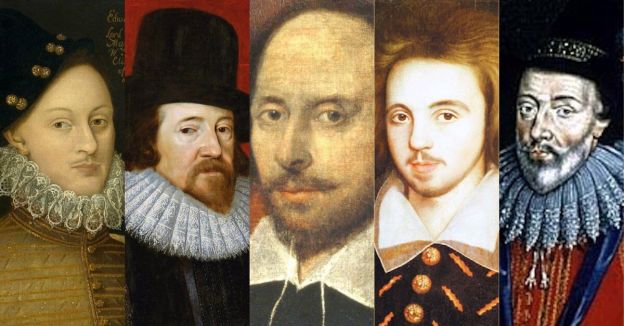
Into this vacuum, a bizarre fraternity, including Mark Twain, Charlie Chaplin, Orson Welles and Sigmund Freud, have projected a “Shakespeare” written by a more obviously accomplished writer: Edward de Vere (the 17th earl of Oxford), Sir Francis Bacon and the playwright Christopher Marlowe, to name the leading contenders in a field that also includes Sir Walter Raleigh, John Donne and even Elizabeth, the Virgin Queen herself.
One view of who could have written Shakespeare’s works is Christopher Marlowe. Marlowe was a 16th-century playwright and poet, born in 1564, the same year as Shakespeare. He was recognized for his exceptional writing abilities in his school years. Unlike any other candidate to the “who really wrote Shakespeare’s works” debate, Marlowe is the only writer who matched with Shakespeare’s wit and writing style. When comparing Marlowe’s and Shakespeare’s works, it is obvious both are very similar in the way they sound and how they are presented. Marlowe’s story is more interesting than that, though. It is recorded Marlowe was stabbed to death on May 30, 1593. However, Shakespeare’s plays did not start being published and acknowledged until after Marlowe’s death. People believe Marlowe’s death was faked, so he could write the plays and poetry. He faked his death because people wanted to kill him because he was a suspected of being a spy for the Queen and, worse, an atheist and heretic. Marlowe was even reported as claiming Jesus was a pervert, who engaged in homosexual relationships and was not the Son of Man. With all of these titles and suspicions from other people upon him, he had no choice but to fake his death so he could continue writing, as Shakespeare.
Another candidate for writing Shakespeare’s works is the Earl of Oxford. Some logical reasoning that supports this theory is because of the many influential people and foreign places mentioned in the plays and poems are connected to Edward de Vere. Born in 1550 (14 years before Shakespeare’s birth), he became the Earl of Oxford at the age of fourteen and hid his love for literary works and art because it would not have been acceptable for his reputation in court. De Vere’s life also is paralleled in many of the plays, such as Hamlet. De Vere also has the exact education and social class to have the knowledge about politics, other countries, and important historical figures displayed in Shakespeare’s plays. Another compelling and convincing fact that could prove de Vere is the true Shakespeare is de Vere was once described with “Thy countenance shakes spears” in a royal court. This means de Vere could have been acknowledged as “Shakespeare” during his days. De Vere also spent many years in Italy, and 14 of Shakespeare’s plays occur in Italy.
Sir Francis Bacon is also a candidate for writing Shakespeare’s plays. This theory was suggested by none other than Mark Twain in the 19th century. Bacon graduated from Cambridge at the age of twelve. One piece of evidence that can be used to prove Bacon was the true Shakespeare is that in one of his works he uses the line “All is not gold that glistens,” and in Shakespeare’s play The Merchant of Venice is written, “All that glisters is not gold.” The interesting part of the Baconian theory is the claim he is the true writer because of Baconian ciphers, cryptograms, and codes found in Shakespeare’s plays. Baconians say, “Bacon, who was a leader in early scientific thought, and who invented ciphers to ensure posterity would remember him as Shakespeare, inserted secret messages in his plays.” According to Baconians, an epitaph is on his tombstone: “FRA BA WRT EAR AY.” This is interpreted as “Francis Bacon wrote Shakespeare’s Plays.” Though this may seem absurd, this theory is not to be cast aside because proven throughout history many great minds have used cryptograms and such to reveal hidden messages and secrets to those who are supposed to know certain things.
However, none of these, in my opinion, beside de Vere, can truly be the real Shakespeare besides Shakespeare himself. William Shakespeare was born in April 1564. He grew up in a working class family and married Anne Hathaway. He then joined a troupe of actors and traveled all the way to London. He became one of the leaders in the most recognized theater company at the time, the Lord Chamberlain’s Men. Shakespeare then wrote plays and became a sharer at the Globe Theater. Proof of his existence and that he is, in fact, the writer of the poems, is that his name appears on the poems and plays, such as The Rape of Lucrece, Romeo and Juliet, Henry IV, and Hamlet, where his name is signed and attributed to the works.
More proof Shakespeare is the true author is he was an actual actor in a theater company that acted out his plays (The Lord Chamberlain’s Men). On March 13, 1602, John Manningham recorded in his diary a racy note about Shakespeare and Richard Burbage:
Upon a time when Burbidge played Richard III there was a citizen grew so far in liking with him, that before she went from the play she appointed him to come to her that night unto her by the name of Richard III. Shakespeare, overhearing their conclusion, went before, was entertained and at his game ere Burbage came. Then message being brought that Richard III was at the door, Shakespeare caused return to be made that William the Conqueror was before Richard III. Shakespeare’s name [is] William.
Shakespeare was not just a playwright; he wrote his plays with specific actors and settings in his mind. This proves he wrote his plays because his characters and settings are all very detailed. Shakespeare traveled with a specific group of people, he knew their appearances, their strengths and weaknesses, so we can logically assume he wrote accordingly.
William Shakespeare the Globe-sharer is the same person as William Shakespeare of Stratford-upon-Avon. William Shakespeare, the Stratford-born actor, was titled “gentleman” after his name by right of being granted a coat of arms. This is proven in a mortgage deed of trust in October 7, 1601 by Nicholas Brend to John Bodley, John Collet, and Matthew Browne, where Bodley was given control of the Globe, which is described as being occupied by “Richard Burbadge [sic] and Willm Shackspeare [sic] gent.”
The reason the Shakespeare debate is large and ongoing is because Shakespeare’s name is registered so differently. But in actuality, Shakespeare went through many titles as his social status went up. As mentioned earlier, Shakespeare may not have had a great social status as a child, thus he could not have been very well educated. But that really means nothing; Shakespeare may have had the ability to learn quickly, and while he toured with The Lord Chamberlain’s Men, his knowledge of different lands and countries must have expanded while he traveled. It is inevitable to learn about new things when you are living in different environments. Interestingly enough, there are even poems addressed to Shakespeare acknowledging him.
To our English Terence, Mr. Will. Shake-speare.
Some say (good Will) which I, in sport, do sing,
Had’st thou not plaid some Kingly parts in sport,
Thou hadst bin a companion for a King;
And, beene a King among the meaner sort.
Some others raile; but, raile as they thinke fit,
Thou hast no railing, but a raigning Wit:
And honesty thou sow’st, which they do reape;
So, to increase their Stocke which they do keepe.
These historical documents are proof Shakespeare was exactly who he is said to be. Though The Earl of Oxford is very much qualified to have been “Shakespeare” because of his social class, environment in which he was raised in, and his connections to the court and politics, his writing skills were nowhere near as genius as Shakespeare’s were.
Christopher Marlowe was the only man who wrote as eloquently as Shakespeare did, but his life and death are too different from any of the other candidates to be qualified as the real Shakespeare. He “died” at the age of twenty-nine, but still did not have the experience needed to write Shakespeare’s works, and he is not recognized as an author or actor, nor does he have any historical documents that prove he wrote much of anything besides his own plays, whereas Shakespeare was recorded acting in his own plays and also signed his works.
Sir Francis Bacon also does not have much of a stand on being the true Shakespeare either. He is recorded as being extremely intellectual and a good writer, but other than that, he is not very well connected to Shakespeare’s plays and poems besides similarities in writing styles. Another fact to take into account is, why would these authors, all who are well known in society, write anonymously? In the 1500s and 1600s artists dreamed of being well known, much like today. So why would anyone, besides Christopher Marlowe who was in hiding, assume a secret identity? They would most certainly want the credit as the original playwright and poet of Shakespeare’s works.
As a result, Shakespeare is truly Shakespeare, and the conspiracies surrounding his existence and authenticity are made up because we as humans question everything; that is our nature. Shakespeare, the Shakespeare who still lives in the works of literature that bear his name, would not want future generations to sit around analyzing how his life dictated his writing but rather how his writing applied and influenced our lives and our writing. Instead of debating who wrote what, we should enjoy Shakespeare’s art. His literary talents are unique to this day. No other writer has been able to match his style exactly, and no other writer has captivated the hearts of millions of people throughout the centuries like Shakespeare has. His works should not be debated over but enjoyed thoroughly in society and appreciated among all literary scholars.
Bibliography
Kathman, David. “The Shakespeare Authorship Page.” Shakespeare Authorship. Web. <http://shakespeareauthorship.com/>.
The Marlowe Society. Web. <http://www.marlowe-society.org/>.
McCrum, Robert. “Who Really Wrote Shakespeare? | Culture | The Observer.” Latest News, Sport and Comment from the Guardian | The Guardian. The Observer. Web. 12 Mar. 2010. <http://www.guardian.co.uk/culture/2010/mar/14/who-wrote-shakespeare-james-shapiro>.
Milner, Cork. “Christopher Marlowe — Shakespeare.” Netplaces. About.com. Web. <http://www.netplaces.com/shakespeare/shakespeares-rivals/christopher-marlowe.htm>.
—. “The Baconian Stance — Shakespeare.” Netplaces. Web. <http://www.netplaces.com/shakespeare/did-shakespeare-write-shakespeare/the-baconian-stance.htm>.
 Redeeming Pandora