
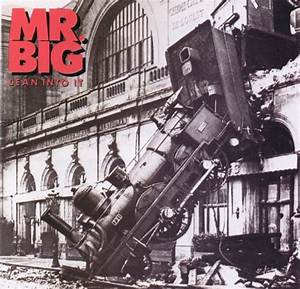
Lean Into It
In early 1991, one of the few long-lasting rock supergroups released its second album, Lean Into It. That band’s name was (and still is today) Mr. Big. What distinguishes Mr. Big from many bands of its ilk are quality lyrics and quality musicianship. True, conflict and tensions saw one short-term personnel change in the late ’90s and one lengthy hiatus for most of the ’00s, but the original group is back together again (as of this writing) and still putting out more fine work. Though they are much bigger in Japan than in the United States (a sad commentary on American standards), Mr. Big is still a good band worth knowing, even if one is not a fan of guitar shredding and power/hard rock: Mr. Big is hard to quantify, since its sounds and styles are often developing and shifting not just between albums but within albums as well.
As sturdy a powerhouse quartet as we may ever see, Mr. Big was first formed by its most famous member, bass player Billy Sheehan. Well-renowned front man (especially on the Asian circuit) Eric Martin joined shortly thereafter; technical masters Paul Gilbert (guitar) and Pat Torpey (drums, after he finished touring with Robert Plant — you know you’re a great drummer if Neil Peart is impressed by your work) filled out the supergroup.
Their self-titled debut album did not fare too well in America, but their fame in Japan was almost instantaneous. That changed somewhat, as indicated above, with their second album in 1991, Lean Into It, perhaps their tightest, most enjoyable album from beginning to end, and another forgotten gem of recent music history.
Electric Drills in Perfect Harmony
“Daddy, Brother, Lover, Little Boy” is one of those quintessential tongue-in-cheek hair band songs from the late ’80s-early ’90s. True, it gets mildly saucy (just a smidge piquant) at the end of the second verse, but it is mediated well by metaphors and power chords. Despite the lack of seriousness in the lyrical content, the song immediately demonstrates the band’s musical skills. Though this opening number borders on thrashing guitar rock, it’s the fastest song on the album and not really representative of the album’s style — as mentioned above, the style changes frequently. It is the fastest song on the album, but possibly not the loudest/heaviest. Don’t let that dissuade you from the song or the album, though — Mr. Big is not a typical hair band (or post-hair hair band in their later oeuvre); though this song is intentionally lyrically shallow, this does not represent typical Lean Into It (or typical Mr. Big). It is, as said just now, a humorous number designed more to show off their musicality (including Martin’s vocal oomph, if not his range). The highlight is certainly the most unexpected moment of the song: even though the subtitle denotes this as “The Electric Drill Song,” it is not until the brief moment of the harmonious electric drills one understands why it has that title. The feedback of the guitar at the beginning prestidigitates the audience only; the real thing comes as impressively and suddenly as the skill of the band as a whole. All in all, it’s a great, energetic start to the album.
Unexpected Enjambment with Hard Rock Claps
“Alive and Kickin’” is the jauntiest number on the album, which is fitting, since the lyrics enjoin us to “keep [our] love alive and kickin’” throughout. It’s a typical tale: a young guy and gal (experiencing mild regret — “tears in her eyes”) are running away from their families and starting a new life together. Before we get too frustrated or judgmental, though, the girl writes in her goodbye letter to her mother she is running away with her love “Just like you did, momma.” Since her mother did it, clearly it must be acceptable for her to do it; besides, they have “everything [they] own in the trunk and on the roof / And she’s got baby-sitting money in her pocket.” They’ll be fine. What could possibly go wrong when you are driven by love, doing it your way, “Pedal to the metal shooting down the highway”?
The title, and the way it’s sung throughout the song, leads the audience to think both verbs are equal: certainly the final line of the song supports such an interpretation. The verbs, though, are not equal: primarily, we are to keep our love alive; secondarily, we are to keep our love first “kickin’ / Down the door” because “it’s what we’re livin’ for” and second “kickin’ / Down the walls” because “that’s when / Freedom calls.” It’s impressive enjambment, especially since the subordination of the phrases following each “kickin’” is emphasized (in a roundabout fashion) by the diminished vocals: not every band can pull off changing the vocal dynamics partway through a major line of the chorus/song, but Eric Martin and Mr. Big do it well here. Though the “kickin’ / Down the door (then, walls)” lines may seem akin to stereotypical “hair band” lyrics, the final reminder from Martin “kickin’ / Down the walls, that’s when / Freedom calls” is reminiscent of virtually every well-respected, highly-esteemed Romantic poem (and quite a few Symbolist poems, as well) in the last two hundred+ years — it’s much more meaningful than a cursory dismissal of their appearance/style allows. The groovy hand claps accompanying the chorus toward the end of the song maintain the overall fun atmosphere of the album. Though we would not advocate young children (even those “in love”) running away from home and going “Rockin’ side by side,” it’s still a good song to enjoy (especially for vicarious living).
Thirty Is the New Old
Eric Martin tells us “old movies” from the ’60s have a green tint to them in “Green-Tinted Sixties Mind” (considering it was around 1990 — or even earlier — when he wrote that, how would he feel twenty years later, now that he is old?). Perhaps the televisions on the road, especially in Japan, gave him that impression. Today, with the advent of high fidelity, the song may seem dated, but the older the song gets the less time really affects it, strangely enough: it attempts to capture a moment in or attitude of the ’60s, which it does fairly well, despite the at-times goofy lyrics.
The second verse contains some of the best lyrics on the album: “She keeps her memories locked away / But they are always escaping / Neglect won’t make them fade away” — good stuff (and it goes on from there). The overall emphasis of the song comes in the second version of the chorus, belying the verses’ attempts to capture a moment of time: “Gotta face the day / There is no other way / To clear the fog inside your mind / Fill it up with dreams” (and et cetera). Later we are told (it applies to the person first being directly addressed, but it can be extrapolated to all of us) you “Could’ve made it if you tried.” If we want to improve our lives, we should be active about it. This is certainly good advice as well; and, coupled with an appropriate Christian perspective on actively/expectantly waiting on/for the Lord, it is a fine song that transcends its own attempts to chronologically date/freeze itself.
Do Not Adjust Your CD Player
The first time I heard this song I thought my cd player had suddenly malfunctioned: this was possibly Mr. Big’s intention, but that seems more malicious than they otherwise appear to be. We are told by various other sources the song’s title, “CDFF — Lucky This Time,” is so called because the CDFF does precisely what we just thought happened: the cd fast forwards through the song “Addicted to That Rush” from their debut album. Why, I don’t know, but it does sound somewhat interesting (or “cool,” as the kids say). The main song, written by friend of the band Jeff Paris, is superficially a typical hard rock love song, but it soon demonstrates its suitability in the Mr. Big oeuvre with its heart: the lyrics are not about “getting” lucky (as the kids also say) but about “being” lucky — this very may well be the relationship that works out for both of them, says the song. Though she (and, presumably, he) has been hurt by other failed romances before and has thus built “a wall between [her] dreams and the madness,” and though he reaches out his hand to her and she responds by running and hiding away, if she heeds his advice (“Open your heart to mine”) she will not be sorry this time — she will be lucky this time. (This is a dominant theme in Mr. Big’s optimistic output.) The second verse is a shatteringly lucid portrayal of love in the modern world: “No guarantees when you risk your emotion / So you surrender and it all went astray / Bitter and hopeless in your cold isolation / But you my love won’t ever fade away.” (I believe it avoids the triteness others suspect it falls into.) The tone shifts to a very optimistic and encouraging rescue away from the despoiling consequences of isolation: continue to seek out love — preferably in the right location — for though the risk (and sometimes cost) is high, it is not nearly as costly as the alternative.
Not Your Zydeco Kind of Creole
“You get what you pay for / You get what you pray for” is the message of “Voodoo Kiss.” This is a true story and well worth heeding. This song is perhaps the saltiest on the album, not because the lyrics are bad, but because it implies a few situations in which most decent citizens probably would not want to find themselves (“A touch of the sweet and nasty” indeed). This is the dark and seamy side of Creole Cajun territory, in contrast to the pleasant and socially acceptable side from Graceland. Most people will want to eschew such territory (all people should, but some people — those in the kingdom of darkness — delight in those places/things). Because it is genuinely talking about some dark and dangerous activities, some people might find the tone of the song too light to be acceptable, as if the spryness of the number trivializes the evil/inappropriateness being recounted here. That is certainly a fair point. The same could be made for the movie version of Live and Let Die, in which Roger Moore’s James Bond does not take the voodoo accoutrements too seriously (in contrast to Ian Fleming’s novel, in which Bond takes most of it quite seriously). We should, indeed, never delight in representations of what is sinister or evil, especially ones that trivialize or denigrate their reality or seriousness (as has been addressed in earlier Redeeming Pandora articles). However, we should not preclude the possibility Eric Martin is creating a persona for this song: instead of intimating he himself (or any otherwise fine upstanding citizen) has had and is currently craving such sordid and mystical experiences masquerading as sensually salubrious situations, he is, rather, telling a rhetorically distant story from the perspective of a persona, and thus indirectly didacticizing about the true dangers concomitant with such a deleterious lifestyle or habit. As fun as the song makes it sound, we are, in fact, being warned against it, in much the same way C.S. Lewis styled The Screwtape Letters. I tend to favor the later interpretation, though I do not seek this song out for repeated listenings separate from entire album digestments.
The Way it Ought to Be
As great as the final song is, “Never Say Never” has possibly become my favorite song on the album. It is the best-paced song of the bunch — not as frenetic as “Daddy, Brother, Lover, Little Boy,” not as off-kilter as “Voodoo Kiss” or “Road to Ruin,” not as jaunty as “Alive and Kickin’” — all good songs, of course, but “Never Say Never” achieves the best driving tempo for the message involved. The opening few measures re-hone the hard edge of the album without devolving into overly raucous noise and cacophony. Some may object to the lyrics of this song not because they are inappropriate but because they may come across as trite and typical for “love songs from guys with big hair.” Admittedly, the song utilizes many of the popular tropes of interpersonal communication popularized in ballads and whatnot from time immemorial — what’s wrong with that? Nothing. The song uses what is familiar in a pleasing, satisfying way; sometimes, that’s exactly what we want from a song, especially one so optimistic as this. Additionally, it moves significantly beyond merely the ordinary with the harder edge from the rhythm section and Eric Martin’s vocalizations. Then, the end: the powerful ending of univocal “oohs,” which does not sound nearly as impressive here as it comes through in the song, is a surprisingly energizing conclusion to the fast-paced (but not too fast-paced) rock song, making it from beginning to end one of the better constructed rock songs of the ’90s, if not of all time.
One Part Sour, Two Parts Sweet
As its title indicates, “Just Take My Heart” is the sad break-up song of the album, typical of that sub-genre of hard rock to which Mr. Big sometimes ascribes (but more often transcends, as this article has attempted to posit). Like most other songs on Lean Into It, I would suggest the combination of soulful guitar work and sincere lyrical presentation surpasses the typical: “Where is our yesterday / You and I could use it right now” — golden. Certainly we are not in favor of broken relationships, or ones in which either or both might find themselves unable to sleep late at night “Wondering why so many questions have no answers” or “searching for the reason why we went wrong” — but, sometimes, listening to and living vicariously through such pathos in a quality song like this helps us better frame our own experiences and self-awareness, assisting our own introspection and relationship assessments. We all get in that mood, even if our lives are going fairly well on the whole, in which we want to listen to a sad song (just as we find ourselves at times watching a sad movie or perhaps reading a tragic classical or Shakespearean play). “Just take my heart when you go / I don’t have a need for it anymore / I’ll always love you, but you’re too hard to hold / Just take my heart when you go” — with a chorus like that, you know it will get the job done. Don’t overindulge in the sorrow, of course, but we could all certainly benefit (in that sort of cathartic way) from adding “Never Say Never” to the short list of such quality experiences (or simply enjoying the musicality of it in its own right, whichever).
Picture Perfect, Song Imperfect
“My Kinda Woman” is a decent number, sure. It starts out quite well, nice and strong, but then it fades and sort of hangs on for a while. Let’s be honest, every album has its weak link: “Baby Be Mine,” “Oh Daddy,” “Red Hill Mining Town” (and calling these songs “weak links” is admittedly a bit of a stretch, since they come from close to perfect albums). “My Kinda Woman” is Lean Into It’s weak link. Let’s not get upset: I’m not declaring Lean Into It is in the same league as Thriller, Rumours, and The Joshua Tree. It’s a very good album, true, and a forgotten gem from the early ’90s, but I’m not saying that. All I’m saying is “My Kinda Woman” is, according to my sound judgment, the weakest song on the album. It’s not terrible — as mentioned above, the opening bars are good and strong. The message is also not terrible: a guy laments a lost love who, unfortunately for him, was a silver screen actress from 1946. The song is not explicit as to which one, but certainly many potential candidates exist: Rosalind Russell, Rita Hayworth, Myrna Loy, Lana Turner, Jane Wyman, Gene Tierney, Ingrid Bergman, Olivia de Havilland, Dorothy Lamour, Judy Garland, Anne Baxter, Donna Reed, Ava Gardner, Jean Simmons, Lillian Gish, Irene Dunne, Jennifer Jones, Gina Lollabrigida, Marjorie Reynolds, Loretta Young — no wonder the singer wants to go back to that time! True, not all of them played femme fatales, but so what? Now that I think about it, the singer actually has a really good idea considering the age of great movies (true, we’d have to endure the ’60s again, I suppose — maybe we should just get and enjoy the dvds). Feel free to disagree with me (about the stars of 1946, my estimation of “My Kinda Woman” as the weakest track on the album, or the wink leaks of those aforementioned albums) once you listen to the album — we at Redeeming Pandora are always open to reproof, emendation, and/or positive reinforcement from our fan base.
A Little Too Saucy in Oklahoma City
Well … actually, this (“A Little Too Loose”) might be the sauciest song on the album, again, fortunately, mediated somewhat through metaphors and other figures of thought and speech. Not that I’m excusing this song or its message — though at least the message is another warning against such life decisions. If you ever become a famous rock ’n’ roller and tour long and hard on the road, don’t betray the girl or guy you have back home. The song is salvaged, at least in a musical sense, by the variety of musical tempos and sections. That the most enjoyable musical section of this song accompanies the sauciest lyrics of the song … well, that’s just one of those things. It can’t be helped, really.
The Road More Travelled
The penultimate song on this forgotten gem of an album, “Road to Ruin,” is a more socially-acceptable version of the previous song. The message is essentially the same, completing the trilogy of “don’t do this yourself” songs about the dangers and disastrous consequences of fraternizing with debauched women. It’s the most rock-edged and rock-tempoed song of the trilogy, as evidenced by the musical accompaniment once it gets started. The near-a cappella introduction is another fresh entry on the album, belying any notion all Mr. Big songs are alike. Once the rhythm section is fully engaged in the song, it takes off at a good pace, complementing the straightforward (yet still highly figurative) lyrics appropriately. It probably won’t be your favorite track on the album, but it most likely won’t be your least favorite (not the greatest praise for the song, true, but it’s one of those kind songs: better than average but not superlative). Again, if you disagree, all to the good.
This is Where We Came In
“To Be With You,” the closing track on the album, is most likely where you first (and perhaps only) experienced the musical styling of Mr. Big. Such was my experience: I heard “To Be With You” on the radio, thought it was a very good (perhaps even great) song, and acquired the album (by asking my dad to buy it for me, along with AC/DC’s Back in Black, the first two cds I ever owned, actually). Though I believe I have come to enjoy “Never Say Never” even more (as indicated above), this is still a good and worthy candidate for everyone’s favorite Mr. Big song. It’s not one of those “famous for being famous” things people sometimes rebel against (like La Gioconda and Hamlet sometimes are considered, erroneously by feckless wastrels) — it truly deserves to be enjoyed and appreciated. Admittedly, the line “Waited on a line of greens and blues” is thoroughly inscrutable and most likely intentionally inane, but that’s fine. The rest of it congeals (in a good way) into a worthy hit song. Some criticism takes the tack the song is about an overly-dated girl being sought after by a desperately patient (and inexperienced) guy who doesn’t fully understand love (“A broken heart can’t be that bad”) — this is a cynical, malevolent interpretation worth no further attention. As with many songs written for fun and lighthearted delight, the sentiment behind the lyrics is more important than the diction and denotations utilized. The fact a group of hard-edged long-haired rock ’n’ rollers can also enjoy playing this laid back acoustic ditty should convince us all of its truth and beauty. Enjoy. Again and again.
Hard Rock Zero (Caffeine Still Included)
Mr. Big is a good band to enjoy for those interested in harder-edged music that does not indulge in grotesque display or cacophonous “musical” demonstration. Some may find it still too rough, but underneath that rough exterior is a gooey, nougatey goodness of genuine heart and musicality. They are worth knowing, and their second album, Lean Into It, is a great place to start — though it is their best, most replete album, it can also be a viable starting point for another new favored band. Get the whole set and, again, enjoy.
 Redeeming Pandora