
Christopher Rush
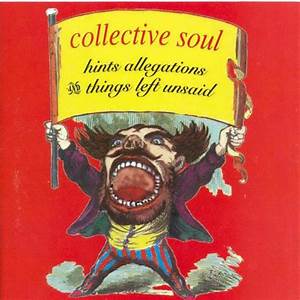
Hints Allegations and Things Left Unsaid
When this project was first conceived and the list of worthy albums first compiled, I did not consciously associate the albums by any criterion other than my personal desire for them to regain more public consciousness. On further reflection, however, I realized the first three albums are connected in other ways as well: Graceland and Lean Into It both address various musical forms/situations in bayou country, and Collective Soul’s debut album took its name from “You Can Call Me Al” on Graceland. Thus, it is fitting to bring them all to your attention in this issue.
Collective Soul is one of the few ’90s bands with any staying power. This most likely is due to their skill and intellect. Let’s be honest: Collective Soul’s music is beautiful and their lyrics are true — if any other requirement is needed for a band to be great and worth knowing/enjoying again and again, I don’t know of it. Certainly all of Collective Soul’s oeuvre could be considered “forgotten gems,” and possibly their self-titled second album has fallen further in public esteem, but Hints Allegations and Things Left Unsaid should be the beginning place of anyone’s newfound appreciation for one of the few great bands today.
Ye— oop, wait for it … Yeah!
“Shine” is arguably Collective Soul’s biggest hit. Supposedly it was to be their one hit, making them simply another one-hit wonder from the ’90s. Six number one songs later, Collective Soul is still around. “Shine” was my first experience of Collective Soul, hearing it on the radio (which is exactly what they wanted, I must admit). It was one of those songs Neyens and I made our own for a while, going to/from band practice, singing along with the chorus (at least the “yeah”s) whenever it came on over the radio (he was always the one doing the driving, of course — perhaps that’s where my affinity for singing in the car along with the radio/cd arose, bolstered later by the gang’s penchant for Eve 6’s “Inside Out”).
The song itself is straightforward enough: like most contributions to the Collective Soul oeuvre, it’s about love. God created the universe by and out of love, not logic or mathematics. Collective Soul recognizes this far better than most bands publishing under “Christian” labels. The repeated request “Heaven let your light shine down” is true and right and something we should all desire, just as we should all actively pursue the ameliorative effects of Heaven’s light as the final lines enjoin. It’s a great song all around.
Lyrical Genius at Play
I don’t want to step on any toes (especially my father’s) by intimating Ed Roland is in the same conversation of musical geniuses as Brian Wilson, but his lyrical ability is quite adroit, especially as evidenced in this song. “Goodnight, Good Guy” asks very sincere questions from the perspective of genuine faith. It would take quoting the entire lyrics to begin to capture the depths of the song, but for a good sampling peruse the second verse:
I’ll break the bread of a new day and wonder
If faith would carry me along
But days are longer as my heart gets weaker and
I can only stay so strong
Well, I’ll just sit here like a wounded soul
Who’s finding difficult to just let go
Let it go
Pretty powerful stuff, especially when supported by the laid-back musical offerings of the band. It’s a great optimistic song despite (because of?) the questions it asks and the adherence to the divine protection of the Lord. It’s certainly a great song that deserves far more appreciation and recognition than it has heretofore gotten from most music lovers.
A Great Use of Time
“Laid-back” is probably the best description of the entire album, despite the more famous zest from songs such as “Shine” and “Breathe.” Nowhere is that better captured in a rock-n-roll form than “Wasting Time,” almost a misnomer of a song, since it is one of the most catchy, enjoyable, repeat-worthy songs one will ever listen to in one’s lifetime. The mellow introduction breaks out all the Latin Percussion™ instruments most dabblers in percussion own. Added to that comes more pensive, soulful lyrics from Ed Roland that, despite their potential to weigh down in despondency, avoid such a miasma by the song’s (and album’s) ever-present embrace of optimism: “Well something’s going wrong inside of you / Burdens bearing down and seeping through / Well, I don’t wanna bleed anymore for you / Oh and I don’t wanna breathe any hatred too.” The second verse ends with probably my favorite line in the entire Collective Soul oeuvre: “And I don’t want to cling to our ‘used to be’s.” From that great line about, truly, putting off the old self and putting on the new (and now), the song ratchets up the tempo and vocal emphasis with a sincere and loving (in a “tough love” sort of way) enjoinder to all who are unwilling to cast their cares on the Lord and cling to them desperately for comfort to “take your heart, just take your soul / Just get yourself on out of here / Just take your hurt, just take your pain / Just get yourself on out of here,” because clinging to past hurts and failures is simply “wasting time.” It’s time to pick up the pieces (all right) and move on. All of this beauty in under three and one-half minutes. It’s definitely an album worth listening to from beginning to end, again and again.
No Tears Needed
The same theme continues in “Sister Don’t Cry,” though it’s a much more comforting kind of song. The music transforms into more of a funk groove, though only slightly, as the synthesized Hammond organ-like sounds propel the song through its sundry sections. The simple chorus belies the simplicity of its messages: as with “Wasting Time,” genuine life must be lived now; with salvation reigning over us now; we must put aside all the pain we’ve been through (as much as possible) and don’t cry anymore. Life is a communal journal of relationships and co-mutual restoration through shared sorrows and joys. Be not afraid of it; cry when it’s time to cry, but (as we learned so well in Twelfth Night) when it’s time to stop crying, stop crying and live again.
Higher and Higher
Most of the selections on Hints Allegations and Things Left Unsaid are unified songs, making “Love Lifted Me” the most disparate song on the album with three distinct sections. The first and third sections (the verses and the bridge) are among the most strident moments on the album (certainly “Scream” is the harshest). This makes the up-tempo dolce middle section (the chorus) seem out of place, at least at first. With enough repetition, the song leaves one with the impression it all works well together, like another crunchy nutty candy shell and a gooey, nougat-centered treat. It is a variation on “Amazing Grace,” perhaps, but that theme is true enough to hold up under countless reinventions (lazy contemporary adaptations simply attaching a new “praise chorus” to the old lyrics notwithstanding, a despicable practice worthy of excoriation which Roland masterfully avoids): “Once, I was down and couldn’t see / Then love lifted me. / Yeah, love; it was love / Oh I believe, that love lifted me.” True indeed.
Brevity is the Soul of Life
Continuing the pervasive “laid-back” style of the album, “In a Moment” is another impressive display of Ed Roland’s lyrical creativity. Behold the second verse: “Well, it’s a shame our world / Responds to life / As a puzzle in disguise / I wish our course / Would lead us towards / The peace and loving kind.” The first three lines are excellent (forgiving the overly-informal “well”). The secular atheist world around us does indeed consider the world to be a puzzle needing decoding (or deconstructing), but too much of life is inexplicable by scientific means alone as if the real source/truth of life is disguised to us in our present inferior material evolutionary state. Certainly as Christians we know the proper solutions to these confusions, and Roland sings of them quite lucidly: “We’ll never walk hand in hand / Until we let old wounds mend / And we’ll never sing songs as one/ Until we find love.” The entire album is really an interconnected whole; each song leads into the next and builds upon what has come before. Some of the unfounded negativity against the album is the seemingly simplistic lyric content: “In a moment, it could happen / We could wake up and be laughin’ / In a moment, it could happen / We could forgive and be happy.” The truth, especially the truth of the gospel, is linguistically straightforward and simple — and the atheistic world around us is too infatuated with “hard work” to accept this. It’s merely the practical application of the simple truth that is complicated and difficult. Fortunately, though, Collective Soul has already given us the answer: love lifts us while Heaven’s light shines down on us. The redemptive power of Eternal Love only takes a moment to change our lives to enjoy the abundant life we have not just in the life to come but now as well.
Speaking of The Abundant Life…
With the exception of U2 (which is akin to any fantasy discussion beginning with the requisite “with the exception of Tolkien”), no one composes songs about eternity better than Collective Soul does (though Steve Winwood and Three Dog Night come close). “Heaven’s Already Here” is a great example of Collective Soul’s ability to capture what abiding in Christ is about — true, it’s not just about the life to come, but as Jesus makes clear in John 10:10, eternity is not a “yet forthcoming” thing anyway. We are in eternity right now (the notion there are two eternities, one that ended when the universe and Time were created and another that will commence when the events of Revelation occur, is, I think we can all agree, preposterous). The Holy Spirit is within us now — we are, in one very real sense, in Heaven now: at the least, Heaven is in us now. For the first few years of listening to this album and this song, I completely misunderstood what Ed Roland was trying to get us to realize. I thought it was some sort of Cosmic Humanist/Transcendentalist malarkey about the “divine essence of monistic spiritual divinity is within so all we must do is seek there to be in harmony with the metaphysical energy of existence,” which made me quite sad for a while — here was an artistically skillful band with many lyrically moving and cogent points, but smack dab in the middle of the album was this song potentially discrediting their other fantastic works. Finally, though, after taking a pretty decent Sunday school course on “the abundant life,” I was not only reawakened to the truths of John 10:10, but I was also awakened to the Christian verity of this song. Roland is not urging us to commune with the “occult relation between man and the vegetable” as Emerson enjoins us to do in “Nature.” Rather, Roland is reminding us of another simple truth Jesus revealed to us so long ago: “Who could bring me Heaven / When Heaven’s already here?” The brief lyric of the entire song is worth reading through (note the exquisiteness of the second verse — Roland often seems to peak lyrically in the second verse):
v1
Wake up to a new morning
Got my babe by my side
Now I won’t yield to new warnings
’Cause I got my piece of mind.
chorus
Who could bring me Heaven
When Heaven’s already here?
Who could bring me Heaven
When Heaven’s already here?
v2
No more living in darkness
Now that love lights my way
I don’t need any new changes
To make me love today
chorus x2
Combined with the music, this is as about as perfect a song as anyone has ever or could ever compose. But just when you think the album couldn’t possibly get any better…
Beautiful, More Like
“Pretty Donna” is admittedly not a rock song, but one would be hard-pressed to find a song on a rock album more beautiful than this (Genesis’s “Horizons” comes close from Foxtrot, but I think “Pretty Donna” surpasses it — but only just). If you are looking for something sublime for a wedding, look no further. It’s one of those songs that must be experienced to be understood, so listen to it as soon as you can. Again and again for the rest of your life.
The Trilogy
“Reach,” “Breathe,” and “Scream” have always seemed to me to be a thematic trilogy, increasing in volume, tempo, and temper. “Reach” is another great example of early Collective Soul’s simple, laid-back style, providing more thoughtful lyrics from the creative mind of Ed Roland: “Should I thirst for meanin’? / Can I beg you for some water? / Should I fight your battles? / Or can I rest upon your shoulders?” Verse two: “Should I beg for mercy? / Can I be the one you treasure? / Should I question knowledge / Or can I have all of your answers? / Hope I’m able to find love today / Or can I ask you just to light my way?” Without trying to sound redundant, it’s a great song. Those listeners who require more “oomph” in their songs might disapprove of the mellow nature of this delightful song, but Beauty needs not apologize to anyone, especially to those whose aesthetic tastes are in need of refinement (or vivification).
“Breathe” brings back a little bit of the groove from “Sister Don’t Cry,” but neither of these early songs is nearly as funky as selections on later albums in Collective Soul’s career. The lyrics of this ditty are true but most likely the weakest on the album (something has to be). Continuing the thematic importance of love, love is now a seed and a tune: cultivate it and it will grow, and others will join in on the tune. Additionally, love is to be the air we breathe (though this may have the weakest lyrics of the album, this song is far better than Michael W. Smith’s semi-recently popular “Breathe” with barely-similar content). If we breathe love, even in little increments, certainly that will be contagious (in a good way) and help make society what it should become.
“Scream” may be the weakest song on the album (in terms of being the least desirable to listen to again), but only because it is the hardest-pounding song on an album that is mostly, as we keep saying, laid-back and mellow. It doesn’t seem to fit too much (akin to “Bullet the Blue Sky”’s jarring position on The Joshua Tree), but in other ways it is a natural culmination of the recent lyric progression. Though later songs in the Collective Soul canon (especially from Blender) are louder and more driving, the song ties elements of trying to understand life’s questions and answers from “Reach” and needing more room to breathe from “Breathe” to an angry, irritated desire for resolution, bringing the trilogy to a full (and dynamic) conclusion. Even though the beat may perturb, Ed Roland does manage to squeeze in some thoughtful lines: “I don’t want to be some puppet on a string / I don’t want to learn from things you can’t explain / And I don’t want to have your views on everything,” quite similar to W.H. Auden’s point in “The Unknown Citizen.” In the third verse, Roland gets his most cosmically irritated: “Well God is great and God is good / But God you’ll never be.” True, but Roland’s motivation for saying this is unclear, unless he is now confronting pseudo-Christian hypocrisy of the time or perhaps just general atheistic destructive and malfeasant attitudes and actions to what life should really be about: “I don’t want to be your hospitality / I don’t want to live with false reality / See I’m the one obsessed with truth and honesty / I just want to scream.” Most likely we all feel that way (increasingly so) in this dark world and wide as it continues careering away (increasingly so) from Biblical truth toward the morass of diabolical relativism, pragmatism, and Brave New Worldism.
A Double Ending
With all of his ire and energy purgated in the cathartic “Scream,” Roland begins to draw this pristine album to a close with the first of the album’s double-ending songs (another connection to Graceland). I consider it a double ending because either “Burning Bridges” here or the final song, “All,” could serve equally well as the album’s final musical and lyrical offering. The music here is self-explanatorily beautiful and needs no further comment. The sentiment behind the song some obdurate-centered people may find more maudlin than sweet, but the opinions of those people never need be considered. Sentimentality is painfully underrated today. The chorus is especially ideal: “So I’ll lift you up and hold you near / I’ll warm your heart and calm your fears / See I don’t want to lose this love I found / So I’ll burn my bridges, burn them down.” The title might make one presuppose “burning bridges” is a negative thing, since it is so often thought of as a drastic, anti-social event. Here, though, Roland upends our limited perceptions and connotations by presenting “burning bridges” positively: don’t “keep your options open,” people, he says. Commit. John Adams knew it, Ed Roland knows it, God knows it, we should all know it and embrace it. Commitment. Love is a commitment, not a fleeting feeling. The singer hurts when he is not with the one he loves — so do we all. He is willing to change himself to conform to what love requires of him — so should we all. It is a great song — so say we all.
As with so much of this album, the thoughts of one song blend into the next, and that is true for its double conclusion. The solidarity and commitment embraced in “Burning Bridges” continues throughout “All,” especially as evidenced in the chorus: “Yeah, all is all I can give you / All is all I can do / All is all I wish for when I’m with you.” The pervasive laid-back tempo is present again here, as well. The quality of musical accompaniment is a dominant factor in Collective Soul for most of its canon (the electronic-driven Blender is a main exception, but it, too, has some very gentle music at times). Their unique admixture of energy, gentleness, melody, harmony, and intelligent lyrics has dominated the album, and perhaps it reaches an emotional zenith with the bridge of this final song: “Well, I’ll push the clouds away so you can have sunshine / And I’ll give you anything that your heart desires.” With everything else from Collective Soul, it must be heard to truly be understood and appreciated. Fortunately, the time taken to listen to their often under forty-minute albums is time wisely and well spent. You won’t regret it, no matter how many times you do so.
A Double Ending Yields a Double Beginning
By his own admission, most of this debut album was the work of Ed Roland. Though the band restructured the arrangements and performances somewhat for their early touring, and not all of the band members noted on the album may have actually contributed as much as the liner notes intimate, it is certainly fair to say Hints Allegations and Things Left Unsaid is the nascence of Collective Soul’s career. Though the band may consider their self-titled 1995 release their genuine debut album (as a band), and though later sounds and instrumentation of their later work (especially in their electronic phase) are in noticeable ways distinct from this album’s sounds, enough similarities continue and (perhaps inchoately so) tendencies that later return in more mature forms are still extant and evident here: the predominance of one-word-entitled songs, most songs ranging between 3 and 4 minutes in length, Biblical Christian themes and ideas underpinning most lyrics, the impressive mixture of intelligent lyrics and beautiful melodic and harmonic lines, and the cohesion of the entire album as a unified whole more than the sum of its parts. Similar to Genesis’s From Genesis to Revelation and Trespass (as we saw last year), Collective Soul truly does begin at Hints Allegations and Things Left Unsaid. It is truly an enjoyable album from beginning to end, one worth experiencing again and again forever.
 Redeeming Pandora