
Connor Shanley
Music: it is known as the universal language. All cultures have some form of music, and just as cultures change, so does music. Music is a building that will never be completed; each trend and fad contributes to the next. Think that if some primitive man didn’t think to tighten an animal skin over a circular piece of wood, we would never have the snare, tom, and bass drums we have today. Every musician throughout all of history has been influenced by someone else; Mozart to Lil’ Wayne have/had an influence. This is even true today with the rise of electronic music such as dubstep, techno, dance hall, etc. It is true the instruments for these genres to even exist are somewhat recent inventions, but nonetheless their roots can be clearly traced. To truly understand a genre of music or an artist, one must trace their influence.
We now stand on the verge of a new musical era; the days of rock and hip-hop dominating the radio are coming to an end. Now there are all sorts of new kinds of music; techno has been sweeping Europe for the past decade, and now dubstep looks to take over America. Where did these kinds of music come from, though? The recent rage over electronic music can be easily traced. The first major event to get the ball rolling was the invention of the electric guitar.
In 1931, Adolph Rickenbacker introduced the first patent to make a guitar that could be played through an electric amplifier. This invention was later improved with a solid body by Gibson Les Paul and Leo Fender (who actually came up with the idea first is widely debated) in 1941. The invention of the electric guitar was the first step in bring electronics into music. The next invention was similar to the guitar: the electric bass guitar. The electric bass was invented in 1947 by Leo Fender (that’s not debated). The invention of both these instruments may not seem important to modern day electronic music, but many inventions for the recording of these instrument are crucial to the start of electronic music. These inventions also got many music engineers and producers to start exploring other ways to make more instruments electronic.
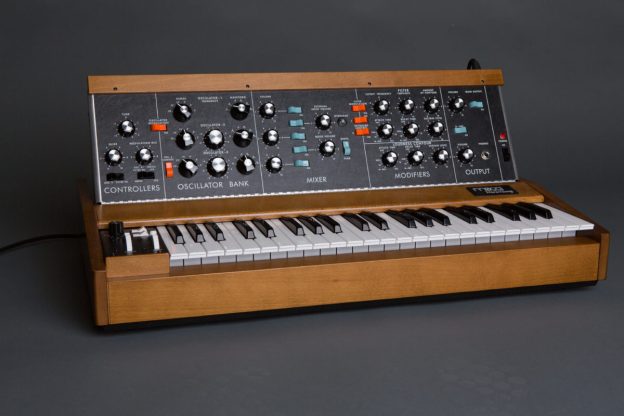
The next invention to start the electronic era is obvious. In the 1940s, many people made claims to its invention including the Russian government; no one can say for certain when it was introduced or who made it, but in the 1940s the synthesizer was made. When the synthesizer first came out, most people didn’t even think to put it in music. The original synthesizer was made more for scientific experiments in order to understand sound waves rather than used for music. Then in 1958, Dr. Robert Moog, an American scientist, made some of his own modifications to the original synthesizer; he made it more “musically usable.” Dr. Moog added smoother tones and more keys to make it easy to play.
Dr. Moog’s invention was not well received by most musicians. It would take years for his instrument to become more popular. In July 1965, a major event happened in the history of electronic music. A young graduate of the UCLA film school named Ray Manzarek was walking on Venice Beach in Los Angeles, when he came upon another UCLA film school graduate writing poetry. The man’s name was Jim Morrison, and that chance meeting was the creation of The Doors. The Doors put a demo together and managed to release it just two months after getting together. The demo was well received by the local Los Angeles crowd but got no national attention.
The Doors were revolutionary in their use of the Moog synthesizer, but before they could make it big another band had to pave the way. The Beach Boys were the first band to use a Moog synthesizer to break onto the charts. In October 1966, the Beach Boys released the single “Good Vibrations”; the song took 90 hours to complete and was at the time the most expensive song ever recorded, costing $40,000. It was the first song ever to be a number one hit using a Moog synthesizer. This opened the door for The Doors.
In November 1966, The Doors released their self-titled album; they also released their first single “Break on Through,” which did not have much radio success. The band decided to edit their seven-minute ballad “Light My Fire” down to three minutes, releasing it as their second radio single. “Light My Fire” achieved great radio success and brought The Doors popularity with the masses. Critics did not all find this new use of the synthesizer pleasing to the ear. Many critics complained that the synthesizer wasn’t a real instrument, that it took no skill to play, and that it sounded too spacey. The synthesizer had been used in songs before 1966, but no song with a synthesizer reached the popularity that “Good Vibrations” and “Light My Fire” did.
The Doors brought major attention to the use of the synthesizer as a lead instrument; they revolutionized the use of electronic music. The Beach Boys may have had the first hit using a synthesizer, but it was The Doors who really made it popular. Shortly after the release of The Doors’ album, other bands began to experiment with the synthesizer. The following year The Beatles released the album Sgt. Pepper’s Lonely Hearts Club Band; the album has a few songs using the new electronic instrument, mainly on “A Day in the Life.”
Jim Morrison in a later interview before his death said, “I see a new era in music, a mix between the rock we have now and electronics. I see a single man using tapes and a keyboard being able to replace whole bands.” Morrison would never live to see his vision come true, but if one looks at modern day music, it has come. The modern day DJ only needs himself and a keyboard. Listen to dubstep or techno and see the advances in musical technology since the ’60s. Jim Morrison never got see what he started, but, nonetheless, it was the band he started that got the public interested in electronic music; The Beach Boys helped, but The Doors were the real original electronic band.
 Redeeming Pandora