
Connor Shanley
There are certain bands throughout music that impacted music in such a way they cannot be ignored. Nirvana created “grunge” and was the voice of a whole generation of angry teenagers; Elvis Presley combined blues and country to make what we now know as rock and roll. Everyone knows who the Beatles are; everyone has at some point in their life heard a Beatles song. Many people don’t see the Beatles’ true impact on music, however; many people think the Beatles are overrated and over played. The Beatles are the most influential band in the past century; their influence is so felt in music most people wouldn’t even noticed it, and their influence is so ingrained in modern day music and fashion people just overlook them. Something people can’t deny though is that for better or worse the Beatles changed music. Think: a band that was only together from 1962-1970, only six years, and they’re the bestselling band in the history of rock and roll.
The Beatles started in 1955 when Paul McCartney joined John Lennon’s band “The Quarrymen.” A year later a thirteen-year-old guitar player named George Harrison also joined the band. In 1960, Peter Best became their drummer, and they renamed the band “The Silver Beatles.” In 1961, “The Silver Beatles,” now just shortened to “The Beatles,” were making their mark playing in clubs in Hamburg, Germany. They would return to Liverpool in late 1961; here they began to attract a big following.
When the Beatles returned home and started playing at the Cavern Club, they made a very big impression on Brian Epstein. Epstein was a young manager who wanted to record a few demos with the Beatles. Epstein got them into the recording studio but not without one big change, their drummer. The Beatles were no longer impressed with Peter Best as a drummer; Epstein simply voiced the Beatles’ feelings, and in 1962 Peter Best was kicked out of the Beatles. The drummer they got to replace Best was the only professional musician prior to being with the Beatles. His name was Richard Starkey, but in his year of on-stage performance, he earned the nick-name “Ringo Starr.” “Ringo” was because he liked to wear a lot of rings on both hands, and “Starr” was short for “Starkey.”
In September 1962, the Beatles released their first single, “Love Me Do/P.S. I Love You.” Their first single was not a great success; it barely broke onto the Britain top 20. In early 1963, the Beatles released their second single titled after their debut LP, “Please Please Me.” The LP would be at the top of British music charts for an amazing 30 weeks. In December of 1963, the Beatles released their first U.S. single, “I Want to Hold Your Hand.” The single was instantly at the top of the charts in the U.S. Then they were asked to perform on the Ed Sullivan Show in February of 1964. After their U.S. tv debut, the Beatles would be a hit like no other band in history. After the Ed Sullivan Show, the Beatles had the top five singles in the U.S. and the top two albums.
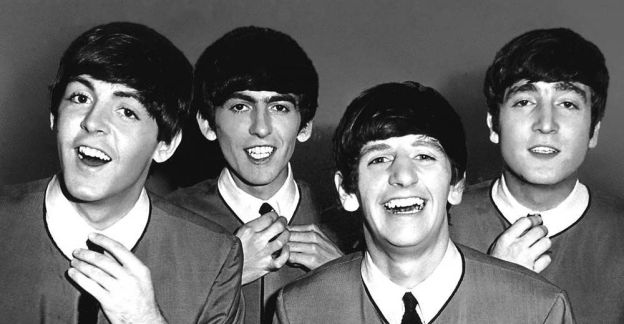
The Beatles were now making movies; their infamous “mop top” haircuts were seen on most young men in the U.S. In 1964, Beatles merchandise outsold Disney. The impact the Beatles had on pop culture was clear. The Beatles brought a very upbeat and happy sound to rock and roll. In 1965, their image would change. With the release of their album Rubber Soul, the Beatles did away with their “good boy” image, and their sound also started to change. Instead of just making upbeat pop, the Beatles started to make more deep meaningful tracks such as “In My Life” and “Norwegian Wood.” “Norwegian Wood” was the first top ten hit to feature a sitar.
Rubber Soul was its own unique musical experience, and each song showed how the Beatles were changing. The Beatles began to stray away from their upbeat pop sound. The Beatles began to explore more influences from the east, and they began to get into eastern mysticism. The next album after Rubber Soul was Revolver, the album featured the songs “Eleanor Rigby” and “Yellow Submarine.” The album revolutionized the use of background instrumentation apart from just guitar, bass, and drums in popular music. The Beatles’ changing style was greatly helped by their producer George Martin, who encouraged the Beatles to experiment.
After Revolver was Sgt. Pepper’s Lonely Hearts Club Band; the album started with a concept by George Martin of two separate tracks working together. This can be seen in two songs on the album, “Sgt. Pepper’s Lonely Hearts Club Band/With a Little Help from My Friends” and “A Day in the Life.” The album also showed the contrasting styles of John Lennon and Paul McCartney. In “A Day in the Life” was a competition between Paul and John to see who could write a better song. This sort of competition began to drive Paul and John apart; that, combined with the fact their girlfriends were constantly fighting, began to end the Beatles.
The Beatles’ next album was Magical Mystery Tour, which, when it was released, was a huge flop. The music critics at the time complained the album had too much psychedelic influence; this can be seen in the only top ten hit of the album “I am the Walrus.” The Beatles even admitted they didn’t put their best effort into the album, which was a soundtrack to a tv movie; the movie was the least successful of the four movies the Beatles starred in.
The next album was a mix of the Beatles’ psychedelic influences and their old pop sound; the album released in 1968 was simply titled The Beatles LP, but it came to be more commonly known as the White Album. The White Album was the Beatles’ only double album, and it was recorded during a time of great turmoil after a controversial visit with the Maharishi in India. The album featured the single “Helter Skelter,” which in Ozzy Osborn’s words, “was the first metal song ever made and my greatest inspiration.” The Beatles were starting to get a bit more into hard rock; this was mainly spurred on by Paul.
There were two albums after the White Album; Let it Be and Abbey Road. Let it Be was recorded first, but the producer George Martin decided to extend the release date because he felt it needed more work. The Beatles then started to work on their last studio album, Abbey Road. The album continued a lot of the same ideas Sgt. Pepper’s Lonely Hearts Club Band had. Both albums are considered to be concept albums, which means songs could be mixed together and could be played one after the other without any pause in between. The best example of this is the last five songs on Abbey Road, known as “The Abbey Road Medley.” The last five songs are all really one song. The last song ever recorded by the Beatles in studio was “I Want You/She’s so Heavy.” Four days after the recording was finished, John announced to the band he was leaving; he agreed he wouldn’t make a public announcement until certain legal issues with the record company were resolved. Abbey Road came out in September, 1969. John Lennon announced publically he was leaving the band in December of 1969. Let it Be then came out in May of 1970, and Paul released a statement explaining reasons for the break with the album’s release.
It was the end of the Beatles, but what they accomplished in only seven years of making albums is remarkable. They brought the idea of the concept album to the forefront of music. They changed pop forever; pop no longer had to be upbeat guitar riffs and songs about girls. Pop was deeper now; it can be seen in their last single, “Let it Be.” The Beatles forever changed how music was made and how the public perceived music. They influenced generations of musician after them from Ozzy Osborn to Michael Jackson. Without the Beatles it is a fact music as we know it today would not exist. They changed music forever, and no band after has had as great an impact on music and pop culture as the Beatles.
Bibliography
“Beatles Bio.” Keno.org. Keno, 1999. Web. 27 Sept. 2011.
Costello, Elvis. “Rolling Stone: The Beatles’ 100 Greatest Songs.” New York, NY: Rolling Stone, 2010. Print.
Osborn, Ozzy. “VH1 Special to Take a Look at ‘100 Greatest Artists of All Time.’” Entertainment Close-up. 1 Sept. 2010. Print.
 Redeeming Pandora