
Christopher Rush
It Was 1992…
Scott and Jean were not yet married (though she was still alive again). Cable was still a mysterious figure. We weren’t sure who Stryfe was. The newly-launched X-Men and X-Force titles had not-yet participated in a major X-Titles crossover. The New Mutants had recently become X-Force and were, in effect, part of the problem now. Bishop had just arrived from the future, and we still didn’t know what he meant to the team. We had so many questions, but we were certain that the future would be impressive — like the Edwardian Age, optimism abounded. What came next did not disappoint (not the real fans).
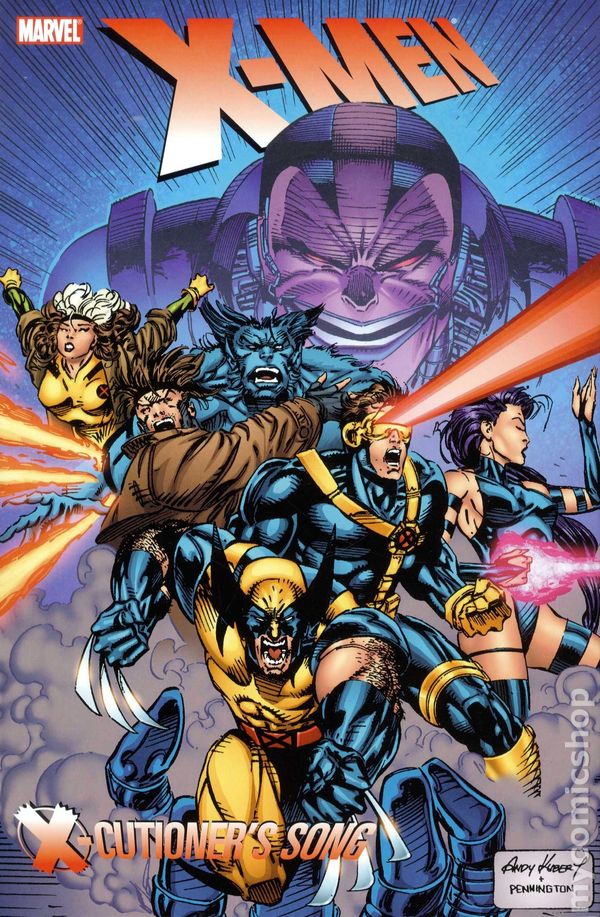
X-Cutioner’s Song is an oft-overlooked great crossover in the history of the Children of the Atom. Before Onslaught, the House of M, and Grant Morrison came along and changed everything (again and again), the revitalized X-Titles were hitting a new stride, despite the great talents of yesteryear (Chris Claremont, especially) no longer being a part of the process. A simplicity still existed that seems lost today. X-Cutioner’s Song, about to turn twenty years old, deserves a second look. As is our wont, we won’t reveal all the plots, subplots, and exquisite details that abound throughout the series — you should read it for yourself, even if you don’t know the difference between Cyclops and Havok.
Part 1 — Uncanny X-Men 294: “Overture”
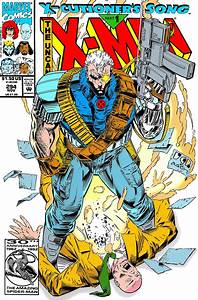
Though this will sound rather hyperbolic, Uncanny X-Men 294 is about as close to perfect as a comic book can get. The better issues of comics, for me, fall in two categories: monumental (and believable) significant changes and laid-back, “day in the life” episodes — admittedly, two ends of a rather vast spectrum. UXM 294 has both. For most of the issue, we see various X-Teams going about their day: Scott and Jean are relaxing at Harry’s Hideaway; Bobby and Peter are shopping for groceries; Warren is on a date; Guido, Jamie, and Pietro are sitting down to watch Charles Xavier on television. Bishop and Rogue are on perimeter detail, discussing previous occurrences (it’s always nice when the characters remember events from previous issues), and so are Ororo and Remy (two unlikely pairings), all surreptitiously guarding Xavier as he prepares to address the gathered crowd about unwarranted mutant bigotry. As is often the case, these relaxed “day in the life” experiences are interrupted: Scott and Jean are attacked and kidnapped by Apocalypse’s Horseman and Stryfe (pretending to be Cable) shoots Xavier in front of everyone. Just like that, the relaxing day becomes the beginning of a very good and vastly underrated cross-over: X-Cutioner’s Song. The only thing that prevents this from being a full five-star great issue is the ambiguity of Scott and Jean’s kidnapping: one moment the roof is collapsing, the next we are told they have been spirited away — a minor confusion, but it is still confusing. Other than that, the issue is remarkable for its brief character moments and its scenes of conflict and tension.
Part 2 — X-Factor 84: “Tough Love”
A great deal of the success of this issue is the unique pencil work of Jae Lee. For the longest time, when first reading X-Factor back in ’92 when these issues came out, I could not tell why the artwork was so much edgier for the issues in this crossover than the issues before and after it; it was not until much later I realized (by looking at the credits, finally) the penciler, Jae Lee, did his only X-Factor work on the three issues of this event. Though his exaggerations of muscles (Bishop’s especially) can get a bit extreme, his artwork for this issue is admirably suited to the story; his penciling of the characters and their taut emotions both in their concern for Xavier and their anger at having to fight their own, albeit temporarily rogue, friends and former understudies is fitting. Equally fitting is Peter David’s writing. He has admitted to being a character-driven writer, and this issue exemplifies that important attribute of better comics, even in the midst of a story-driven multi-part crossover. Archangel’s moment of anger at Apocalypse, Strong Guy’s humor even in the most awkward moments, and Quicksilver’s lines throughout the issue are all great examples of Peter David’s skills. Being the second part of a series is a challenging role to fill, and X-Factor 84 does a remarkable job keeping the pace and tension going after Uncanny X-Men 294.
Part 3 — X-Men 14: “Fingers on the Trigger”
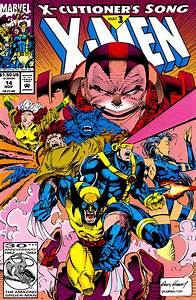
The cover of X-Men 14 is a bit misleading, considering Cyclops is in suspended animation during the issue, being transported by Mr. Sinister to the Mutant Liberation Front. Additionally, this issue suffers (though only slightly) in that it has to be a joining episode of a multi-part story arc essentially acting as the set-up issue to the exciting second part of the battle between the X-Men/X-Factor unit and X-Force, completed next in X-Force 16. Since it is a set-up issue, we have a lot of travelling panels, “here’s what we’re going to do next” conversations, and rapid oscillation among the various plot threads and teams involved. That’s not necessarily a bad thing, for the overall story, but it does diminish the enjoyment of this particular issue qua issue; however, some of the brief character moments make this issue worthwhile and surprisingly enjoyable even for a transition issue. Havok’s internal struggles over confronting and capturing X-Force are a great touch, elaborated on further in X-Force 16: he works for the government, but he is still a part of Xavier’s dream. The discussion of said dream is also one of the better moments in this issue, as Wolverine (ever the cynical one) intimates it might be time to give up on the “dream” and realize it is all a “nightmare.” Having to attack their former pupils (for attempting to assassinate their mentor, no less) certainly adds to the uncertainty of this time in the X-Teams’ existences and personal lives.
Part 4 — X-Force 16: “Jacklighting”
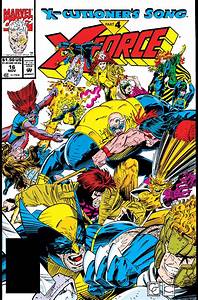
Underlying this crossover is Xavier’s dream: humans and mutants can live together in harmony, free of hatred and bigotry. In the previous installment, Gambit and Wolverine speculated it was past time the X-Men realized the dream was illusory and the pragmatic realities of their day should make them realize the world is a “nightmare.” The dream is tested in X-Force 16, as X-Factor and the Blue Team X-Men fight X-Force again. Cannonball’s leadership is also tested again: he knows they are no match for the older, more experienced teams, and he even has to leave some wounded mates behind in their tactical retreat; eventually he surrenders, knowing full well Wolverine would kill them to get what he wanted.
The changing nature of the X-Universe is furthered in the issue by Bishop’s confrontation with Mr. Sinister. Bishop’s lack of hesitation in pulling the trigger pleases Sinister, which is not a good sign for the Dream. Wolverine, Bishop, Cable — they and their interactions all point to the changes in Xavier’s dream in the years ahead, climaxing (for now) in the events of the Second Coming event and its aftereffects. The storyline of the X-Cutioner’s Song moves ahead with this issue: Sinister tells Val Cooper who is behind it all, Cable prepares to confront him, and Stryfe reveals himself to Cyclops and Jean Grey. The final page of the issue, though, is the best part: once X-Force is in captivity, Havok asks in desperation, “What do we do now?” He is clearly not just asking about how to save Xavier’s body — if the followers of Xavier’s Dream can’t even trust each other, how can the Dream survive outside of mutantkind?
Part 5 — Uncanny X-Men 295: “Familiar Refrain”
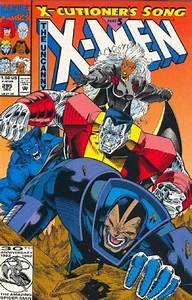
Part of the interesting nature of the X-Cutioner’s Song crossover is the relative newness of many characters we now take for granted, especially Bishop and Cable. Cable had only been around for a couple of years; we still did not know if he was Cyclops’s son taken into the future (or if Stryfe was). Before the traitor of the X-Men turned out to be Xavier (and later Bishop himself), Bishop was a mysterious young man from the future, like Cable, who didn’t yet fit in despite his commitment to them. With those mysteries going on, Archangel’s unresolved anger over Apocalypse’s transformation of him from the Angel adds to the tension of seeking out Apocalypse’s help to rescue Xavier, the father of the X-Men as a whole. Stryfe’s first encounter with Cyclops and Jean Grey in the previous installment of the crossover included him calling them his father and mother (in quotation marks), and now his revenge on them begins in earnest (though since his mother is Madelyne Pryor, not Jean Grey, his anger with her is misplaced) — all for the purpose of finding out why they treated him the way they did, sending him into the future (though it was actually Cable). Even before The Adventures of Cyclops and Phoenix, the effects of that series shaped the direction of the X-Men for a time. Though Stryfe does not become a major villain in the future of the X-Men, his existence is important here and now. The issue is fairly strong, especially with all of its sub-plots. The one irritating aspect of it is that suddenly Wolverine and Bishop have gone off to Department K, though we never knew they were going there. Their unexpected run-in with Cable is a little forced, but the humor sprinkled in the issue, especially from Wolverine, helps alleviate the slightly jarring plot progression.
Part 6 — X-Factor 85: “Snikts and Bones”
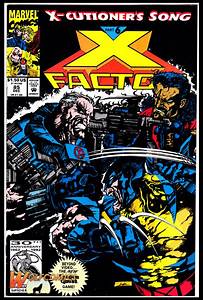
Though this issue is another “transition” episode between major points along the X-Cutioner’s Song plotline, Peter David’s emphasis on character moments make this a much more engaging transition than X-Men 14. The unique (and dark) Jae Lee pencil work makes the melee combat scenes extra taught (especially Bishop’s muscles). Cannonball’s decision to help the X-Teams in their investigation into the Mutant Liberation Front is a good one (for his maturation), though I would have liked to have seen a scene of him telling the rest of the imprisoned X-Force that he is going out on a work visa. Wolverine is especially lucid in this issue, showing his open-mindedness in listening to Cable — which is also a good decision for his character, but it strikes as a little odd, especially with his “anti-Dream” talk earlier in the crossover. Cyclops’s scene of impulsive frustration (though after hours of solitary incarceration) is a sign of his tough-as-nails personality in post-M-Day issues a decade after this storyline, but it seems a smidge out of place here. His reaction to the realization he just optic blasted children and Jean is fitting with his character. It is a good coupling with Stryfe’s scene with Jean in the previous installment, but the episodes are too brief, especially since the crossover is now half-over. The most interesting scene is Archangel’s accidental decapitation of Kamikaze. Archangel’s reaction is apropos; Boom Boom’s reaction is likewise apropos for her character, and the juxtaposition of her immaturity and his maturity is remarkable — especially after all of Archangel’s talk about wanting to assassinate Apocalypse.
Part 7 — X-Men 15: “The Camel’s Back”

This may be the weakest link in the chain of X-Cutioner’s Song. It’s not that we expect non-stop action and major plot points throughout all twelve episodes in the crossover; the story is certainly allowed to transition from set piece to set piece with intervening respites. What sets X-Men 15 apart from other linking issues, though, is that it lacks the good character moments that bolster the story-movements in those other episodes. Though Colossus has a good moment pondering his brother’s recent actions, Strong Guy’s interruption does not improve the scene, even in a comedic way. Similarly, Stryfe’s moment of humiliation for Scott and Jean in this issue is too bizarre to provide a good continuation of his vengeance scheme. The dialogue throughout the issue suffers: Reaper is too casual at the beginning, Stryfe is too congenial with Zero, Beast is too easily angered with Moira, and Scott and Jean — despite being major motivations for the story — have again almost nothing to say. The X-Teams get beat up in this issue: Boom Boom’s jaw is broken (perhaps fitting punishment for her juvenile reaction to Kamikaze’s death in the previous episode) and Rogue is temporarily blinded. Stryfe’s quick dismantling of the Dark Riders begs the question — why would Apocalypse have such a weak team around him? Havok again has to ask someone for advice on what to do next — before it was a sign of his deep emotional struggle with their plight; now he just looks indecisive and weak. The story moves along a little bit, thanks to Stryfe and the dismantling of the Mutant Liberation Front, but little overall progress is made.
Part 8 — X-Force 17: “Sleeping with the Enemy”
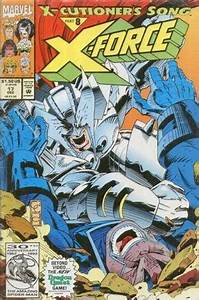
Part of the impressive and enjoyable aspect of this crossover is that the “big battles” come in a progressive series: the story presents the one about to happen as the real climactic battle, but when it’s over, we know the next one is going to be even more significant. Such development does not happen as successfully in many crossovers. The battle between Stryfe and Apocalypse seems like it should be bigger, even though it occurs at the beginning of the issue. When it ends, we know that more important things are about to happen. Finally, we hear from Cable about his history with Stryfe — that he doesn’t even know yet why they have the same face is part of the creative atmosphere of the time: here was an interesting mystery in the X-Universe that did not require major retcons or total multi-series changes (Disassembled, Civil War, Dark Siege, etc.). The Stryfe/Apocalypse connection is also enjoyable, but a bit confusing if you are unfamiliar with their appearances/history. Why Stryfe is glad the Dark Riders so quickly turn to him is odd, considering his disgust with them in the previous installment for being so weak — perhaps having weak acolytes is acceptable if they are your weak acolytes. The comedic snippets in this issue are better than the attempts in X-Men 15: Wolverine’s struggle with Graymalkin’s anti-smoking programming is a highlight. Other character moments help this issue succeed: Rahne’s talk with her former teammates, Siryn’s realization she was involved not with Madrox but one of his duplicates, and Cannonball’s confrontation with Havok reminds us he (Guthrie) is fit to lead after all (Havok again comes off as a bit weak and thoughtless). Finally Scott and Jean get to do something again, though it’s only for a couple of panels. Their relationship is presented well as something good in this issue — the later destruction of it will forever be a dark spot in Marvel’s history. Archangel’s confrontation with Apocalypse at the close of the issue is a good reminder of their connection and just how integral Apocalypse was in the development of the X-Universe in the ’80s and beyond.
Part 9 — Uncanny X-Men 296: “Crescendo”

This issue does a fair amount with not much material, which is impressive considering the couple of flaws in it: the beginning is confusing, made more so by the incorrect footnote from Bob Harras on page one; when did Cyclops and Jean encounter the Dark Riders?; the missing footnote on page 22 (though the issue doesn’t have page numbers for some reason) — the references to years-ago back issues are more important than references to issues in the same crossover. It’s also a bit confusing how the Dark Riders got to the moon so quickly from Egypt, after Stryfe just swayed them over in the previous episode. Aside from those aspects, this issue does have some good moments. The “story thus far” recap by Bishop, Cable, and Wolverine is interesting enough to prevent being tedious. Cyclops and Jean’s kiss before they head into more danger is another great aspect of their good relationship in the good ol’ days, before more recent writers felt free to destroy one of the best things about the X-Men and Marvel Universe. It’s about time Scott and Jean finally got to do something substantial for the first time since the beginning of the crossover (before they were captured by Caliban). Stryfe’s reaction to their sacrificial response to his test is great, even though one could make the argument not enough time in the series has been given to him and them. Some might prefer his realization to be in subconscious thought bubbles instead of editorial rectangles, but that is not as important as the event itself. Stryfe is no longer certain Scott and Jean abandoned him…what has he left now?
Part 10 — X-Factor 86: “One of These Days…Pow! Zoom!”

So late into a crossover, one might expect an issue to drag any potential momentum down — not so with this final David/Lee match-up. This pair did great things with these three X-Factor issues, but Lee may steal the show here. The best moments in this great issue are wordless images from Lee. Few great authors would allow the images do all the narrating, even in comics — Peter David proves his greatness by letting Lee’s images tell everything we need, both in a comic scene and a heart-wrenching romantic scene. The image progression of Scott and Jean running out of oxygen and turning to spend their last moments embracing is one of the best moments in Marvel’s history. Later, the comic wordless scenes of Cable, Wolverine, and Bishop waiting for Graymalkin to recalibrate for the Moon are a great progression (especially Cable whittling a Domino statuette). David does get some great character lines in, though: Havok gets some leadership skills back with his humor, Strong Guy’s comedic moment is far superior to the weak scene with Colossus a few issues before, and Cable’s “hour and a half” line is priceless. Stryfe’s tearful confrontation of Cyclops and Jean is what the series (at least their section of it) has been waiting for — genuine emotion. That Storm and Havok listen to Warren in letting Apocalypse finish saving Xavier from the techno-organic virus is a good testament not only to their good leadership skills but also Warren’s strength as a character and original X-Man. This is a stupendous issue.
Part 11 — X-Men 16: “Conflicting Cathexes”

Admittedly, this issue suffers structurally, in that it is the final set-up piece before the grand finale of the crossover, so we shouldn’t be too harsh on it. It does have some good character moments: Cannonball’s brief confrontation with Cable and Archangel’s lines to Bishop are great — “His life has been marked by pain and loss,” says Bishop of Apocalypse. “And that’s an excuse, Bishop? Which one of us hasn’t gone through the same? You just don’t see us choosing to mark everyone else’s life with the same brand of hatred that’s inflicted on us,” replies Warren. That sums up ’90s X-Men, pretty much. By this point in their lives, all of the X-Men had gone through an awful lot of turmoil and heartbreak…but they were still there, fighting to protect a world that hated and feared them — even fighting against other mutants. It was never about sheer force, which Bishop acknowledges. That the beginning of the issue tries to reject that (in Wolverine) is part of why the issue is somewhat flawed. Other smaller scenes and tidbits detract from the issue as well, but it does serve its overall purpose of drawing the various plot strands and character groups together for the final act.
Part 12 — X-Force 18: “Ghosts in the Machine”
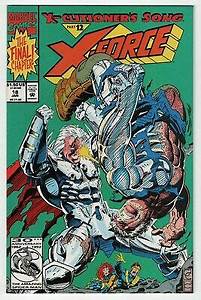
Sometimes the finale of a major crossover can be a giant letdown; sometimes the payoff is not worth the investment. Neither of these is true of X-Force 18: this is a marvelous conclusion, bringing us fully (and finally) to the heart of what Stryfe and X-Cutioner’s Song have been about from the beginning — family (one could make the case for “love” as well). In one sense, there was no “need” to bring in Apocalypse to the story at all. Stryfe could have certainly shot Xavier with a regular plasma gun or something, not a techno-organic virus only Apocalypse could cure. The reason he was brought in to the series seems to be the great scene of weakened Apocalypse and Archangel here: Warren declares (and possibly realizes for the first time) the true part of him that makes him himself was not altered by Apocalypse — he is not truly his son. Havok’s weak moments throughout the series are forgotten in his personal confrontation with Stryfe: he finally voices his perspective at being a Summers but not Scott Summers, and he seems to begin to cope pretty well (for the time being — he’s one of the worst-treated characters in Marvel’s history). Underlying this crossover is the question “who is Cable?” Is Stryfe or Cable the son Cyclops had to send into the future? Though this crossover was supposed to answer that question, it didn’t…which is much more satisfying as an ending, surprisingly enough. That Scott starts to suspect that Cable is, to Jean’s surprise, is a great way to conclude the song. Keeping the mystery alive (especially while delivering an emotionally moving conclusion) is far superior to answering the question and then having the writers retcon it all twelve years later (the current fashion). Some may think Stryfe’s desire for togetherness is too sappy of a motivation — they are mistaken. The epilogue, Stryfe’s “pox on all mutantkind,” is of course the release of the Legacy Virus. That later writers of X-Books did not know what to do with it is not the fault of this storyline. Sinister’s stoic response to being tricked by Stryfe is consistent with his equipoise throughout the series. X-Cutioner’s Song is a story about family, about belonging, being together, and how (much) the Children of the Atom have to sacrifice in order to do that, even a little. This is a great story that shows us the heart of many of these great characters.
Epilogue — Uncanny X-Men 297: “Up and Around
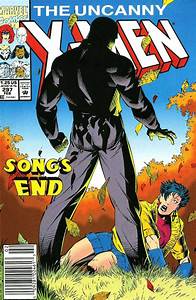
This is the best comic issue I have ever read. As an epilogue to a great crossover, Uncanny X-Men 297 has the perfect mood: quiet. Some might argue the issue needs Cyclops and Jean to reflect on what just happened to them: perhaps, but they already did that (albeit briefly) in X-Force 18. Now is the time for the other refrains of the song to reach their codas. Rogue and Gambit spend some time together as she recovers (on the roof) from her temporary blinding in the crossover, though in a way that finally allows Rogue to speak her mind about what she needs, her desire for Gambit, and her great disappointment (irately so) that they can’t be together: Gambit’s power is to charge up objects and throw them away — Rogue certainly doesn’t want that to happen to her; she’s a woman, not a thing. After some hours of separation, Gambit finally returns and offers Rogue what he can, a blanket and some reassuring words — for now, his presence is enough. The thread of Warren and Hank rebuilding Harry’s Hideaway is the greatest series of panels probably ever. What’s great about it, as with the entire issue, is the genuineness of the emotions and dialogue. Finally we get some reflection on where the original X-Men used to be, how things were in the old days before Hank and Warren turned blue (literally and figuratively). It’s so easy to forget they started out as students, as kids, writing term papers and struggling with their personal issues before Magneto, Apocalypse, the Sentinels, and the M’Kraan Crystal changed everything (again and again). Hank’s laughter and Warren’s reflection on his old attitude are superb. Better still is Hank’s encouragement to Warren, especially after Warren’s own confession to Apocalypse the day before: he has struggled through his experiences (we all have), but he has come through them truly human and mature. The final thread of the issue is Professor X’s moments with Jubilee, as he enjoys a few hours’ ability to walk again. That he spends them with Jubilee is a great touch — the two ends of the good X-Universe spectrum. The quiet scenes of his reflections on losing his mobility, gaining it again, and imminently losing it again are excellent character and narrative moments. The final two pages are some of the most moving in X-Men history, rivaling the great Cyclops and Jean moments earlier in the crossover. This issue shows us what Professor Xavier’s Dream is all about: it’s not about fighting evil mutants and bigoted humans; it’s about love.
Addendum – Stryfe’s Strike File
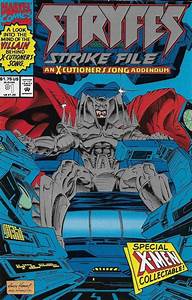
Being a completist, I had been searching for this comic since 1992. I finally found it for 25 cents in 2010. Shortly thereafter, I began finding it in every comic store I visited — strange how that happens. The issue serves its purpose well, and the writing, though defamed by some, is aptly written as the writings of the deluded and maniacal Stryfe. It’s challenging to view the X-world through the eyes of a recently-arrived crazy man. The first appearance of Holocaust is here; more notable is Stryfe’s comment that he isn’t supposed to be in this timeline — two years before the Age of Apocalypse. Similarly, Threnody’s first appearance is here, almost a year before she appears in X-Men 27. Before Colossus becomes an Acolyte, Stryfe says it’s coming. It’s odd to think of Bishop and Wolverine as lesser players than they think they are, especially considering Wolverine’s stratospheric popularity. Too bad Stryfe could not see Scarlet Witch’s future destruction of the X-Universe a decade in the future. His comments about Cannonball are perhaps the kindest things ever said about Sam Guthrie. The frame story of Professor X reading through these files is a nice narrative device, but it’s more impressive that, despite his desire to know what Stryfe knew, he purges the files — the X-Men will face the future, together, without the perspective and machinations of madmen like Stryfe.
The Song Remains Supreme
The good news for you is we are living in an age in which Marvel has recommitted to releasing its classic crossovers and series in remastered hardcover and trade paperback sets (some at better prices than others if ordered on-line). Instead of trying to track down the separate issues in the various comic book stores around town, you can simply wait a couple of months and order the future hardcover release scheduled to come out August 2011 (with both Uncanny X-Men 297 and Stryfe’s Strike Files, you lucky duck, you — no waiting eighteen years needed). True, it might be more enjoyable to track down the issues and look at the advertisements for Aladdin the movie and Hook the SNES game, but if you are just interested in reading one of the better X-Men stories at a time before the crazy retconning and character destructions of the 2000s, getting a copy of X-Cutioner’s Song is the way to go. It’s a great story with some of the best character moments in X-Men history.
 Redeeming Pandora