
Christopher Rush
It’s Not About Vengeance…
Despite the sudden proliferation of “Pandora”-titled things this past year, none of them were the inspiration for the name of this scholarly journal. Similarly, before the theme of the 2010-2011 was announced to us as being about “redemption,” the title for this scholarly journal was already “in the works,” as the kids say. So though it may have appeared to be a combination of recent things, the name has its origin in older, far different sources.
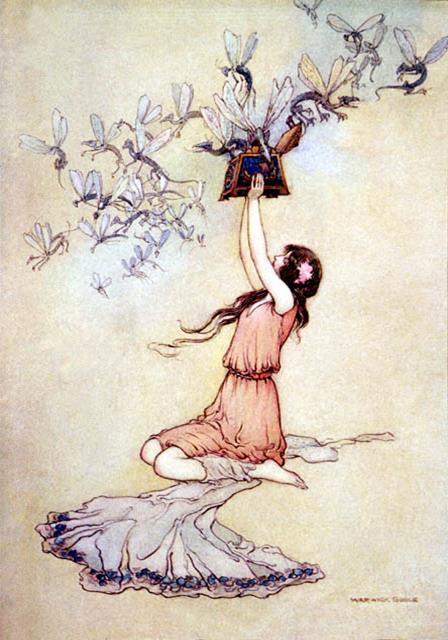
The “Pandora” is, as you can probably suspect, the Pandora of classic Western mythology, especially out of Hesiod’s works (though you may have heard of her from other summary/anthology sources). Since she opened the jar (it wasn’t a box, really) out of curiosity and not malice, as an individual she doesn’t need “redemption” in that sense, as if she had willfully done something wrong and needed internal restitution, even though some accounts of her tale make her out to be somewhat tawdry. The history of Pandora, her story, and its variations is complicated — fortunately, though, the most genuine origin of the inspiration of the title does not really come from those literary sources (not directly). The real source of both parts of the scholarly journal’s title is the video game series God of War (the main trilogy, not the miscellaneous sub-stories). The God of War series is M-rated, for good reasons. We are not urging you to go out and play them, especially if you are under seventeen, and even then not without parental (and conscience) consent. There’s a lot of violence/gore, some unclothedness, and some intense scenes of ruthlessness — it’s definitely not for the faint of heart or young of spirit. The point, then, here, is to look at the story and explain why it’s so good (despite the saucy parts), good enough to supply the title of this journal.
Ares Unleashed
The first God of War game is mostly a flashback frame story: it begins about five minutes before the game is over, with Kratos (the…hero) giving into despair, believing “the gods on Olympus have abandoned me.” Throughout the game, various incidents and encounters trigger further flashbacks into Kratos’s history: once the proudest, strongest Spartan warrior, Kratos’s life was about to end at the hands (and hammer) of the Barbarian King. Before the Barbarian King can finish him off, Kratos appeals to Ares: if Ares will help him destroy his enemies, Kratos will become Ares’s servant. Ares responds by bestowing (after a fashion) the Blades of Chaos on Kratos, the weapons that allow for such rapid gameplay (much better than the button-mashing of street-fighting games). Kratos serves Ares for years waging a war on all of Greece until the fateful night Kratos attacks a village of Athena worshippers. Defying the village oracle, Kratos storms a hut and accidentally kills his own wife and daughter, whom he thought were far away. He knows Ares is behind it: Ares intended to use the removal of this final connection to humanity to make Kratos into a heartless, machine-like warrior; instead, Kratos renounces his affiliation to Ares. The oracle curses Kratos as the hut burns to the ground; the ashes of his family are bound to his body, turning him into the “Ghost of Sparta.” For ten years, Kratos serves the other gods in hopes they will remove his nightmares and guilt. They do not. Poseidon asks Kratos to kill the Hydra and save his seas; this is when the player gets control over Kratos and the game begins. After working through the first level and killing the Hydra (the first of only 3 bosses in the game), Kratos’s patience with the gods is at an end. Athena asks him to do one last favor and the gods of Olympus will finally forgive him: kill Ares, who is now out of control and destroying Athens itself. Kratos agrees, believing he will be able to avenge his family and finally be rid of his nightmares.
Kratos fights into, around, through, under, and above Athens for a good third of the game, sometimes aided by the gods and their magic/weapons (including an easy victory over Medusa). After a mysterious encounter with a gravedigger, Kratos meets Athens’s oracle, who tells Kratos the key to destroying rampaging Ares is finding Pandora’s Box, which is strapped to the back of mighty Cronos in the Desert of Lost Souls. Kratos wends through the desert, killing some Sirens along the way, and summons Cronos. After three days of climbing up him, Kratos comes to Pandora’s Temple. This is the majority of the game (at least it feels like it). Kratos fights through the many levels and tests of the Temple, solving puzzles and slaying monsters all the while. Once Kratos secures Pandora’s Box (a very large, intimidating box of fire), the player wonders how he is supposed to carry this all the way down Cronos and through the desert back to Athens. Ares solves that problem by killing Kratos, sending him down to Hades, and capturing Pandora’s Box for himself. Kratos struggles through Hades and is rescued by the mysterious gravedigger just in time to find he is too late to save the Athenian oracle. With a little bit more Olympian help, Kratos confronts Ares for the last time. Through physical and psychological battles, Kratos eventually conquers Ares…only to find the gods of Olympus forgive his blasphemy but will not take away his memories of his family, bringing us back to the beginning of the game. Athena prevents Kratos from ending his life and gives him new blades as the replacement god of war. Kratos takes his place on Olympus.
Fate Unravelled
Kratos has not done much better than Ares as the new god of war, and the gods of Olympus regret their decision. Kratos has been leading his Spartans against Greece again; during an assault on Rhodes and its Colossus, Zeus tricks Kratos into sacrificing his divine powers, eventually killing him with the same sword that he used to end the War of the Titans so long ago. In Hades a second time, Kratos meets Gaia and becomes a part of her plan to lead the Titans in revenge against Zeus. In order to do so, he must turn back time and conquer the Sisters of Fate: Lakhesis, Atropos, and Clotho. With Pegasus’s assistance, Kratos begins his next adventure. With the aid of Titans (sometimes at their expense), Kratos finds the Island of Creation, wrangles the Steeds of Time, and wages a one-man campaign against the myths of Greece: Prometheus, Icarus, Theseus, Perseus, Euryale (Medusa’s sister, but you knew that already, right?), and even the Barbarian King again all get in Kratos’s way…oops.
Kratos defeats Cerberus (after he finishes munching Jason) and filches the Golden Fleece out of his throat. After defeating Icarus (and taking his wings), Kratos encounters Atlas and learns more of Zeus’s story and why the Titans are against him. With his help, Kratos resumes his quest for the Sisters of Fate. At the Palace of the Fates, Kratos does some dastardly deeds, kills the Kraken, and resurrects the Phoenix, who takes him, finally, to the Temple of the Fates. After the most annoying bell-ringing sequence you’ll ever experience in your life, Kratos works his way to the Sisters of Fate, dispatching them in appropriate fashion. Once Kratos controls the Loom of Fate, he returns to the moment of Zeus’s betrayal, igniting the final boss battle of the game. During his multi-part confrontation with Zeus, Kratos learns from Athena that he is Zeus’s son! Zeus did not want his own son to usurp him like he did his father Cronos. This only motivates Kratos more. Returning to the Loom, Kratos travels back to the War of the Titans and brings them back with him to the present, setting the stage for the final chapter.
Pandora Unchained
The finale of Kratos’s story (or is it…?) came out for PS3, ratcheting up the graphics, details, gameplay, and, unfortunately, the sauciness. Some might be disappointed in that most of the “new” weapons in this game are just minor variations on the familiar blades; additionally, the story is much more vertical, in contrast to the widespread horizontal levels in the first two games (this is due, primarily, to the nature of the game being mainly an assault on Mt. Olympus, so it couldn’t be helped too much). The game is also shorter than the first two, which made the initial PS3 release price a bit of a challenge (though that shouldn’t be a problem by now). These niggles aside, it’s an impressive game. The creative studio is different from the first two, so the design and story changes are quite noticeable; we might never know fully what the original ending would have looked like had David Jaffe and the original team finished the story themselves; even so, the story and ending provided by the God of War III we have is a great gaming and emotionally-moving experience.
Picking up right where God of War II left off, Kratos and the Titans assault Mt. Olympus. The first twenty minutes of the game is as incredible a gaming experience (especially the Poseidon battle) comparable to the opening twenty minutes of Saving Private Ryan as any you’ll play (rivaling many individual scenes even of Final Fantasy VI, but not the entire game). During the early conflict, the Titans cast off Kratos as a means to an end. Having been completely betrayed by virtually the entire pantheon of Greek mythology, Kratos resolves to bring it all to an end. His final journal is started by a resurrected Athena — though she has changed quite a bit from the being Kratos once knew (the similarities to the end of Assassin’s Creed II are eerie). Along the way, Kratos returns to Hades, is tested by the Judges of the Underworld (Minos, Rhadamanthus, and Aeacus), climbs the Chain of Balance, and quenches the Flame of Olympus. He also encounters (read “kills”) Peirithous, Hephaestus, Hermes, Hercules, Hades, Helios, Hera, Poseidon, Daedalus, Perses, and Cronos himself. It’s pretty intense. During the mostly-vertical journey, Kratos learns that the key to final victory is, once again, Pandora’s Box. In order to get to it this time, he needs the help of a rather unlikely source…Pandora herself.
After each victory over a god of Olympus, Kratos makes the world worse: Hades’s death means the chaotic release of the souls in torment, Helios’s death darkens the sun, Hermes’s death results in a plague, Hera’s death is an end to plant life — it seems the game is about destruction, vengeance, and chaos…but it’s not.
Once Kratos breaks the Chain of Balance and raises Daedalus’s Labyrinth up to the heights of Mt. Olympus so Pandora can quell the fires of Olympus and open her Box, he realizes that the only way Pandora can “open” the Box is by her own death. With Zeus looking on and taunting them both, Kratos decides at the end to prevent Pandora from killing herself — he won’t let another innocent girl die because of him. Pandora, though, will not listen to him. In a chaotic scene, Pandora sacrifices herself for the good of others and the Box is opened again. This time, instead of giving Kratos the power to destroy a god, the Box is empty. Enraged, he assaults Zeus again. Gaia intervenes, resulting in her own death and seeming death of Zeus through Kratos impaling them with the Blade of Olympus. Before Kratos can depart, though, the spirit of Zeus sends Kratos into his own psyche. Feeling the weight of his life and crimes, Kratos sinks into despair again, only to be rescued by Pandora. She saves him and leads us to one of the most touching moments in video game history, the reconciliation of Kratos and his family, as he finally forgives himself for what he did. With this renewed self-awareness, Kratos frees himself from his past and can finally conquer Zeus once and for all.
…It’s About Hope
When it is all over, the mystical Athena returns for the contents of Pandora’s Box, refusing to believe Kratos that it was empty. We now learn why Zeus betrayed Kratos in the first place and the true nature of Pandora’s Box. Zeus sealed all the evils in the world in the Box; knowing it would be opened one day, Athena placed hope inside it as well before Zeus shut it. When Kratos first opened it against Ares, the evils of the world infected not mankind but the Olympians. Athena wants the hope back so she can rebuild the now-chaotic natural world and hold dominion over the mortals her way. Kratos will not let this happen; he plunges the Blade of Olympus into himself one last time, releasing hope and its power back for all mankind. Athena, enraged and disappointed, abandons Kratos as he fades away. After the credits, a trail of blood intimates Kratos may still be alive.
The story is all about hope. Hope is not for the weak, despite Kratos’s claim: hope, says Pandora, is what makes us strong, what makes us human; it is why we are here. There is a monumental amount of truth in what she says. Hope is one of the three key virtues according to 1 Corinthians 13:13. True, love is more important, but that does not mean we should ignore genuine hope. Hope is not a groundless, amorphous “gee, wouldn’t it be swell if…” emotion that flitters about willy-nilly. “Hope is the thing with feathers.” Hope is that ground upon which our faith is based, the assurance that God is Who He is, whether we see it (believe it) clearly in the moment or not.
“Babylon 5 was the last of the Babylon stations. There would never be another. It changed the future and it changed us. It taught us that we have to create the future or others will do it for us. It showed us that we have to care for one another, because if we don’t, who will? And that true strength sometimes comes from the most unlikely places. Mostly, though, I think it gave us hope, that there can always be new beginnings. Even for people like us.”
God of War is about hope. Redeeming Pandora is about hope, joining Pandora’s willing sacrifice to make hope a palpable part of who we are, how we think, how we live…and how we die. Being a Christian — being human — is about…hope.
 Redeeming Pandora