
Christopher Rush
Those Were the Days
Final Fantasy VI is the best RPG (role-playing game) of all time. This makes it the best video game of all time. I understand the FPS, MMORPG, Sims, Mario, Link, and Kratos fans will disagree, but reality is what it is — no use arguing. I enjoy Mario Bros., Legend of Zelda, and God of War games as much if not better than most people. I enjoy the nonlinear form of Myst and SimTower. I have spent hours of delight playing Return to Zork, The Oregon Trail, Number Munchers (most MECC games — those were the days), Where in the World is Carmen Sandiego? (where did you go Brøderbund?), Pac-Man, Ultima Underworld, Wing Commander II, Indiana Jones and the Fate of Atlantis, Galaga, Maniac Mansion, TIE Fighter, Conquests of the Longbow, King’s Quest V (Activision and Sierra…you are much missed), D/Generation, Heroes of Might and Magic, NCAA Football 2003, Tetris, NES Golf, BattleToads, Mega Man, Metroid, Double Dragon, and many more. And you thought I just watched tv all day. We barely even mentioned the golden arcade days. Before that were memorable years of Texas Instrument games you’ve never heard of, many of which are superior to the games being made today. Those were golden days, when the small bit size required compelling storylines and creative gameplay to make a game — not fancy graphics and nonsensical button-mashing combinations. Though I have and still do enjoy these great games from days of old (and the occasional newer games such as the Assassin’s Creed and Uncharted series), the RPG is the superior game genre, and Final Fantasy VI is the best of them.
Declaring something “the best” is a bold move — one that lends itself readily to ridicule and contumely. One could easily make an argument for the “milestones” of computer/video games as the best or most important: Pong, Space Invaders, Pitfall, Asteroids, Donkey Kong, Paperboy, Dragon Warrior, Street Fighter II, Mortal Kombat, Shadow of the Colossus, and Tomb Raider (to name a few). Those games, while influential and important for the history and development of the gaming industry, are sometimes considered good mainly for sentimental reasons. There’s nothing wrong with sentimentality, especially when given to the right things for the right reasons, but when considering the “best” video game ever, more than nostalgia and influence are important for such a declaration. The best has to be intrinsically worthwhile and enjoyable. Part of the problem is that sometimes people are limited to a platform or two: computer gamers often favor their computer platform over console games and platforms. Nintendo users don’t talk to PlayStation users. Neither of them associates with Xbox users. This may have been more of an issue in the late ’90s and early ’00s. Nor does this include any of the handheld consoles. Personal experiences often inform (a nice way of saying “bias” or “taint”) our favorites: when Dragon Warrior came in the mail, my brother and I held it aloft and made a slow, majestic procession from the living room, down the stairs, and to the family room where the NES was. Playing Dragon Warrior was a life-changing experience that helped solidify the superiority of RPGs: “A slime draws near! Command?” I have killed a few Metal Slimes in my day, I don’t mind telling you. Dragon Warrior IV is indeed a classic worth playing, in part because it “breaks the mold” of traditional RPGs. It was better on NES than the DS remake, but if you don’t have a working NES, you have to go with what you’ve got. The Dragon Warrior (Dragon Quest in Japan) series is older and more popular than the Final Fantasy series in Japan, and Dragon Warrior solidified what turn-based RPGs would become (perhaps forever). Dragon Quest VIII, recent release for PS2, has helped renew America’s interest in the Dragon Quest series and is worth checking out. The differences in style takes some getting used to, but it is still an enjoyable game/series (and more humorous than the Final Fantasy series). A few other enjoyable and worthwhile RPGs (and near-RPGs) include Lagoon, Breath of Fire, EarthBound, Secret of Mana, and Illusion of Gaia. Each presents a different perspective on the RPG format, and they are all worth playing, for the spiritual questions they raise and the fun they are to play.
Returning to the issue at hand, a handful of games vying for “the best” spring readily to mind (in addition to the games already listed): Super Mario World, Super Mario Kart, Super Metroid, Legend of Zelda: A Link to the Past, Mega Man X, God of War, Assassin’s Creed. Then there are the handful of ultra-elite games: GoldenEye 007, Final Fantasy IV, Final Fantasy VII, Final Fantasy XII, Super Mario 64, Chrono Trigger, and, of course, Legend of Zelda: Ocarina of Time. Each of these deserves their own articles, tributes, and lifetimes of play. I enjoy them all and have played them for years (though not FFVII so much). Each can make a case for being the best of all time, and I welcome any such response. As mentioned before, any attempt at making a declaration of “this is the best of its kind” is going to be rather arbitrary. Unlike Tanner’s impressively thorough defense of Battlefield: Bad Company 2, this defense of Final Fantasy VI will be less detailed (I won’t list every weapon, piece of armor, spell, and item) with fewer categories. Even so, though this is designed to be a defense of Final Fantasy VI as the best video game ever, if you are prompted to play the game for yourself or at least think about it and try any RPG for yourself, then this article will be a success.
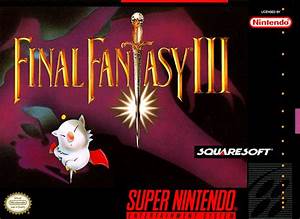
III = VI
There are so many “final” fantasies because they all take place on different worlds. The original Final Fantasy for NES was an Americanized version of the Japanese Final Fantasy. As mentioned above, it drew heavily from Dragon Warrior/Quest and established much of the menu-based design of the series. The Japanese Final Fantasy II did not come to America until the recent PlayStation, Game Boy Advance, and PlayStation Portable ports. It added now-classic elements to the series such as Cid and chocobos. Likewise, the Japanese Final Fantasy III was not available outside of Japan until the DS remake in 2006. Like many DS remakes, it modifies some of the original elements (including the obvious 3D graphic renderings), adding side quests and other tidbits. Final Fantasy IV came to America as Final Fantasy II on the SNES, which made for some confusion in the ’90s and ’00s, though most of that should be dispelled by now. Some RPG fans claim FFIV is better than VI. It has many elements in its favor: 5 characters in the party (sometimes 4, though 3 is more frequent in the later installations); the Active Time Battle system replaces the turn-based system, so players have to pay attention and act with more haste and decision; an impressive variety of locations, including an underground world and even trips to the moon; a diverse set of characters with set character classes, unlike most of the other early FF games. FFIV is a very deep game, with impressive character conflicts and emotional (and believable) ebbs and flows throughout the game. Attributes raise at set levels, unlike the DS remake, which adds the nonsensical Augments aspect (with some other unfortunate “tweaks” and the very fortunate Chrono Trigger-like “New Game Plus” feature). The story is deep, the characters are real, and the developments that occur keep the game interesting throughout (especially the SNES version without the Augments nonsense). Final Fantasy V stayed in Japan until the PlayStation and GBA ports in America. It returns to the structure of FFIII with character class changes and tweaks the ATB system by adding the gauge feature, allowing the player to know which character’s turn is coming next. Final Fantasy VI was released in America on the SNES as Final Fantasy III, which made the next American release, Final Fantasy VII on the new PlayStation console, give some of us youths at the time the feeling we had missed something — what we missed was not being Japanese. I really think so.
Final Fantasy VII is considered by many to be the best in the FF series. I’m not sure why, but I have some suspicions: being the first FF game on PlayStation’s cd platform allowed the introduction of 3D computer graphics and backgrounds (what Super Mario 64 did for the Mario franchise, but on an even more “advanced” scale); VII was the first FF game released in Europe; VII’s setting is a futuristic dystopian world, unlike the usual medieval (with airships) setting of I-V; it has one of the most (if not the most) shocking moments in video game history (but I don’t want to spoil it for you if you don’t know what I’m talking about — and if you don’t, welcome to video games). VIII is similarly well-regarded, thanks to VII’s solidification of the PS1 and realistic character renderings, but it changes a number of the usual FF elements that not all players would enjoy (no MPs? really?). IX returns the series to its roots with more comically-drawn characters, a medieval setting, and character class settings (VII and VIII have more character customizability, if you like that sort of thing). Overall, IX is generally easier and more user-friendly than VII and VIII, and it is more of a nostalgic homage to Final Fantasy’s own roots (almost like a flashback episode of your favorite tv show).
The series entered the current millennium with X on the new PlayStation 2. Ahh, FFX: we had such high hopes for you, and how did you repay us? a 3-character team and…blitzball. Our very own Danny Bogert said it best when he said blitzball is like soccer plus calculus minus fun (I avoid quotations marks because I paraphrase from memory here). The voice acting and cut-scenes are great and cinematic — but that’s not what the Final Fantasy series is built upon. The graphics are impressive with the replacement of the pre-rendered backgrounds to full 3D areas. The ATB system is replaced by the interesting Conditional Turn-Based system. It’s possibly better than the ATB since it allows one to strategize without the time-pressure of the ATB and allows the player to make long-term character battle decisions, which is especially helpful in boss fights. The old “bird’s-eye view” world map and town/dungeon maps are replaced by a fairly smooth, continuous, to scale world map, making the size of the world and your experience of it more realistic. Perhaps the cleverest change to the series comes in the Sphere Grid, a predetermined network of upgrade nodules that allows the player to decide what improvements to give to each character when leveling up. At times the Sphere Grid is a different and fun way to play a Final Fantasy game, since instead of predetermined levels of learning spells and gaining new techniques or attributes as in the early games, you, the player, get to decide how to develop each character. This allows for great re-play potential, as you can change the characters away from their intended function (such as turning Yuna the spell caster into a strong fighter). At times, though, one doesn’t want to strategize too much and just wants to raise levels the old fashioned, preprogrammed way, so one must be aware of that going into FFX (and … blitzball). The story is great and complex: in effect you are accompanying your old friend on a pilgrimage so she can learn what she needs to sacrifice herself to stop the main adversary, Sin (it’s not what you think). The diverse characters are good, but not as great as other characters in other games in the series, in part because one gets the feeling they are trying to be too diverse — try to picture Barney Miller occurring in the late ’90s on Lifetime. X is the first in the series to get a direct sequel, X-2; while X-2 resolves some of the plot/character issues from the end of X, it is sort of a “Girls, we want you to play RPGs, so here is a game with 3 female characters who wear different dresses that help them raise levels and learn abilities” kind of game — I’m not saying it’s bad, just bit of a let down (as many sequels tend to be). X-2 has multiple endings and options depending on the choices made during the game, which could be the only reason to play it more than once. FFX showed us what the PS2 was capable of (just like FFVII did for the PS1), in time for God of War I and II to fulfill PS2’s potential and herald the PS3.
FFXI and XIV are MMORPGs, and thus are fit only for players that like that sort of thing; many consider XIV a big disappointment. Considering they were released in Japan before released in America and Europe, new gamers had to contend with Japanese players that were already far more powerful and advanced. I don’t understand why people would want to buy a game then continue to pay monthly fees to keep playing the game, especially when the world around you continues to advance whether you play it or not, forcing your commitment to be rather intense.
FFXII has an even stronger case to make than FFIV for the best game of all time (though VI still is superior). XII takes the advancements of X on the PS2 to the platform’s pinnacle (though the first two God of War games may have done that as well, as mentioned above, depending on one’s perspective — perhaps they both do so, for their different genres). XII, Stars Wars meets Ancient Rome, is a winning combination of standard FF elements and new developments that make it far more enjoyable than the differences in X. The only drawback is the 3-character battle party, though some may dislike the fair amount of back-and-forth travel, especially when playing the many side quests available. Magic points are now Mist points, which renew gradually as the characters move around. Instead of getting gold from defeating enemies, conquered foes drop items for players to sell in shops, further expanding the layers and complexity (in a good way) of the game. Random battle encounters are replaced by visible encounters on the world map (much like Chrono Trigger), to be avoided when desired (but you can’t raise levels without battling). Again the battle structure is changed with the addition of “gambits,” programmable responses for each character to make battles more fluid (though this is an optional element; old-time gamers can still manually input each command). Since most battles take place in the open world, there is no longer a transition to a battle screen, which means the classic “victory theme song” is only heard after major boss battles (not such a bad change). Another change to character level raising is the addition of the license board — similar to the sphere grid of X, but more enjoyable (though the choices of who gets which Esper can be tricky). Like X, each character can get every level-up attribute, provided you earn enough experience points. The world of XII is vast and impressive, and the side-quests (especially the hunts) make it worth travelling over again and again. Other changes, such as the quickenings, must be experienced to be understood and appreciated. If one cannot get a hold of FFVI, FFXII is the way to go (though IV should be played as well). It was worth the 5-year wait after X.
XIII brought Final Fantasy to the current generation platforms, including the Xbox 360, which was a big surprise to many of us. I admit that I haven’t played it yet, so I can’t say too much about it. I hear good things about it, and I hear not so good things about it. It has apparently tinkered with the battle components yet again, with a new combination of AI support characters and a modified return to the ATB. The character leveling system sounds like a modified sphere grid from X, with emphasis on crystals (one of the foundational elements to the series). I am certainly willing to play it, especially now that the price has gone down considerably, but I am hesitant to think it rivals XII or VI.
Now that we have surveyed (in an admittedly superficial and cursory way nowhere near the extent to which the series deserves) the diverse and mostly wonderful worlds (as far as gaming enjoyment — you certainly wouldn’t want to live any of these places) of the Final Fantasy series, how could it be possible to single out one specific game among so many similar titles as the best video game ever, especially on a platform that stopped production before most of you whippersnappers were even born? Let’s find out. (And I mean “whippersnappers” in as nice a way as possible.)
Gameplay
The end of the fourth generation of video game consoles in the early ’90s was an important turning point in the history of electronic gaming. In a way, the end of the 16-bit era was the end of the “golden age” (Nolan Bushnell might disagree). Other than the N64, the cartridge era was over, and 3D renderings and polygons took center stage (which is ironic, considering Nintendo declared 1994 “The Year of the Cartridge”). By April 1994, the NES had released all but its last game, the Entertainment Software Rating Board was created to change the nature of gaming advertising forever, and two of the best games of all time (one the best) had arrived: Super Metroid and Final Fantasy VI (to us it was III).
Though we ruled out “influence” as a factor in calling a video game “the best,” it is not hypocritical to emphasize Final Fantasy VI’s place in video game history to better understand its gameplay. Super Metroid uses 24-bits instead of the usual 16, and Chrono Trigger in 1995 uses 32-bits. That extra advantage is often overlooked when people rank them higher than FFVI. VI maxes out the 16-bit system using the SNES Mode 7 graphics. What that means is FFVI has an early 3D look to a lot of its graphics, such as the world map and airship flights. The fight scenes are more active than FFIV, but obviously nothing like later installments on more advanced systems. Gameplay aspects that help VI stand out are the four-person combat team, the unique special ability each character can implement during combat, the customization elements (relics and magicite), and the diversity of gameplay itself.
The four-person combat team is the ideal size for combat teams. Though five in IV is nice, it does get cumbersome (and adds to the difficulty of the game, not to imply that VI is a cake walk). Three-person combat teams are just silly. This is most evident in X, with the open field combat world: the “realism” of the game is tainted if your 3-person team is wiped out by a berserk Malboro and eight characters just stand there watching while your game suddenly ends. (Dragon Warrior/Quest IV doesn’t have this problem, as the other characters can jump in to replace the dead characters — very helpful.) XII has 3-person combat teams, but the game is so fun it overrides that flaw (thanks, in part, to the quickenings, when those are finally mastered). What makes the four-person combat team in VI so good is that before too long into the game, once all the characters are gathered, the player can decide who is in the group. Various stages in the game require formation of multiple groups, and the player controls, at times, who is in each party. Unlike the linear narrative demands of IV, the player eventually has control of 14 different characters to play with throughout the game. Thus, the variety and number of characters are key aspects of what makes VI the best. Each of these fourteen characters has a unique skill or ability that can be used in combat, either as a substitute for a regular attack or as a substitute for some other combat-related element (many times these special skills are more helpful than just regular attacks, but it depends on the character, setting, and position in the game — requiring some skill on the player’s part).
In addition to the usual four-fold equipment (right hand/weapon, left hand/shield, head/helmet, body/armor) that modifies character attributes and levels, VI gives most characters the ability to equip up to 2 relics: rare(ish) objects that give different abilities; some are character-specific, others are attribute bonuses. Some of the better relics cast permanent spells on characters that save a great deal of time and MP during combat, especially later in the game. What makes this so great is that these relics and their attribute bonuses are in addition to the generic attribute bonuses gained by regular level raising (before the expansive, yet limited nature of the sphere grid and license board systems). Additionally, the Esper/magicite system is part of the magic casting/eidolon summoning foundation of Final Fantasy, but unlike most earlier and later incarnations in the series, the magicite system allows the 12 main characters (the 2 hidden characters, Gogo and Umaro, are not as controlled by the player as the main 12) to learn every spell. After battles, characters gain both experience points for regular level/stat raising and ability points to learn spells from their equipped magicite/Esper. Though only two characters are natural magic users, given enough patience (and ingenuity finding all the magicite), as just mentioned, each character can learn every spell — much more helpful than the static roles of earlier incarnations and the limitations enforced by the sphere grid and license board in X and XII. This requires a willingness on the player’s part to fight a lot of battles, but such effort and time simply make the later stages of the game that much easier, since the characters’ stats and abilities are that much higher. Magicite can also be used by every character to summon the Esper that created it, much better than the limitations in later installments as well, foreshadowing the increased role of summoners/Espers/eidolons in later games.
Regardless of its combat and equipage influences, the diversity of gameplay in FFVI cements its gameplay aspect as the best video game of all time. Like most RPGs, FFVI has a good deal of linear gameplay, true, but as mentioned above VI provides different opportunities to divide the characters into different groups for small portions of the narrative. Early in the game, the story divides the characters into three story paths (much like the narrative separation of the characters in Ivanhoe, only to re-gather them shortly thereafter for the next major plot point). The player has the choice in what order he/she wants to play the various paths. This helps the player get to know the large cast of characters in small groups while advancing the major story. During the second half of the game, the player has many side-quests to play (or not to play) in order to re-gather the main characters (or not), find major equipment and magicite, raise levels, and other sundry activities. There’s an auction house for rare items, a coliseum to face rare enemies and upgrade equipment, an airship to explore, and there’s even a kind of fishing event to decide the fate of a character (more pressure than the fishing mini-game in Ocarina of Time). Certainly the most unusual gameplay aspect of FFVI is the signature event in the game: the opera scene, in which your undercover character has to sing the right lines of the libretto to advance the game and enjoy one of the most poignant scenes in gaming history. The opera scene is usually everyone’s favorite part of the game (“It is a duel!”), even with the “limitations” of the 16-bit cartridge. One does not need CGI cut-scenes to sing along with and treasure the genuine pathos of the “Aria di Mezzo Carattere,” unquestionably one of the greatest scenes of all time in the greatest video game of all time.
Setting
FFVI changed our perception of where RPGs can go. Yes, earlier RPGs in other media went extraterrestrial, subterranean, and even subaqueous; there were historical military RPGs (wargames aren’t really RPGs), Western RPGs, and Superhero RPGs — but American RPG video games were mostly medieval fantasies, often dungeon crawling experiences. VI breaks that mold. While retaining the classic sword-and-sorcery RPG elements, FFVI occurs on a world (originally called simply the World of Balance) with a late 18th-century European cultural setting. Opera, painting, steam technology, railroads, coal mining, and carrier pigeon communications are the order of the day — except in…the Empire. Unlike most RPGs and fantasy games/stories that accept magic as a regular part of life, magic is a part of the ancient and mythic past when FFVI begins.
1,000 years before the opening credits (yes, it’s one of those stories — the better kind of stories, the in medias res kind), the War of the Magi started to destroy the world. The Warring Triad (the Demon, the Fiend, and the Goddess) created the World of Balance (and mankind) but soon, fearing each other’s magical powers, started the war. Their magical energy, amidst the chaos, transformed unwitting humans and animals into Espers, berserk magical beings. Some humans were magic-infused without becoming Espers. The parallels to Athena, Aphrodite, and Hera beginning the Trojan War are not accidental. When the Triad realized what they were doing, they gave the Espers self-control and free will, then encased themselves in stone statues. The Espers hid them away, keeping the statues in proper balance; magic using humans (Magi) faded into obscurity; and the Espers themselves fled to their own inaccessible realm. Until…
982 years later, young Madeline stumbles into the Esper world somehow and is rescued by sensitive but masculine Maduin. They fall in love, marry, and have a child. 2 years pass, and the seal between the worlds is transgressed again, this time by the power-hungry Gestahl, a soldier-scholar who seeks the secrets of the magic of legend. The Espers banish Gestahl and his soldiers, but not before he captures some Espers; the child is also accidentally expelled, to be raised by Gestahl for his own purposes. Over the next sixteen years, Gestahl, with access to ancient magic, creates his Empire on the mixture of science and Esper magic, called Magitek. He is not satisfied, of course, and is desperate to return to the Land of Espers and gain more power. Somehow, though, he keeps his true plans hidden from even his most trusted generals, except for his right-hand man, Kefka. Like under most tyrannies, a rebellion forms…
The beginning of the modern world meets the ancient mythic and magical past in FFVI; in the World of Balance, the Fine Arts are as popular as steam and coal technology. And then, suddenly, half-way through the game, a seal is broken, a continent rises from the sea, and the world is literally destroyed. How could you not love a game like that?
Characters and Story
For anything to be “the best” of anything in this dark world and wide, it has to say something meaningful about, while trying to eschew banality, the human condition. Fantasy and science fiction do this better than any other genres. More so than the unique yet familiar gameplay, the characters are what make the game. The setting is unique in gaming, the gameplay is unlike any other game, but the characters (and the story they tell) make it the best. Without giving away too many (more) plot spoilers, we shall survey this large cast of memorable characters as briefly as possible.
Terra, the first character, is a soldier for the Empire tasked with acquiring a recently-found Esper. It does not go well, and she finds herself thrown in with the underground rebellion known as the Returners. While Terra is the central character of the overall story, FFVI does such a great job with the largest playable cast in FF history that we tend to forget it’s mostly her story. Like many great heroes (Achilles, Ivanhoe), Terra disappears for a time, allowing other characters to lead the story along (coupled with the many times the player divides up the characters into little away teams). She is mainly a magic user. The next character is Locke, the Han Solo rogue-like treasure hunter with a tragic past who now works for the Returners mainly out of vengeance against the Empire. He is an all-around character, though it’s easy to make him a very strong physical attacker. His special “steal” ability is one way to get many rare and valuable items from monsters in battle. Celes is an Imperial general in exile, rescued by Locke from imminent execution for a treasonous response to Gestahl’s poisoning of Doma Castle (it will make more sense when you play it). She is a product of Magitek infusion, and her true loyalty is an issue throughout the game. Celes is the main character in two emotional highlights of the game: the opera scene and the quiet events on Solitary Island.
Two of my favorite characters are the twin brothers Edgar and Sabin, princes of Figaro with no desire to rule. Years before the game started, Edgar “lost” the coin toss that determined who would take over the Figaro kingdom from their ailing father. Sabin’s victory enabled him to pursue his destiny as a martial arts expert, leaving Edgar the mechanic to rule Figaro (sort of). Edgar’s tools, especially the drill and crossbow, are powerful and very fun to use. Sabin, as can be guessed, is a dominating physical force and most likely a must for your final party at the end of the game (a tough decision in FFVI, since you have control over the characters so much, in contrast to the linear movement of FFIV, among others). Sabin’s backstory is typical of Japan’s love of warrior monks, but it plays very well in the game.
Cyan, the loyal samurai retainer of the fallen kingdom of Doma, is typical of the “last survivor from the clan” character, while adding an Elizabethan nobility (and dialect) to the game. FFVI contains a great deal of sacrifice and loss, but it only makes the main characters more heroic and enjoyable. One possible exception to that is Shadow, the mysterious ninja who is sometimes available for your party and sometimes working for the Empire. Depending on decisions the player makes in the game, Shadow may or may not be available in the latter half of the game. Tip: when asked, always wait for him. He is worth having around. When you learn his backstory, and his connection to another member of the cast, you’ll be glad you waited for him — especially at the very end of the game.
Gau is a unique character in video game history (his type is watered down as an “energetic boy” in later FF installments). As an abandoned, feral child, Gau grew up on the Veldt, the home ground of the monsters in the World of Balance. The scenes of Cyan the Elizabethan samurai and Gau the feral hunter together are highlights of the game, both for humor and heartache. Setzer is a gambler and owner of the only airship in the world (or is he?). Setzer is like Gambit from the X-Men, in that his main fighting action is to throw playing cards at the monsters. Also like Gambit, Setzer is a womanizing scoundrel (less heroic than Locke, at first). His special technique is a slot machine that can either deal heavy damage to enemies or heal the characters, depending on the success of the player playing the slots.
Strago is a descendent of the Magi living in the secret magic-user town of Thamasa. Strago can learn magic spells used against the party during combat, which help makes him a valuable magic user at various points in the game. He is the grandfather of Relm, a young artist and precocious girl. Her presence in the party later in the game will determine whether Strago will rejoin the cast after the tumultuous events midway through. Relm can sketch various enemies that magically come to life during combat, being a descendant of magic users. She is also connected to another character in the game, though I will leave that discovery to the attentive eye of dedicated gamers. The final main character is Mog, a moogle who can speak English (unlike all the other moogles in the game). He and Edgar are the only characters that can use the powerful lances in the game, which can make him a strong fighter. Alternatively, his special dance technique alters the environments of battles and does context-appropriate forms of damage. He is fun to have around, especially while building up levels of various characters, and it’s always enjoyable to watch his little dances.
Mog is necessary to have in the party to acquire one of the two secret characters, Umaro the yeti. Mog can speak both languages, apparently, and will convince Umaro to join the party when they encounter him late in the game (though he is spotted and spoken of throughout the game). Constantly in a berserk state, Umaro is a powerful fighter though uncontrollable by the player. The other secret character is the most mysterious in the entire game: Gogo. Gogo’s gender is unknown, his/her motivation for joining the cast in unclear, and his/her general purpose in life is vague. All that is known is that Gogo is a master of mimicry, and his/her customizability allows the player to have Gogo mimic or use almost all the other characters’ special abilities. This versatility makes Gogo helpful during specific points of the game, but the player can get along just fine without either secret character. Completists who want to enjoy the entire gaming experience of the best video game of all time, however, will want to seek them out and recruit them.
The major villains of the story are worth mentioning in passing. Much has been said of Emperor Gestahl already, who must never be trusted despite certain appearances. The Cid of FFVI is the chief magitek/Esper researcher of the Empire, who experiences a change of heart (too late, as most heart changes are). Like with many characters in this game, Cid’s fate is eventually placed in the player’s hands. The story progresses in any event, but the right decision is to save his life. Ultros, while not a major villain, is a recurring source of irritation mingled with comic relief. General Leo is the typical warrior-with-a-conscience, the admirable man of honor caught between the trying circumstances of a tyrannical emperor and the duty of a soldier. And then there’s Kefka. Ahh, Kefka. Kefka must be experienced to be understood — and even then, it’s hard to understand him. Calling Kefka a nihilistic madman would be unkind to nihilistic madmen. Nihilistic madmen don’t destroy the entire world. Kefka does. He’s not conflicted, or overcoming a troubled past — but he’s not pure, unadulterated evil either. Kefka is unique in the history of villainy, and, as unpleasant as it might sound, helps make this game so good.
It might sound like the game has too many characters, like it could be confusing or hard to keep track of everyone. It’s not. A remarkable aspect of Final Fantasy VI is that even though it has the largest cast in the series, it presents its characters better than any other game in the Final Fantasy series. The characters are extremely well-developed, even those who don’t appear very long and those who are mysterious (like Shadow). Because of the diverse narrative and structural episodes, FFVI allows for plenty of time with each character in little groups (much like the development of G.I. Joe characters in pairs or trios). You get to know these characters very well: their pasts, their frustrations, their failures, their motivations, and their desires for the future. The great length of the game is as well-developed and moving as any novel, and the characters are a meaningful part of that story.
A fair amount of the basic story has already been intimated in the “setting” section above. Like most Final Fantasy games, FFVI is basically a ragtag group of rebels struggling against a tyrannical empire (the Star Wars parallels are overt at times, unashamedly so, since Star Wars certainly didn’t invent that kind of story/conflict). The admixture of the technological revolution with the reemergence of magic and the rediscovery of the Esper world provides a unique spin to the otherwise typical plot devices. The diversity of characters, as indicated above, also makes the story far more interesting than most RPGs or action-adventure games: a ninja, moogle, yeti, mimic, feral child, forgotten mage, precocious artist, wanton gambler, treasure-hunter (thief), and more. The story deals with all of these characters and their lives throughout the overarching freedom-fighter frame story.
It would be difficult to discuss even more of the story without giving away too many plot twists and surprises. Perhaps a brief overview of the early sections of the game and the order in which the main characters are met would whet your appetite for further game play (if this article hasn’t already demonstrated the enjoyable greatness of this game). The story begins with Terra and some Imperial soldiers marching on Narshe (the base camp of the Returns, though that’s unknown at the time) to gather a recently-discovered frozen Esper, as indicated earlier. The failed assault leaves Terra unconscious and free of her Imperial control, though her identity is lost to her. Locke the treasure hunter rescues her and vows to protect her (for reasons we discover later in the game), helping her join the Returners. The two make their way to Figaro Castle and meet up with Edgar and eventually Sabin. The group gets broken up shortly thereafter as Locke goes to investigate the Empire (where he rescues Celes), Sabin is carried away and meets up with Cyan and Gau (and Shadow, briefly), and eventually Terra meets Mog (though he doesn’t permanently join at this time).
Once the player navigates through the three diverse narrative paths, the characters re-gather at Narshe to defend it against an Imperial assault. Following this defense, Terra leaves (in a very dramatic fashion that shan’t be spoiled here), and the main characters go looking for her. At this time the Espers start to play a major role in the motivation and waking consciousness of the characters — no longer is the story about rebels against a material tyranny. As the Returners become increasingly enmeshed in this magic-heavy world during their search for Terra, they require the use of an airship, which leads to the gulling of Setzer and the wonderful Opera House scene. Mog eventually joins the party, and the characters make a startling discovery on their way to rescue more Espers and find Terra. When Terra is eventually discovered, her connection to the Espers brings the two plotlines together rather compactly, and the player is soon leading a charge into the Empire itself, after the Espers make their presence felt rather dramatically. After more deceit and subterfuge, an unusual away team meets up with the final main characters Relm and Strago (the two rare characters do not become playable until later in the game, as mentioned above). Shortly after the party is all together, sudden and saddening losses occur just before what seems to be the final assault on Gestahl and the Empire. And then, without warning, the world is destroyed. And the game has only just begun.
Like Swords or Cold Iron
C.S. Lewis gave The Lord of the Rings the greatest praise any work can receive: “Here are beauties which pierce like swords or burn like cold iron. Here is a book which will break your heart.” Final Fantasy VI is such an experience. In an age of short attention spans, a dearth of quality programming, and a pervasive malaise in the hearts of American youth, a return to the greatness of yesteryear and the best videogame of all time would provide an enormous boon to the world today — and we’re always on the lookout for enormous boons. Some argue that RPGs are slow and boring — this is nonsense. Admittedly, one has to enjoy the hours of level-raising requisite for success in an RPG. “Grinding” is an unfortunate and unnecessarily derogative term for the gameplay needed for RPG progression. Several solutions are readily apparent: commit a couple hours in an evening, or an entire Saturday afternoon, to primarily raising levels; turn the volume down; and pop in some classic albums to listen to while raising levels (saving one’s game frequently) — perhaps the oeuvre of Genesis during the Peter Gabriel era, or some deep cuts from Deep Purple, or the Led Zeppelin box set, or U2 or Pink Floyd or Queen or Rush or The Moody Blues — the possibilities are virtually endless. Not only will you get to enjoy some quality music, but you will also get to enjoy playing the best video game of all time, raising your characters’ levels high enough to have them learn every spell and have enough HP and MP to survive the final exciting boss battle extraordinaire.
Final Fantasy VI has it all: customizability, opera, love, ninjas, magic, chocobos, moogles, heartbreak, apocalypse, and eucatastrophe. Final Fantasy VI is a great story, far superior to even the better stories in recent games and series. There’s no button mashing, even for Sabin’s combos; instead, strategy and flexibility. It has no vulgarity, no excessive violence; instead, the fine arts — music, painting, dance, and writing. It is expansive, challenging, and long. Most importantly, it is fun. Final Fantasy VI is enjoyable to play: the characters are worth knowing, the story is engaging and soul-moving, and the game is fun. The game speaks truth about reality. It brings light and warmth and joy into one’s soul. ChronoTrigger, Ocarina of Time, Super Metroid — they are great games, and well worth playing, but Final Fantasy VI is the best video game of all time. Play it. Love it. Enjoy it.
 Redeeming Pandora