
Alice Minium

In twenty-first-century America, most children don’t see education as a privilege, an honor, and a freedom. They do not see education as the trapdoor of escape from a life of ignorance, the chisel to articulate one’s decisions, desires, perspective, and dreams, or the pathway to behold a colorful, complex, mysterious world of adventure.
Children don’t see the bland pages of their mass-produced history textbook as a passageway into anything. The term “education” no longer describes a journey of stimulating discovery and enrichment of one’s perception. Instead, what comes to mind is a seven-hour school day in a desk chair, thick textbooks nobody wants to read, and at last the shrill bell of sweet relief. Ask a student to define learning, and listen carefully to the response.
An anonymous junior high student, when asked, defined learning as “when you know stuff, and get good grades, and know all the answers on a test.” A high school student, who also wished to remain anonymous, insisted that “Learning is what we’re supposed to do at school. When you remember something even after you turned in your homework, then you’ve learned it. People always think about grades, but learning is supposed to be more than that.”
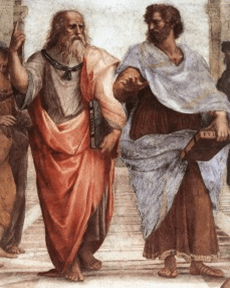
Ask a few of the greats from several thousand years ago. According to Plato427-327 BC, “The object of education is to teach us love of beauty.” Ask Aristotle384-322 BC, “Education is an ornament in prosperity and a refuge in adversity.” Or, in the words of Socrates469-399 BC, “Education is the kindling of a flame, not the filling of a vessel.” Needless to say, these men saw education as a beautiful, precious privilege, not a dull chore.
Back in the days of Plato, Aristotle, and Socrates, education was primarily available only to upper-class males, sometimes in a schoolhouse and sometimes through a private tutor. Up until the age of seven, children were taught basic morals in the home, and then they would begin instruction in letters and syllables, followed by words and sentences, finally leading up to reading and writing. Women, slaves, and the very poor usually did not receive a formal education. The Greeks saw education an invaluable pursuit, and it was the key foundation to the intellectual progressions that distinguish ancient Greek society.
The early American fathers shared a similar attitude with the Greeks. They saw education as the soil that nurtured America’s growth, and Thomas Jefferson drafted a bill in 1791 for the institution of a public education system. In his own words, “The object [of my education bill was] to bring into action that mass of talents which lies buried in poverty in every country for want of the means of development, and thus give activity to a mass of mind which in proportion to our population shall be the double or treble of what it is in most countries.” However, until the mid-nineteenth century, education in America was still highly localized and not available to the very poor. The first law to require school attendance was passed by Massachusetts in 1852, and by 1918 underage education was required in every state and available to all children without charge (excluding the inevitable tax). In the words of early American education activist Horace Mann, “The common-school reformers argue for the case of a public education system on the belief that common schooling will create good citizens, unite society, and prevent crime and poverty.”
This is, without a doubt, one of the greatest beauties of America. Every child born in America today grows up with the privilege and the right to attend school, which for millennia beforehand has been largely unheard of. However, as any individual with a basic knowledge of economics would know, the easier the access to a product, the lower the value and appreciation for it. This is applicable to the current education situation. The byproduct of children raised with schooling as a granted, disposable institution, is generations of children that do not appreciate it whatsoever. School has become a chore, a necessary evil of adolescent life, and an object for widespread apathy. The fact that the education system has become lax, haphazard in its ways, and overlooked by government funds does not help improve this attitude. Our founding fathers would be appalled at the current state of our education, and children from centuries gone by would be awestruck by our nonchalant, obligatory-like attitude.
Junior high and high school students are especially guilty of a lack of interest and passion for their education. To truly learn, one must possess a personal thirst for knowledge that drives you to work on your schoolwork, read your reading assignments, and excel on your exams. Too often it is about grades, and too often it is about revulsion and torpidity to the general idea. It is too easy for the methodical “busy work” to seem non-beneficial and generally less important than one’s personal life. I cannot deny that I shared this attitude and slipped into the apathy of the majority. Years in hindsight, I have no greater regret. My lack of appreciation for the privilege of a fine education resulted in low grades, which are now on my transcript forever. I was told by people that my early years of high school were not that important, but the bottom line is that those years were when I formed my study habits and when I dug the foundation for the rest of my intellectual life. I’ve reached the end of the road and the days of being prodded toward and guided through my education have come to an end. It is up to me and only me to ensure that I have a plan for my future and means of consummating that plan. At the finish line, you may have the support of parents and teachers, but there is no one to guide you anymore. The responsibility belongs to you and you alone. Now, I’m having to work twice as hard to pull loose ends together and ensure that I will be prepared.
Do not make the mistake of trivializing your schooling. Let your schooling truly be your education. Develop a craving for education, and success in your schooling will inevitably follow. Seize advantage of your rare blessing and enumerated right. Don’t sigh the next time you get assigned a five-page paper; instead, close your eyes, take a deep breath, and thank God for the privilege you have that so many other people would have died for.
 Redeeming Pandora